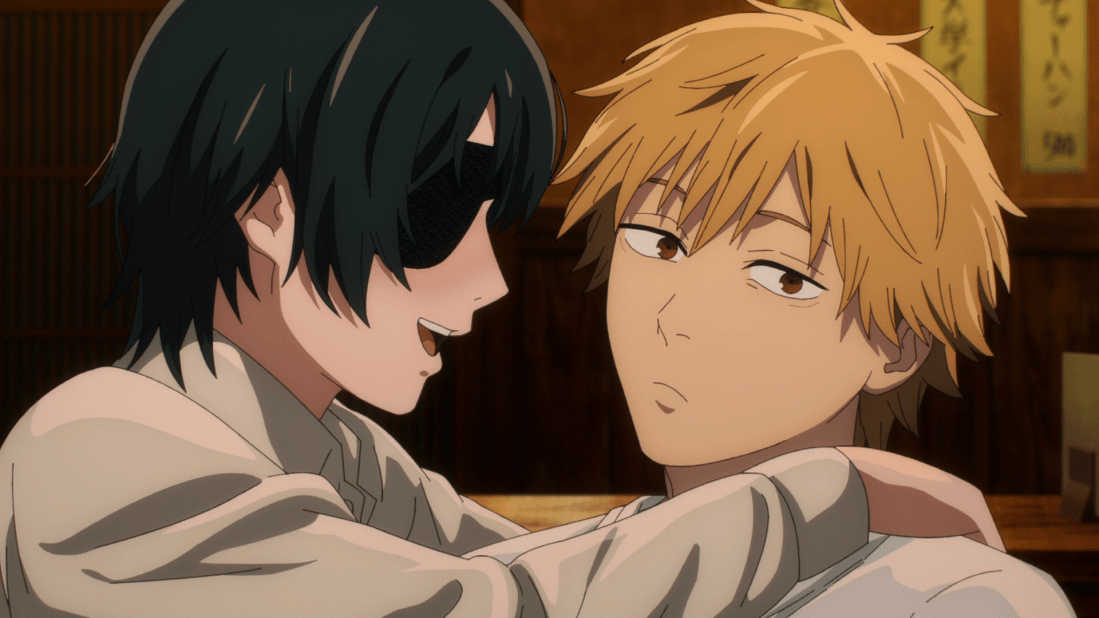
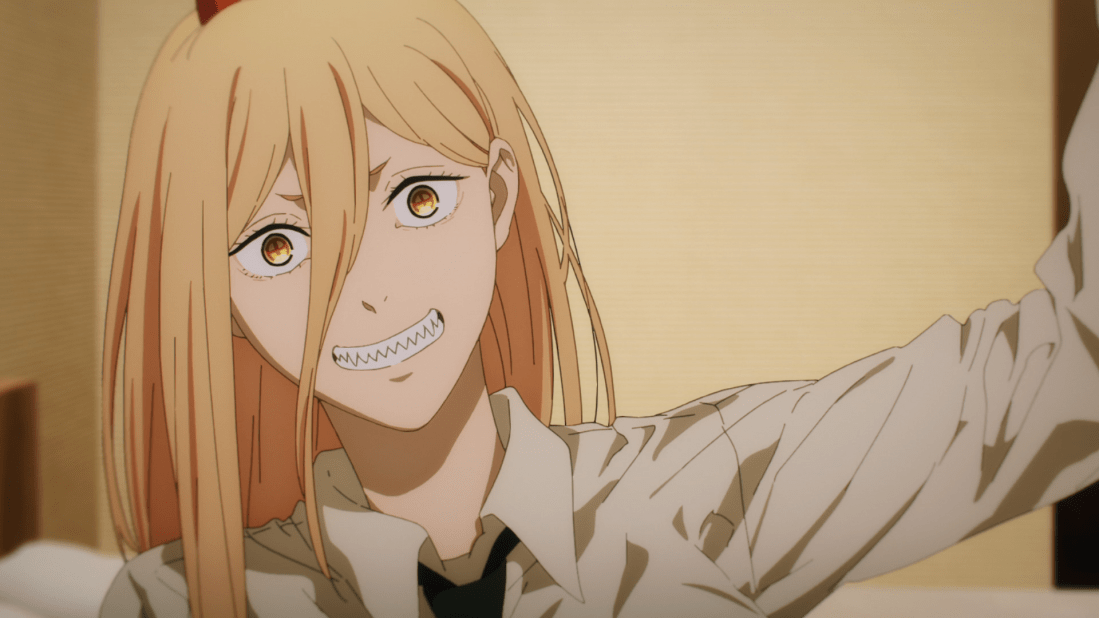
Chainsaw Man Episode Six, Kill Denji Review: A Nobel Prize Deserving Episode.

Episode Six of Chainsaw Man, “Kill Denji” is the best episode in the history of anime and one could even call it a nobel prize contender.
No, this review is not written by Power.
In all seriousness, the Shun Enokido directed episode is another great one, delivering a fantastic adaptation of the manga with as usual stellar animation.
“Kill Denji” picks up from the cliffhanger of “Gun Devil”, where Division 4 found themselves stuck in a loop on the eighth floor of an apartment building.
The opening of “Kill Denji” follows this up by showing how this loop works, using Kobeni.
First, Himeno has the terrified woman make a peace sign and then runs down the stairs of the eighth floor, emerging at the top.
She sees Kobeni still pulling the peace sign, meaning that there is no illusion going on.
Aki then invesitgates the rooms and learns that the windows connect to the rooms on the opposite side of the apartment, leading back into the eighth floor hallway.
They are well and truly trapped.
Following the opening, the squad debriefs in one of the rooms, establishing that even trying to go through the ceiling leads back to the eighth floor.
The situation is grim and Kobeni is certainly not helping matters, being on the verge of hysterics.
Arai tries to motivate her by mentioning how she joined the Devil Hunters to put her brother through college.
This does the exact opposite of calm Kobeni down because she revealed her parents forced her to get a job to put her brother through college, when she wanted to go too, giving her the choice to either become a Devil Hunter or a sex worker.
A tragic backstory, which Power finds to be utterly hilarious, as she breaks into laughter at Kobeni’s terrified face.
Denji and Power are the only ones in the group not alarmed by their situation as, when Aki says time may be frozen so help is probably not coming, Denji is happy about this because it gives him plenty of time to get some sleep.
He actually manages to do so before being awoken by Himeno.
In the time that Denji has been asleep, Aki has been constantly searching for the Devil, Arai has since locked himself in his room in a panic, and Kobeni tried to drink out of a toilet so Himeno knocked her out.
Most disturbing of all is Power who, in a fit of madness, reveals her plan to win a Nobel Prize so that she can raise sales taxes by 100%, just to see humans suffer!
Oh, wait, no, that’s just how Power always is.
My bad.
True to form, Power is disappointed that Himeno is so calm, and Himeno explains this is because Aki is working hard, revealing that she was the one who introduced him to cigarettes.
Bad Himeno.
We then flash back to Himeno and Aki working togethor as partners, where Himeno tried to convince Aki to start smoking so they could get along better.
Aki refused because “it’s bad for your bones.”
Good Aki.
Himeno explains that most Devil Hunters take up smoking because, with the death rate being what it is, most do not have to worry about living long enough to be affected.
Aki says he plans to live a long time and Himeno says he should because “it’s a pain in the ass when your partner dies.”
This serves as a perfect transition to Himeno being assaulted by the girlfriend of her deceased partner.
Himeno reveals to Aki that this happens regularly, as her partners’ families cannot take their pain out on the devils so they do so on her.
Offended, Aki sneaks before the woman who slapped Himeno and puts gum on her back as revenge.
This juvinile kind of humor is classic Chainsaw Man, and it cheers up Himeno immediately, as she later tells Aki that her master told her that the Devil Hunters the Devils fear most are the ones with a few screws loose.
So, Denji and Power should be fine then.
Himeno then finally convinces Aki to smoke, who swears it will be his only one.
Cue a comedic cut to the present, where Aki enters the room and demands a cigarette from Himeno.
Bad Aki.
Aki reveals that the Devil Power killed has returned and become larger.
Now a giant mass of squirming faces and limbs, the Devil offers a contract to the group: kill Denji and feed it to the Devil and they will be allowed to leave.
A terrified Kobeni jumps at this offer immediately, running to stab Denji, only to be knocked out by Himeno and Aki.
Afterwards, the two attempt to kill the Devil with their own Devil contracts but they have no effect.
Himeno then reveals that if they actually do kill Denji then they will be allowed to leave because the Devil offered a contract and contracts are life binding to a Devil.
Like Kobeni, Arai also wants to kill Denji to ensure their escape but Aki knows this will benefit the Devil so refuses.
Himeno is team agree with Aki and Power is team murder Denji for her nobel prize.
As time goes on, Aki contemplates using his sword to kill the Devil but since this will take many years off his life Himeno refuses, and tells Denji that if it really comes to that then they will have to kill him after all.
Unfortunately, at that exact time, Aki discovers that Power has eaten all their food.
Kobeni loses it, believing Power is somehow behind everything.
Arai speaks up for Power, only for Kobeni to declare that he is a spy too.
“He’s spicy!” Power says in a show of humorous support.
Kobeni runs towards Arai in a threatening manner and their combined fear and screams give power to the Devil, which begins to expand further, revealing itself to be the Eternity Devil.
The Eternity Devil grows so large that it causes the hallway to tilt up, forcing everyone to hide in their rooms.
Aki resolves to use the sword, causing Himeno to suddenly switch to team kill Denji, and she, Kobeni and Arai rush to complete the contract.
Kobeni lunges at Denji with her knife, only for Aki to take the stab.
As the group look on in shock, and Power works to stop the bleeding, Aki explains that he needs all the help he can get to kill the Gun Devil so will not allow anyone to kill Denji.
This causes Himeno to panic and Kobeni to selfishly blame Denji for her stabbing Aki.
The latter action, along with pretty much everything Kobeni does this episode, has caused her a lot of backlash in the fandom.
This is entirely understandable, if you ask me, because I disliked her here too when I read the manga.
Her blaming Denji does motivate him to attack the Eternity Devil, though, with his new plan being to torture it to death using his chainsaws.
Denji jumps down into the mouth of the Eternity Devil and falls through an endless abyss in a great shot that brings an end to the episode.
Overall, “Kill Denji” is yet another great Chainsaw Man episode that adapts the manga excellently.
It is has plenty of laughs and plenty of character development.
Someone give “Kill Denji” the nobel prize.


Manga Spoilers:

While I do understand why people hate Kobeni after this episode, considering I disliked her at this point in the manga too, I am curious to see what their opinions will be of her later in the story.
I came around to her character after she saved Denji from Katana Man and only felt more sorry for her as she went through so much hilarious misery throughout the rest of the manga.
It will be interesting to see if anime only viewers will come to feel the same way about her character or if they will just keep hating her.
We will not get Kobeni’s big redemption moment until a couple of episodes, though, and we have a lot to look forward to before that, especially with the next episode and Denji’s infamous first kiss, one of the funniest and most disgusting moments in the entire manga.
I am curious if the next episode will end with Makima being shot because that seems like a good cliffhanger but it might make the episode too long so it will most likely end with Denji at Himeno’s house.
Whatever ending for the next episode they decide to go with, I am still excited to see it tomorrow.

God of War: Ragnarök Review: Making Your Own Destiny.

The God of War reboot was one of my favourite games of 2018.
Sure, I did not play it until many months after its release, mostly because I personally could not connect with the original trilogy.
But when I did finally get around to playing it, I regretted that I had ever waited.
Now, four years later, the highly anticipated sequel, God of War: Ragnarök has finally released and, in my opinion, it is a more than worthy follow up. 

God of War: Ragnarök lives up to the hype and then some.

Directed by Eric Williams this time, and set years after the beginning of Fimbulwinter, Kratos (Christopher Judge), Atreus (Sonny Suljic), and Mimir (Alastair Duncan) are still living in their secluded home, while being constantly hunted by Baldur’s vengeful mother, Freya (Danielle Bisutti).
However, Atreus is far from content and, after a friendly visit from Thor (Ryan Hurst) and Odin (Richard Schiff), he and Kratos have to seek shelter with Brock (Robert Craighead) and Sindri (Adam Harrington), as they begin their search for the imprisoned Norse God of War, Tyr (Ben Prendergast). 
All of this is done in the hopes that they can find the answers Atreus seeks, while also attempting to avoiding the prophesied Ragnarök, which seems to be drawing closer with every action they take. 
The story of Ragnarök is compelling from beginning to end, with plenty of fantastic characters, both old and new.

Many characters from the previous game return, some with bigger roles than others.

There are many interesting twists to this story, which will make a second playthrough much more rewarding to see all of the foreshadowing.
It is the bond between Kratos and Atreus that really makes this story so great, as both characters grow in touching ways, which made me tear up a couple of times.
Christopher Judge is especially excellent as Kratos, bringing so much strength yet so much vulnerability to the character.

Kratos’ continued growth as a father in this game is fantastic.

Then, there are the antagonists, with Odin being quite the surprise for me.
His personality was certainly not what I expected and it made him a fun villain.
Much like Kratos, Thor is also given quite a bit of humanity, despite his terrible actions.
As for criticisms I have of the story, I do wish that certain parts of the final battle had been grander or, at the very least, had a greater emphasis placed on them.
This is a minor issue though and the other problems I have with the story are mostly nitpicks.
So, all in all, the story of God of War: Ragnarök is pretty spectacular and is accompanied by fantastic gameplay.
Seriously, the gameplay here is a great improved on God of War (2018).
There are plenty of new abilities, weapons and, best of all, enemies to fight.
My biggest criticism of God of War (2018) was its servere lack of enemy variety.
I quickly grew sick of fighting reskinned trolls in that game so to see such a diverse group of foes in this game was excellent, and many of them were fun to fight.
This extends to some pretty great boss fights, although I will say that the bosses were overall better in the original, at least when it comes to the gods.

Although I think the god fights in God of War (2018) were better, I still cannot deny that the ones in Ragnarök were a lot of fun.

There are also plenty of great side missions, with many of them being available after beating the main story. 
In my first playthrough, I only experienced a couple of glitches.
The first was a couple of pop ins in the realm of Vanaheim but this was minor.
The second glitch was a funny one, where Kratos’ leg moved to stand on a bench while I was leveling up my armour, making it look like he posing for the dwarf behind it. 

M’Lady.

Other than these few glitches, the game performed perfectly.
The graphics and soundtrack of Ragnarök are also superb, with Bear McCreary delivering plenty of epic and somber pieces.
All in all, God of War: Ragnarök is a stellar video game.
Its epic and emotional story makes me even more excited for the continuation of this franchise in whatever form that may take, now that Norse mythology been convered.
Ragnarök is one of the best games of the year, and you should definitley play it. 

Black Panther: Wakanda Forever Review: An Emotional Tribute to Chadwick Boseman, Weakened by Future MCU Influences.

I really enjoyed the first Black Panther.
It provided a compelling story, with a great dynamic between its protagonist and antagonist, and made the country of Wakanda a character in its own right.
If Black Panther is not in my top ten MCU films then it certainly comes close.
So, obviously I was looking forward to the sequel from the moment I walked out of the theatre after seeing the first movie.
Most of all, I was looking forward to seeing how the story of Chadwick Boseman’s T’Challa would continue.
Unfortunately, as we all know, in August 2020, Chadwick Boseman passed away from colon cancer.
His tragic passing left director Ryan Coogler, and everyone else involved in the making of Black Panther: Wakanda Forever, with the monumental task of paying tribute to Boseman’s legacy, while also crafting an interesting story without him.
For the most part, I believe they succeeded.
Indeed, Wakanda Forever does begin by honouring Chadwick Boseman by also honouring his character T’Challa.
The King of Wakanda passes away in the opening minutes of the film, and the weight of his legacy is felt immediately, with the following MCU logo being completely silent and only accompanied by footage of Boseman’s T’Challa.
It was a moving sendoff to both the character and the actor.

Boseman’s prescence is felt throughout the film, despite him not appearing, due to his tragic death.

From here, the film follows how Wakanda moves on from the death of their king, along with the consequences of the world now knowing about them and wanting their vibranium.
This leads Wakanda into the conflict with the hidden undersea civilization known as Talokan, lead by the the film’s antagonist Namor (Tenoch Huerta).
Namor is a compelling villain and he and the Talokan’s first scene is one of the scariest villain introductions in all of the MCU. 

Namor’s first scene is quite creepy.

This leads you to be fearful for the fate of the characters we came to care about in the first film, like Shuri (Letita Wright), Ramonda (Angela Basset), Okoye (Danai Gurira), M’Baku (Winston Duke) and Nakia (Luptia Nyong’o).
Shuri especially is struggling with the death of her brother and the new responsibilities that are heaped upon her shoulders as Wakanda draws closer to conflict with Namor and Talokan.
It is Ramonda and Okoye who stood out the most to me, though, because of the incredible performances from Angela Basset and Danai Gurira.
One emotional scene they share togethor is the best in the movie, in my opinion, based off their acting ability alone. 

Basset and Gurira did an excellent job portraying their characters’ emotions in this scene.

However, although all of this made Wakanda Forever a worthy sequel to Black Panther, there were a number of things holding it back, most of all the film’s reliance on setting up future Disney Plus shows and MCU films.
This is evident with the character of Riri Williams (Dominique Thorne), who is basically dropped into the story to set up her upcoming show, Ironheart; plot holes surrounding her need to be in this movie be damned.
Worst of all, though, is the suplot with Everett Ross (Martin Freeman) and Valentina Allegra de Fontaine (Julia Louis-Dreyfus), which felt like a gigantic waste of time, with its only point probably being to set Fontaine up for a future Thunderbolts movie.
As for Everett Ross, his decisions in this movie felt oddly strange with how he characterized in prior films, politically speaking. 

I am not sure that Ross’ depiction is completley accurate with how he is portrayed in Civil War and the first Black Panther.

The political decisions in Wakanda Forever are actually pretty hit or miss for me.
Sometimes I thought the characters were making good decisions, while other times I thought they were making bizarre ones.
Along with this, the CGI of the film is a bit questionable at times.
At least it never got as bad as it was in the third act of Black Panther, which is one of my few flaws with that first film.
It is the overreliance on setting up future stories that hinders Wakanda Forever the most, however; as it not only brings the story to a grinding halt at times but also takes away potential screentime from characters like M’Baku, who really needed it.

Wakanda Forever needed more M’Baku.

Overall, though, I would still say that Black Panther: Wakanda Forever is a good movie, despite its issues.
The character arcs of the Wakandan characters are solid, the acting is amazing, Namor is a great villain who I am interested to see more of and, most of all, the film does an excellent job paying tribute to the memory of Chadwick Boseman.
May he rest in peace.  

Chainsaw Man Chapter 111, Aha Ha Ha Ha Review: An Imposter?

Going into Chainsaw Man Chapter 111, “Aha Ha Ha Ha”, I was expecting Fujimoto to lay the groundwork for Yuko’s story going forward.
Instead, in a typical Fujimoto move, we got the unexpected, as he proceeded to wrap up Yuko’s story in a satisying way but also a way that raises many interesting questions.
The chapter picks up from the cliffhanger of the last, with Asa opening the door to speak to Yuko, who has now turned into a Devil resembling a Fiend, although one with her mind still intact.
Asa asks if Yuko wants to eat her and the following exchange had me cackling.
“Oh, gosh. A little bit,” Yuko says, to which Asa replies, “Holy crap.”
I just love Fujimoto’s humor.
Turning away from Asa so she will not want to eat her, Yuko explains that she came to say goodbye to her, as she has a distant relative she plans to go to who is a Devil Hunter.
This reminds me of the old theory of her being related to Kusakabe but he’s dead so he can’t be the relative she is referring to.
It will be interesting to see if this relative becomes important, or if he is never mentioned again because of what happens later in the chapter.
After telling Asa what she plans to do, Yuko also reveals her reasons for accepting the Justice Devil’s power were not just to help Asa.
She accepted because she wanted to become liked like Chainsaw Man.
She helped Asa for selfish reasons as well because she was lonley and wanted a friend.
Yuko goes on to denounce her crimes while using the Justice Devil’s power and, when Asa attempts to console her over this, one of Yuko’s new tail-spike things wraps itself around her neck and begins to strangle her, without Yuko telling it to.
Realizing it is dangerous to stay around Asa, Yuko goes to leave.
Before she does, however, she tells Asa that the Justice Devil is still at the school.
It would seem that the Justice Devil is the main antagonist of Part Two.
The Justice Devil still being at the school does make me curious, though.
Does this mean that the Justice Devil was actually not killed with the class president in Chapter 98 and then reincarnated?
Is it just hanging out at the school, handing out powers to students, which is what we saw the class president and then Yuko using?
We have very little time to consider this question before Yuko prepares to leave, only to be stopped by Asa, who returns the shoes Yuko gave her, since she is barefoot.
Yuko tries to refuse the shoes but Asa throws her words from Chapter 100 right back at her.
“If you don’t need them, sell ’em. If they won’t sell, you can just throw them away.”
This beautiful moment really brings the friendship of Asa and Yuko full circle, and I was kicking myself by the end of the chapter for not realizing this was an obvious death flag for Yuko.
Yuko then says she can’t beleive she said something so embarassing, before the two friends laugh togethor, ending with Yuko accepting the shoes and promising to return them to Asa later.
It is a promise she will never be able to keep.
We then see Yuko jumping across the rooftops, startling a bunch of birds, before we get a line of panels of Asa, Denji and the bully girl in their beds.
The panel of the unnamed bully girl confirms to me that Fujimoto will make her an important character in the future.
Maybe she really does know Denji is Chainsaw Man, or maybe she will try to actually befriend Asa after seeing her try to fight him.
It will be interesting to see what Fujimoto has in store for this character.
Just as interesting is the panel of a sleeping Denji, whom is still keeping Makima’s dogs.
In the panel of him, we see a small mop of black hair just below his face.
This is almost undoubtedly our first look at Nayuta in Part One.
Hopefully, this means that Fujimoto will be showing us more of her.
The final panel in this line of sleeping faces is that of Yuko, whom appears to be sleeping out on a building, until the next page shows she has been decapitated, her body dangling in the arm of a Devil, whose shadow looks exactly like Chainsaw Man, bringing an end to the chapter.
This cliffhanger raises so many questions because it is pretty clear that the Devil who killed Yuko is not Denji.
We see him sleeping a couple of panels before Yuko is killed.
So who is this Devil and why does he look like Chainsaw Man?
I have heard various theories, from it somehow being Pochita, to another hybrid similar in appearance to Chainsaw Man, to it actually being a Devil born from the fear of Chainsaw Man.
Only Fujimoto really knows for sure at this point, though.
I do wonder if this imposter is the reason why there are so many rumors about Chainsaw Man eating people and animals?
Maybe the imposter is doing it?
Either way, Yuko’s death at the hands of a Devil appearing to be Chainsaw Man could be something to push Asa into helping Yoru try to kill him.
Chapter 111 is another solid Chainsaw Man chapter.
It has a lot of funny moments in the beginning and ends Yuko’s story well.
And, with the mystery of the Chainsaw Man imposter, the Justice Devil still being at school, the bully girl seemingly getting more focus, and the hints of Nayuta’s return, there are so many directions Fujimoto could take the rest of Part Two.
I am intrigued to see which direction he takes.

A Plague Tale: Requiem Review: More Rats, More Tragedy.

A few months back, I finally managed to get my hands on a PlayStation 5, and the first game I bought to play on the console was A Plague Tale: Innocence.
I had been interested in playing it for a while and since its sequel, A Plague Tale: Requiem was coming out soon, I decided for it to be the first game I would play on the PS5.
Overall, I really enjoyed Innocence.
Sure, plenty of its mechanics seemed pretty dated, with the enemy AI in particular being quite stupid, but the game came from a smaller studio which still managed to make the game fun, despite its limitations, and create an interesting story with compelling characters to follow. 

Innocence was a lot of fun, despite its limitations.

Over three years from that game’s release, the sequel, Requiem, has been released and, after playing it, I can say that it improves on its predecessor in a lot of ways.
The story is still set in Medieval France and once again follows Amicia (Charlotte McBurney), her little brother Hugo (Logan Hannan), their mother Beatice (Lucy Briggs-Owen), and young alchemist Lucas (Kit Connor), after supposedly stopping the Rat Plague in the previous game.
However, after multiple incidents, the Macula in Hugo’s blood begins to awaken again, plunging the country into an even larger rat infestation.
Desperate to protect her little brother, Amicia decides to take Hugo to a mysterious island he dreams of, in the hopes that there is a means to cure his affliction there, meeting another cast of compelling characters along the way, like Arnaud (Harry Myres) and Sophia (Ellie Haydon).

The cast of Requiem is just as compelling as Innocence.

The story of A Plague Tale: Requiem is another good one, with plenty of standout moments for almost every character.
I do wish that Melie from the first game had returned but the rest of the cast is just as interesting.
Chief among these characters is Amicia, whose journey to protect her brother is very compelling and results in a lot of tragedy along the way.
There is one moment in this game that actually had me tearing up and Asobo Studio did an excellent job at pulling on our heart strings.

There are a lot of tragic moments in Requiem, from beginning to end.

Another thing they did a great job at was improving the gameplay from the first one.
As I said earlier, the enemy AI in Innocence was quite poor.
You could literally just walk into a bush after being spotted and the enemy would instantly lose sight of you.
In comparison, the AI of Requiem is much better, along with the stealth mechanics.
Now, if you are caught, you don’t instantly die, and you also have a lot of new opportunities for stealth kills, like with the crossbow, which you can level up along with other mechanics.
You can even use Hugo’s ability to control the rats a lot more, which is fun to use.
Speaking of the rats, though, holy hell are there a lot of them in this game.
There are quite a few chase scenes with swarms of rats that number in the thousands if not millions. 

The rat chases are always intense.

It is amazing what Asobo Studio was about to achieve with the graphics of the rats.
The quality in graphics extends to the environment as well, both in beautiful and disgusting ways.
There were many times I stopped to look at the beauty of the world Amicia and Hugo were standing in, and there were even some times when I felt like I wanted to hurl when looking at the disgusting graphics of Amicia struggling through a river filled with rotting, fly-ridden corpses.
So, there were quite a few gameplay improvements with Requiem, although not everything is stellar.
Due to the limited combat mechanics, the numerous segments where waves of enemies were sent Amicia’s way felt very tedious. 

The set pieces where you are forced into combat do feel a bit out of place at times,

At least it was not as bad as in Innocence, where the sling sometimes felt broken, often leading to an instant death way too many times.
Despite this, and a few other mechanical issues, I would say that Requiem is an enjoyable game and a more than worthy sequel to Innocence.
It improves the gameplay in numerous ways and provides a story that is both tragic and beautiful.
I looked forward to seeing what Asobo Studio does next.

Overlord Season Four Review: Only Evil Gets the Power of Friendship.

I quite enjoyed the first three seasons of Overlord, once I got around to watching them.
Based off the light novel by Kugane Maruyama, Overlord follows the story of Sataru Suzuki (Satoshi Hino), a salaryman who, while playing a video game, was isekaied into a fantasy world, along with various other NPCs loyal to his character, Ainz Ooal Gown.
Seasons One through Three followed Ainz’s journey to learn about the new world around him, while his NPCs misinterpreted this as an attempt to take over the world, practically steam-rolling every culture they came across due to being so overpowered.
Season Three saw Ainz’s conquest of the Re-estize Kingdom begin in bloody fashion and this follows through to become the main plotline of Season Four, with the CGI being being much more digestible than it was in that third season, where it was pretty terrible
The first and third act of this season are also great, with the first few episodes wrapping up storylines in the Baharuth Empire in humorous fashion, while also setting up the dark third act by introducing the colossal idiot known as Philip (Yoshitsugu Matsuoka).

Say hello to Overlord‘s stupidest character, Philip.

It is the second act of the season where things falter a bit, though, as the Dwarf storyline did feel pretty rushed to me compared to the other ones.
Along with this, there were two whole volumes cut from the anime after the Dwarf arc, so there was a bit of confusion surrounding some events in the third act.
However, we will still be getting an adaptation of the cut volumes in a movie, so we have that to look forward to.
As for the third act, it does a great job of bringing the season together, especially with how it handles its characters.
Ainz continues to both be funny and cruel, Pandora’s Actor (Mamoru Miyano) finally gets more screen time, and the other Floor Guardians also have their moments.
It is the side characters I was most impressed with this season, however; specifically Renner (Kiyono Yasuno), Zanac (Kouji Fujiyoshi) and Brain (Koji Yusa).

The side characters really stand out in Overlord Season Four.

Renner continues to be the entertaining psychopathic yandere that she is, with her manipulations being fun to watch play out.
Brain has a great standout moment in the last few episodes.
As for Zanac, he really surprised me with his heroism this season.
When we were introduced to him in Season Two, I expected to hate him but, much like Ainz, I had a newfound respect for him after this season. 

Zanac went from another suspicious noble to the future king his kingdom deserves.

Coming back to Ainz and the Floor Guardians, if viewers somehow did not get we were following the villains after the third season, they should definitely realise it now.
As I mentioned in my review for the first few seasons, Ainz and his crew are so overpowered that all we can do is hope that the heroic characters can survive their genocidal actions and, sometimes, they do not.
At least there is plenty of humor to provide levity for following such evil characters.
And if there’s one thing we can always count on Overlord for, its providing a good OP.
Season Four’s, “Hollow Hunger” by OxT, is another excellent one that I never skipped throughout. 

Overlord OPs are always killer.

Overall, Season Four is a pretty good one for Overlord.
The quality of animation is much better than Season Three, the beginning and ending of the season are great, and side characters like Renner, Zanac and Brain really shine.
Now, I am just curious about where the anime goes from here?
Maybe we will get an idea when the movie finally releases?
I have heard from Light Novel readers that the volumes the movie will adapt are some of the best in the entire series so that it exciting.   

Chainsaw Man Episode Five, Gun Devil Review: Manipulative Makima.

Mappa’s adaptation of Chainsaw Man is still going strong with its fifth episode, “Gun Devil.”
Directed by Yōsuke Takada, “Gun Devil” begins by immediately following up the cliffhanger from Episode Four, where Power confronted Denji in the bathroom to follow through on her promise to let him fondle her breasts three times.
From Denji’s thoughts declaring Power “an angel”, you would think that this would satisfy him completley.
Unfortunately, this is not the case for Denji.
First, Power is humourously revealed to be wearing breast pads after the first squeeze and then the other two squeezes produce nothing special for Denji, leaving him to wonder “that’s it?”
Denji’s emotionally stunted reaction continues into the next day, leaving him in the perfect state to be manipulated by Makima.
She all but seduces him, biting his finger and allowing him to touch her own breast.
Denji’s reaction to this is particularly hilarious, as he falls to the ground with a hand over his heart, gasping as he looks up at the hand Makima had allowed him to touch her with.
If you showed this short clip to anyone out of context, they would believe Denji was having a heart attack.
Instead, he is freaking out because he touched Makima’s breast.
Now having gained Denji’s full attention, Makima moves in for the kill, offering him any one wish he wants if he kills the Gun Devil for her.
Makima is pretty devious in her manipulation of Denji, using sexual attraction to manipulate him into taking on a dangerous Devil.
We then see just how dangerous this Devil is in a flashback.
After a terrorist attack in America involving guns (because of course it would be in America), guns became feared, making the Gun Devil incredibly powerful.
It then struck around the world, killing 1.2 million people.
Among these victims were Aki’s family.
We see the flashback from his point of view, as he has a snowball fight with his little brother, before sending him back to get a baseball glove.
Aki’s house is then struck by the Gun Devil, killing his parents and little brother.
This creates immense guilt for Aki, since he sent his little brother into the house, and also creates his drive to kill the Gun Devil, which we see when he and Himeno take down a Devil to retrieve flesh of the Gun Devil.
Makima explains to Denji that these flesh parts make other Devils stronger and can help lead to the Gun Devil.
So, Denji’s goal is to kill the Devils that have consumed pieces of the Gun Devil, which will eventually lead him to it and, upon killing it, will allow him to ask any wish of Makima.
If he survives fighting the Gun Devil, that is.
Still, Denji is determined to win his wish from Makima, completley ignorant to how he is being used by her.
It is not long before Denji gets his first chance to take on a Devil which has consumed flesh of the Gun, as he, Power, Aki, Himeno, Kobeni and Arai are sent to a hotel to take out such a Devil.
Following some comedic beats between Denji, Power and Aki, Himeno starts joking around, offering a kiss to anyone who kills the Devil.
Denji, however, remembers his wish for Makima so refuses, saying he has to kill the Gun Devil for her, drawing Aki’s attention.
Himeno is prodded further by Denji’s refusal, offering to kiss him with tounge,
This promise causes Denji to forget all about his Makima wish, as he runs down the hotel hallway to fight the Devil and earn his kiss, with Arai running behind to stop him.
Aki and Himeno use this time to discuss their new recruits, with Himeno commenting that Arai is not very competant yet is motivated, while Kobeni is timid but talented.
This causes Aki to remember his first meeting with Himeno and we see a very different person from the seemingly upbeat woman Himeno was previously.
The man who trained Aki introduces them at a Devil Hunter graveyard, where Himeno reveals that Aki will be her sixth partner, telling him not to die like the others.
The shot composition for this moment is great, as Himeno’s position and posture in the flashback when she tells Aki not to die is the exact same as in the present.
Going back to that present, the group finally locate the Devil they were hunting, which is just a head with two feet attatched.
It lunges at Kobeni but is stopped in the air by Himeno and then taken out in bloody fashion by Power.
As expected, Power’s narcissism drives her to believe the Devil froze in midair because it was afraid of her, so Himeno explains that it stopped because Himeno used the Ghost Devil’s power.
In exchange for this power, Himeno gave the Ghost Devil her right eye.
Power questions the logic of Himeno telling her all about her power, threatening Kobeni, only for Himeno to reveal this as a non-issue by threatening to strangle Power with the Ghost Devil’s hand.
Due to the dead Devil not creating any reaction from the Gun Devil flesh, the group decide this is not the Devil they were hunting, so they go up the stairs to search the ninth floor… only to emerge onto the eighth floor.
Arai notices this and runs back down the stairs, quickly emerging at the top of the eighth floor stairs, confirming to everyone that they are in a loop, as Kobeni timidly stammers in horror, bringing an end to the episode with the next ED, “In the Back Room” by Syoudo.
Overall, “Gun Devil” is another solid Chainsaw Man episode, with plenty of funny moments and excellent animation throughout.
Some of the shot composition was also great and, as for the story, Chainsaw Man seems to have finally introduced its main big bad of the Gun Devil.
I am looking forward to Episode Six, where we will see the explanation for why our characters are stuck on the eighth floor.

Manga Spoilers:
Okay, now that I am in the spoiler section, I can stop acting like the Gun Devil is the big bad.
The story does a great job with the misdirect, however, as it is introduced through Makima, the true antagonist of Chainsaw Man Part One.
It was also nice to get out introduction to Kishibe this episode, though he is not named.
Kishibe is one of my favourites from the manga so I am looking forward to seeing more of him, and Kenjiro Tsuda was definitley a great choice to voice him.
Another interesting detail in the episode is the first instance of the town and country mouse story.
We see Aki’s parents read this story to his brother before their deaths and this story is important because of how it relates to Denji.
Denji was a “country mouse”, living a life in squalor, wishing for bigger things.
So, he became the “town mouse” moving to the city and becoming a Devil Hunter for a better life, despite the extreme danger of the job.
The symbolism of this story will be further explored when we eventually get to the Bomb Girl Arc, which will introduce Reze.
We will probably have to wait for the next season to see this, though, since I think this one is only supposed to have twelve episodes.
If the high quality of animation continues, however, you certainly will not hear me complaining.

Chainsaw Man Chapter 110, A Ring in the Night Review: A Part One Callback.

When reading Chapter 110 of Chainsaw Man “A Ring in the Night” it was funny to see that one of my theories about what would happen in this chapter was correct.
This confirmation occurred within the first couple of pages of “A Ring in the Night”, when Yoru finally confronts Denji.
As I predicted in my review for Chapter 109, Denji is too distracted by Yoru being half naked to take her creating a Yuko Leg Sword seriously.
Then, Denji is distracted further when the bully girl he saved emerges from under Yuko’s guts.
Denji’s immediately prioritizes the girl, probably hoping to convince her to be his girlfriend by revealing himself as Chainsaw Man.
One thing that did confuse me about this moment was how Fujimoto seems to imply that the girl actually does not know Denji’s identity.
I thought that she saw him transform in the previous chapter but, looking back, the girl did close her eyes in fear before Denji shows up and the next time we see her with them open is when Denji has already transformed.
So Denji’s identity is probably safe for now.
As for Denji himself, he is typically too distracted by trying to reveal his identity to the traumatised girl to notice Yoru about to attack him.
It is up to Yoshida to save him, as he drags him away using the power of the Octopus Devil.
This frustrates Yoru, who yells at Chainsaw Man to show himself.
It is also quite darkly humorous to think about what the bully girl is probably thinking in this moment.
She just watched her friends get killed by a Devil, was nearly killed by that same Devil, was saved by Chainsaw Man, and now the girl she bullied is standing in front of her, half-naked with a leg sword, screaming about obliterating Chainsaw Man.
I would be questioning reality.
While this is happening, Denji is dragged into a classroom where Yoshida is waiting to remind him that he said he would stop him by force if he had to.
The last we see of Denji this chapter is him crying out in despair, “But that was such a natural reveal!”
It is a great comedic moment that immediately turns dark as Fujimoto details the public’s reaction to Yuko’s attack.
It is revealed that four students died, meaning two of the bullies and probably the student Devil Hunter who got impaled.
I am not sure who the final one is, though.
What is especially surprisingly, however, is the reveal that Yuko actually somehow survived and escaped.
I was so sure that Denji had killed her last chapter.
This reveal flows into the final scene, beginning with Asa having a nightmare, once again focusing around her guilt for killing Bucky, as she runs through an alleyway full of dead chickens.
After waking up from the nightmare, Asa goes get some water, only to be interrupted by a knock at her door from Yuko.
Asa goes to open it but, in what feels like a callback to Pochita telling Denji not to open the door in Part One, Yuko also yells at Asa not to open the door, explaining that she has become a Devil and does not want to eat Asa.
Asa opens the door anyway and we see that the horns of the Justice Devil have grown into Yuko’s face, as the chapter comes to an end.
Yuko’s appearance in this final scene honestly reminds me a lot of a Fiend.
However, the Fiends from Part One were all Devils who had taken over a dead body.
Yuko is still very much alive and seems to be in control of her body.
Maybe this has to do with some unique quality of the Justice Devil, like how Yuko said she only “recieved” from the Devil earlier, instead of exchanging something in a contract.
I am curious about what Yuko’s role will be in the future of this story.
In a prior review, I said that Yuko was probably too far gone, after killing so many people.
I am intrigued to see if Fujimoto will attempt to redeem Yuko or have her double down on her actions.
“A Ring in the Night” was a good chapter of ChainsawMan, with quite a few interesting reveals and funny moments.
Hopefully, the next chapter will go into detail about what exactly is going on with Yuko and maybe also the identity of the Devil who resurrected her in Chapter 108.

House of the Dragon Episode Ten, The Black Queen Review: The Dance Commences.

The first season of House of the Dragon has come to a close with its tenth episode, “The Black Queen”, and I do not know how I am going to be able to wait until 2024 for Season Two.
Directed by Greg Yaitanes, “The Black Queen” was a fantastic way to end the season.
The episode begins, rather fittingly, with Lucerys.
He is still having doubts about his future inheritance of Driftmark, yet Rhanerya seeks to console him, only to be interrupted by the arrival of Rhaenys who has brought word of Visery’s death and the Green’s coup.
What follows is a tense scene between her, Rhanerya and Daemon, with Rhanerya being understandably distraught, while Daemon is enraged, believing the Greens have murdered Viserys.
Him coming to this conclusion is natural, given that we saw how suspicious he was of Viserys recieving milk of the poppy in Episode Eight.
There is even some suspicion around Rhaenys, due to both her unlikely escape and the fact that she did not burn the Greens with Meleys.
In the end, Rhaenys advises that Rhanerya leaves Dragonstone, before the Greens come for her and her children.
This is not possible, however, because Rhanerya’s grief and shock causes her to go into a horrific early labor.
Daemon proves himself to be quite the poor husband, as he immediately starts planning for a war, instead of being by Rhanerya’s side.
Although, he is rather smart about it, threatening the two Kingsguard on Dragonstone to swear fealty to Rhanerya or die by Caraxes’ flames.
As for Rhanerya, the stillbirth scene that follows is arguably even more graphic and disturbing that Aemma’s C-Section in Episode One.
First, there is the way that Rhanery’a screams are mixed with Syrax’s, once again showing the connection between Targaryens and their dragons.
Most of all, though, are the horrifying visuals of the stillbirth, with the amount of fake blood and prop of the baby itself being absolutley haunting.
This then leads into the funeral scene for the baby and the devestated feeling transforms into a hopeful one with the arrival of Erryk Cargyll, who stole Viserys’ crown.
And so, with Ramin Djawdi’s epic Rhanerya theme, Rhanerya is finally crowned as Queen of the Seven Kingdoms.
The planning for the Blacks’ war then begins, with the painted table on Dragonstone being lit up in a fantastic shot.
We can clearly see that Rhanerya and Daemon are on opposite sides, with Rhanerya being more cautious while Daemon wants war.
When it comes to dragons, the Blacks do have the advantage, and if they can sway the other lords of Westeroes to their cause then it will also boost their chances.
Before any decision can be made, Otto arrives with a delegation from King’s Landing to offer Rhanerya peace.
This is clearly Alicent’s gambit, since she won control over Aegon in Episode Nine.
Had Otto won this would have been an assassination attempt rather than a negotiation.
The meeting on Dragonstone perfectly mirrors the one from Episode Two, as Otto arrives to confront Daemon, only to be interrupted by Rhanerya and Syrax.
Only now, she stands with Daemon, and Syrax blocks the Greens’ escape as a serious threat.
Otto offers Rhanerya and Daemon control of Dragonstone, Lucerys of Driftmark, and high places at court for Aegon the Younger and Viserys.
That last one would make them, in effect, hostages and Daemon clearly picks up on this stating, “I would rather feed my sons to the dragons than have them carry shields and cups for your drunken, usurper c**t of a king.”
A classic Daemon line.
Rhanerya is not swayed by Otto’s offer, throwing away his Hand of the King badge.
However, she is convinced to think on it through Alicent’s gesture of good will, the page Rhanerya tore from their book when they were younger and closer, recalling a happier time between them.
The choice of the writers to make Rhanerya and Alicent childhood friends was an excellent one, as it creates much more compelling drama.
Alicent’s touching gesture is enough to get Rhanerya to consider the offer, angering Daemon further.
Rhanerya does make some good points in saying that relenting her claim to the throne would create peace as her father wished for.
She even brings up how this could eventually lead to the fulfilment of Aegon’s dream, thinking Daemon would understand.
Instead, Daemon grabs Rhanerya by the throat while berating Viserys’ obsession with prophecy, stating, “Dreams didn’t make us kings. Dragons did.”
This causes Rhanerya to realise that Viserys never told Daemon.
Essentially, the grief Daemon feels for Viserys’ death makes him lash out at Rhanerya when he learns that his own brother never trusted him with such vital information.
On another note, it is kind of funny that some people were annoyed by Daemon choking Rhanerya, saying he would never do something so cruel.
They seem to be forgetting that Daemon murdered his wife.
Daemon has never been a good person.
Interesting?
Definitley.
A good person?
Absolutley not.
Following Daemon and Rhanerya’s confrontation, a recovering Corlys arrives at Dragonstone and is attended to by Rhaenys.
What follows is a tense conversation between the couple as Rhaenys condemns Corlys for leaving her alone for six years, following the deaths of their children.
Their relationship is much healthier than Rhanerya and Daemon’s, however, as, upon learning of Vaemond’s death, Corlys admits his weakness for ambition, resolving to be a changed man and retire to Driftmark with Rhaenys.
Unfortunately, this has come much too late, as Rhaenys points out that their grandchildren will still be in danger with war looming, and Rhanerya being the only one showing restraint.
And so, Corlys enters the meeting room to decide which side he will choose, if any.
It honestly feels as though Corlys was still considering, right up until he looked upon his grandchildren and saw that they had chosen to stand by Rhanerya and her family.
This makes Corlys side the Blacks, revealing his control over the Stepstones means he can block all trade with King’s Landing.
Once this is done, all that will be needed is to confirm Rhanerya’s allies among the great houses and then they can force the Greens into abdicating power without the need for bloodshed.
At Jace’s suggestion, Rhanerya decides to send her sons to confirm her allies, rather than ravens, sending Jace to the Eyrie and Winterfell, and Lucerys to Storm’s End, making them swear not to fight on their missions.
As this is happening, Daemon is attending to the unclaimed dragons on Dragonstone, among them the Bronze Fury, Vermithor, King Jaehaerys’ dragon.
Singing a High Valyrian lullaby, Daemon soothes the old dragon, as it breaths fire across the room, showing the strength the Blacks could have on their side if they could just find riders to claim these dragons.
They will certainly need it because of what happens next.
Lucerys flies to Storm’s End to treat with Lord Borros Barethon, only to find he is not the first one there.
In an intimidating the shot, the head of Vhagar rises above the castle walls, like something out of a giant monster movie.
Despite the danger, Lucerys enters the castle to treat with Borros, finding that Aemond is already there, having brokered a marriage pact between himself and one of Borros’ daughters in exchange for Borros’ support.
Lucerys gives Borros Rhanerya’s letter (leading to a humorous moment where Borros needs a Maester because he cannot read, which is true to Medieval times) but he refuses to fulfill his father’s oath, since Lucerys has nothing to offer because he is already betrothed to Rhaena.
Lucerys then attempts to leave, only to be stopped by Aemond who wants him to cut his eye out as payment for his own.
Aemond removes his eye patch, revealing that he has stuck a saphire in his eye socket, in a great adaptation from the book.
Before Aemond can attack Lucerys, Borros orders Lucerys removed, not wanting blood shed beneath his roof.
Lucerys is taken back to his dragon, Arrax but, chillingly, sees that Vhagar is gone.
It is at this point that I would like to commend Elliot Grihault for his performance as Lucerys.
He plays the character’s fear well and his High Valyrian is excellently pronounced.
Lucerys takes to the sky but the stormy weather keeps Vhagar out of sight, allowing the massive dragon to fly overhead in a terrifying shot that shows just how outmatched Arrax.
Aemond then ambushes Lucerys with Vhagar, intent on taking Lucerys’ eye.
Thanks to Arrax’s small size, Lucerys manages to manuvere him through a cliff face, allowing them to temporarily escape Aemond.
However, as Viserys said in Episode One, “The idea that we control the dragons is an illusion” and this is proven in the most disastrous way possible.
First, Lucerys loses control of Arrax, as he breaths fire at Vhagar.
This agitates Vhagar to the point that Aemond cannot control her.
In an effort to escape, Lucerys flies Arrax high above the clouds.
Unfortunately, this leads to Vhagar jump-scaring them and the audience, as she flies up out of the clouds and rips Arrax apart with a massive bite, also killing Lucerys.
Aemond clearly did not wish for this happen, as evidenced by his commands for Vhagar to stop.
This is different from the book where Aemond supposedly murders Lucerys.
Although, this version of events was just from second hand accounts, and the only one who would know what really happened is Aemond.
In any case, the horrified look on Aemond’s face shows that he clearly realizes the magnitude of what he has done as he flies back to King’s Landing, fully aware that he has started a war.
This is all but confirmed in the final scene of the episode, which sees Daemon tell Rhanerya of Lucerys’ death.
The hopeful note of Rhanerya’s theme then turns dark as Rhanerya turns towards the camera, her grief and rage obvious.
Emma D’Arcy does an excellent job of portaying Rhanerya’s feelings in this ominous moment.
They do an incredible job across the entire episode as well, from the horrifying stillbirth scene all the way up to this grim ending that has me especially excited for Season Two.
“The Black Queen” is a fantastic ending for the first season of House of the Dragon.
As for where I would rank the episode, it is definitley among the top three, including Episodes Seven and Eight.
However, at this point, I am unsure if I would rank it above or below either and will probably need a few more rewatches to decide.
Nevertheless, House of the Dragon has been a fantastic spin off to Game of Thrones, redeeming the series after the horrible Season Eight, and I cannot wait to see more.


Book Spoiler Section:

In regards to what Aemond will do when he arrives back at King’s Landing, I can definitley see him acting like he meant to kill Lucerys.
Aemond is in a no win situation.
He either claims he murdered Lucerys, which will make him known as a kinslayer, or he admits that he lost contorl of Vhagar, which will make him seem weak.
Given how we saw that Aemond being bullied as a child lead to him compensating by claiming the largest dragon in the world, I cannot see him owning up to weakness.
He would rather be known as a kinslayer than weak so he will act like killing Lucerys was intentional.
Alicent will no doubt be horrifed by her son’s actions as this has ruined any chance for peace between the Greens and Blacks.
Westeroes will be plunged into civil war in Season Two, and I am excited to see many of the events from the book unfold.
I think Season Two will end either with the Battle of the Gullet or Rhanerya taking King’s Landing.
If I am right, this means that we will also see Blood and Cheese, the death of Rhaenys, and the introduction of the Dragon Seeds in Season Two.
Of all these events, I am excited for the Sowing of the Seeds the most.
Characters like Nettles and Addam Velaryon are some of my favourite characters in the entire Dance so I am very excited to see how they will be portrayed.
Although, I have heard theories that the show will replace Addam and Nettles with Laenor and Rhaena.
To be honest, I would absolutley hate it if the writers did this because it could ruin so much of the story going forward or, at the very least, lessen the impact of numerous scenes.
I do not mind if Laenor and Rhaena have more scenes but make their characters seperate from Addam and Nettles.
However, this is just a theory at the moment and hopefully a wrong one at that.
There is no reason to be concerned until there is actually evidence of this happening.
In the meantime, there is so much to be excited for in Season Two.
It’s just a shame that we have to wait until 2024 to get it but I am sure the wait will be more than worth it.
House of the Dragon has pulled me back into the world of Westeroes and I will eagerily await its return.

Chainsaw Man Episode Four, Rescue Review: Meet the Gang.

Just like Episode Three of Chainsaw Man ended with an incredibly animated action scene, Episode Four, “Rescue”, begins with an incredibly animated action scene.
Directed by Tatsuya Yoshihara, the episode begins with an anime original scene of Power grossly killing and consuming various animals before coming across Meowy, leading into the Bat Devil taking them hostage.
We see how desperate Power was to save Meowy, running so fast that she trips up, as she reflects on how wanting to save Meowy is foolish.
This ties back into her relationship with Denji in the present as, after her and Meowy are rescued by him, she questions why he would save them, only for Denji to point at her breasts and then do a fondling motion with his hand.
Much like how Power concluded running to save Meowy was a “foolish reason”, she also concludes Denji saving them to cop a feel is also a “foolish reason.”
Nevertheless, she agrees to honour her part of the deal, to which Denji celebrates, only to have his hand cut off by the Leech Devil mid-cheer.
The Leech Devil was the girlfriend of the Bat Devil and is wanting to kill Power and Meowy in revenge but is willing to let Denji go since she considers him cute.
Determined to cop his feel, Denji refuses.
The big fight of the episode then begins, and it is just as excellently animated as Denji’s fight with the Bat Devil in the previous episode.
It is also well adapted from the manga, with various new moments to the fight, like Denji hiding under the Bat Devil’s guts to launch a surprise attack.
In the end, though, the result is the same, with Denji being impaled with the Leech Devil’s tongue, ending their “dream battle.”
Thankfully, Aki shows up as uses his contract with the Fox Devil to save Denji.
“Kon” he says, forming a fox symbol with his hand, causing the Fox Devil to appear from nowhere and bite the Leech Devil’s head off.
It is in the aftermath of this fight where we get a brief look at the gang of Division Four.
We of course have Aki, then the eye patched Himeno (Mariya Ise), and new recruits Kobeni (Karin Takahashi) and Arai (Taku Yashiro).
Their introduction is brief, we do not even hear the recruit’s names, but the introduction shot of them does highlight their future importance.
On a side note, I will also say that I do really like Karin Takahashi as Kobeni so far.
I know she only said one word but she displayed it so timidly that it really sounded like Kobeni to me.
In any case, Aki then takes over the battle scene, helping an injured Denji to his feet and sending Meowy off to a veternarian for a checkup.
Later on, Denji awakens in the hostpital with his arm reattached.
Aki arrives with an apple for Denji and provides us with another lore dump, explaining that Devil Hunters make contracts with devils in order to fight them.
Aki is contracted with the Fox Devil, which eats a bit of his skin in exchange for him using its power.
As for Aki himself, he is still conflicted by Denji, shown by him holding off on giving Denji the apple pieces when he attempts to cover for Power, despite Denji reaching out for them.
But then Aki remembers all of the conflicting reports he heard about Denji from his fight with the Bat Devil.
Among those were the woman he yelled at to run if she did not want to get eaten, and the man who Denji injured by throwing his car at the Bat Devil with him in it.
Along with these, is the father and daughter who Denji saved.
Like I said in my Episode Three review, these two are actually from Chapter Two of the manga, where Denji saved the girl from the Muscle Devil.
This was cut from the anime but the father and daughter characters were kept and moved to the Bat Devil fight for Denji to save.
This was a good way to remove the Muscle Devil scene, yet retain its impact because the father and daughter still come to talk to Aki about Denji helping them.
In the end, Aki decides to work with Denji if he follows his every order, to which Denji does agree.
Aki then leaves Denji’s room and has Power freed, much to Himeno’s concern.
Following this, we get an anime original scene of Aki reporting to Makima.
Before he knocks on her door, however; he stops and then checks himself in the window, showing his crush on her.
While speaking with Makima, Aki also curiously mentions something about both the Bat and Leech Devils having “no traces of Gun flesh.”
After he finishs his report, Makima is rightly suspicious of how convenient Denji and Power’s side of the story is.
Aki covers for them by chalking it down to them being “unbelievably stupid”, which, to be fair to him, is not exactly wrong.
Makima also calls out how flexible Aki is being with the rules, correctly deducing Denji’s influence, to which Aki denies.
The anime original scenes continue, with the next one being Aki’s morning routine which, again, is extremely well animated.
Mappa really is going above and beyond with this adaptation, putting so much effort into the smallest of details.
Aki and Denji’s simple morning is quickly interrupted by the chaotic arrival of Power, whom Makima has assigned to live with them.
Aki protests until Makima compliments him, to which he ascends.
He probably quickly regrets this, though, because what follows is a comedic segment, of Power refusing to eat vegetables, refusing to flush the toilet, and refusing to bathe, things which are even too much for Denji to suffer through.
However, although Aki is suffering under the chaos his new roomate is causing, things are looking up for Denji because Power corners him in the bathroom to follow through on their deal, allowing him to touch her breasts three times.
Once for saving Meowy, a second time for killing the Bat Devil, and a third for lying about her to Aki.
This causes Denji to internally declare her an angel, bringing a comedic end to the episode.
This is followed by the ED “Jouzai” by TOOBEE; another fun ED with a lot of fun visuals of Power.
“Rescue” is another great episode of Chainsaw Man. 
Like Episode Three it has an incredibly animated fight scene, the quality of which also extends to the quieter moments.


Manga Spoilers Section:

“Rescue” had a lot of great hints towards the future of the story, most of them concerning Makima.
First, there is her interest in Denji influencing Aki, which is shown in the anime original scene.
This is a great addition because it subtly hints at her trying to create a family unit between them, just so she can rip it away from Denji to make Chainsaw Man hers.
Her having complete control over Aki is also foreshadowed by him immediately agreeing to house Power when Makima compliments him.
It is a funny moment now but it will become much more sinister when Makima is revealed to be the Control Devil.
The anime original scene also gives us an earlier mention of the Gun Devil, which will add to the reveal of what it is in the next episode, along with Aki’s backstory, which I am excited to see.