His Dark Materials, Episode Two, The Idea of North, Review. Don’t be Molded Lyra.

4 stars
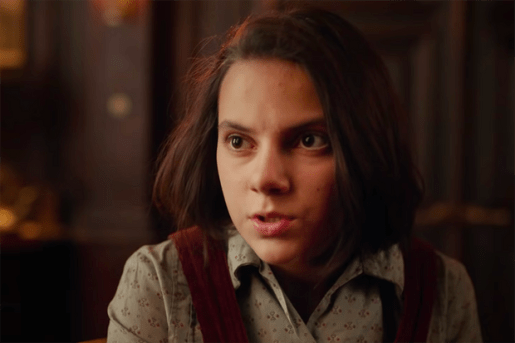
“You must let me mold you” Ruth Wilson’s Mrs Coulter tells Dafne Keen’s Lyra over lunch, serving as the the first of many warnings signs of the possessive and almost psychopathic behavior she displays.
Again, directed by Tom Hooper and written by Jack Thorne, the second episode of His Dark Materials “The Idea of North” focuses on the growing cat and mouse game between Lyra and Mrs Coulter as Lyra slowly comes to realise her true intentions.
Having seen the first adaptation, I knew Coulter would not turn out to be a good person and Wilson does a great job portraying her complex personality and the abusive bond she forms with Lyra.

coulter and lyra 2.jpg
Coulter’s friendship with Lyra quickly turns volatile and Lyra refuses to be molded.

Although, Coulter is shown to care for Lyra somewhat as seen by her crying outside of Lyra’s door, however, she is not above hurting Lyra to get her to act the way she want, as seen by her having her daemon attack Pan to hurt Lyra.
Through this it is made clear that if Coulter cannot convince Lyra to be molded then she will do it by force.
This manipulative trait is also made clear through how she acts kind to the abducted children like Roger and Billy (Tyler Howitt), making them believe the letters they write will get to their loved ones, only for her to burn them when she leaves with a satisfied look on her face.
Such a look is also apparent when she tortures Lyra through Pan before accidentally revealing that Lord Asriel is her father, and this reveal does seem to bring a temporary moment of humanity to her, the only moment in the episode that her affection for Lyra seems genuine.
Basically, what I am saying is that Wilson steals the episode with her great performance as the manipulative Coulter.

evil coulter
Wilson pulls off Coulter’s abusive character perfectly, portraying both viciousness and weakness.

That is not to sell Dafne Keen short, though, because she is also amazing as Lyra slowly coming to the realization of how cruel Coulter is and refusing to be molded.
This results in great scenes like when Lyra throws her knowledge of Dust in Coulter’s face.
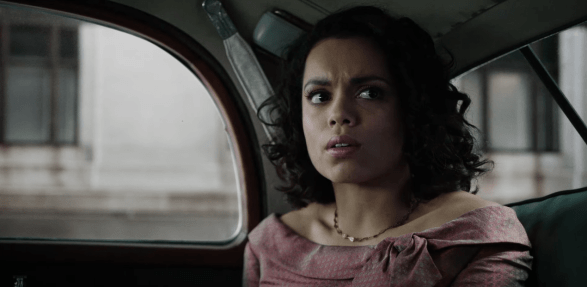
However, her big revelation about Coulter being connected to the Gobblers does not come through her own investigation but through a random journalist named Adele (Georgina Campbell) informing her, leading to her escape.
Said journalist is then immediately captured and killed by Carlo Boreal (Ariyon Bakare) when he crushes her daemon in his hand.
Seriously, though, how unlucky is Adele to have a butterfly for a daemon?
All it would take is for someone to accidentally step on it and she’d die.
Talk about bad luck.
Adèle_Starminster
Adele is killed very quickly upon being discovered showing the brutality of the Magisterium. 

As well as killing the journalist, Boreal plays another interesting role in the episode by traveling to another dimension which appears to be our own.
He is looking for the man Asriel claimed had been murdered in the first episode by presenting his head, which Boreal now believes was not him.
Boreal hires someone to track the man down, showing his snake daemon to appease him.
Now that I think about that, though, it is kind of funny how the villains of this series are all telegraphed by their stereotypically evil daemons.
A snake, a bug, a lizard, what’s next a rat?
Anyway, other characters that the episode focuses on are the Gyptians whose hunt for the missing children remains unsuccessful, although they are getting closer.
Sadly, Lyra now looks to be one of the children they have to save because she is kidnapped by the Gobblers at the end of the episode after escaping from Coulter.
All in all, I found “The Idea of North” to be just as good of an episode as the premiere episode, making His Dark Materials look to be another hit show this year, quality wise.
Watchmen, Episode Four, If You Don’t Like My Story, Write Your Own, Review: Lady Trieu Enters Stage Right.

4 stars
Directed by Andrij Parekh, episode four of Watchmen, “If You Don’t Like My Story, Write Your Own,” certainly seems to be the episode that begins to connect the plot lines together.
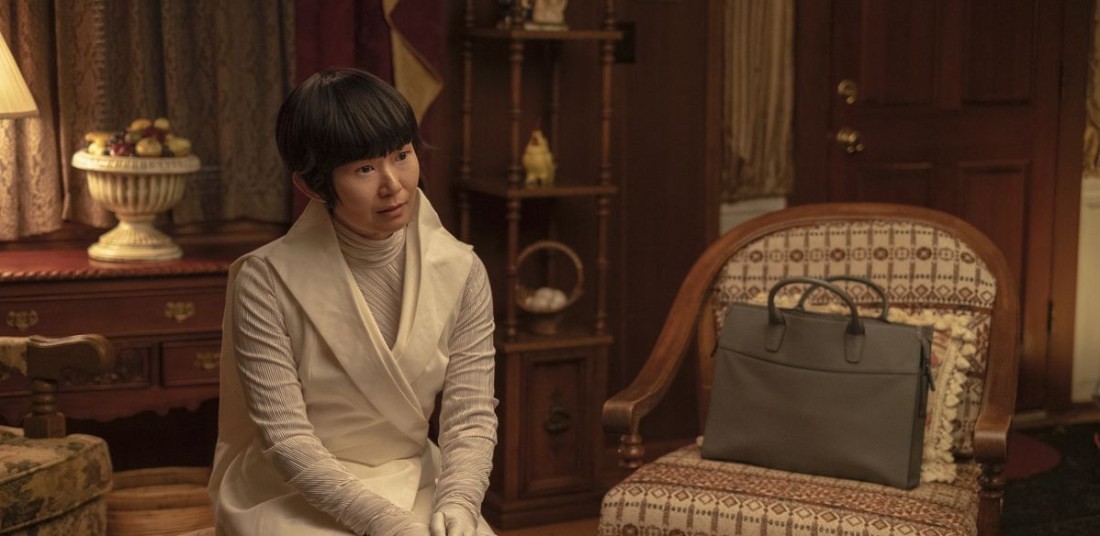
And this all starts with the appearance of the mysterious Lady Trieu (Hong Chau) in the opening scene.
“If You Don’t Like My Story, Write Your Own” begins with the Clark family receiving a visit from Trieu who knows of their struggles to have a child.
So, she decides to gift them with one, essentially cloning a baby with their DNA.
This gift does not come without a price, though, because Trieu wants to buy their land, apparently because of some kind of object that crash lands there after the Clarks give the rights to her for the baby.
With this baby being delivered to them, the object that appears to be from space crashing in their back yard, and the fact that the couple’s last name is Clark, it is obvious that this first scene is allegorical to Superman.

meteorite.jpg
Some kind of meteorite crashes on the land of the Clarks who then receive the miracle baby they always wanted. Is this Watchmen or Superman?

Given that Dr Manhattan is essentially Watchmen‘s  Superman, this speaks to the possible connection between him and Trieu.
The signs are everywhere both through this scene and Ozymandias’, who we see again testing the limits of his prison by launching his murdered servant clones out of it with a catapult.
However, before this, we get a disturbing explanation of these servant clones who Ozymandias fishes out of the water as babies, using traps, and then transforms them into adults through some kind of machine.
The sounds of his transformation are particularly gruesome but the implications of these clones are very clear.
Ozymandias says that he did not create the clones, highly implying that Dr Manhattan or Lady Trieu, or possibly both of them, have something to do with it.
Dr Manhattan did say he was going to create some life when he left earth in the Watchmen graphic novel, and Trieu has been shown capable of creating life in the opening scene.
Along with this, Tieu’s daughter Bian (Jolie Hoang-Rappaport) also seems to be some kind of clone, having nightmares about the war in Vietnam when she is way too young to have been alive then.
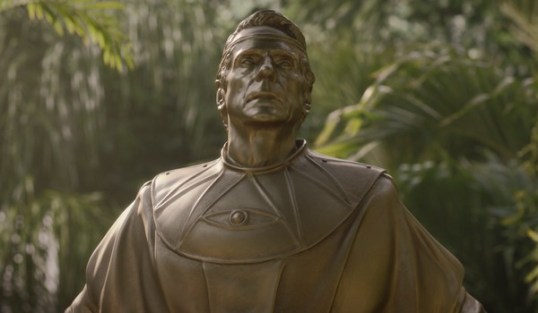
Then there is the statue of Ozymandias Trieu has, which looks exactly like the man himself does in his captivity.
All these signs speak to the links between Trieu, Dr Manhattan and Ozymandias, and these should hopefully become clearer in future episodes.

Ozymandias statue.jpg
Ozymandias, Trieu and Dr Manhattan all appear to be linked in this episode, although, to what extent we will have to find out later.

Either way, Trieu somehow manages to top Ozymandias as the most interesting character this episode with various hints to her connections with other characters.
She is also confirmed to be working with Will Reeves for some, as yet, unknown goal.
Them working together is first revealed by Trieu subtly telling Sister Night in Vietnamese that her grandfather wondered if she had the pills.
Then there is the final scene, which shows the two are planning something big in three days that Sister Night will hate Will for.
If I had to guess, I would say that Will and Trieu’s plan was probably generated by the racism they have suffered.
Will’s parents were killed in the Tulsa Massacre and it is highly implied that Trieu and her family were severely impacted by the Vietnam War so it makes sense that the trauma caused by these events would lead them down the path they are now on.
Will also appears to be in perfect health now, walking normally, despite being 105-years-old, which does make it possible for him to have been the one to kill Judd Crawford.
He also repeats the catch phrase of the Seventh Kalvary, “tick, tock”, showing the importance of Trieu’s Millennium Clock, which is clearly representative of the Doomsday Clock in the graphic novel.
With so much emphasis on Trieu, Ozymandias and Will, it was a little hard for Sister Night to stand out, although there is one scene of her that has stuck in my mind.
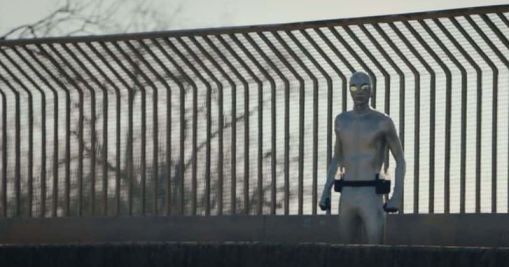
However, this is not because of her but because of the weird vigilante figure watching her who has been dubbed Lube Man.

lube man
Na, na, na, na, na, na, na, na, Lube Man!

This weirdo, who in all likelihood is probably Petey (Dustin Ingram), sees Sister Night dispose of Will’s wheelchair before running off and using his lube to escape into a sewer.
Sister Night’s following exclamation of “the f$#*!” basically voices what the viewers were thinking at this moment.
Speaking of Sister Night, though, there is something off about her husband Cal (Yahya Abdul-Mateen II).
He tells their adopted children that there is no heaven and when you die you don’t exist anymore.
Now, Cal could just simply be an atheist, but this seems a little too much of an apathetic thing to say to children who have just lost their uncle and also lost their biological parents.
There are some theories out there that Cal is a form of Dr Manhattan and there is some evidence that seems to support this.
However, I have no idea why Dr Manhattan would return to earth to live out life as a family man when he did not seem to care about such things so the theory is probably wrong.
Either way, “If You Don’t Like My Story, Write Your Own” is another solid episode of Watchmen that seems to be connecting the plot lines together, building towards whatever the finale will be.
The next episode looks to be centered around Looking Glass who appears to be going undercover to investigate the Seventh Kalvary.
He knows about Crawford’s possible Kalvary connections from Sister Night and he has Will’s pills so this could lead to him discovering the conspiracy.
Let’s just hope he doesn’t die as soon as he discovers it.

My Hero Academia Season Four, Episode Four, Fighting Fate Review: Can Fate be Averted?

4 and a half stars
After the anticipated arrival of the adorable Eri last episode, the fourth episode of My Hero Academia‘s fourth season “Fighting Fate” picks up with the rest of her first encounter with Deku and Mirio.
Unfortunately, this is also Deku and Mirio’s first encounter with the villain Overhaul as well.
What follows is an intense scene where Deku tries to protect Eri while maintaining the facade that he does not know who Overhaul is.
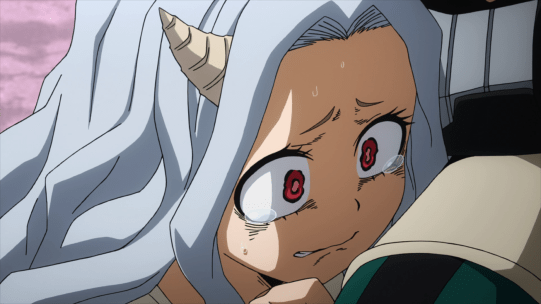
Ultimately, though, Deku’s instincts as a hero overrule this second priority when Eri begins to beg Deku not to leave her.

protect her.png
With Eri’s introduction, the emotional core of the season arrives.

It is in this scene where we get to see both Deku and Mirio’s skills as future heroes because while Deku is protective, Mirio is quick thinking, dodging Overhaul’s prying questions expertly.
However, both their combined efforts are not enough to save Eri as the two are incredibly out of their depth, which Eri clearly notices because she goes back to Overhaul when he makes a subtle threat to kill Deku and Mirio.
Her doing so gives us a really good sense of her character as, despite the pain she has endured at Overhaul’s hands, she is willing to go back with him so he won’t hurt anyone.
The consequences for her are clearly laid out as Overhaul brings her into an experimental room announcing her to be the “crux” of his plan.
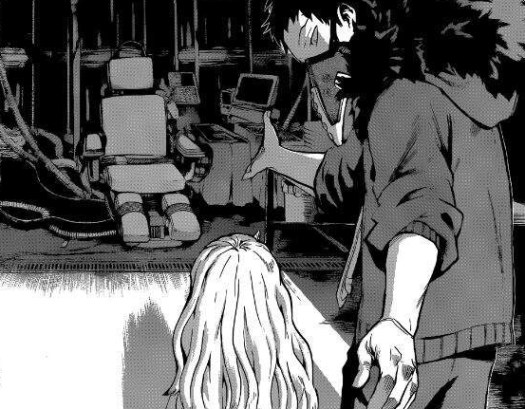
This is where one of my very few problems with the episode comes in because, compared to the manga, shots like that of the room Overhaul brings Eri into are not as detailed, lessening their impact.

experimentation.jpg
This detailed room that makes the horror Eri is experiencing very clear in the manga is sadly reduced in the anime.

Another thing from the manga that I was disappointed to see left out of the anime was Sir Nighteye’s reaction to hearing Deku wish he could have protected Eri.
In the manga we get a panel of him looking remorseful with his back to Deku, showing he does care, despite wishing Deku had not been chosen to receive One For All.
Sadly, this effective shot is nowhere to be seen in the episode.
Thankfully, what is not removed is Overhaul’s cruelty because he murders the subordinate who was supposed to be watching Eri when she escaped.
Overhaul then makes a comment about people being sick with “hero syndrome,” foreshadowing the future reveal of his motives.
Following these dark scenes, we get the emotional highlight of “Fighting Fate,” which is Deku’s confrontation with All Might.
Deku wants to know why All Might never told him about Mirio being the original candidate for One For All but instead learns a darker truth.
This truth is that when All Might and Sir Nighteye separated because All Might refused to retire after his injury, Nighteye used his foresight to predict that All Might will die a gruesome death in the near future.
The music and voice acting during this scene are top notch with Night Eye’s voice actor Shin-ichiro Miki doing a great job.

prediction.png
Nighteye’s prediction is the most emotional moment of the episode with a dark fate for All Might being set up.

The following moment with All Might and Deku after this moment are also fantastic with the best animation of the season so far giving the emotion of the scene a bigger punch.
In the end, Deku begs All Might to live long enough to see him tell the world that he is here and All Might swears to fight the fate he has been given.
And then, of course, the episode ends with a comedic moment, as All Might is once again too scared to reconcile with Night Eye.
“Fighting Fate” is another great episode of My Hero Academia that is probably tied with “Overhaul” as my favourite episode of the fourth season so far.
And now, with Eri, the emotional centerpiece of the season, introduced, the story will begin to pick up even more.

Jojo Rabbit Review: Hilarious, Heartwarming, and Dark.

5 stars
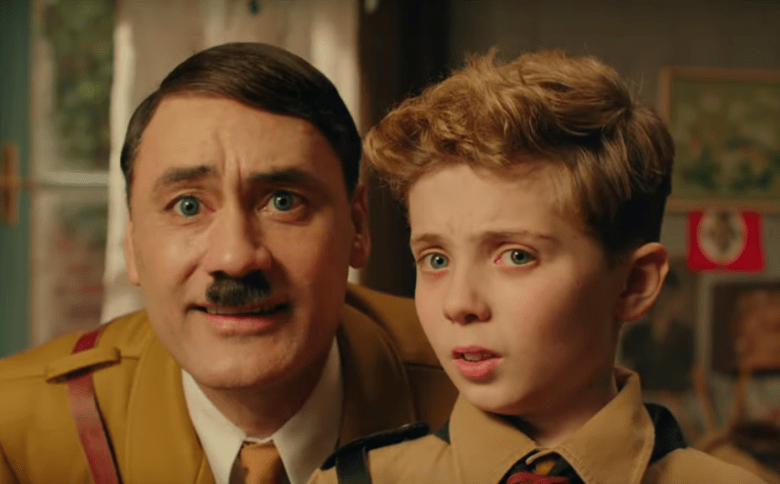
Taika Waititi playing Hitler… well, I think it’s safe to say that I have seen everything now.
In all seriousness, when Jojo Rabbit was first announced there was a bit of controversy over the satirical plot being about a young boy in World War Two Germany whose imaginary friend is Adolf Hitler.
Thankfully, such controversy was unwarranted as Waititi has crafted a film that manages to be hilarious, heartwarming and dark, resulting in a film that is probably my favourites of his.
The story follows the young Jojo (played by Roman Griffin Davis in his first role) a member of the Hitler Youth who is so misguidedly infatuated with the country’s genocidal leader that he imagines him as his imaginary friend.
After learning that his mother, Rosie (Scarlett Johansson), is hiding a Jewish girl named Elsa (Thomasin McKenzie) from the Nazis, Jojo desperately tries to figure out a way to get rid of her without getting his mother into trouble.

Elsa.jpg
It’s interesting how Elsa is framed to suit Jojo’s negative perception of her only for this to slowly evolve over the film as he comes to realise she is just as human as he is. 

What follows is many endearing scenes between the three characters as Jojo comes to learn that Elsa is far from the monster Nazi propaganda would have him believe.
All three actors give great performances, delivering both emotional weight and humor perfectly.
The same can be said for the other characters like the disillusioned Captain Klenzendorf (Sam Rockwell) and Jojo’s friend Yorki (Archie Yates) who is just too pure for this world.
I especially loved Waititi’s portrayal of the imaginary friend Hitler, taking him from the childish and friendly character of Jojo’s imagination to the cruel and detestable dictator we know from history.

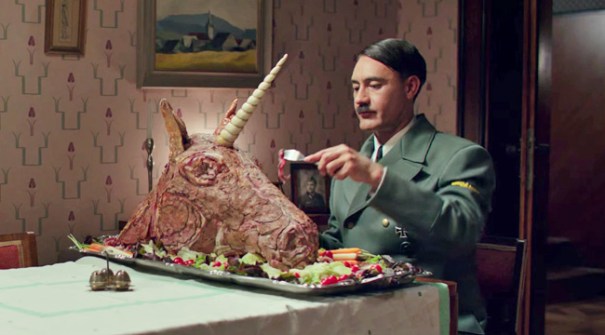
Hitler eats a unicorn.jpg
The visual of Hitler eating a unicorn is both darkly hilarious and great symbolism for Jojo slowly coming to realise the dictator’s true nature.

This slow decrease in Jojo’s perception of Hitler, results from many surprisingly tragic moments in the film, including one moment that left me gaping for at least a full minute.
I probably would have cried if I had not been so shocked by it.
Ultimately, this is what proves JoJo Rabbit to be one of Waititi’s best films.
It balances its often dark tone with humor brilliantly, often combining to create dark humor, resulting in a satire that comments on the impact of war, hate, and by the end, love.
I highly recommend Jojo Rabbit. 

His Dark Materials, Episode One, Lyra’s Jordan Review: Enter the World of Daemons.

4 stars
HBO has put out many amazing shows in 2019 from Chernobyl, to Watchmen, to the final season of Game of Thro-oh wait, no, that last one sucked.
Anyways, while HBO did not make its latest show, merely distributed it, that show, His Dark Materials, looks to be another great one nevertheless.
Based off Philip Pullman’s successful trilogy, the story is set in a world where people’s souls manifest as talking animal companions known as daemons.
If this sounds familiar to you but you have not read Pullman’s novel then you probably recognize it from the earlier movie adaptation, The Golden Compass, which got a less than stellar reception to say the least.

The Golden Compass.jpg
Will the new His Dark Materials series go on to be as badly received as The Golden Compass or will it be better?

I have only seen this film once when I was a kid and I thought it was pretty good, although, to be fair, I was only nine and I could not tell the difference between a good and bad move to save my life back then.
In any case, even if The Golden Compass really is as bad as I don’t remember it being, His Dark Materials already looks to be miles better than that film adaption, if the first episode “Lyra’s Jordan” is anything to go by.
Directed by Tom Hooper, and written by Jack Thorne just like every other episode will be, the episode mostly follows the titular Lyra at the beginning of her adventure.
Lyra is played by Dafne Keen who I am glad to see is getting more work.
I loved her performance in Logan and I cannot wait to see what she does with the role of Lyra.

Lyra.png
Dafne Keen does a solid job in the first episode of His Dark Materials.

Speaking of the X-Men, James McAvoy is also in the series, playing Lyra’s guardian Lord Asriel.
McAvoy delivers a fantastic performance, especially in an impassioned speech he delivers to his colleagues about Dust to get more funding for his research, which is considered heresy by many.
It is with this and many other moments in the episode that the anti-religious themes of Pullman’s story can be seen.
Along with Keen and McAvoy, another actor to watch out for in this show is Ruth Wilson who plays the sinister Marisa Coulter.
Another thing I enjoyed about “Lyra’s Jordan” is how the daemons are shown to be incorporated into the world.
We get a Gyptian ceremony in the episode, which shows how they celebrate when a daemon settles as a single animal.
Many of the daemons are established from Lyra’s Pan (Kit Connor) and Asriel’s Stelmaria (Helen McCroy).
Then there is the fact that all of these daemons have great CGI.
The downside of this is that they did not have the budget to animate many side characters’ daemons, which are just never acknowledged, but this is better than having a bunch of completely fake looking daemons running around.

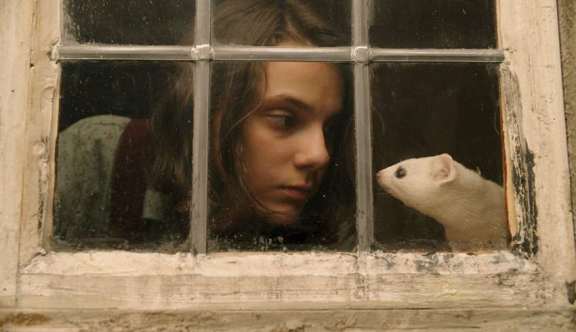
Lyra and Pan.jpg
The Daemons are very well animated, blending seamlessly with the actors as can be seen by this shot of Lyra and Pan.

And, as stated, the daemons that are in the episode are incorporated so well that it makes the world feel lived in by them.
However, this has a negative effect on the characters as a Gyptian child is kidnapped after the celebration of his brother’s daemon.
Many Gyptian children are revealed to have been kidnapped by the end of the episode
by the so called Gobblers.
Even children who aren’t Gyptians like Lyra’s friend Roger (Lewin Lloyd) are taken and this is one of the reasons why Lyra departs with Coulter at the end of the episode, with her alethiometer in hand.
Overall, the first episode of His Dark Materials, “Lyra’s Jordan” is a solid start that has me interested to see where the series will go.
Hopefully, this will be liked by fans of Pullman’s novel and not go on to be regarded as another The Golden Compass.

Watchmen Episode Three, She Was Killed by Space Junk Review: Everybody Goes to Hell!

4 and a half stars
Watchmen
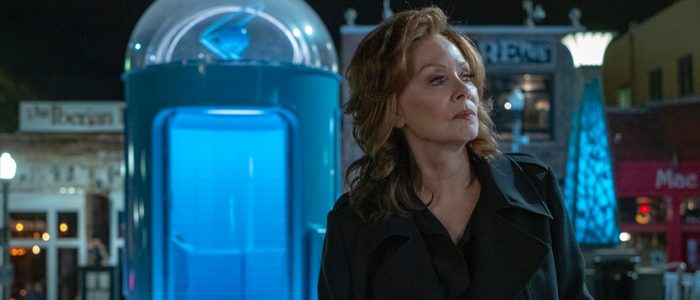
‘s third episode, “She Was Killed By Space Junk” is the best episode of the series so far with the role of main character temporarily switching from Angela Abar to Jean Smart’s Laurie Blake.
Directed by Stephen Williams, the story of the episode centers on Laurie being brought into the Seventh Calvary Case while flashing forward to her sending a message to Dr Manhattan through a phone to mars.
This message is a joke about three heroes, Dr Manhattan, Ozymandius and Night Owl, who appear before god to receive judgement.
All three go to hell until god sees a woman standing behind them who identifies herself as the girl who a threw a brick from the joke Laurie appeared to screw up earlier.
The brick falls from the sky and kills god, sending him straight to hell.
The flash forwards to Laurie’s joke are the best part of the episode because I was very intrigued by what the joke ended up being.
Personally, I think it has great thematic purpose with the girl who threw the brick clearly being representative of Laurie, and the joke itself being similar to Rorschach’s Pagliacci joke from the original graphic novel.
Dr Manhattan also seems to appreciate the gag because Angela’s car, which Will escaped in last episode, descends from the heavens, nearly crushing Laurie like god’s head got crushed by the brick.
In all likelihood, though, the car was most likely dropped by the people who rescued Will who want Laurie to become a part of the case for as an unknown reason.
But, for the moment at least, Laurie seems to believe it is Dr Manhattan, bursting out into laughter, being very reminiscent of her father The Comedian.

snap.png
Laurie’s phone booth scenes are the best of the episode with Jean Smart delivering a great performance.

With this, and the fact that she has taken on his last name, it is apparent that Laurie has started to feel some kinship with her destructive father over the years.
As for the rest of the episode, it is also great with Laurie being revealed as part of a vigilante capture task force of the FBI.
Night Owl is also revealed to be in prison.
Laurie actually drives quite a few comedic interactions as well, like with Looking Glass, Red Scare (Andrew Howard), and Pirate Jenny (Jessica Camacho).
Then there is her Dr Manhattan dildo, which is a real “wait, what!?” moment.
Laurie also has a few action moments as well, shooting the Seventh Calvary member with the suicide vest who tries to kidnap Senator Joe Keene JR (James Wolk).
Speaking of him, I think it is pretty apparent that he will most likely be involved somehow in the conspiracy Will mentioned.
The fact that he was at Judd’s house where Angela found the Ku Klux Klan robe last episode also supports this.
Aside from these individual moments, however, one of my favourite things about the episode is its soundtrack with Laurie having a killer theme.
This soundtrack accompanies her pretty much through the entire episode, apart from the Ozymandias scenes and, unfortunately, it is these ones that keep the episode from being perfect.
While the scenes are great I do have a few flaws with them, like the CGI Buffalo, which look completely fake.
Then there is the official reveal that Ozymandias is… well, Ozymandias.
This was presented as some kind of shocking twist but I am pretty sure we all knew it was him going in so they did not need to act like it was some big moment.

Ozymandias outift.jpg
While I did like Ozymandias’ scenes, there are things about them that hold the episode back, like his obvious identity reveal.

Other than this, though, Ozymandias’ scenes are still intriguing, with us learning he is the captive of “the game warden.”
There are multiple theories about who this game warden could be but the most likely seems to be Dr Manhattan.
We will just have to wait and see as Ozymandias’ escape plan slowly comes to fruition.
Overall, “She Was Killed by Space Junk” is the best episode of Watchmen so far with just a few scenes holding it back from being a truly fantastic episode.

BoJack Horseman Season Six, Part One Review: A Surpisingly Happy First Half… Until The End.

4 and a half stars
At the end of BoJack Horseman‘s fifth season many of the characters looked like they were in happier places.
BoJack (Will Arnett) was finally going to rehab to get the help he needed, Mr Peanutbutter (Paul F. Tompkins) proposed to his girlfriend Pickles (Julia Chan), and Princess Carolyn (Amy Sedaris) had adopted a child.
However, based on what I knew about these characters, I highly doubted these instances would make the characters happy in season six.
This was because after all BoJack had been through and done I was unsure if he ever could change, and both Mr Peanutbutter and Princess Carolyn appeared to be ignoring their own problems by taking on their new responsibilities.
So, imagine my surprise when all three characters did end up happy in this season.

Surprise.png
Despite characters like Mr Peanutbutter looking like they were heading in an unhappy direction at the end of season five, they are happy in season six.

Granted, this was probably because Netflix had decided that this sixth season would be the final one but creator Raphael Bob-Waksberg and the other writers really wrote these characters emerging happiness right for the most part.
The one exception to this is definitely Mr Peanutbutter because the story they seemed to be building up for him in season five is pretty much ignored in favor of improving his relationship with Pickles, which I am not sure was the right decision.
However, this is only the first half of the final season so I cannot judge Mr Peanutbutter’s storyline too harshly because it has yet to be completed.
And, other than him, I loved the direction the sixth season took, especially with BoJack as by the end of the season it is clear that he is a changed horse.
This resulted in many heartwarming scenes like the final interaction between BoJack and Mr Peanutbutter.

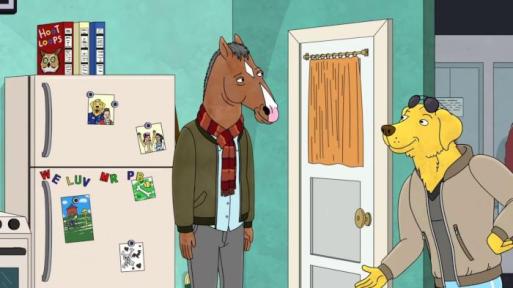
crossover!.jpg
BoJack’s scene with Mr Peanutbutter pays off a scene that I never thought would be and I love it.

Then there is Diane’s (Alison Brie) sweet, growing relationship with the buffalo Guy (Lakeith Standfield) and Todd’s (Aaron Paul) relationship with his stepfather and mother, which looks set to be expanded upon in the final half.
All of this builds to put all the characters in happy positions at the end of the fist half, most of all BoJack… only for the final episode just tears that all down.
“A Quick One, While He’s Away” has to be one of the most gut wrenching episodes of the entire series.
Just as BoJack is redeeming himself and becoming a better person his past truly comes back to haunt him, with many of his darkest secrets looking to be exposed in the second half.
And, as someone who considers the final scene of season four to be the most heartwarming moment of BoJack Horseman, the last scene of the final episode made me feel like I had been sucker punched.

season 4 ending.jpg
I loved the season four finale so much that it made me cried so to see that happy ending threatened by the the last episode of the first half really worries me.

I am now genuinely scared about what is going to happen to BoJack in the final season.
One thing is for sure, though, and that is that the first half of season six has built up to whatever this finale will be nicely.
It started by building up a feeling of hope before pulling the rug out from under us with a crushing final episode that has me eagerly anticipating the final half.
I know it will crush me emotionally but I have to see it through.

Attack on Titan Chapter 123, Devils of the Island Review: Eren Equals Nightmare Fuel.

4 and a half stars
Honestly, it felt like it was taking forever for Chapter 123 of Attack on Titan, “The Devils of the Island” to be released.
After the best cliffhanger of the entire series in Chapter 122, I was desperate to see what would happen now that the Rumbling had been initiated.
However, in true Isayama fashion, he started the chapter not with the Rumbling but with a flashback to when Eren and his friends first went to survey Marley.
This surprisingly lead to some of the greatest jokes of the entire series.
There is the amazingly comedic moment where Hange, Sasha and Connie are amazed by a car, with Sasha and Connie mistaking it for a cow.
What makes this joke truly shine, though, is the following exchange between Levi and Onyankopon where Levi expresses his concern that they may try to feed the car a carrot.
Onyankopon thinks he is joking until he looks and cries out “they’re buying a carrot!”
But, by far the funniest gag of the entire chapter that left me in stitches came when a clown approaches Levi and offers him candy, thinking he is a little boy because of his height.
Levi’s expression during this moment is priceless and the fact that this random clown had just inadvertently insulted the strongest character in the manga who could tear him to pieces had me howling with laughter.
I know the chapter just came out but I already think this joke is my favourite out of the entire manga so far.
The flashback is not all sunshine and rainbows, however, as is quickly proven by a surprising character reveal when Levi notices a young boy trying to steal Sasha’s money and calls him out on it.
What is so surprising about the boy is that he is the one with the fez hat from the memory fragment in Chapter 120.
I had previously predicted that this boy would turn out to be a young Tom Xaver or a kid from the future that Eren was seeing with the Attack on Titan power but I was completely wrong about this.
No, instead the boy turned out to be an immigrant from the Mid-East Allied Forces, fleeing his country because of its war with Marley.
This leads to him being singled out by the crowd of Marleyans and it becomes clear that the country’s racism does not just extend to Eldians.
Thankfully, Levi using his quick thinking to save the boy, claiming he is Sasha’s brother before fleeing with him just as the crowd starts to turn violent.
Upon escaping, Levi notices that the boy has taken the money again.
However, I do not think he stole it because of the memory fragment in Chapter 120.
Because we now know that this fragment came from Eren’s perspective we can see there was a moment he made this boy smile.
I think the reason that the boy was seen smiling is because Eren secretly gave him the money.
If he did so it would most likely be because he sees a part of himself in the boy, as pointed out by the scene with him and Mikasa looking at the boy’s camp with his family.
Eren highlights their similarities and then makes a very ominous statement about the boy when Mikasa asks if something happened to him, stating “nothing yet.”
Given this, and the fact that Eren was crying before Mikasa found him, it points to the notion that Eren already knows he will cause this boy and his family’s deaths when he initiates the Rumbling.
Eren is clearly struggling with this knowledge as he asks Mikasa what he is to her.
Many people have interpreted this as a shipping moment but I do not think this is the case.
Rather, I think Eren’s questioning of Mikasa is both a blind hope that she can unknowingly convince him he does not have to destroy the world, a way to test if she only cares about him because of her Ackerman blood, and to see if the future memories of the Attack Titan are really destined to happen, all in one.
This last point seems to be proven by the arrival of Jean, Connie and Sasha to which Eren notes that it is “perfect timing”, as if he knew they would come at that moment.
Then we get the last happy moment of the chapter with the Scouts all getting drunk and partying with the young boy’s family.
This moment is also particularly sad in hindsight because it is the last time that Eren, Mikasa and Armin were happy together.
After this, Eren gets his proof that the subjects of Ymir on Paradis would always be persecuted by the outside world and leaves to plan his attack on Liberio.
From here, “The Devils of the Island” transitions into the present with the much anticipated Rumbling and this is where my one criticism of the chapter comes in.
During this moment we see that Mikasa, Armin, Gabi and Pieck are all safe, when they were in imminent danger at the end of the last chapter.
It was quite jarring to see they were safe without showing how they escaped the collapsing wall.
This problem aside, though, the panels of the Rumbling are both magnificent and terrifying.
The horrifying aspects of these panels are highlighted further by the absolute nightmare fuel that is Eren’s new Titan form.
I was pretty sure he would get a new form after finally utilizing the Founding Titan power last chapter but I was not at all expecting the dinosaur skeleton hybrid that we got.
What’s more is that this Titan puts Rod Reiss’ to shame, with it being at least three times times the size of his Titan, and that’s only when it’s on all all fours!
Eren is practically unstoppable at this point and the full force of the Rumbling is shown through how Armin and Mikasa have to shout to hear one another because of the noise.
Armin quickly realizes that Eren is using way more Titans than would be necessary to crush the Allied Forces in Marley and this leads to Eren’s announcement of what his true intentions are.
He uses the Founding Titan power to communicate with all Subjects of Ymir, seemingly temporarily transporting them to the Path Dimension.
Curiously, Mikasa is also transported there, which is strange because I though she had no Eldian blood, having an Asian mother and an Ackerman father.
However, I think the reason she is there is not because she can be turned into a Titan but because as an Ackerman the past battle experience of her predecessors was given to her through a Path.
So, even if Mikasa is not an Eldian, she is still connected to the Paths so she can hear Eren.
More important, though, is Eren announcing his intentions.
He declares that he plans to use the Rumbling, “until all life existing there has been exterminated from this world.”
And there we have it.
As many of us thought, Eren intends to enact a worldwide genocide to protect his friends.
Anyone who still thinks Eren is a hero after this really should take a good look at their morality because, although Eren is doing this for the right reasons, what he intends to do is still monstrous.
And this monstrous intent is perfectly portrayed by the final panel of the chapter where Eren announces he will kill everyone outside Paradis.
He looks absolutely demonic in this panel, only further implying that he may turn out to be the devil in Ymir’s story.
Devil or not, though, the question is if he will succeed in destroying the world or not?
He could just be trying to make himself the enemy to unite the world against him but this seems a little too similar to Code Geass’ ending.
Isayama has said that he wants to hurt the readers so I see Eren’s plan of worldwide genocide succeeding with him achieving freedom for his people, but at the worst possible cost with many beloved characters dying.
“The Devils of the Island” makes it even clearer that the story of the manga is drawing to a close.
And from the events of the chapter, that ending looks to be on such an epic scale to the extent that we have not seen in this series before.

Watchmen Episode Two, Martial Feats of Comanche Horsemanship, Review: “Friends in High Places” Indeed.

4 stars
The mystery deepens in the second episode of Watchmen “Martial Feats of Comanche Horsemanship”, with Angela beginning her investigation into the death of Chief Crawford.
Her prime suspect is the 105-year-old Will who claims to have “strung up your police chief”, despite looking physically incapable of doing so.
Directed again by Nicole Kassel, episode two dives head first into the interactions between Angela and Will as the costumed detective tries to learn the truth from him.
An interesting point to note is that, as far as I can remember, Will never outright says he murdered Crawford.
Again, he merely states that he “strung up your police chief.”
So, while he may have had a hand in hand in hanging Crawford, he may not be behind his murder.
Although, Looking Glass later says Crawford did die of asphyxiation, likely from being hung, so I may be wrong about that.
Or maybe he was killed elsewhere before being hung.
Either way, Crawford’s murder is not the only mystery surrounding Will because it is revealed that he is Angela’s grandfather at the end of the episode.
One thing I did find interesting was that it was mentioned that Will has two descendants.
This means, along with Angela, there is one other character who is descended from him.
Following the realization that Will is her grandfather and realizing he will not cooperate, she decides to take him in, ignoring his claim of having “friends in high places.”
This comes back to bite her when, after putting Will in her car, a magnet descends from the sky and picks up the car with Will in it, flying off.
“Friends in high places” indeed.

Will leaves.jpg
Will disappears with a smile as he is rescued from Angela’s custody. 

The scenes between Angela and Will are great as they continue to build in suspense and anticipation for the reveal of the conspiracy Will claims is currently happening in Tulsa.
The only weak moment came in the aftermath of Crawford’s murder, where Angela lets out a cry of anguish that seemed kind of artificial to me.
Aside from this small moment, though, their interactions are very good.
There are already multiple theories surrounding Will, including one that he was Hooded Justice who appears on a TV show called “American Hero Story”in a brief yet interesting scene that speaks to Angela’s character.
Supporting this theory, is the opening scene where Will’s father is fighting in World War One and sees a German pamphlet that urges black soldiers to come over to their side where they will be treated fairly, and Hooded Justice was thought to be German.
Speaking of theories, I also like the one that Crawford was the Seventh Calvary member who shot Angela.
In a flashback of the White Night, Angela is shot and about to be killed by one of their members but then it cuts to her waking up in the hospital with Crawford beside her.
However, none of these scenes are my favourite of the episode.
That award goes to the scene where we get to see Ozymandias’ play.
This moment proves to be the most confusing yet interesting scene in the show so far, with his production of Dr Manhattan’s transformation being particularly disturbing and also somewhat comical.
We watch as he literally burns his assistant Mr Phillips to death to simulate Dr Manhattan’s transformation, upon which it is revealed that all of his assistants are clones.

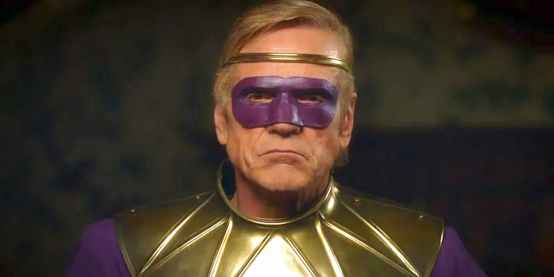
Ozymandias.jpg
Watching Ozymandias burn one of his clone servants to death, only for the next clone to eagerly take their place, is both disturbing and oddly comedic.

Why Ozymandias has all these clones and what exactly he intends to achieve by making this play for himself is uncertain.
One thing is clear, though, and that is that he has been deeply affected by his last meeting with Dr Manhattan, remembering his last words to him before he departed, “nothing ever ends.”
I am probably looking forwards to Ozymandias’ scenes the most in future episodes as Jeremy Irons is doing a great job.
Other notable scenes in this episode include the discovery that Crawford may have been in the Ku Klux Klan, and the touching moment where Looking Glass reveals that, despite seeming completely cold, he is actually crying under his mask.
Overall, I would say that “Martial Feats of Comanche Horsemanship” is another great episode of Watchmen that, while not as enjoyable as the first episode, deepens the mystery and creates more interesting questions for the show to answer.
Let’s just hope those answers will be satisfying.

Zombieland: Double Tap Review. Admittedly Fun But Unecessary.

3 stars
When I first heard there was a sequel to 2009’s Zombieland coming out, I had quite a few reservations.
The first film came out ten years ago and, although it is a very enjoyable film, I thought it was very unnecessary to make a sequel now.
A few years after the first film came out, sure, but ten years later?
So, I admit I went in with a lot of skepticism.
Still, I enjoyed myself.
Zombieland: Double Tap is a fun film with a lot of great gags and zombie action.
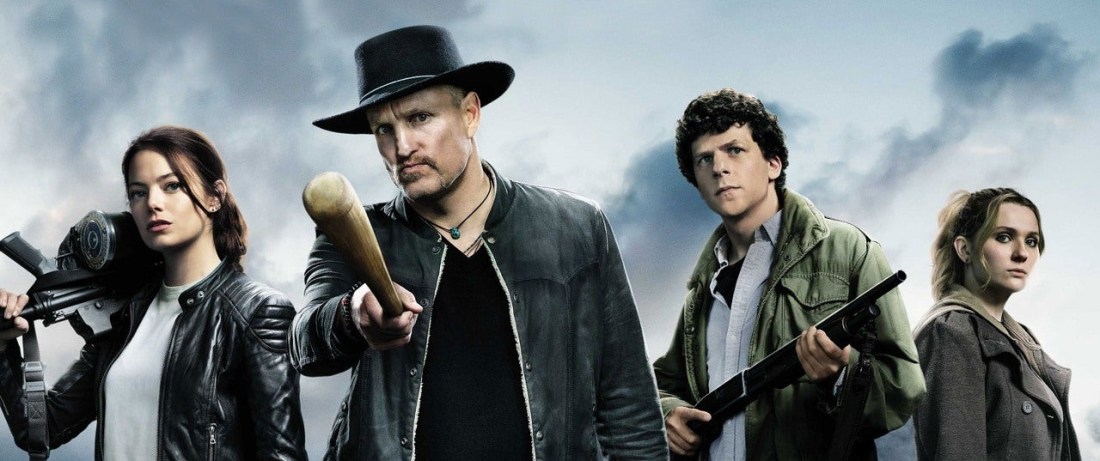
Returning director Ruben Fleischer did a good job helming this film, which again follows the characters of Columbus (Jesse Eisenberg), Tallahassee (Woody Harrelson), Wichita (Emma Stone), and Little Rock (Abigail Breslin) on their bloody adventures in Zombieland.
All four of the actors do a great job portraying the characters they played ten years ago, although Breslin sadly does not have enough screen time to stand out.
That aside, the team’s banter is great and it leads to a lot of exciting action sequences, my favourite of which is a long take fight sequence following the arrival of two characters that are hilariously similar to Columbus and Tallahassee.

elvis and cowboy.jpg
The introduction of Albuquerque (Luke Wilson) and Flagstaff (Thomas Middleditch)  leads to the best action scene of the film.

There are plenty of creative moments in the film as well, including one at the start that actually made me jump in surprise.
Then there is the surprise cameo when the credits start to roll, which is also highly enjoyable.
So, if you are looking for a good time at the movies then Zombieland: Double Tap will definitely provide that.
However, the film does still have quite a lot of issues.
One of those is the lack of agency in much of the plot.
The film basically follows Columbus, Tallahassee and Wichita on a mission to save Little Rock but, honestly, I felt very little suspence in this mission for whatever reason.
On top of this, while many of the jokes do land a lot of them don’t as well.
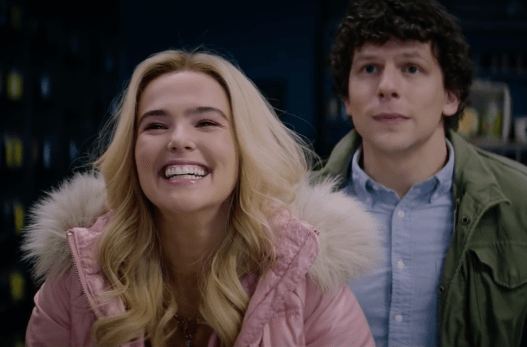
This is mainly due to the new faces in the film, primarily Madison (Zoe Deutch) and Berkeley (Avan Jogia), who are both incredibly annoying and not at all funny.

Madison
Madison’s dumb blond, stereotype of a character provided no laughs whatsoever for me.

There is also a supreme lack of stakes.
I remember being concerned for the characters in the third act of the first film but here I felt much of the tension in that final act to be artificial and, thus, not investing.
So, in conclusion, while Zombieland: Double Tap does provide a fun experience, it has quite a few problems that make the sequel feel unnecessary.