I have reviewed a lot of anime on my blog. If I have learned anything in the process, it is that time plays a big part in my opinion. I will often look back at a positive review I did of an anime and wonder, why did I rate that one so highly? Not to say that my opinion of these anime have turned negative, but I would say that some of them are not as fantastic as I once thought. However, there is one anime that I enjoyed and continue to enjoy whenever I revisit it, which is often. That anime is Saga of Tanya the Evil, and it follows the story of a Japanese salaryman, cursed by a supposed god to be reborn into another world. Now a little German girl named Tanya, the salaryman must survive an alternate universe World War One, where mages fly over the battlefield. The anime has a lot of great qualities, the best of which being the titular Tanya herself. She is a compelling character with her strict mindset, constant hilarious misunderstandings, and rivalry with the god she calls “Being X.”
Tanya’s constant mental battles with Being X were a highlight for me in the first season.
After finishing the anime, I was eagerly anticipating Season Two. So, I waited… and waited… and waited…until it felt like we were never going to get Season Two. Well now, in 2026, we finally have our first trailer (that is not just old footage), along with a release date. The trailer begins by showing that Season Two will pick up from the movie. Tanya has been gifted a full combat battalion by the military branch; despite the aneurysm it gives one of her superiors. We get a brief look at all of the characters, including those in Tanya’s squad, two new communist characters and, of course, Tanya’s human rival Mary Sue (yes that is her actual name). From there, the trailer goes through a series of fast animations, teasing what is coming. We see Tanya engaging in an air battle, what looks to be some sort of demon and, most disgusting of all, Loria licking his finger. Loria is based off Lavrentiy Beria, one of Stalin’s chief enforcers, who was definitely a sexual predator and probably also a serial killer. Given that he obviously has nothing good planned for Tanya, I think we can all agree to pray to Being X that Loria receives a painful end.
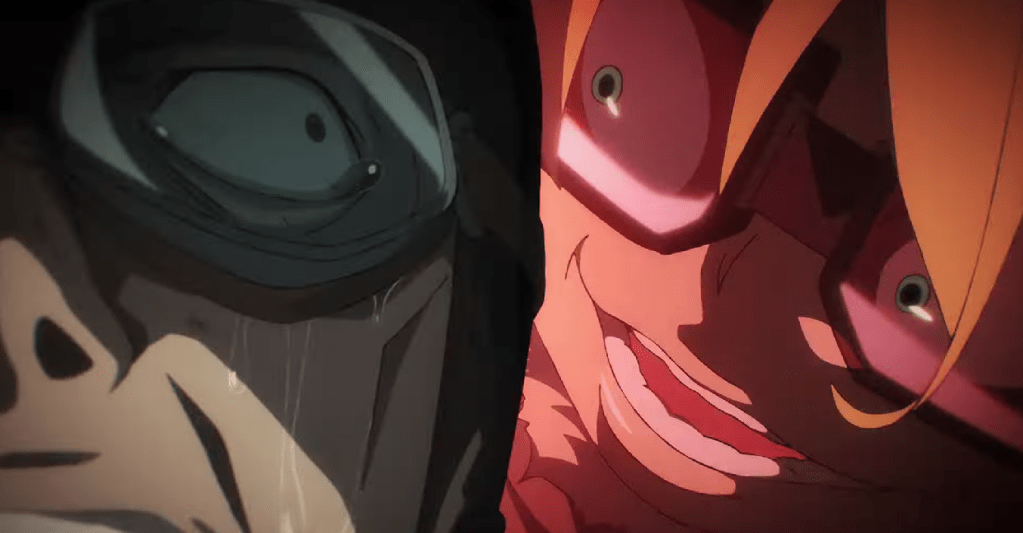
I hope Tanya eventually strikes the same fear into Loria that she does to this pilot in the trailer.
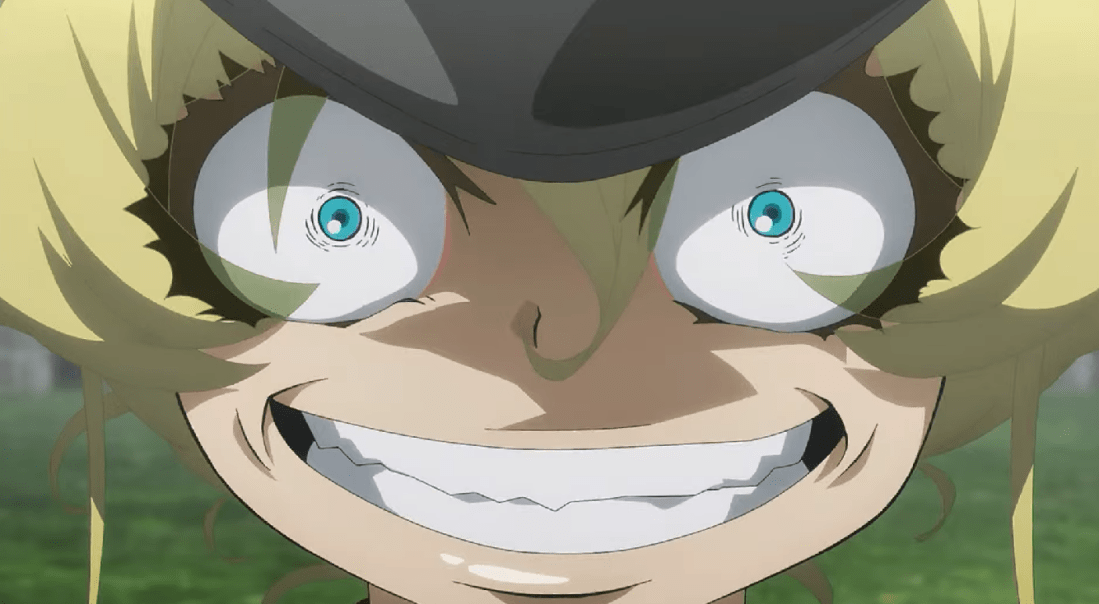
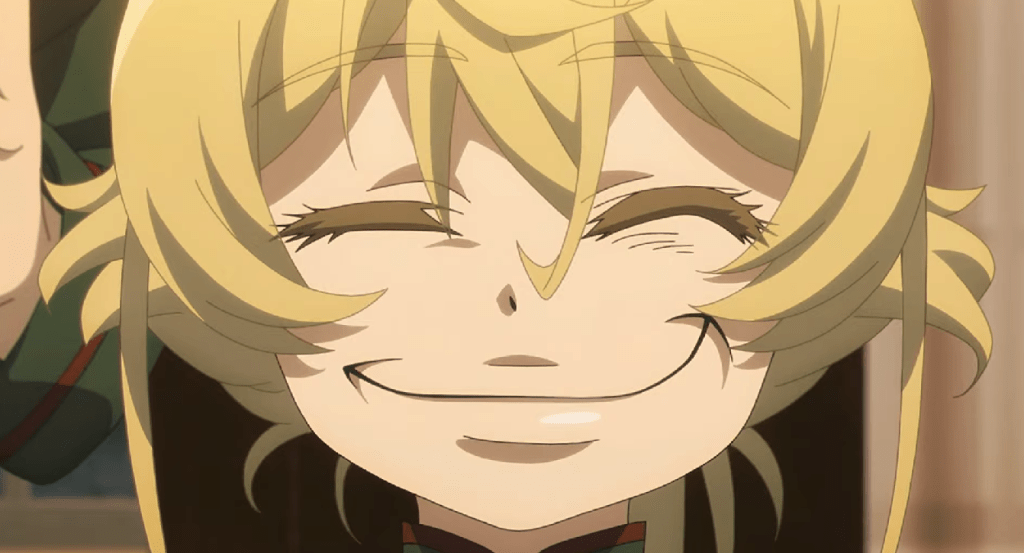
But the highlight of the trailer is Tanya’s crazed expressions. We see these insane smiles while she fights and tells her troops to prepare for war. It will never not be funny to see hardened soldiers terrified by a little girl who they constantly misunderstand. Case and point, the final shots of the trailer are everyone looking horrified as Tanya puts on her little girl voice and smiles sweetly. To be fair, the last time Tanya used this voice was to trick her enemies into thinking an attack was not coming in a way that would avoid war crime charges.
Knowing that, Tanya’s soldiers being afraid of this face is completley understandable.
It will be both interesting and terrifying to see how Tanya schemes her way out of such charges in the new season, now revealed to be airing in July. I will be watching day one, and plan to review each episode weekly. Hopefully Season Two can live up to the first and, if we do get a third season, we will not have to wait as long.
There was a rather strange disconnect between English speaking and Japanese viewers in regard to their opinions on the first season of Chainsaw Man. Many English speakers, myself included, loved the first season, especially with how it paid homage to various aspects of film, which the mangaka Tatsuki Fujimoto is a big fan of. However, the Japanese viewers’ reactions were mostly the complete opposite. There was a lot of hate directed towards the first season, due to the style being seen as different from the manga, and a few other reasons I do not quite understand. Therefore, for the movie continuing Chainsaw Man’s story, it was decided a different director would take on the job with a different animation style. To be honest, I was a bit concerned with what I would think about the new art style, since I really liked the old one. Today, I got the chance to sit down in a theatre and watch Chainsaw Man – The Movie: Reze Arc and see this change for myself.
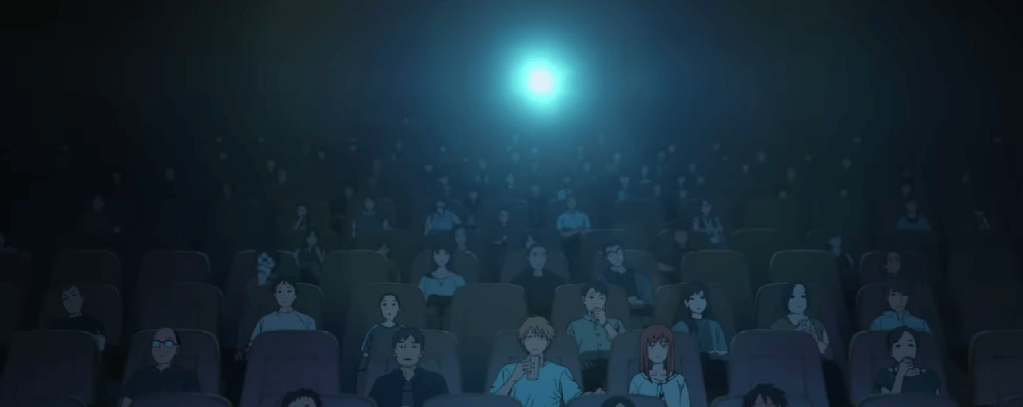
Kind of fitting that the arc chosen for a film has a scene where Denji and Makima go to see multiple movies.
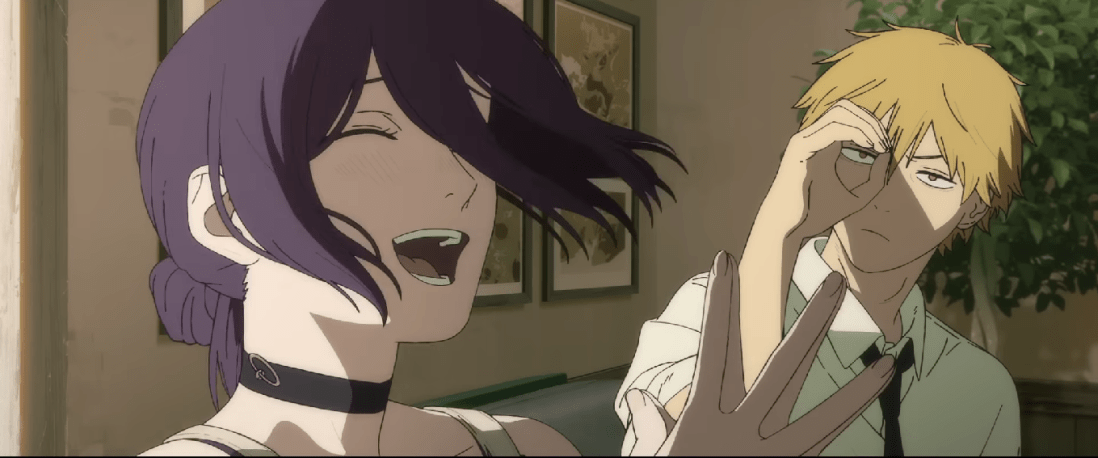
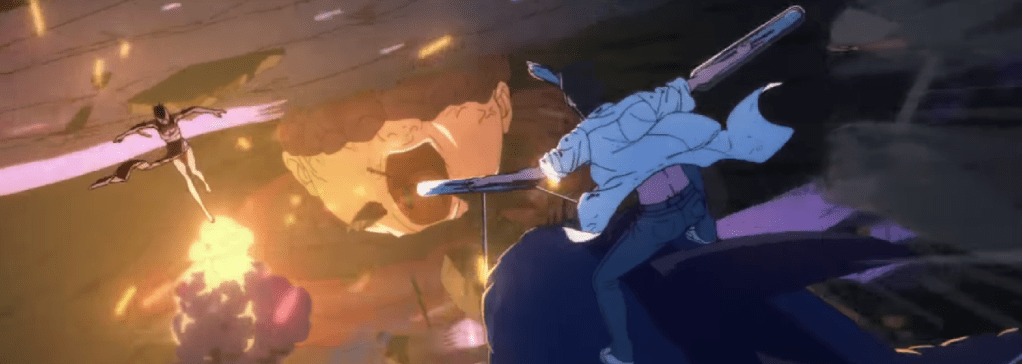
You can imagine my relief when I absolutely loved the new style and actually think it is better than Season One’s. That is not to sell the old art style short, but the new one has so many unique moments, with many shots looking like a manga panel brought to life. Along with this, the animation quality is incredible. Whether the scene was a slow, thoughtful one, a comedic one, or an action extravaganza, I am sure you could pause the movie at any point and end up with a great shot.
See?
Likewise, the music and sound design are top notch, with the sound of explosions being particularly gripping to hear in the theatre. And then there is the voice acting. Everyone from the First Season does a great job, as expected. Kikunosuke Toya brings the perfect mixture of emotion and comedy to his portrayal of Denji. Tomori Kusunoki makes Makima sound creepy as ever. Then there is the new voice on the block for Chainsaw Man, Reina Ueda as Reze. Talk about perfect casting for the character. Because of her and Toya’s performance, Reze and Denji have great romantic chemistry, making the events that play out later in the film both tragic and epic to witness.
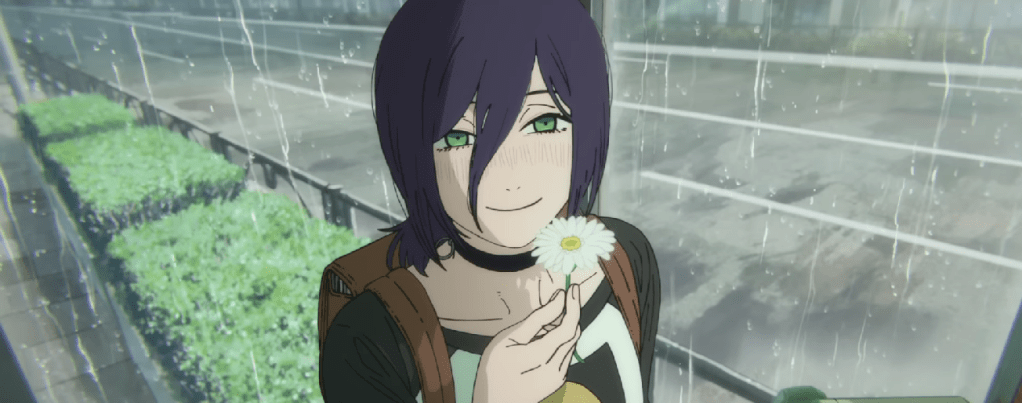
It was a joy to see Reze finally animated.
All in all, The Reze Arc is a fantastic adaptation of the storyline from the manga. The portrayal of its two leads is excellent, and the animation style, its quality, the music and sound design are all peak. I am honestly so glad that they chose to adapt the Reze Arc as a film instead of in an episodic format. Watching Chainsaw Man on the big screen really reminded me of my love for Part One of the story. I cannot wait to see the rest of this adaptation, whether that be with more movies, or another season. Unfortunately, we will probably have to wait years to find out which format it will be. Oh, well, at least Chainsaw Man is still going strong with Part Two, so us fans of Tatsuki Fujimoto’s work are not starved for content.
Spice and Wolf was one of those anime I heard a lot about, but never really got around to checking out. So, when I learned there would be a reboot, Spice and Wolf: Merchant Meets the Wise Wolf, I figured watching it would be the best way to introduce myself to the story. And I am very glad it was my introduction.
The reboot is a great way for new viewers to first experience Spice and Wolf.
Based off the light novel of the same name by Isuna Hasekura, Spice and Wolf begins with Kraft Lawrence, a travelling merchant who encounters a wolf deity named Holo. Taking the form of a young woman, Holo makes an agreement with Lawrence. As the two travel together, Holo’s knowledge helps Lawrence grow his profits, while he helps her find information about her mysterious hometown, which she wishes to return to. Over the course of their 25-episode journey, Lawrence and Holo grow closer, often bickering like an old married couple.
Watching these two characters together is never boring.
Their chemistry is sold both through the solid animation and the excellent work done by their voice actors, Jun Fukuyama and Ami Koshimizu. The latter in particular does an excellent job, with Koshimizu bringing Holo’s charming cheekiness to life. Lawrence and Holo play off each other so well that I would say the weakest part of the show is the arc where they are separated and we have to spend a long time with Lawrence alone.
The story is definitely better with Lawrence and Holo together rather than apart.
This is only one arc, however, and the payoff to it is pretty good. Speaking of, charming moments between Lawrence and Holo are not the only payoff we get because Spice and Wolf also does an excellent job of making the economic elements of Lawrence’s trade interesting. It was always interesting to see how he and Holo would work around their monetary and debt issues with corrupt officials, which constantly plagued them throughout the season.
A lesser show would have struggled to make the merchant aspects interesting, but this is half the fun of Spice and Wolf; the other half of course being the relationship between Lawrence and Holo.
What also helped is that the characters the two meet on their journey are likeable, or at least understandable in their motivations. The real focus is on Holo and Lawrence though, as it should be. Watching their bond grow, along with their clear romantic feelings for one another, made for a fun watch. It is clear that many others agree because, immediately after the finale aired, a Season Two was announced.
I look forward to seeing more of Lawrence and Holo’s adventure in the future.
If Season Two is anything like the first, it will be more than worth the watch. Spice and Wolf: Merchant Meets the Wise Wolf has a fantastic dynamic between its two romantic leads and does a great job of explaining and making its economic nature entertaining. If, like me, you had not experienced this story before, I would recommend this series as a great way to introduce yourself.
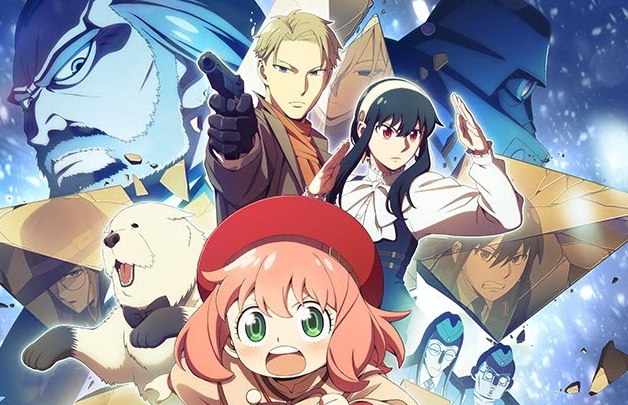
Tatsuya Endo’s Spy x Family is one of the manga industry’s most recent successes. I have enjoyed both reading it and watching the anime over the years, even if I never did get around to reviewing the second season. Well, with the show’s success, it was only a matter of time before it got an anime original movie. Code: White is the first of potentially many such movies. Having recently released on Crunchyroll, I decided to give it a shot and, as expected, had a lot of fun.
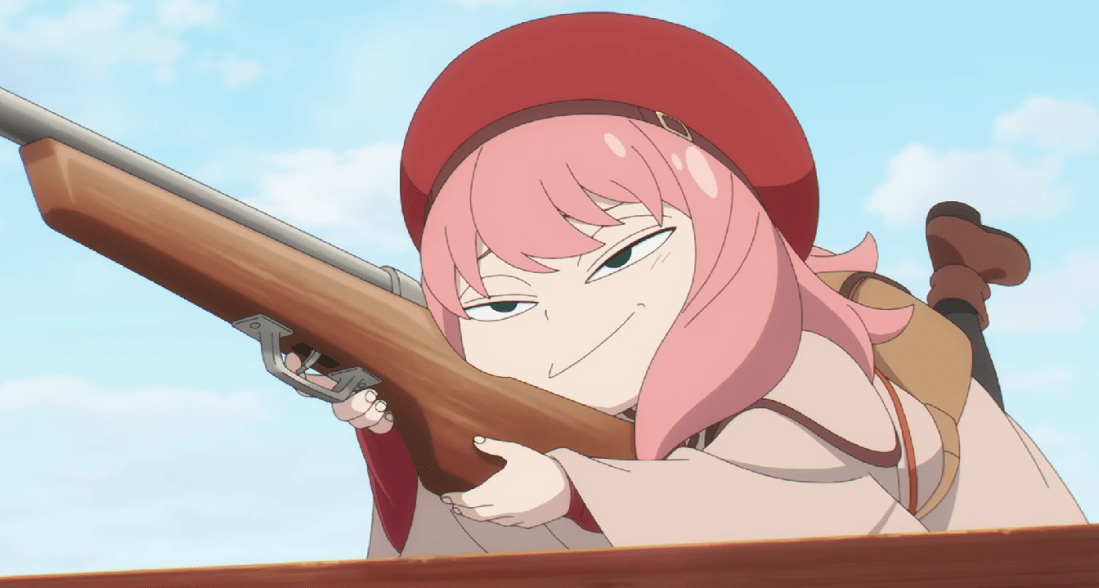
Like My Hero Academia, Spy x Family could be getting a lot of anime original movies in the future.
To recap, Spy x Family is set in a cold war between two rival nations, Ostania and Westalis. Top Westalis spy Twilight (Takuya Eguchi) has to forge a fake family in the hopes of getting close to a man who could bring both countries back to the brink of war. Taking on the persona of Loid Forger, Twilight adopts a little girl named Anya (Atsumi Tanezaki), gets into a marriage of convenience with a woman named Yor (Saori Hayami), and adopts a dog named Bond (Kenichiro Matsuda). However, everyone in this family has a secret, not just Loid. Yor is an expert assassin named the Thorn Princess, Anya is a telepath, and Bond can see the future. The only member of the family who has any knowledge of this is Anya, due to her telepathy, resulting in many hilarious moments in the series where she tries to help her adoptive family while keeping up appearances.
Each of the Forgers have their own advantages, which is always hilarious to see Anya play off of.
This is the setting Code: White emerges from, as Twilight takes the Forgers on a trip to a place called Frigis, where he hopes to find a dessert to give Anya an advantage in a cooking competition, which will also hopefully help his own mission. But, of course, this simple vacation takes a turn when Anya accidentally eats a chocolate containing a microfilm, which in the wrong hands could start the war again. Code: White’s story is a pretty standard Spy x Family experience, and is used as a vehicle to bring the audience great animation, fun action and wholesome moments. The latter takes up at least half the movie, with a large amount of focus being centered on the fun the Forgers get up to before the action takes center stage. This is most apparent with Yor, whose storyline centers around her concern that Loid has a mistress, leading to lots of great humor.
Yor can go from sweet and loving wife and mother to dangerous assassin at the mere hint of danger.
The comedy also continues into the action portion of the movie, with Anya’s being particularly funny, while Loid and Yor get all the cool fight scenes. All three of their storylines get fantastic animation, creating an especially fun third act. The only issue I had with with this is the logic issues. I know Loid and Yor are pretty dense when it comes to recognizing one another’s true identities, but the plausibility that they would not be at least a little suspicious of each other in this movie is stretched a little.
The extent of Loid and Yor’s awareness of each other was a little too oblivious in this film.
Still, this is only a minor problem, in a good filler movie. Throw in a few cameos from Frankie, Yuri, Fiona and other characters, and you pretty much have a Spy x Family episode, only extended to movie length. Code: White is a fun experience with a lot of good humor and action, along with excellent animation in the third act. I hope we get more of these.
The anime community has been blessed with some fantastic anime as of late, two of which being particular standouts. The first of which is Frieren: Beyond Journey’s End, the greatest anime adaption of all time, in my opinion. The second of these is The Apothecary Diaries, an amazing anime in its own right. Based off the light novel by Natsu Hyūga, the story is set in a country resembling Imperial China. Our main character is Maomao (Aoi Yuki), an apothecary who is kidnapped to sell as a servant for the Imperial Palace. Recognizing an illness that is affecting the concubines and children of the Emperor, Maomao anonymously writes a letter to stop the unintentional poisonings.
Maomao is relatable for the beginning. She does not want to get involved in court politics but steps in when her morals and interests compel her.
This catches the attention of the important eunuch Jinshi (Takahiro Sakurai), who sets about using Maomao to solve other mysterious poisonings and illnesses within the palace. And so, the story follows the friendships and rivalries Maomao forms as she investigates case after case, while she and Jinshi grow closer. Maomao, herself, is an excellent character, as her obsession with poisons often drives her to humorous, cat-like behavior. However, this behavior can often flip to being more like a tiger, as Maomao’s anger is pretty fearsome to behold. Just ask Jinshi.
I would not have blamed Jinshi for having a heart attack when Maomao glared at him like this.
Speaking of the supposed eunuch, he is also a great character with a lot of mystery to him. He has great chemistry with Maomao as well, often finding himself exasperated by her antics. The cases these two end up investigating creates what feels like a Sherlock Holmes and Dr Watson dynamic, only with a more humorous spin on the relationship. Like Sherlock Holmes though, the story often gets dark, with many working behind the shadows in the Imperial Palace. This leads to explorations of many shady characters, like Lakan (Takuya Kirimoto), the spy master with an interest in Maomao.
Lakan is suspicious and intimidating right from the start.
The ending revelations about these mysterious characters and the events around them are always satisfying, with some of these mysteries even being currently unsolved, leading into Season Two, which has thankfully been confirmed. I look forward to seeing the resolution to these mysteries, just as much as I look forward to seeing Maomao and Jinshi’s relationship progress, alongside the inevitable comedy that will result from this. The Apothecary Diaries is an excellent anime, which will often have you laughing at its characters’ antics, while also being intrigued by the many questions the show raises.
I have been keeping up with Frieren: Beyond Journey’s End ever since I first read the manga back in 2021. Written by Kanehito Yamada, the manga has a unique spin on the fantasy genre. Rather than follow the heroes Himmel (Nobuhiko Okamoto), Frieren (Atsumi Tanezaki), Heiter (Hiroki Tochi) and Eisen (Yoji Ueda) on their adventure to defeat the Demon King, the story instead takes place decades later, with Frieren reminiscing on that epic, ten-year journey. This was a journey that passed in the blink of an eye for Frieren, due to her long life as an Elf. By the time she realizes what that time meant, the hero Himmel and the rest of the party are either gone or fading. The current story thus follows Frieren, as she embarks on a new journey with Heiter’s adopted daughter Fern (Kana Ichinose), and Eizen’s apprentice Stark (Chiaki Kobayashi), while reflecting on her old adventure. It is a moving story that I was quite excited to see animated by Madhouse.
Past events take new meaning for Frieren on her current adventure.
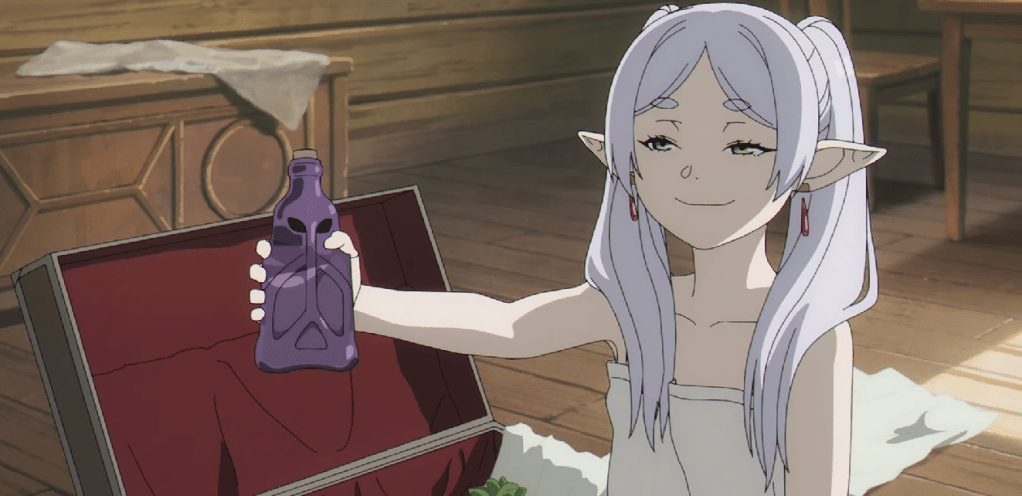
Directed by Keiichiro Saito, the studio clearly had a lot of faith in Frieren: Beyond Journey’s End because, not only did they greenlight 28 episodes, but they also aired four of the first episodes together. Seeing this faith in the project made me excited for the adaptation but nothing could have prepared me for how masterful it was. I would go as far to say that Frieren: Beyond Journey’s End is the greatest anime adaptation for a manga of all time. This is a bold claim but I feel that it is more than warranted with just how much the anime elivates the source material. So many battles in the manga take place in single panels, yet the anime adapts these into fully fledged and meaningful fights, with stunning animation that never falters. The incredible animation even applies to character building scenes, with a moment as simple as Frieren jumping out of a bed being unbelievably detailed.
The humor of this scene was enhanced by the animation.
The emotion of the anime also just hits deeper, with the soundtrack by Evan Call working with the animation to bring the viewer into the scene, whether that be a fight scene or a character growth one. Staying on tune with the sound of the anime, the voice acting is also superb, with the actors ironically bringing a lot of life to the often-monotone voices of the characters. This monotone style of speaking creates a lot of humorous situations, as do the few moments when characters break out into explosions of expression, as mostly seen with Stark.
Stark reacting to Fern being angry at him will never not be funny.
I have been heaping praise upon praise for this anime adaptation but now comes the time in the review where I have to state my criticisms… or I would, if I had any. Seriously, this adaptation is so good it even removed some of my criticisms of the manga. In my review for the manga, I said that it felt like some storylines overstayed their welcome, yet the flawless nature of this adaptation made the scenes flow so well together. Seeing the quality of this adaptation made me extremely excited to see future arcs in the story adapted.
Epic scenes like this one make me even more excited for Season Two.
If the anime can keep up this level of quality for future seasons, then Frieren: Beyond Journey’s End could stand among the best anime of all time. I would even argue this first season is one of the best in all of anime. Frieren: Beyond Journey’s End is now the gold standard of anime adaptations, for me. I would say goodbye to it, until hopefully Season Two, but it would be embarrassing when we meet again.
Attack on Titan has taken us all on quite the journey. Over the span of ten years, and with four seasons, Wit Studio and Mappa have animated Hajime Isayama’s story brilliantly. Now, it’s over. Going into the final episode of Attack on Titan, I was curious to see how I would feel about the ending compared to the manga. When I first read the final chapter, I honestly went back and forth on whether I liked it or not. Then, I sat down and read through it while thinking about what Isayama was trying to say, and I came to the conclusion that the ending was a mixed bag, with plenty of good and bad things about it. It was for this reason that I was hoping the updated ending, which released months later, would fix some of my problems. Unfortunately, the opposite happened, with the extra pages pushing my opinion on that final chapter into a negative direction. I have re-read the series a couple times since then and, while I still love it, my opinion of the ending has only become worse with each read through. All of this made me hope that there would be some changes to the anime’s ending. I knew we would not be getting an anime original ending, but I had my fingers crossed that there would be extra scenes or dialogue to explain some things better. After all, Mappa added an extra scene showing what happened to Grisha’s parents in the previous special episode, which I unfortunately did not get around to reviewing. Seeing that added scene gave me some hope that there would be new additions to the conclusion.
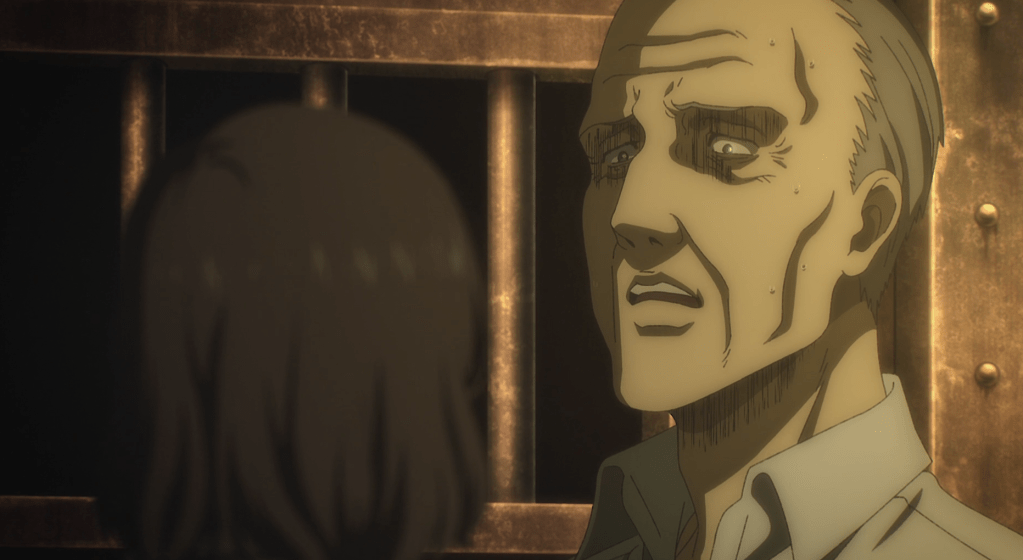
I was glad to see the fate of Eren’s grandparents confirmed in the anime, even if it was tragic.
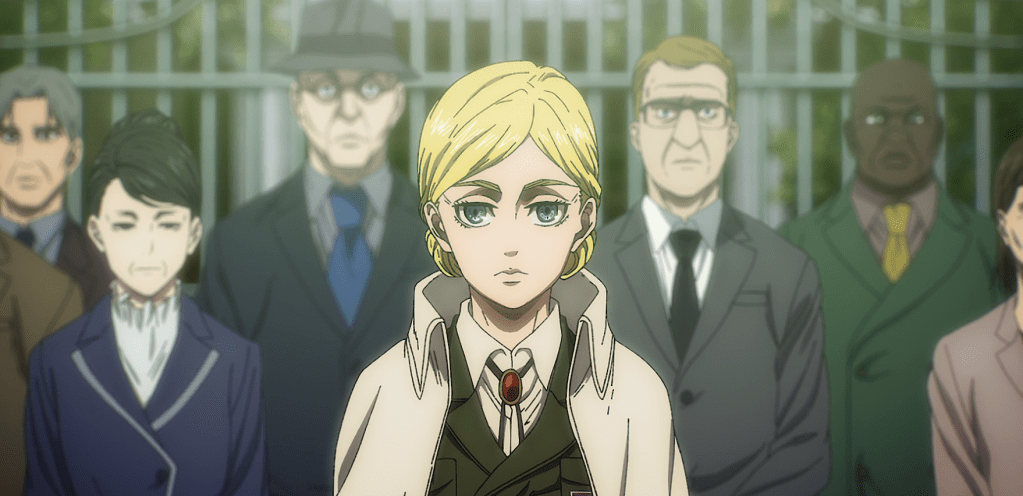
So, having now seen the final episode of Attack on Titan, do I think the anime improved on the manga’s ending? Yes! Do I like it now? Not exactly, no. In my opinion, the ending still has a lot of problems. However, most of these big issues only appear in the last half hour. The rest of the final episode is mostly great, with incredible animation from Mappa and a fantastic score. This is going to be my largest review by a wide margin, so buckle up. The episode begins where the previous special episode left off, with the Alliance landing on Eren’s gigantic Titan to confront him and stop the Rumbling. Armin quickly realizes he has to transform into the Colossal Titan to try and locate Eren and Zeke but, before he can, he is kidnapped by an okapi Titan created by Ymir. The panels of the okapi sticking its tongue down Armin’s throat to prevent him transforming were already disgusting in the manga, but it’s a million times grosser here. As the okapi takes Armin away, the rest of the Alliance are surrounded by countless Titans, whom Pieck correctly speculates are copies of all the previous Titan Shifters. Back when this happened in the manga, I criticized it for feeling out of nowhere, but in retrospect I think this was actually a pretty cool writing decision on Isayama’s part. Realizing the danger they now face, Pieck goes to kill Eren quickly by attempting to detonate the explosives at his head, but she is stopped by a copy of the Warhammer Titan. Following this, the Alliance are attacked by the copies, including ones of Porco, Marcel and Bertolt, in a thrilling action scene, expertly animated by Mappa. This ends with everyone in the Alliance cornered, about to be killed, when who should show up to save the day but Annie, riding Falco’s flying Titan with Gabi.
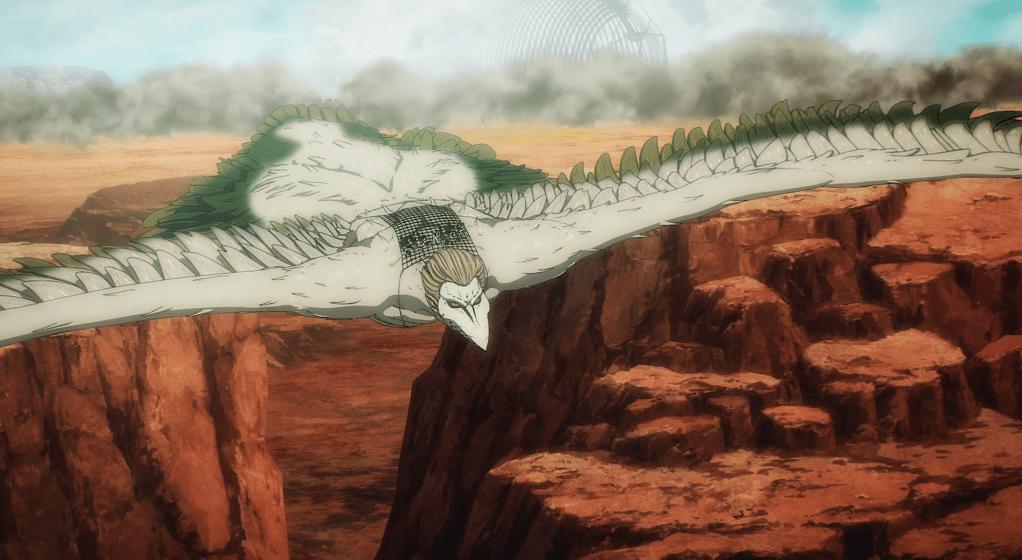
It was cool to see Falco flying after the previous episode foreshaodwed it.
Now safe on Falco’s back, the Alliance discusses their next move, and all regretfully agree that their only option is to kill Eren, much to Mikasa’s horror. Circling back to Eren, the Alliance splits up, with Jean and Reiner going to detonate the explosives Pieck wrapped around Eren’s neck; Mikasa, Annie and Connie going to rescue Armin; and Falco, Levi and Gabi continuing to fly above. More amazing animation follows, with the best parts of this section being Pieck’s jet-pack Titan skills, and Mikasa and Annie humorously arguing over which Titan it was that took Armin. This second match goes about as well as first, however, with the Alliance on the ropes again. Armin is watching all of this happen and, standing over his own unconscious body, screams at himself about how useless he often feels. This is probably my favourite voice acting from the final episode, with Marina Inoue giving a fantastic and emotional performance. Although, despite how emotional this scene is, it has nothing on the cliff scene that follows. When I watched the previous special episode, I was disappointed to see this moment was not adapted, and I was desperately hoping that it would be in the final episode. Well, I was not disappointed because this scene is next and it is even more powerful that I imagined it being. The scene shows a group of thousands of people trapped between two kinds of certain death. They can either be crushed by the Rumbling, or they can fall off a cliff to their deaths. As the Rumbling closes in, people are eventually forced off the cliff, one of these people being a mother. With one last, courageous act, the mother passes off her baby before she falls to her death. As the next person holding the baby falls, they also pass the baby on, and on, and on, and on. Countless people all facing their inevitable deaths pass this baby on in what they know will most likely be a futile attempt to save its life. It is one of the most beautiful and horrifying moments in the entire series, and seeing it in the anime made me tear up. The visuals for this scene only add to the emotion, with everything being in black and white with the exception of the mother and her baby. I am almost certain that the way this scene was animated was inspired by the little girl in the red coat from Schindler’s List. This scene is, without a doubt, my favourite in the entire episode.
This is one of the most powerfully emotional scenes in Attack on Titan.
Back with Armin, after some perseverance, he realizes he is in the Paths Dimension and this leads to his meeting with Zeke, who has been trapped ever since Ymir chose to support Eren over him. Zeke has completely lost all motivation to keep going, now believing life to be more pointless than he already did. Armin, however, speaks against this, remembering a time when he, Eren and Mikasa ran to a tree on a hill, comparing it all the wonderful little moments in his life which made it worth living. As a leaf Armin picks from the sand turns into a baseball before Zeke’s eyes, the Beast Titan remembers playing catch with Mr Ksaver and how this was also one of those little moments which made life worth living. This somehow motivates the ghosts of past Titan Shifters to appear and help the two. Armin says this was Zeke’s doing but how Zeke achieved this is never really explained. Unfortunately, there are quite a few things in this final battle which are never explained but I will get to those in a bit. In any case, the past Titans, who knew the Alliance, come back from the dead temporarily to help stop the Rumbling. Among these Titans are Grisha and Kruger, and some fans have questioned their reasons for doing so. For Kruger, I think it makes sense. Yes, he would want to free the Eldians of Paradis, but a full Rumbling would also kill all of the Eldians outside Paradis, which he would be against since he wanted to free them too. As for Grisha, I still find myself confused about his motives. Yes, he did tell Zeke to stop Eren but Zeke later says that Eren showed Grisha something which made him hand over his Titan powers. We never see what this was, and the reason for Grisha giving Eren the Attack and Founding Titans and then later helping the Alliance are a mystery. I just wish there was more of an explanation for Grisha’s actions. As for his son, Zeke decides that, even though he does not believe his euthanization plan was wrong, he would not mind being reborn again. With this fitting decision, Zeke reveals himself to Levi, giving the Scout the chance to cut off his head and stop the Rumbling. While I would have liked it if Zeke had more time to shine in this final episode, his ending is satisfying to me.
It is fitting for Zeke to realize the beauty the world has to offer moments before his death.
Following Zeke’s death, we get another moment which does not make much sense, which is the stopping of the Rumbling. The reasoning for this is that Zeke’s royal blood was key to the Rumbling continuing so killing him stops it, but the only reason royal blood was needed was because Ymir valued it. However, Ymir disobeyed Zeke and sided with Eren so royal blood should not be a factor, anymore. Yet, the Rumbling still stops? Whatever the explanation for this, Armin is freed and Jean blows up the explosives, freeing the source of the Titan powers from Eren’s body, which seeks to reconnect with him. To stop this, Reiner holds the creature down while Armin transforms into the Colossal Titan, blowing Eren’s gigantic Titan form away. In the aftermath of the explosion, the Alliance lands at the fort and the Warriors reunite with their families, only for the creature to still be alive, and for Eren to transform into a Colossal Titan. The creature then sends Titan smoke up to the fort to transform all the Eldians there so they can help it reach Eren. And so, Mikasa, Levi, and the rest of the immune Alliance go to fight Eren, leaving Jean and Connie to their fates. If this had been Jean and Connie’s final scene then it would have been a pretty tragic one, as would Annie reuniting with her father only for him to be immediately transformed. This transformation also crushes a lot of the rapport Mr Leonhart was building with Secretary Muller, which could have had a lot of hope for the future. As Reiner, Annie and Pieck hold the creature back from reaching Eren, Armin fights his old friend off, while Mikasa and Levi rush to them. While they are doing so, Mikasa experiences another headache and seemingly remembers an alternate version of the future Eren showed her, where they ran away together. Honestly, I do not believe Eren would have run away. Sure, I think some part of him may have desired to, but he has always been the kind of guy to stand and fight so I don’t think him running away with Mikasa would have happened, even if she had offered. Still, the scene is pretty emotional, with Eren using this as his goodbye to Mikasa. After this goodbye, Mikasa somehow knows Eren is in the mouth of his Colossal Titan, which is something else I wish was explained but is not. Levi blows a hole through Eren’s mouth and Mikasa leaps through to decapitate Eren and finally end the nightmare of the Rumbling once and for all. Eren’s death is very emotional but I wish the following kiss with Mikasa had occurred in the alternate version of the future he showed her, and not when Eren is dead.
Seriously, the shot of Mikasa kissing Eren’s decapitated head is pretty uncomfortable.
Also, Mikasa remembering the alternate realtiy Eren showed her raises yet another plot hole. In the manga, I was fine with this moment because I thought Eren was showing it to her in the present, but the anime seems to confirm that Eren showed her this alternate future and then erased her memory of it. This should be impossible because Ackermans are immune to Titan powers. As I have shown, there are quite a few plot holes with Attack on Titan’s final battle. However, despite this, I would still say that the final episode has, up until this point, been very good. The animation, soundtrack and action have all been spectacular, and there have been some emotionally powerful moments, most obvious of which is the baby scene. Unfortunately, the episode then gets into adapting Chapter 139 and this is where I think the writing goes downhill. This is mostly because I believe the following scene is the worst in all of Attack on Titan. The scene is a flashback, revealing that Eren brought Armin into the Paths when he was on the boat. The reason I consider this scene to be the worst is because it is full of so many last minute plot twists that are either poorly foreshadowed, problematically written, or recontextualize prior amazing scenes to make them worse. The first of these twists is the reveal of Eren’s motivations. Eren reveals that his plan this entire time was to commit the Rumbling so that the Alliance would kill him and become heroes to the world, allowing them to potentially save Paradis. Was there foreshadowing for this? Yes and no. On the one hand, if you look at Eren’s actions from the previous special episode onwards, it makes sense. Eren allowed the Alliance to come and fight him, rather than stripping them of their Titan powers, and there were multiple points in the final battle where the only explanation for why none of the Alliance died is that Eren deliberately let them live. However, before the first special episode, there are many moments that seemingly contradict Eren’s supposed motives. The most notable of these is at the end of Episode 87, where Eren states in his own inner monlogue that he will “wipe out every last one of ‘em.” Along with these seemingly conflicting motives, Eren’s plan is just too similar to Lelouch from Code Geass for me. In regards to Eren himself, personally, I think it would have been better if his main goal had been a full Rumbling all along. I am not saying that Eren winning should have been the ending. I do believe that the Alliance stopping him was the right call for the story. But I think Eren would have been a much more compelling character if he had stayed true to what we all thought was his original plan. Still, at least this twist had some foreshadowing, which is more than I can say for the next few ones. Following the reveal of Eren’s motives, the next big twist is that the reason Ymir did all of this is because she was in love with her abuser. I hate this reveal. When I read it in the manga, it took what used to be my favourite chapter, Ymir’s backstory, and threw it far away from my top ten chapters. Ymir loving Fritz makes absolutely zero sense. He killed her parents, cut out her tongue, raped her, used her as a weapon in war and then, when she died, fed her corpse to their children. And you are telling me Ymir loved this monster? If we saw Fritz pretending to be kind to Ymir to manipulate her, maybe I could believe it, but we don’t seeing anything like that. He is just completely horrible to her for all of their time together. It really ruins a lot of scenes from Ymir’s backstory for me, like the moment when Fritz says he will “reward” Ymir with his “seed,” while she looks absolutely miserable. This moment made me feel so sorry for Ymir when I first read it, but now I just feel dirty watching it because it makes me wonder if Isayama is trying to say she was secretly happy about it.
The reveal of Ymir’s love for the king is probably my most hated of the twists because of how it pretty much ruined my appreciation for Chapter 122.
In my opinion, there was another, perfectly good explanation which should have been used to explain why Ymir stayed in the Paths for 2,000 years. She loved her children. We see this later on in the episode when she imagines living on with them. This should have been the explanation for Ymir’s actions, not this extremely problematic love for her abuser, which was probably only a twist to justify Mikasa’s abrupt connection with her. This brings me to the next bad twist, which is that Ymir was waiting for Mikasa the entire time. With the exception of Ymir smiling at Mikasa kissing Eren’s decapitated head, there was zero foreshadowing for this. Not only is there no foreshadowing, but we also get no explanation. What we get instead is Eren saying “only Ymir knows” which is a complete cop-out. This was the anime’s chance to give us an answer for something which was missing in the manga and they blew it. Not to mention that mirroring Eren and Mikasa’s relationship with Ymir and King Fritz’s abusive one is very problematic, since Eren and Mikasa are supposed to be the main ship here. The final terrible twist in this scene is the reveal that Eren caused his mother’s death by making Dina walk past Bertolt. There are so many things wrong with this twist. For starters, it’s a retcon. We already had an explanation for why Dina killed Carla. Dina’s final words to Grisha before she was transformed into a Titan were, “No matter what form I take, I promise I’ll come find you.” So, when we saw Dina walk past Bertolt, we were not wondering why she did so because we already knew. Dina sensed Grisha in Shiganshina, went to his house, only to find Carla, and that is when her Titan instincts took over and she ate her. It was a perfect explanation, and to change the meaning of it removes all emotional impact from Dina’s final words, all for the sake of a such a short twist. This leads into my second big issue with the reveal, which is how brief it is. Out of curiosity, I timed how long this twist is focused on before it is forgotten about forever. Do you want to know how long it was? Fourteen seconds. Fourteen seconds spent on a twist which recontextualizes the entire beginning of the story and, as a result, it makes absolutely no sense. Has Eren manipulated the past before? Yes, but there was a very specific set of circumstances which allowed that to happen. Zeke brought Eren into Grisha’s memories using the Founding Titan. Both Eren and Grisha had the Attack Titan, whose ability is to see into the memories of its future successors. This allowed Grisha to see Eren’s memories of visiting his own. And so the two could communicate across timelines through memories. There was no actual physical time travel. Dina did not have the Attack Titan, she was just a regular Titan, so Eren should not be able to order her through memories. Therefore, in order to control her, Eren would have had to physically gone into the past and used the Founding Titan to command her to walk past Bertolt, which is a power that has never been established. Thus, the twist should be impossible, providing probably the biggest plot hole with the ending.
The reveal of Eren causing his mother’s death was just really unnecessary. If you remove it nothing else changes.
So, as I have shown, this scene has a lot of bad twists, but it’s not just the twists that I take issue with because, up next, is without a doubt the most memed scene in Attack on Titan. After Armin punches Eren for how he treated Mikasa and jokes about her finding another man, Eren cries about it, saying he wants her to pine only after him for at least ten years. I knew this scene was coming, and I still cringed into the back of my seat when I watched it. I think a big part of the reason this moment does not land with me is because of how Eren and Mikasa’s relationship has been handled. Sure, there have been a few romantic moments between them. Their final scene togethor in this episode, Eren saying he would wrap Mikasa’s scarf around her at the end of Season Two, and Eren asking Mikasa what he was to her while they were in Marley. However, these three moments are the only times Eren ever showed romantic interest in Mikasa. Otherwise, he’s either treating her like family or treating her badly. Isayama once said in an interview that he wanted to have them kiss in Chapter 50 but he backed out because he was shy to draw it. Well, I think he should have just bit the bullet and drawn it. Have Eren and Mikasa be a couple up until the end of Season Three, then have Eren go off on his own in Season Four, pushing Mikasa away, and then reveal it was to protect her in the final episode. It would have made Eren say how he really feels about Mikasa a lot less jarring. What also would have helped is a change in dialogue because, to be honest, I just do not think I can take lines like this seriously. Another thing I could not take seriously was what happened after Eren’s outburst in the manga. Back in the original Chapter 139, one of the last things Armin said to Eren was, “Thank you. You became a mass murderer for our sake. I promise I won’t let this terrible mistake you’re making be in vain.” This is, without question, one of the most problematic lines in Attack on Titan, since it makes it seem like Armin is condoning Eren’s genocide. I know this is not what Isayama intended but it is what it comes across as, which is why I was overjoyed to find that this scene has been rewritten entirely by Isayama for the anime. Now, Armin actually accepts his role in the Rumbling through how he showed Eren his book, telling his friend that when they die they will both be in hell togethor. It both managed to be moving and did not skirt around the horror of Eren’s actions, like the manga did. So, despite this being the worst scene in Attack on Titan for me, I think it actually ends pretty well in the anime.
No matter your opinion on the ending, I think we can all agree that this line being removed was for the best.
Back in the present, Armin wakes up, remembering everything and learning of Eren’s death. It is following this that we get my second favourite moment of the episode, which is Levi’s final salute. He sees the ghosts of his former comrades and salutes them, a tear sliding down his cheek. Out of all the characters’ endings, this is probably my favourite. Levi is the last man standing of the old guard, living on to carry on the memory and sacrifices of his comrades. More moving moments follow as Jean and Connie see Sasha’s ghost, and Reiner reconciles with his mother. These happy moments do not last long, however, because, as Mikasa begins her journey back to Paradis to bury Eren’s remains, Muller arrives to hold the Eldians at gunpoint, now scared of them again thanks to their prior transformation. It is in this moment that Armin steps up in his role as humanity’s saviour, proclaiming that the Titan powers have vanished and that he is the man who killed Eren Jeager. As for Mikasa, while she is making her way back, she is confronted by the ghost of Ymir, and realizes that she is the one who has been causing her headaches. To me, this is another blotch on Ymir’s character. Not only was there no foreshadowing for Ymir causing Mikasa’s headaches, but it also makes her look bad because if she knew Mikasa would free her eventually then there was no need to subject the world to such hardship. With that, the story then skips to three years in the future, where we see Historia narrating what is happening on Paradis Island in a letter to the Alliance. We see that Historia has married the farmer and had their child, a girl that I personally like to think she named after Freckled Ymir. It is also revealed that Paradis’ army is led by the Jaegerists. Over time, this was something I extremely disliked in the manga because it made Eren look like an idiot. He trusts his friends to convince the rest of the world to make peace with Paradis and yet he left literal facists in charge of the island. However, the anime makes a point to note that Eren was an idiot with too much power so I can let it slide. What I cannot let slide is Historia’s treatment as a character. She had so much potential in the final arc, and I hate how she was paired off with a nobody and then sidelined with a pregancy subplot which amounted to nothing. In my opinion, the writing for Historia’s character post time skip spat in the face of her character development in the Uprising Arc. Think about this, not only does Historia have less screen time than the Warriors’ families in the final arc, but she also has no scenes in the present timeline. All of her scenes are flashbacks. That is how little she mattered in the end. I hated Historia’s role in the final arc back when I first read it, and I am pretty sure I will hate it forever.
Historia deserved so much better than the horrible role she was given in the Final Season.
As for the letter Historia wrote to the Alliance, Reiner is clearly enjoying it, since he sniffs it like a creep. Reiner liking Historia is not unusal for him, but did the final scene of a character who has had an emotionally powerful struggle with PTSD really need to be a joke? Still, I am glad that he lived, along with the rest of the Alliance, who are now going to Paradis as peace envoys, fulfilling the role Eren gave them. We then get what was, originally, the final scene of Attack on Titan, until the extra pages. Mikasa is resting at Eren’s grave on Paradis, at the tree where the story started. Her presence on Paradis is a bit confusing to me, I will admit. I mean, the Jeagerists know Mikasa killed a lot of them, right? Plus, Mikasa is the only Asian person living on Paradis so she would be pretty recognizable. Wouldn’t she be in constant danger? Well, Mikasa clearly feels safe beneath the tree, where she weeps for the loss of Eren. It is at that moment when a bird appears from nowhere and wraps Mikasa’s scarf around her before departing. So did Eren reincarnate into a bird, or this is just a random bird doing it for no reason? Whatever the reason, it does look a bit goofy to me. In regards to Mikasa, as someone who once thought she was one of the best characters in the series, I have slowly found myself disillusioned with her. I still like her, but there are so many missed opportunities to develop her. From her Ackerman lineage, to her relationship with Louise, to her connection with Hizuru, these were all chances to give Mikasa character development. Instead, she just constantly focuses on Eren, right to the very end, even bringing her new family with her to his grave as the years pass. Speaking of this, I now have to get into the adaptation of the extra pages, which is another area I feel like the anime improved upon. In the manga, I hated the reveal that Paradis was destroyed because it looked like it was only about 50 years since the Rumbling, making all of the characters sacrifices pretty pointless. However, the anime updated it to so that the destruction of Paradis happens at least hundreds of years later. This makes me feel a bit better about the whole thing. What makes me feel less better is that the anime kept the implication that Titan powers were coming back, by showing a boy and his dog heading towards Eren’s tree, which has now grown to resemble the same tree where Ymir got her powers 2000 years ago. While this does tie into the themes of the cycle of violence continuing, I personally don’t like that it removes the victory of Titan powers vanishing forever. The cycle of violence continuing is fitting for the story, but I wish Titan powers stayed gone at the end.
In my opinion, hinting that the Titan powers will return takes away from the Alliance’s victory.
So, since my final impression of the ending is a negative one, I surely think the final episode of Attack on Titan is bad, right? Well, no. While there are a lot of things I dislike, the first 50 minutes of the episode are really good, plotholes aside, and there are quite a few improvements from the manga. I even teared up twice, once during the baby scene, and a second time during Levi’s salute. And, of course, the animation, score, and voice acting are all incredible. Overall, I would still say that this final episode is good, despite its many, many short comings. And, despite not liking how Attack on Titan ends, I would still recommend the series. The themes, twists and characters are things I will remember fondly for years to come. Also, having seen the reactions for the final episode from many anime only fans, I know my criticisms of the ending are in the minority. The vast majority of fans seem to have loved this ending, and I am happy that they do. So, as fans of Attack on Titan, no matter our thoughts on the ending, I think we all owe a big thank you to Hajime Isayama, Wit Studio and Mappa for bringing us this amazing anime. Truly, thank you.
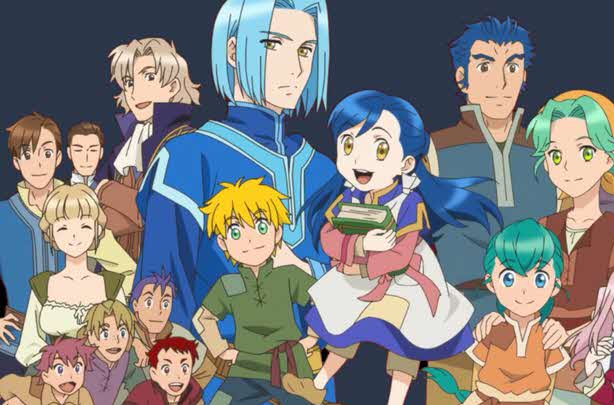
As an avid reader, I found the premise of Ascendance of a Bookworm to be quite interesting. Based off the light novel by Miya Kazuki, the anime follows Urano Motosu, a lover of books who is ironically killed by falling books. She is then isekaied into the body of a young girl named Myne (Yuka Iguchi), only to find she has been reincarnated into a bibliophile’s worst nightmare. Myne is of the peasantry class in her new life and, given that most of the people in her town are illiterate, it makes finding a book next to impossible. Refusing to be dissuaded, Myne sets out to make her own books, surprising her fellow townspeople with her creations brought from her previous life.
Myne’s inventions may be simple in her old life but in the medieval world she now lives in they are revoluntionary.
This premise was such a good one that, after I heard it, I immediately sat down to watch it and was met with a charming anime that has a lot of heart. Myne’s struggles to find a way to read again are relatable, and the cast around her are just as endearing. This is especially the case with Myne’s new family, as her father Gunther (Tsuyoshi Koyama) would probably be high up on a list of great anime dads.
Gunther is a real one.
Myne’s friend Lutz (Mutsumi Tamura) also serves as her constant supporter, while also slowly growing suspicious that Myne is now more than she seems. Other interesting characters like Benno (Takehito Koyasu) and Ferdinand (Shou Hiyami) are also encountered by Myne as her prominence grows in the world. Speaking of that world, it seems to be a simple medieval one at first, yet it slowly expands into a more fantastical one as Myne’s knowledge and desperation to read books lead to her encountering the nobility. This leads to further world building accompanied by solid animation. Granted this animation is nothing spectacular but it never needed to be, as a simple confrontation scene in the Season One finale is quite intense on its own.
Myne’s actions in this episode were surprisingly chilling for what had previously been such a wholesome show.
Along with occasional moments of intensity, Ascendance of a Bookworm is capable of bringing out emotional gut punches when it wants to. This is especially apparent in the Season Three finale where a bittersweet moment between Myne and her family actually had me tearing up.
Season Three’s bittersweet conclusion makes me interested to see where Season Four will pick up.
Myne’s journey across the three seasons we have got so far have been endearing, humorous and emotional. It makes me excited for what will come next in the story, both in terms of Myne and the other characters’ development and in terms of the world building. I hope we get a Season Four soon. I would highly recommend Ascendance of a Bookworm, especially if you are an avid reader like me, as Myne’s struggles will be all the more sympathetic. The anime has a lot of heart.
A few months back, one of the most hyped up anime of the year, Chainsaw Man, began airing. While Chainsaw Man certainly did live up to its massive expectations, what was surprising was that there was another anime airing around the same time that seemed to be getting the same level of buzz, despite not having the amount of hype beforehand. This anime was Bocchi the Rock. Based off the manga by Aki Hamaji, it felt like this show came out of nowhere, becoming one of the most talked about anime of the year. Having heard this discussion, I decided to check it out and discovered a charming and often hilarious story that relates to introverts everywhere.
It was surprising to see just how talked about Bocchi the Rock became, until I watched it.
Bocchi the Rock follows Hitori Goto (Yoshino Aoyama), a teenage girl who suffers from extreme anxiety when it comes to social interactions. Wanting to make friends, she decides to learn how to play the guitar, in the hopes that this will provide new opportunities for her to meet people. Unfortunately, due to her severe introversion, she is unable to approach people for years, until, in a twist of fate, she is approached by drummer Nijika Ijichi (Sayumi Suzushiro), who is desperate for a third member to join her band, known as Kessoku Band.
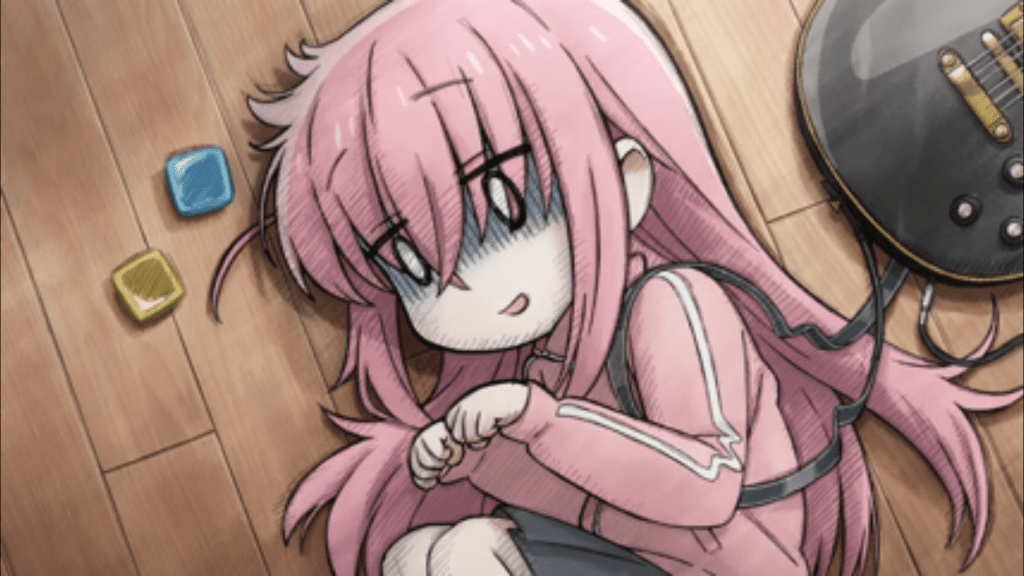
Nijika quite literally drags Bocchi into being social.
Now with a chance to make friends, Hitori joins the band, meeting the third bandmate, who is the bizarrely aloof Ryo Yamada (Saku Mizuno). Later being joined by the upbeat Ikuyo Kita (Ikumi Hasegawa), Hitori earns the nickname Bocchi and struggles to fight her introversion in her efforts to help the band to succeed. These efforts often result in some gut busting humor, including plenty of hysterical fourth wall breaks.
The fourth wall humor in this anime is excellent.
I often found myself pausing at least once per-episode so I could have a good laugh before continuing. What really shines about Bocchi the Rock, along with the humor, is how relatable Bocchi is as a character. Having struggled with a bit of social anxiety myself (although not to Bocchi’s extent), Bocchi’s journey to becoming more sociable through Kessoku Band was easy to become invested in and I know this was the same for a lot of other viewers as well. Bocchi’s relatability makes the high moments of the show shine even brighter, which is most apparent in Episode Eight where one performance had me on the edge of my seat.
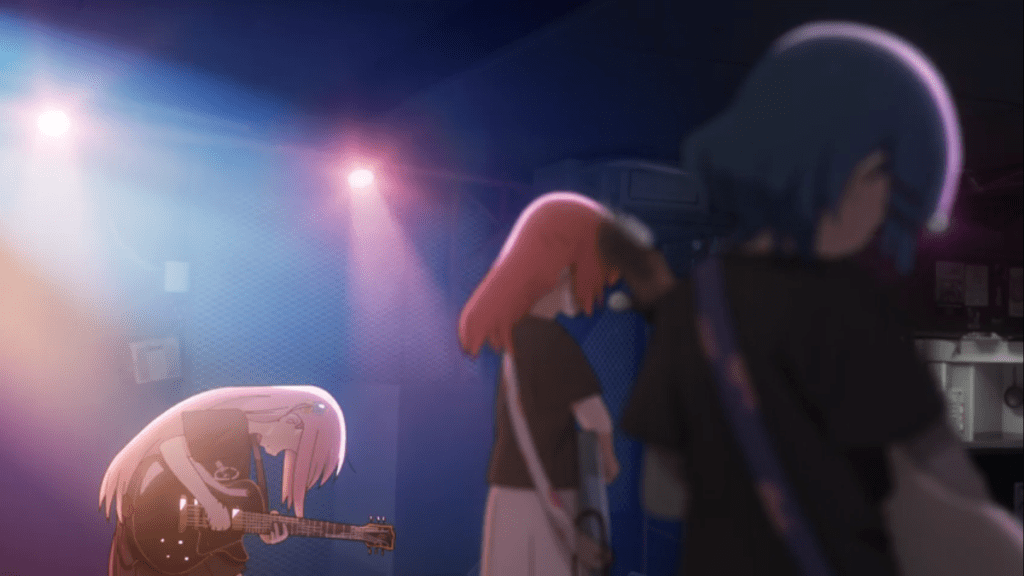
The performance in Episode Eight is the best scene in the anime so far.
These performances of Kessoku Band come with some quality animation, which often changes style to suit the situation, whether that be serious or goofy. The comedy in the goofy style of certain scenes is helped by the voice performances, especially Bocchi’s voice actor, Yoshino Aoyama, who has a truly impressive range.
It’s very impressive that Bocchi’s voice actress managed to do this scene without any voice editing required.
It is not just Bocchi who shines through the comedy though because many of her bandmates also get their funny moments, with Ryo being a standout. Overall, it is the relatability of Bocchi and how she grows as a character that got me really invested in this show. Hopefully a season two will be greenlit so we can all cheer Bocchi and Kessoku Band on, while simultaneously laughing at the excellent humor of this anime.
Episode Twelve, “Katana vs Chainsaw” is the final episode of the Chainsaw Man adaptation’s first season, and what a fantastic point to end it on.
Directed by the series’ overall director Ryū Nakayama, “Katana vs Chainsaw” picks up with the fight between Aki and the Ghost Devil the previous episode ended on.
Aki is currently being strangled by the Ghost Devil and passes out, only to hallucinate a prior exchange with Himeno, where she offered him a cigarette, only to take it back when she learned he was underage, promising to hold onto it for him.
When Aki opens his eyes, the Ghost Devil is holding out a cigarette with “EASY REVENGE” written on it.
Some part of Himeno seems to have survived inside the Ghost Devil and, remembering what she told him about the Ghost Devil only being able to see through fear, Aki uses this to climb the Devil and decaptitate it, leaving only Sawatari to deal with.
Before Sawatari can call on the Snake Devil, however; Kobeni sneaks up behind her and puts a knife under her throat.
Aki asks why she stayed with Public Saftey, causing Kobeni to humorously respond that it was because their bonuses are coming up.
While this is happening, Denji and Power are riding up in an elevator to confront Katana Man, only to stop on a floor full of zombies.
Rather than take the elevator up away from them, Power instead launches herself into the zombies, crying out for Denji to watch her slaughter them.
Instead, Denji takes the elevator up, while an oblivious Power continues to obliterate the zombies
Eventually, Denji reaches Katana Man, who explains that he is prepared to give up so long as Denji allows himself to be killed by him.
Denji refuses and Katana Man attempts to manipulate him, again bringing up Denji not feeling empathy because he apparently lacks a human heart.
Denji may not be smart but he is clever enough to see through this and he cheerfully refuses again, leading to the final fight between him and Katana Man.
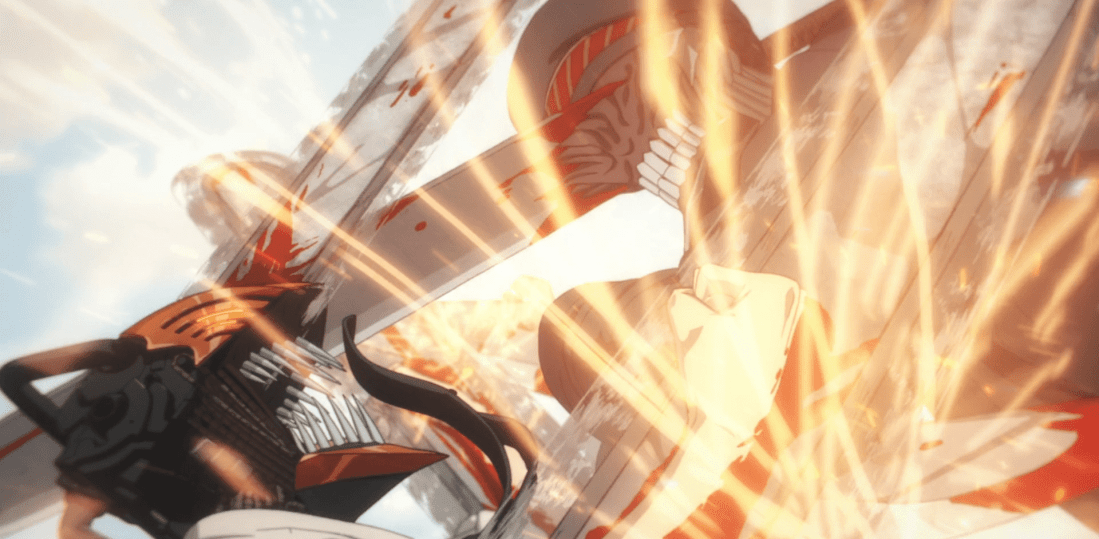
The two crash out of the building, eventually taking the fight atop a train with some truly excellent CGI.
They eventually crash inside the train, with Katana Man using his speed ability to cut both of Denji’s arms off before demanding he apologise for his grandfathr’s death.
This was Katana Man’s mistake, however, because Denji uses this to lure him into another attack, drawing his attention to his head while Denji uses a chainsaw in his foot to cut Katana Man in half.
“Didn’t the geezer teach you that beasts shouldn’t trust anything a hunter says?” Denji shouts, showing exactly what he learned from Kishibe and how much his training paid off.
When Katana Man regenerates, Deni ties him up to the train tracks.
However, much like Katana Man wanted satisfaction by killing Deni to avenge his grandfather, Denji too wants satisfaction for Himeno’s death so he decides to hold the contest to end all contest.
Aki then arrives and Denji gives the rules of the contest.
He and Aki will kick Katana Man in the nuts until the police show up and whoever gets the loudest scream wins his family jewels.
Aki is reluctant, until he again looks at the “EASY REVENGE!” cigarette and decides to compete.
Watching Deni and Aki kick Katana Man in the nuts over and over again to wholesome music was absolutley hilarious.
I like to think that Aki got the loudest scream as Katana Man’s screams serve as a reqiuem for Himeno.
The credits then begin to roll, with Makima reporting on the events of the raid and what they learned, primarily that Sawatari’s deal with the Gun Devil was to obtain Denji’s heart.
However, before they could find out why, Sawatari was killed by the Snake Devil in an apparent suicide part of her contract with the Gun Devil.
Makima then tells her superior that the Gun Devil parts they recovered have begun to move towards the main body, although the ED, “Fight Song” by Eve, begins before we can learn which direction it has started to move.
The ED shows Denji, Power and Aki going about their daily life after the Katana Man raid and it was a good final ED to end on.
Pretty much all of the ED’s are high quality, with them having great music and visuals, showing just how much care went into this anime.
After the ED, we get another anime original scene of Aki, as we see him go outside and smoke the “EASY REVENGE!” cigarette in what is probably his final goodbye to Himeno.
As this is happening, Denji is having a nightmare about the mysterious door, just like he did in Episode One, tying the opening of Season One up with its ending.
Just as Denji approaches the door, he hears Pochita on the other side, ordering Denji not to open it.
The episode then ends with a teaser, as an unseen female character walks through an alleywar towards a cafe, stating, “Tell me Denji, between the country mouse and the city mouse, which would you rather be?”
To anime only watchers, this tease will not mean much but, as a manga reader, it makes me incredibly excited for whatever follows, whether that be a Chainsaw Man Season Two or a movie to cover the next arc.
Overall, “Katana vs Chainsaw” was a fantastic final episode, delivering incredibly well animated fight and nut kicking scenes, alongside excellent music.
It is absolutley apparent that the people who made this anime love Chainsaw Man, as this is easily one of the best adaptations of a manga out there.
Hats off to you and your team Mappa.
I cannot wait to see what comes next for the Chainsaw Man anime.
Manga Spoilers:
As a manga reader, it was exciting to see Reze get teased at the end of the episode.
She is one of the best antagonists in Part One and brings up one of the big themes of the story, which is the whole country mouse vs city mouse argument.
I am curious to see if the Bomb Girl Arc that centers on her will be adapted as a movie or in a Season Two.
After all, the Bomb Girl Arc is short enough to be contained in a movie.
Although, it might be better for the pacing of the series overall for it to be kept for a Season Two.
Season Two could be the Bomb Girl and International Assassins Arc, and then Season Three could be the Gun Devil Arc and the Control Devil Arc, before moving onto Part Two.
Whichever it turns out to be, though, either a movie or Season Two, I will eagerly anticipate the return of the Chainsaw Man anime because of how amazing this adaptation was.














 THE REVIEW MONSTER