A Quiet Place Part 2, Review: An Intense Theater Experience.

4 stars
I loved
A Quiet Place when I first saw it in theaters and my appreciation for it has only increased as the years have gone by.
So, obviously, I was very excited for the sequel, once again directed by John Krasinski.
But then, of course, COVID hit and the film was delayed, until recently.
Well, I just saw A Quiet Place Part 2 and can say that it is a worthy sequel, which I quite enjoyed.
I do prefer the original, but Part 2 is still a great follow up that provided an intense experience that needs to be seen in theaters.
As the trailers revealed, the film begins by cutting to day one of the alien attack, where it is interesting to see how the Abbott family survived the invasion.
From here, Part 2 moves to the present, right after the events of the first film as Evelyn (Emily Blunt), Regan (Millicent Simmonds), Marcus (Noah Jupe), and the newly born baby, are forced to leave their home, now armed with the knowledge of how to kill the aliens. 
Coming across another survivor named Emmett (Cillian Murphy), the family come to realize that the aliens are not the only threat, but people are as well.

Murphy does an excellent job as the isolated and traumatised Emmett.

A Quiet Place Part 2 has stellar acting across the board, with each of the cast providing a standout moment.
Blunt portrays her character’s grief of recently losing her husband excellently, and Jupe delivers a harrowing moment during the first act of the film expertly.
The standouts, though, are definitely Simmonds and Murphy.
I would actually argue that Regan is the main character of this film, as she tries to live up to her father Lee’s legacy, following his tragic sacrifice at the end of the first film.
As for Murphy, he also does a fantastic job as Emmett, portraying his trauma well, and I really liked the slow bond that grew between his character and Regan.

Regan is the hero of Part 2.

I would have preferred to see a bit more of Emmett, though.
We get to see how the Abbott’s experienced day one and I kind of wanted to see Emmett’s story, leading up to him meeting the Abbott’s in Part 2.     
Along with the great acting, the feeling of intensity from the original film is, thankfully, still present here.
I found myself often gripping the chair I was sitting on in scenes where the characters desperately tried to stay quiet to keep away the aliens.
This involved various scenes with intercutting, as each of the separated characters found themselves in mortal danger where the slightest noise could mean their inevitable deaths.
It was amazingly edited togethor. 

Just when you think one character is done for, the scene cuts to another character in a situation somehow even more dangerous that the other one’s.

As for the ending, it ends abruptly, like the first, only I would say more so.
Even though the ending to the first film felt abrupt, it was satisfying enough to the point that it didn’t feel like a sequel was necessary.
This ending, on the other hand, definitely needs to be followed up on with a Part 3.
Maybe they could give us more of Emmett’s backstory in this potential sequel.
Either way, I do find A Quiet Place Part 2 to be a worthy sequel.
It has great acting and delivers many intense scenes that are best viewed in theaters to deliver their full effect.    

Josee, the Tiger and the Fish Review: A Well-Written Romance.

4 stars
Coming into
Josee, the Tiger and the Fish, I wasn’t quite sure what to expect.
I had seen the trailer a while back, so I knew it would be a romance anime but I didn’t know if it would be of the comedic, wholesome, or tragic department.
Well, after seeing it in theaters, I can say that it is kind of all three of those.
Directed by Kotaro Tamura, Josee, the Tiger and the Fish tells the story of the blossoming romance between diving enthusiast Tsueno Suzukawa (Taishi Nakagawa) and the wheelchair-bound Kumiko Yamamura (Kaya Kiyohara) or Josee, as she likes to be called.
Tsueno is a young man who’s passion for the ocean and diving has him hoping to get a scholarship in Mexico to study a certain kind of fish, however, he needs the money.
This is where Josee comes in, as a chance encounter between the two occurs when Tsueno saves her after someone cruelly pushes her wheelchair down a steep road.
Josee’s grandmother (Chiemi Matsutera) kindly offers Tsueno a job to look after Josee, helping him with his fees needed for the scholarship.
The problem?
Tsueno and Josee can’t stand each other.
From there, the film progresses with their relationship as they slowly go from hating one another, to being friends, to falling in love. 

The progression of Tsueno and Josee’s relation is very well handled.

However, given how I said earlier that Josee, the Tiger and the Fish had comedic, wholesome, and even tragic moments, you can probably guess that it is a bumpy road to get to the end goal.
It’s a good thing then that the romance is well written.
This is helped by both voice actors doing an great job with their performance and also the script, written by Sayaka Kuwamura, which does an excellent job at showing how Tsueno and Josee’s growing bond changes them as people.
For example, we watch as Josee goes from being shut in by her grandmother, to becoming more independent and confident, with help from Tsueno’s influence.
Speaking of Josee’s grandmother, she is quite a funny character, with her reactions in one scene creating quite a few chuckles among the audience in the theater.
Along with the well-written romance and humor, there is also the animation, which is quite beautiful at times, like during the beach scene, which brought a smile to my face. 

The beach scene is one of the most smile inducing moments in the entire film.

It is all of these things that combine to make an enjoyable film that will make a good watch for any fan of romance anime.
It’s nothing revolutionary or ground breaking but it didn’t need to be.
Josee, the Tiger and the Fish is a touching romance with a lot of good moments. 

Resident Evil Vlllage Review: A Lot of Fun and Occasionally Terrifying.

4 and a half stars
I remember playing
Resident Evil: Biohazard when it first came out and quite enjoying it.
It was my first Resident Evil game and did a great job at scaring me and keeping me engaged during its action heavy moments.
Not to mention that the DLC was excellent, with every new mini story added being worth the price.
So, as you can imagine, I was excited to finally get to play Resident Evil: Village, when it dropped on the ninth of May.
Developed by Capcom and directed by Morimasa Sato, the game takes place three years after the events of Biohazard, where its protagonist, Ethan Winters (Todd Soley), has settled down in Europe with his wife, Mia (Katie O’Hagan), and their baby, Rose.
However, in the dead of night, Chris Redfield (Jeff Schine) ambushes the family and murders Mia.
With Ethan being transported to a mysterious village overrun with Lychans, it’s up to him to rescue his daughter, as he battles against the evil village ruler, Mother Miranda (Michelle Lukes) and her four lords, Heisenberg (Neil Newbon), Lady Dimitrescu (Maggie Robertson), Beneviento (Andi Norrs) and Moreau (Jesse Pimentel).

Each of the villains Ethan faces off against is interesting in their own way.

Village feels like a love letter to Resident Evil 4 with its main setting, while each of the areas you explore as Ethan provides their own forms of horror and action.
For example, It was quite a bit of fun to be chased around by Lady Dimitrescu and her daughters, and this ended in what I found to be the best boss fight of the game.
While I personally found the Moreau section to be a little weak, I cannot deny it also ended in a fun boss fight.
Heisenberg was kind of the opposite because I found his final fight be a bit of a letdown, yet he had the most entertaining personality out of all the villains, including Mother Miranda who herself is an understandable antagonist, by the end.
My favourite of the five villain’s sections, though, has to be Beneviento’s.
Her section is pure, psychological horror with it reminding me of an Outlast game at one specific point, only somehow a million times scarier.
I was screaming like a little girl at one particular point here.
If you’ve played the game, you know what part I’m talking about, and if you haven’t then, trust me, it will terrify you.

The Benviento household may be my scariest experience while playing a video game.

Most of Village is action oriented, so this solely horror based segment with Beneviento was a welcome and horrifying reprieve.
This is not to say that the action is bad, far from it actually, as many of the action set pieces are quite intense.
Encountering a horde of Lychans is always heart pounding, as you have to run and gun constantly, while making sure to conserve healing items if one gets a hold of you.
Along with the Lychans, there are many other enemy types, a clear improvement from Biohazard.
Speaking of improvements from that game, Ethan is one of these.
In Seven, he was not a very interesting character.
He could be quippy at times but, other than this, there really wasn’t all that much to him.
Thankfully, this is definitely not the case in Village because I found myself getting heavily invested in Ethan as a character and his story.
There were a few particular moments from him that hit me me hard and made me feel bad for the guy.
However, this did result in a bit of a problem at the end because I do think there was a perfect moment to reveal his face but they didn’t capitalize on it.
Along with Ethan, another character I enjoyed was the Duke (Aaron LaPlante), the merchant character who is a constant relieving presence, as he sells you equipment and provides you with upgrades for your journey.
I found myself smiling whenever I came across the jolly giant and I hope he makes an appearance in future games. 

Charasmatic and mysterious, the Duke is a character who I would like to see more of.

Chris Redfield also has importance in the game’s final act and I quite enjoyed his role, even if I think it was a little too convenient to the plot for him to not do something he clearly should of earlier, although the other characters do acknowledge this.
Another character I would like to see more of is Heisenberg, who, as I said, is the most entertaining of the villains.
Maybe he could appear in a DLC?
It would be pretty great if Village got the same DLC treatment as Biohazard, allowing them to expand on many of the stories of these characters.  

One of my hopes for DLC this time around is a Heisenbeg expansion, maybe even an alternate ending to the encounter between him and Ethan.

Village really does have a great cast and this goes well with its intense gameplay and intriguing story.
I definitely think this is a step up from Biohazard.
The game got me invested with its expansive cast of characters, scared the hell out of me at times, and its ending left me very intrigued for how they will close the Winters’ story off with Resident Evil Nine, whenever it is released.
When it does eventually come out, though, the game will definitely be one that I buy on the first day of its release, just like I did with Village.  

ID: Invaded Review: Diving into the Criminal Mind… Literally.

4 stars
When I heard of the premise for the original anime
ID: Invaded, I was immediately intrigued.
A world where detectives can find fragments of a serial killer’s drive to kill at their crime scenes and use this to create an ID Well, a simulated world where “brilliant detectives” dive in to literally explore the criminal mind, all in order to catch them?
It sounded right up my alley and, boy, was it.
Directed by Ei Aoki and written by Ōtarō Maijō, the story follows Akihito Narihisago (Kenjiro Tsuda), an investigator traumatised by a disturbing family tragedy, which gave him his own drive to kill.
This drive allows him to become the brilliant detective Sakaido, when he dives into the ID Wells of serial killers, as he always finds himself investigating the death of the mysterious Kaeru, with the mystery behind her death always leading to the identity of the real life murderer the force are hunting.

The ID Wells are always interesting to see, with each killer’s inner psyche manifesting in different ways.

Once this killer’s identity is discovered, it is up to the team in the real world to catch them, with one new detective, Koharu Hondomachi (M.A.O), having a particular interest in using the ID Well.
ID: Invaded does a great job with its exploration of the ID Wells and the investigation that is taking place in the real world at the same time.
It creates interesting episodes, with each one initially focusing on a single killer as the story progresses, before it branches out to focus solely on the one behind the scenes pulling the strings: John Walker.
These episodes do a good job of getting you into the heads of the killers, although, it should be noted that quite a few of these serial killers are comically over the top.
The anime also makes you feel for the victims as well.
One particular episode has such a masterful bait and switch that it hit me like a train when the rug was pulled out from under us.

Just like Narihisago, we are hit hard with the relization of the big twist of that particular episode.

The show even managed to surprise me by making one of my favourite characters one of the killers, the Perforator (Yoshimasa Hosoya, and I won’t give his character’s actual name, so not to spoil the first few episodes), as I quite liked the progression of his bond with Honomachi.
It’s not all great, though, because I did find the story’s big twist to be entirely predictable, since I pretty much called it right from episode one.
That said, the events surrounding this predictable twist are pretty mind boggling, in a good way.
ID: Invaded honestly reminded me of Inception here with its weird ID Well inside ID Well settings.
The explanation to how all of this was even possible and how it ties in with who Kaeru is was also quite creative and an explanation I really enjoyed.

Along with being creative, the last four or so episodes also bring the feels, with one scene being so emotional that it is difficult not to tear up at it.

Pairing this with the great character growth of Narihisago, Hondomachi and the Perforator, and we have an enagaging show that I would definitley recommend.
Sure, it’s big twist is predictable and it does get a bit formulaic at times, before the last stretch of episodes, but ID: Invaded is still a good time with some very creative story choices in the final half.

Chainsaw Man Review: Can’t Wait for the Anime and Part Two!

5 stars
What an insane ride this one was.

I’d heard a lot about Chainsaw Man over the last few months.
How insane and well written it is, how it’s going to get an adaptation by Studio Mappa, and, most recently, how we can expect a trailer in June.
With this final piece of news, I gave in and read the manga, discovering one hell of a story.
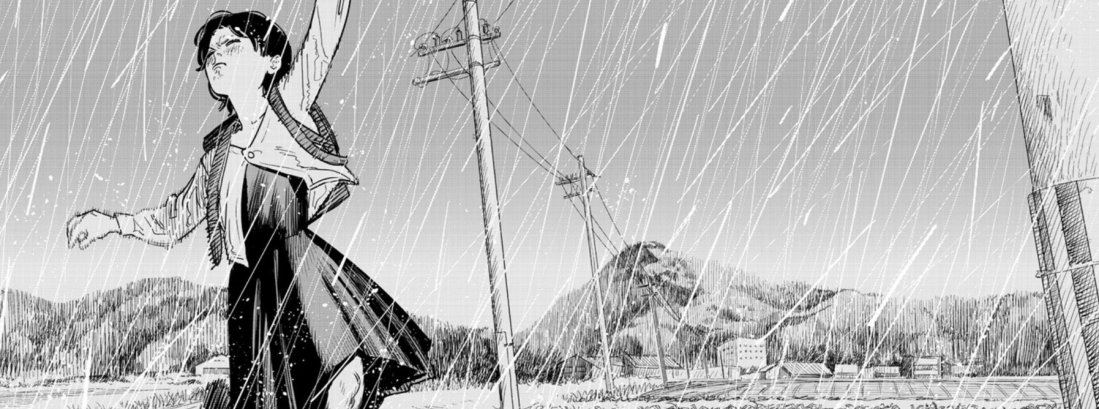
Written and illustrated by Tatsuki Fujimoto, Chainsaw Man is set in a world where humans often find themselves being attacked by Devils, so a group of Devil Hunters has been formed to combat them.
Our main character is Denji, a young man who hunts Devils with his own pet Devil, Pochita, to pay off his dead father’s debt to the Yakuza, which has passed onto him.

Denji has gone through a lot of bad things at the beginning of the story… come to think of it, he goes through even worse things as the story progresses!

However, after a dark turn of events sees Denji dismembered and thrown into a dumpster, Pochita makes a contract with Denji to give him his heart, if he shows him his dreams.
And so, Denji becomes Chainsaw Man, a human with the capacity to transform into a Devil who has a chainsaw head and arms to dismember any Devils that get in the way of his goals.
What are these goals?
Well, they’re simple things, like eating good food, having a nice place to sleep, and touching some boobs.
It’s honestly funny how simple Denji’s motivations are compared to the other characters.
For example, we have Aki, a character whose tragic backstory would make you think he is being set up to be the main character.
But no, instead we have Denji, whose main motivation for trying to kill what is supposedly the most dangerous Devil of all being that he will get one wish from the girl he likes, Makima.
It’s so absurd, yet it somehow works.  

The humor of Chainsaw Man is so outlandish but it is clearly intentional and I just couldn’t stop laughing.

Speaking of characters like Makima and Aki, though, both of them are great, with so many fantastic twists and turns to their arcs.
It’s not just them who are fun characters because there are many others.
Power brings constant laughs to the table and the growing found family dynamic between her, Denji and Aki is beautifully handled.
Kobeni’s suffering is weaponized into being some of the funniest stuff in the entire story, with me laughing my head off, while also feeling sorry for her.
Then there’s the awesome devil hunter Kishibe, who may just be my favourite of the bunch, due to his personality and the way he handles his trauma.
I actually don’t think there’s a single character among the main cast who is a weak link.
This makes it even harder to sit through when Fujimoto inevitably breaks our hearts with another character’s gruesome fate.
Seriously, Fujimoto should go into business with Hajime Isayama, building an onsen where the water comes from their fans’ tears. 
I’m pretty sure a good portion of those tears would come from me too because some of the things that happen got me really emotional.
Chainsaw Man made me go from laughing so hard my sides were hurting, to tearing up, to being left in stunned silence on multiple occasions.

There were so many moments in Chainsaw Man that made me have to take a moment to see if what I just read really happened in the story.

All of this emotion is brought across by Fujimoto’s excellent drawing skills.
The guy is as skilled at illustrating as he is at making us laugh and feel depressed.
This culminates in a fitting ending for this part of the story, which has me not only incredibly excited for Mappa’s adaptation but also for Part Two of the manga, whenever that releases.
Chainsaw Man is one hell of a manga that will leave you clutching your sides with laughter, shedding a few tears, and in stunned silence.  
Hopefully Mappa can do this great story justice. 

Godzilla Vs. Kong Review: Pleasing My Inner Child.

3 and a half stars
Growing up, I always loved giant monster movies.
Peter Jackson’s King Kong remake was the film that got me interested in movies in the first place.
However, my favourite giant monster as a kid was not Kong but Godzilla.
I watched many of his films and even now still own a lot of them.
I’ve always been a fan of Kaiju movies, which has honestly made me disappointed in the whole monster cinematic universe so far.
I loved the first of these films, Godzilla, when it came out in 2014.
However, this was mainly because I was excited to finally see an accurate blockbuster representation of the big G on the big screen.
As time went on, I realized the film’s flaws more, like that it gets rid of the only interesting human character way too early and leaves us with only bland and generic ones, not focusing enough on Godzilla himself.

Killing off Bryan Cranston’s character and focusing on the rest of the bland human characters, instead of Godzilla, were the 2014 film’s biggest mistakes.

Then there’s it sequel and spinoff, King of the Monsters and Kong: Skull Island, which were even more disappointing to me.
King of the Monsters just could not live up to its trailers, delivering an even worse cast of characters than the first, and Kong: Skull Island also focused on a mostly uninteresting cast, while I felt that one characters’ backstory should have been the entire plot of the movie.
So, taking all of this into account, I came into Godzilla vs. Kong excited to see these epic monsters have their first cinematic showdown since 1962, yet I was slightly skeptical.
You know what, though?
I came out of the theater actually very pleased with Godzilla vs. Kong. 
It’s a fun, cheer inducing film that pleased the inner child in me, who so loved Kaiju movies growing up.
Directed by Adam Wingard, the movie justifies its big fight between the two monsters by having a group of mostly uninteresting scientists using Kong to search for a power source inside the earth, with Kong’s presence drawing Godzilla out to fight.
Given how I just described the human characters, you can obviously see that I once again find them to be the biggest problem with the movie.
With a talented cast among the likes of Alexander Skarsgård, Millie Bobby Brown, Brian Tyree Henry, and Julian Dennison, I’d hoped they would at least be more interesting than the ones in the previous movies.
Alas, it was note to be, with many of them being incredibly one dimensional.
Not only this but I found that the storyline centering around Brown, Henry and Dennison’s characters could have been removed entirely from the film.
However, there is one interesting human character in the movie, Jia, a deaf girl played by Kaylee Hottle who has a connection with Kong, leading to a moment that gave me chills in the theater.

The bond between Jia and Kong is fantastic. This is how the relationship between humans and monsters should be portrayed in these movies.

I just wish that instead of the pointless conspiracy theory plotline we got more time with Jia and the characters surrounding her because this could have also made them way more interesting.
I think in the next monster movie they make whoever’s writing it should cut down on the number of characters, so they actually have time to develop some of them to the point that we can actually care about what happens to them and their arcs.
These flawed characters had me concerned for the first quarter of the movie, since it mainly focused on them.
I was worried this was going to be another movie where everything focused on the humans instead of the monsters fights, which were what we all actually wanted to see.
I am so glad that I was wrong and the film actually focused on the monsters.
After this first quarter, the movie picks up, delivering epic fight scene after epic fight scene, as Godzilla and Kong duke it out numerous times.
The way that these fights were shot, edited and given a sense of scale really amazed me.
It was something I’d been wanting from this monster cinematic universe since the very first one.
And that final fight.
That. Final. Fight.
What an incredible climax it was, gifting us with epic scenes that made me grin so hard I was sure my mouth was going to fall off.

The final battle between Godzilla and Kong gave me an experience that I have been waiting to see in theaters for a while.

These fight scenes saved the film for me, making up for the many uniteresting characters, unfunny jokes and pointless conspiracy subplot. 
I came to see the two most famous monsters of all time engage in a battle and that’s what I got, in sometimes spectacular fashion.
This makes the film worth the price of admission for me. 
I am sure that it pleased every single Kaiju fan’s inner child. 

My Hero Academia, Season Five, Episode Two, Vestiges Review: A Look Into the Past.

4 stars
After the filler first episode of My Hero Academia Season Five, I’m sure many people were excited to see what the outcome would be of Dabi’s first meeting with Endeavor. 
Well, we we got the answer to that in the second episode, “Vestiges”, directed by Shōji Ikeno, and I have to say that I’m quite impressed with how they managed to temper expectations but still make it satisfying. 
Before seeing the end of Season Four, I was sure that Dabi’s arrival was going to be the big cliffhanger to get viewers excited for Season Five. 
However, instead the episode cut right before his arrival, instead leaving it for the end of last week’s episode. 
Not only this but they also showed that the fight would not end too badly for Endeavor, given that they showed him alive in the hostpital, before cutting to the cliffhanger of Hawks meeting with Dabi. 
This all allowed viewers to temper their expectations, going in not expecting a big fight, which would leave them satisfied with the outcome, instead of disappointed when they didn’t get what could have been hyped up for ratings. 
In any case, we get to see Dabi and Endeavor’s first meeting in the opening of “Vestiges” with the villain confronting the wounded hero, only to be interrupted by the bunny hero Mirko.
This forces Dabi to retreat using the vomit sludge that was seen all the way back in Season Three.
He does get one last jab in at Endeavor, though, telling him not to die on him and calling him by his full name. 
Yeah, dramatically calling people by their full names is kind of Dabi’s thing. 
He did it with Shoto and now he’s doing it with Endeavor. 
After this brief confrontation, we get the moment teased in last week’s cliffhanger, Hawks meeting with Dabi. 
Turns out that Hawks is actually a double agent working under the orders of the Hero Commission, acting like he is on the side of the League of Villains to get more intel on them. 
Dabi is still naturally suspicious of Hawks so refuses to allow him to meet Shigaraki. 
As the he departs, Dabi recalls the Pro-Hero Snatch, who he murdered during the Overhaul Arc, before saying that he thought so much about those left behind that it drove him insane. 
He also appears to be crying blood when he says this. 
Quite curious. 
Cutting back to Endeavor, we get a family meeting fueled by tension as he begins what will undoubtedly be a slow process in making amends with his children for what he did to them. 
Fuyumi seems entirely willingly to forgive her father but Shoto and especially Natsuo are less certain. 
Shoto gets a good dig in when he brings up Endeavor’s scar, forcing his father to look at his own son’s scar, which he inadvertantly gave him through pushing Rei into a mental breakdown. 
Natsuo is far more uprfront in his anger, calling Endeavor out for neglecting them and keeping them all seperated from Shoto. 
Of all the Todoroki siblings, Natsuo will definitley be the least likely to ever forgive their father. 
Endeavor has certainly changed for the better, though, refusing to ask for forgiveness because he only wants to atone for all he has done. 
The episode then switches perspectives from our slowly reforming hero to the up-and-coming hero Deku, who experiences the titular vestiges of One For All in a dream. 
In this dream, he experiences what lead to the creation of the One For All Quirk. 
As All For One rose to power, removing Quriks from those who saw it as a curse and gifting them to those who had none, his younger brother stood against him.
Wanting to bend his brother to his will as well, All For One forced a Quirk on him, unintentionally creating his arch nemesis, One For All. 
How ironic. 
The scene where One For All is created is especially good, as the first holder uses an argument about a comic book they both read where a demon king rises to undermine All For One’s point of view. 
The first holder notes how All For One only read to volume three and, at the end of the story, a hero saves the day because the bad guy never wins. 
Before the dream ends, the first user of One For All finally talks with Deku, informing him that they are past the singularity point, causing Deku to wake up and shatter his window, which was the cliffhanger for the post credits scene of Season Four.
So, now we’ve finally caught up on all the events teased in the Season Four finale and are left with more questions, like Dabi’s motives and the supposed singularity point the first holder mentions. 
It’ll be interesting to see how anime only viewers react to what these answers are, both in this season and further down the line. 
Overall, “Vestiges” is a solid episode of My Hero Academia that will build nicely into the events of the next story arc. 

Attack on Titan, The Final Chapter, Toward the Tree on That Hill Review: A Conflicting Ending for My Favourite Story.

please fucking work
Well, it finally happened.
After well over a decade and only one break due to a pandemic, Hajime Isayama has brought his epic story of Attack on Titan to a close.
I can still remember entering this fandom when I watched the first season, all the way back in early 2018.
When I saw the second season, I knew that this story would become something special to me and, sure enough, it is now my favourite story of all time.
Chapters 119-123 especially are the best fiction I’ve ever read.
Now, it’s over.
Isayama concluded his story with Chapter 139, “Toward the Tree on That Hill.”
So, what did I think about the ending?
Well… it’s complicated.
Ever since I finished the chapter I’ve been constantly changing my opinion, going from liking to disliking the way it ended.
Eventually, I just sat down and carefully read the final chapter, trying to understand what Isayama was attempting to say with this ending.
This caused me to come to the conclusion that the ending is decent.
Not great but certainly not bad either.
There are both great and bad things in the chapter, though.
In fact, I think the perfect way to describe “Toward the Tree on That Hill” is as a mixed bag.
There’s a lot to like and a lot to dislike.
I’ll start from the very beginning.
Chapter 139 opens with a flashback to Chapter 131, where it is revealed that Eren actually spoke to Armin when he pulled him into the Paths Dimension.
It is here that Eren proves one of my past theories right, that he did the Rumbling to set up the Alliance as heroes to the world so he could protect them.
Is this a little too similar to Lelouch from Code Geass?
Yes but it certainly makes certain plot holes from prior chapters easier to solve, like why Eren didn’t have the Warhammer Titan remove the explosives.
As for the potential problem of Paradis being destroyed, Eren reveals that the Rumbling will kill 80% of humans outside the walls, giving the island a fighting chance.
The horrified look on Armin’s face following this declaration is really well drawn by Isayama.
From here, Isayama gives a great reflection of Eren and Armin’s friendship, as the two journey to lands they always dreamed of through Paths, which is something I really appreciated.
It is in these travels that Eren provides some more twists and it is here that my problems with the final chapter begin to pop up, and the first problem is by far the worst.
Eren tells Armin that the reason why Ymir didn’t go against King Fritz for 2000 years was because she was in love with him.
Yes, you heard right, Ymir was in love with the guy who killed her parents, enslaved her, used her as a weapon in war, raped her, and fed her dead body to their daughters.
I suspected Ymir was suffering from some kind of Stockholm Syndrome, given that she sacrificed her life for King Fritz.
However, the problem is that the story does not seem to be classifying it as that.
Eren says that what Ymir felt for her abuser was actual love and then Isayama draws a parallel to Mikasa’s love for Eren by having Mikasa’s actions in Chapter 138 cause Ymir to be free from that burden of love, just like Mikasa freed herself.
The one thing you definitley don’t want to do is draw a parallel between your main couple and an incredibly abusive relationship, if you can even call Fritz using Ymir a relationship because I know I don’t.
Another reason I really don’t like this is because it makes me like Chapter 122 so much less to the point that I’m not sure that I can call it my favourite chapter anymore.
When I first read it, I interpreted Ymir following the King because of her stockholm syndrome, not of love but of enslavement.
Ymir had been a slave for so long that she didn’t know how to be anything else and so she continued to do as she was ordered for 2000 years until Eren freed her.
But, no, she did it because she apparently loved the guy who abused her for long, which still does not appear to be labeled as Stolkholm Syndrome, which it most certainly is.
Now, I’m not saying that Isayama actually believes that what Ymir had with Fritz is love, certainly not.
I’m just saying it was badly portrayed.
Also, what the heck even happened to Ymir anyway?
She was completley absent in this chapter.
Did she just disappear with the Titan realm?
It’s a shame because not only does all of this lessen my appreciation for “From You, 2000 Years Ago” but also because it is obviously quite problematic to portray Ymir’s feelings about King Fritz in this way.
Unfortunately, this is not the only problematic thing in this scene because later on Armin actually thanks Eren for becoming a mass murderer for their sake… yikes.
I’ll always defend Attack on Titan from those who claim that it is facist propaganda but if this is an accurate translation then Isayama really dropped the ball when considering the implications of this line.
It also seems quite out of character for Armin to thank Eren for killing potentially billions of innocent people.
Speaking of out of character, there’s also the reveal that Eren sent Dina to kill his mother to set them on this path.
Not only do I not believe Eren would do this but it is also brought up and then forgotten about in an instant.
You could completley remove this twist and nothing about the final chapter would change.
Then there’s Eren crying out about how he doesn’t want Mikasa to have any other man but him and how he wants her to be constantly thinking about him.
This scene seems like it’s being played for laughs but, given how it came after the reveal that Eren had murdered 80% of the human population and allowed Dina to kill his own mother, it feels really out of place.
Eren finally revealing his true feelings for Mikasa should have been played as serious rather than comedic.
We also get the teased final panel in this scene and it is actually not the final panel but rather a small flashback of Grisha telling Eren that he is free.
While I do like the symbolism of this, showing that Grisha changed his ways and also set Eren on his path to freedom, I do think that teasing this as one of the last panels was a mistake.
It led to too many fan theories and expectations, which naturally made a lot of people disappointed when their own theories didn’t turn out to be true.
In any case, following Eren’s goodbye to Armin, we then cut to the present where Eren being killed has caused the Hallucigenia to self destruct and turn all the Titans back into humans, including Jean, Connie and Gabi.
While this is quite convenient, I’m just personally glad that those three characters came back because I felt their goodbyes in Chapter 138 weren’t as fleshed out as they could have been.
Along with this, it’s revealed that Eren also sent most of the Alliance a goodbye, before erasing their memories of it.
This includes Mikasa, which doesn’t really make sense because she’s an Ackerman, so her memory shouldn’t have been able to be erased.
Although, maybe the memory she saw was the one Eren sent her right before she killed him in Chapter 138, so that would explain it.
Either way, this does lead to some pretty funny and moving moments, like Pieck comedically saying she wishes she could have spoke to Eren too and Falco running to reunite with Gabi, only for her to fling him in the air in excitement.
Following this, we get the absolute best moment of the final chapter.
The scene that actually made me tear up.
As Levi is resting up against a rock, he see his old comrades standing among the smoke, giving him the Survey Corps salute.
Levi says that this outcome is the result of their devoted hearts, before returning the salute and shedding a tear.
What an absolutley perfect way to conclude Levi’s arc.
It was beautiful and, in my opinion, the best conclusion of any character in this chapter.
Almost as beautiful was Jean and Connie seeing Sasha.
Following this heartfelt moment, Mikasa takes Eren’s head to bury it in the place the entire story began, just as Muller and the other Marleyan officers from Fort Salta arrive.
Muller is anxious about the Eldians, which is consistent from him seeing that they all transformed in Chapter 138.
I also like the line where he tells them to prove if they are humans or Titans, just like Eren was told to prove this when he transformed for the first time in the Trost Arc.
It is at this point that Armin strolls in and begins the peace negotiations, claiming that he was the one to kill Eren.
On this dramatic note, the chapter cuts to three years later and another one of my problems come in, this being Historia’s fate.
It is revealed that her pregancy went well and she now lives on her farm with her daughter and the farmer, who she married.
That’s right, those of us who thought Eren was the father looked too deep into it.
Now, I just want to say, this is not me criticizing Isayama’s choice to not make Eren the father.
That’s on me for looking too deep into it and getting invested in that theory.
More so, this is a criticism of Isayama pairing Historia up with the farmer of all people.
I just think it is poor writing to have a character, who was once so important, be completely sidelined and then married to an unamed character that no one cares about.
It is especially annoying when this is the replacement for a fantastic relationship, if Freckled Ymir and Historia really were supposed to be implied as romantic, which I like to think that they were.
Speaking of which, my headcanon is that Historia named her child after Ymir and I will not be accepting any arguments against that.
Jokes aside, I’m actually not going to hold the farmer being the father against this chapter.
No, that’s more a problem I have with its reveal in Chapters 107 and 108.
What I will hold against the chapter, though, is the completely baffling lack of importance surrounding the birth of Historia’s child.
With all of the themes about children, it seemed like Isayama wanted us to think there was going to be something important about this baby.
From Historia’s pregancy being the cliffhanger of the first chapter for the final arc, to her pregnancy constantly being brought up, despite her barely making an appearance, to her asking Eren what he would think about her having a child, to her being shown about to give birth right before the final battle.
All of this seemed like foreshadowing for the baby’s importance.
I thought it was going to be through a Founder Ymir reincarnation or, at the very least, a symbolic representation of freedom, with Historia’s child being the first Eldian born after the Titan curse had been removed.
Instead, her pregnancy was pointless and all of that build up and Historia being sidelined was for nothing.
It seems pretty clear now that Isayama had no idea what to do with Historia post time skip.
Oh, well, at least she seems happy and Isayama didn’t decide to just kill her off during childbirth.
Anyway, once this brief moment with Historia’s unimportant child is shown, we get another reveal that is controversial within the fandom but one that I actually like.
This is the reveal that the cycle of violence hasn’t truly ended because Paradis has formed an army to fight the remainder of the world if need be, with Eren being viewed as a martyr.
While many seem to think that this makes Eren’s actions pointless because the cycle isn’t over, I think it actually works well because Eren still gave the island a chance and it’s also representative of the real world.
Unfortunately, total unanimous peace just isn’t feasible.
There will always be violence, war and horrors throughout our history.
That doesn’t mean that there isn’t good in the world, though, because as one of Attack on Titan‘s main themes states, “the world is cruel but it’s also beautiful.”
It is this world that the Alliance now seek to help make better, going on a diplomatic mission to Paradis where Historia and Kiyomi are waiting.
Speaking of Kiyomi, though, if she’s there then where’s Yelena?
Last we saw of her, she was on a boat in the ocean with Kiyomi and now she’s gone.
There’s another character Isayama didn’t know what to do with at the end but she wasn’t too much of an important character, so it’s thankfully not as bad as it is with Historia.
Back to the Alliance returning, we get one last goodbye with all these characters who we have come to know and love, with plenty of Isayama’s textbook humor on display, as the characters joke about Reiner’s crush on Historia and Jean looking like a horse.
The conversation then turns serious when Annie and Pieck wonder if they’ll really be welcomed as ambassadors to Paradis for the world but Connie says to trust in Historia and Armin tells them those on Paradis will want to know what they saw.
I wonder if this is implying that Armin’s narration throughout the story is actually him telling the people of Paradis what lead them all to this point.
That’s pretty cool if it’s true.
We also get a look at Levi, Gabi, Falco and Onyankopon living their lives in the outside world.
I’m really glad that all the surviving members of the Alliance got their own happy ending.
I’m pretty much satisfied with all of their conclusions.
The panel of Armin, Annie, Jean, Connie and Pieck looking up at the sky from their boat, right as Levi and the others do where they are, is striking.
We then get the final, touching scene of this fantastic story, as Mikasa rests at the titular tree on the hill where the story began, right next to Eren’s grave.
As she breaks down into tears about wanting to meet Eren once more, a bird flies down and wraps the rest of the scarf around her before taking off.
The manga ends with Mikasa looking up at this bird, thanking Eren for wrapping the scarf around her all those years ago.
Pretty fitting that the story ends with all of the characters looking up at the sky, at the freedom of birds and planes.
So, all in all, this final chapter is a mixed bag.
There is some really bad stuff about it, like the extremely problematic writing of the opening scene and Historia and her pregnancy’s treatment.
However, there is also some amazing stuff, like Levi’s tear jerking conclusion to his character arc and the final scenes with all the characters we love.
With this mixture of good and bad scenes, it creates a final chapter that I consider to be overall decent.
Not nearly as good as it could have been but still satisfying enough, nonetheless.
Yet, even though I am slightly disappointed with the ending, I still appreciate Hajime Isayama for gifting us with this amazing story that delivered some of the best characters and plot twists that I have experienced.
So, from the bottom of my heart, thank you, Hajime Isayama.
You have been hard at work on this story for over a decade and you should pat yourself on the back for all your hard work and the joy (and suffering) you brought to so many readers, myself included.
Attack on Titan will always remain as one of the greats for me and I can’t believe that it’s over.

My Hero Academia, Season Five, Episode One, All Hands on Deck! Class 1-A Review: A Much Anticipated Ending.

3 and a half stars
Well, My Hero Academia has finally returned with its fifth season and it began just like last season’s premiere, with a filler episode, albeit a better one.
I’m not the kind of person who usually enjoys filler so I was not eagerily anticipating the first episode, “All Hands on Deck! Class 1-A”, because I thought every scene would be kind of meaningless in the long run.
While this is mostly true, with none of the filler scenes in this episode seeimingly having any importance to the story, the ending did surprise me with a scene I thought we would be getting next episode that I had been looking forward to for a long time.
Not only this but the filler content is actually pretty funny.
Directed by Tsuyoshi Tobita, the episode follows Class 1-A as they go through a hero training course, in which they have to beat the fake villains, Tamaki and Nejire, and rescue the fake civilian, Mirio.
It is Tamaki and Mirio who bring the biggest laughs here with Nejire, as per usual unfortunately, falling into the background.
Mirio is absolutley hilarious as the clumsy civilian who constantly needs to be saved and Tamaki is just as funny as the villain who just wants to go home.
What isn’t as enjoyable is the show once again going over who all the characters are and what quirks they have.
We’ve been watching this show for five seasons, almost all of us know who these people are and, even if we don’t, we still remember the important characters the story focuses on.
We don’t need to hear all of this info that we’ve had five seasons to digest.
It just gets tiring.
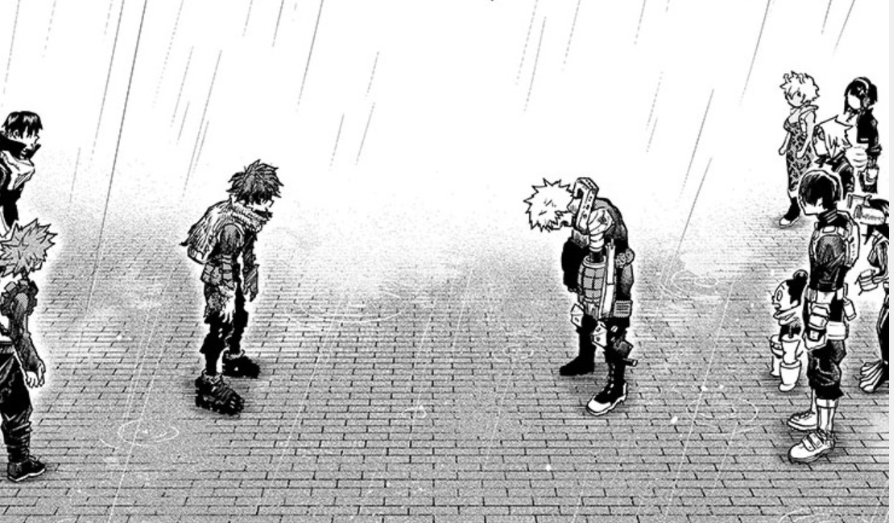
At least this filler content has a funny ending, with Bakugo going insane and trying to blow up Tamaki, who just wishes that he had chosen to go home.
Bakugo really needs to go through an anger management program before he becomes a hero.
The shot of the dazed Class 1-A students stumbling through the dust caused by Bakugo’s explosion before collapsing, including Deku with some funny looking hair, gets another laugh.
When looking at the filler content alone, I would say that the Season Five premiere has about the same ranking as the Season Four premiere for me.
Both are filler episodes with some funny moments but overall they don’t add anything to the story and mostly feel like a waste of time.
At least, I would have said this about “All Hands on Deck! Class 1-A” if it hadn’t been for the ending, where Dabi finally confronts Endeavor.
This is a scene that I’ve been wanting to see for a while and I thought we were going to get it next episode, when I learned that this episode would be filler.
So, imagine my surprise when it turned up as a post-credits scene.
Not only this, but the cliffhanger of Dabi meeting up with Hawks is also expertly placed to get anime only viewers asking questions.
The music during this post-credits scene is also top notch.
Although, there is a slight animation error because Dabi’s ears are not scarred when he goes to confront Endeavor, when they have been scarred in every scene he has previously been in.
It did take a second viewing for me to catch this, though, so it’s not a big deal and I think they’ll fix it later, maybe for the Blu-Ray.
Overall, with the unexpected scenes of Dabi confronting Endeavor and the Hawks cliffhanger, I would say “All Hands on Deck! Class 1-A” is elivated from an average episode to a good one that does a nice job of building up to the next episode.

Attack on Titan Season Four, Episode Sixteen, Above and Below Review: Part One Ending as it Began.

4 stars
Well, that’s a wrap people, at least for now. 
Part One of the Final Season of Attack on Titan has concluded with its sixteenth episode, “Above and Below”, with Part Two airing either later this year or in early 2022.
What a place to end Part One on as well, considering that what many people, including myself, consider to be the best part of the Manga is set to be adapted next. 
At least the wait will be worth it. 
I just hope that the Mappa animators don’t have to deal with such a hellish schedule this time around but, given what they’re going to have to animate, I unfortunately doubt it. 
As for the episode itself, “Above and Below” does a very good job of getting viewers excited for this second half. 
Directed by Teruyuki Ōmine, Tomoko Hiramuki, and Jun Shishido, the episode begins with a brief showcase of the aftermath of Zeke setting off the thunderspear at the end of “Sole Salvation.”
With his lower half completley gone, he lies dying in a field of flowers, when he recieves a brief and mysterious vision of a young girl with shaded eyes, who is carrying a bucket. 
Before this can be explained, one of Zeke’s Titans, who survived Levi’s purge last episode, crawls up to Zeke, rips open its stomach, and stuffs him inside, no doubt confusing many anime only viewers. 
This is the last time we see Zeke in the episode and Part One, creating a slight disappointment in me that a scene I expected to be adapted in “Above and Below” wasn’t. 
The scene that was cut is quite an amazing one from the manga, so I’m sad that we’re going to have to wait a while to get it but, hey, it’s not the end of the world. 
I know I’ll get to see this moment eventually, along with the plenty of other mind blowing moments from the manga that have yet to be adapted. 
Once this scene with Zeke is over, the episode cuts to Shiganshina, where Yelena is having her self prophecized dinner with Commander Pyxis, who notices that the Volunteers and the Yeagerists are using Marleyan tactics to take over the military, identifying people with armband. 
White means they’re a Jeagerist, red means they were blackmailed into working with them through the tainted wine, and black is for those who continued to drink the poisoned wine without realizing, like Pyxis. 
His bleak situation does not erase his sharpness, though, as he quickly picks up on Yelena commenting about a plan to “save the world.” 
This confuses Pyxis because he and many others thought the plan was to save just the island with a partial Rumbling, completly unaware of Zeke’s Euthanization Plan, which Yelena then brings to the locked up 104th. 
Yet, before she explains this plan to them, we get the fallout from Eren’s disastrous meeting with Armin and Mikasa, which ended with him telling Mikasa that he hated her and beating up Armin. 
Mikasa just seems dead inside about the whole thing and Armin appears to be more conflicted than ever. 
That leaves Jean to reassure them, unexpectedly saying Eren must have had a reason for what he did. 
This is some great development for Jean because, at the beginning of the story, he would never have spoken in Eren’s favour, yet here he actually does so, showing true growth. 
As for another character who gets more entertaining as the show goes on, we then get one of Yelena’s best scenes, as she enters to tell the 104th about the Euthanization Plan.
With her are Onyankopon, who seems to have betrayed them, and probably now one of the most hated characters Greiz.
I say this because he dared to mock and degrade Sasha in front of her possible boyfriend and family, long after she died. 
Seeing Yelena put a bullet in his head after he called her the W word pleased a lot of fans, I’m sure. 
It also shows just how enjoyably nuts Yelena is.
You never know if she’s just going to have a conversation with someone or stab them in the neck. 
Speaking of stabbing people in the neck, we then get Pieck’s epic entrance with the adaptation of one of her best scenes from the manga, as she manages to corner Eren when he goes to try and blackmail Gabi into helping him by using Falco.  
Marching into the room and stabbing Eren’s guard, Pieck seems to have the advantage, until Eren clearly points out she’s in no position to kill him, being under orders to capture the Founding Titan. 
It’s here that we end up seeing why Pieck is one of the smartest characters because she actually manages to fool Eren into thinking she wants to defect to save her father, or at least make him think that trusting her is worth the risk. 
Although, one criticism I do have that carries over from the manga about this scene is that I do feel that Pieck’s backstory is a little too similar to Annie’s but it’s not a massive problem. 
Also, the rest of the scene is pretty great, with Pieck ripping away the last shreds of Gabi’s indoctrination, explaining to her that the Marleyans will never free her, no matter how hard she tries.
Pieck then offers to prove herself to Eren by taking him up to the roof where she can point out her comrades. 
The scene then cuts to the reveal of another character who is a pretty great liar, that being Armin. 
As Yelena fanatically explains the Euthanization Plan, Armin appears to laugh but covers it up with tears, or maybe cries for a very different reason to what he claims to Yelena.
Either way, he’s certainly fooled Yelena into thinking that he is on board with the Euthanization Plan. 
Any way he can take this further is quickly interrupted by news of Pieck’s apparent defection, though, as Eren leads her to the top of the roof. 
It looks like many of the Yeagerists are ready to become Pieck simps when she smiles and waves at them.
Unfortunately for them, they are not long for this world, as you can see Porco hiding amongst the crowd, having seen the handcuffs that Eren had placed on Pieck and Gabi to prevent her from transforming.  
What follows is pretty much a full minute of Pieck basically rubbing it in Eren’s face about how smart she is and trying to worm any additional information out of him before the inevitable ambush happens. 
What an ambush it is too, as Eren is prepared to transform but completley unprepared for Porco’s attack from below and Marley’s attack from above. 
The build up to this moment is great with the lack of music up until Pieck points the finger at Eren when he asks where the enemy is, and her well animated smile of reassurance at Gabi. 
Once the tables turn and Porco attacks, biting off Eren’s legs, we get a great transformation scene of Eren, in which his Titan is 2D, most likely pleasing those who had a problem with the CGI this season. 
However, I do think some of the animation was lacking in this scene and also in a few others. 
For example, the shot of the airships coming down to assault Shiganshina does look quite a bit off. 
So, I suppose it’s a good thing that Mappa’s getting more time to animate Part Two.
Again, though, I hope the animators get treated way better than they did this time around with the really bad production schedule and tonnes of crunch. 
Aside from the couple of animation issues, this final scene is still incredibly hype, ending Part One of the season exactly as it began, with Reiner in an airship ready to attack. 
This parralel makes it a fitting place to end Part One of the Final Season. 
There was certainly a different part they could have ended it on, which would have frustrated anime only viewers even more, so it’s probably a good thing they ended it where they did. 
Overall, “Above and Below” is a pretty good episode, with a hype ending. 
It might not be the best episode of the season so far but it was a fitting way to end the first half. 
And, even though we may have to wait a while for Part Two, us manga readers still have the final chapter of the story to look forward to, which is supposed to be dropping on the ninth. 
It’ll be interesting to see how this story will end and how Mappa with adapt it when the next half of the Final Season starts, either in late 2021 or early 2022.