The Long Walk Review: Well, This was Depressing.

If you ask any Stephen King Fan what the name of the first novel he wrote is, I believe the majority would say Carrie.
However, while this was the first book King published, it was not the first he wrote.
No, that honor goes to The Long Walk, which was eventually released under the pseudonym of Richard Bachman.
Many decades after the novel’s release, we finally have our first adaptation, directed by Francis Lawrence, and, man, it is depressing.

Although often tragic, The Long Walk also has a beautiful message about brotherhood.

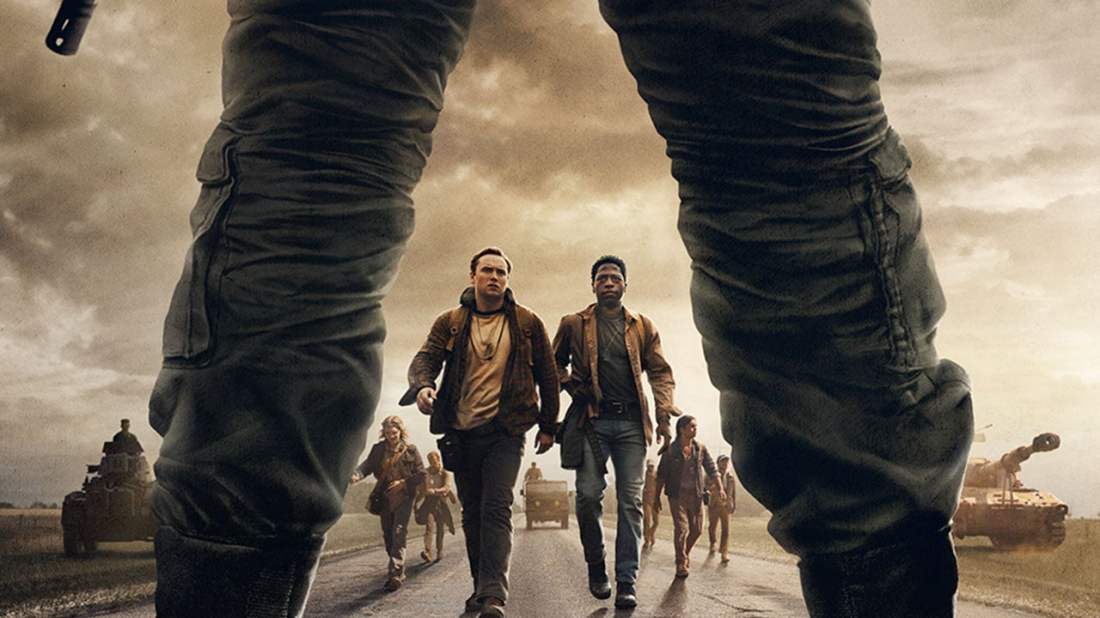
Set in a dystopian version of America, The Long Walk is a competition where 50 young men are chosen from 50 states to walk continuously at a pace of three miles per hour.
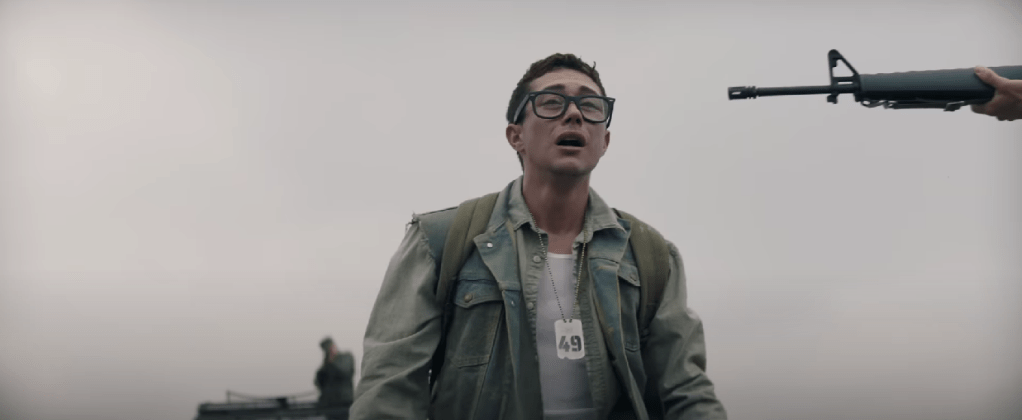
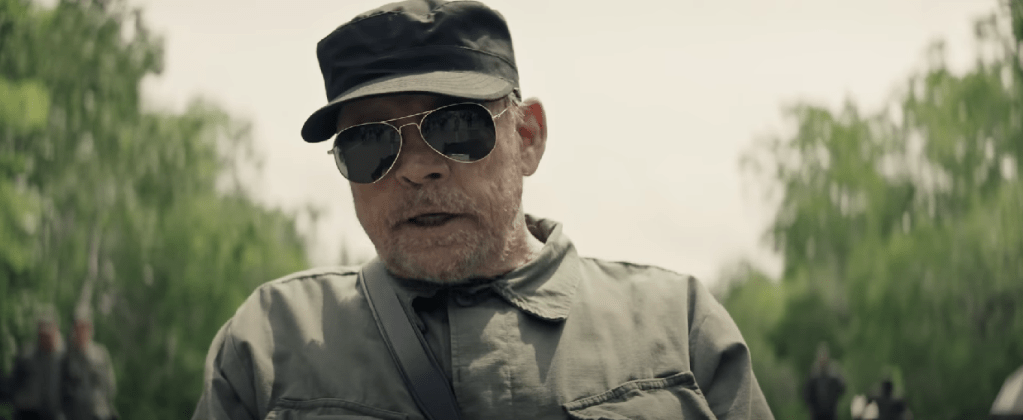
If they fall below the speed three times in three hours then, in the words of Mark Hamill’s villainous Major character, “You get your ticket.”
In simpler terms, you get your brains or guts blown out in a grim and gory fashion.

The deaths in this movie are unflinching in their brutality.

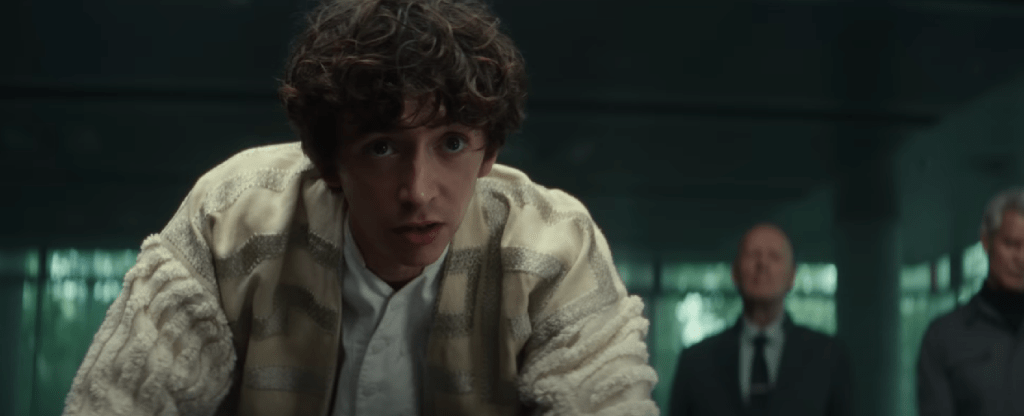
Joining The Long Walk this year is Ray Garraty (Cooper Hoffman, son of the late great Philip Seymor Hoffman), who has joined the life-or-death competition for very personal reasons.
However, over the exhausting days of his journey, he unexpectedly finds a close camaraderie and even brotherhood with his fellow walkers.
This makes the inevitable, gruesome demises of these characters all the more gut wrenching, leading to various emotional sendoffs. 

This does not stop the Major from glamorizing the deaths, making him all the more detestable.

Hoffman is excellent as Garraty, and every other actor in this film does a similarly great job.
There are two I want to highlight though.
The first of these is David Jonsson as Peter McVries, the man who grows closest to Garrity during The Long Walk.
Jonsson was one of the best parts of Alien: Romulus and this trend continues in The Long Walk.
The second actor I want to praise is Judy Greer, who plays Garrity’s mother and delivers some of the most gut wrenching acting of the film in her few scenes.

Even though she does not have much screentime, I would say Greer is the standout.

As I mentioned before, the deaths in this film are gruesome, made all the worse by how likeable the characters are.
Their deaths range from shocking, to abrupt, to heroic, to even one of the most undignified deaths I have seen put to film (trust me, you will know what death I am talking about when you see it).
All of this builds to a crushing ending, which diverts from the book, and leaves a lot to interpret. 

The film ending is a very different experience from King’s novel.

Personally, I liked the change and have my own interpretations of what it all means.
Overall, The Long Walk is one of the best films of the year.
It is full of great characters with fantastic performances, whose constant deaths get you emotional.
That being said, while The Long Walk is a great film, it is certainly not an experience which generates much happiness, so I cannot imagine myself rewatching it that often.
Still, if you are looking to be emotionally destroyed, The Long Walk is the film for you. 

Top 10 The Expanse Books.

There are many different, highly praised sci-fi series out there, so many, in fact, that it is often difficult to decide which one to dive into next.
Sometimes, all you need is the right push at the right moment to get into another great series. 
For me, the push to read James S.A Corey’s The Expanse was the reveal of the upcoming Osiris Reborn videogame by Owlcat Games. 
I rocketed head-first into this spacefaring epic, ultimately finding the burn of the journey more than worth it.  
And wouldn’t you know it?
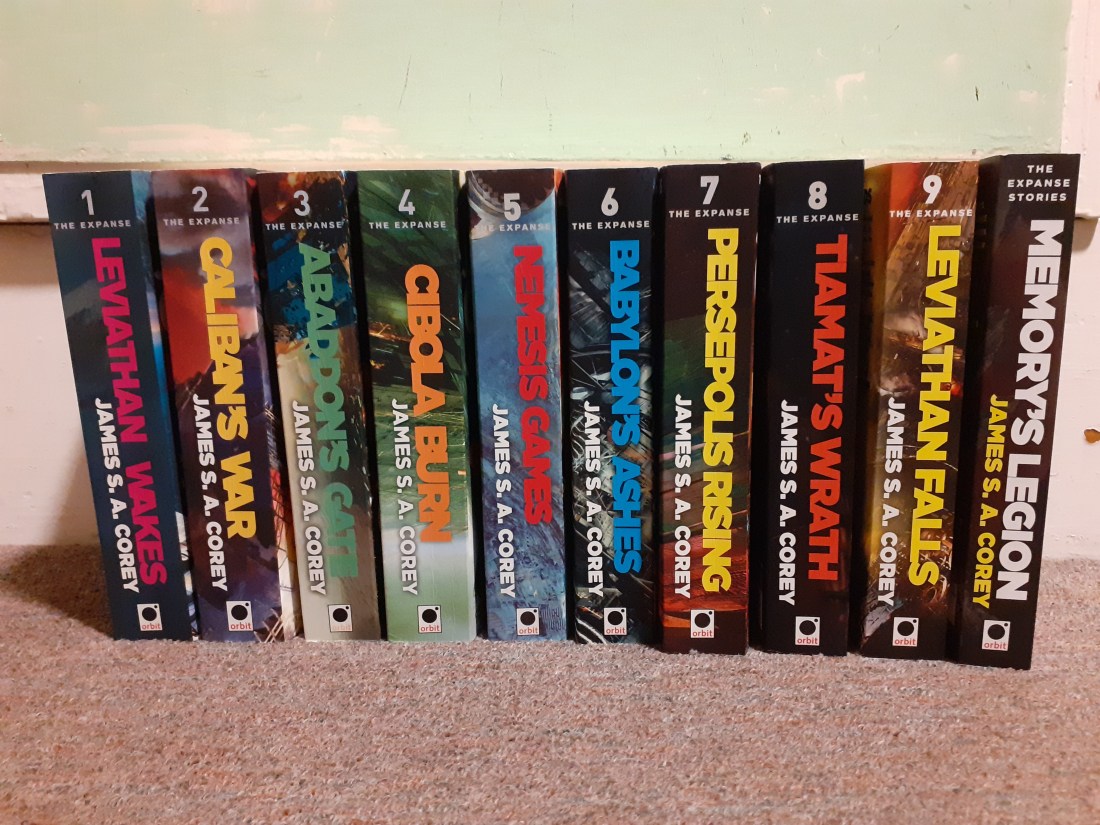
The Expanse consists of ten books.
So, what better way for me to celebrate finishing this amazing story than to rank them from weakest to best?
Keep in mind before reading, this ranking will contain spoilers for the entire series, so only continue if you have read all of the books.
With that warning out of the way, here are my top ten books in The Expanse, starting with…

10. Book Three: Abaddon’s Gate.

The third book in The Expanse is the one I ultimately got the least enjoyment out of reading.
That is not to say the novel is completely without merit though.
Jim Holden remains an interesting protagonist, and his connection with the Protomolecule Miller is quite compelling, especially with how it leads to the Ring Gates opening.
It was Abaddon’s Gate which made me understand why this series was called The Expanse, with the doors to thousands of planets being opened.
For me, though, the best moment in this book was the death of Sam.
I found it to be an abrupt and disturbing moment, which left an impact.
Now we get into my negatives, most of which stem from the other point of view characters.
Bull and Ana make for fairly average POVS but they are nothing offensive.
The real problem emerges with the fourth and final POV character, Clarissa Mao.
Her whole shtick is that she wants to get revenge on Holden for locking her father away in the previous book.
The thing is, her father is a terrible person, who funded experimentation of an alien bioweapon which killed millions, including Clarissa’s own sister.
Not only that, but Clarissa intends to get revenge on Holden by framing him for a terrorist attack she commits, leading to many more deaths.
On paper, this makes Clarissa sound like a villain we could love to hate.
Unfortunately, she is supposed to be seen as redeemable.
This makes every single chapter we spend in her head insufferable to read through.
We have to suffer her murderous hypocrisy, all the while characters like Ana insist she can be saved.
Speaking of, this also makes the story predictable.
The moment Clarrisa joined Ashford’s coup, I knew the conflict would end with Ana convincing her to change sides, thus redeeming her.
Sure enough, that is what happened, removing a lot of the stakes since I could see where the story was going from a mile away.
Thankfully, Clarissa becomes tolerable in later books, but her introduction in Abaddon’s Gate was so unbearable to read through that it shot the book all the way to the bottom of this list. 
Still, I would not say Abaddon’s Gate is a bad book.
It is just my least favorite in The Expanse.   

9. Book Six: Babylon’s Ashes.

After loving Nemesis Games, I went into Babylon’s Ashes excited for the story to come.
Unfortunately, I finished the book rather underwhelmed.
For one thing, this was the first book in the Expanse to expand the POV chapters beyond four characters.
However, instead of expanding the story in interesting ways, it left the novel feeling bloated.
So often, Babylon’s Ashes cuts to a character we have never met before and then we never get their POV again, making it difficult to care.
Not only that, but the antagonists of this book, the Free Navy, are probably the most unthreatening force in The Expanse.
They were a threat in Nemesis Games, but it is made apparent from the beginning of Babylon’s Ashes that they do not really have a chance of succeeding at their long-term goals.
Their biggest success in this book is Fred Johnson’s death but, even then, they cannot claim that because he died of a stroke caused by overwork, rather than their attack.
Another disappointing thing was their defeat, since we had already seen the alien force disappearing ships at the end of the previous book.
All of that being said, there is still a lot I like about Babylon’s Ashes.
Although the amount of POV characters is annoying, some of them do have interesting chapters.
Along with that, the main POV characters are still good, with Holden’s standout moments coming when he attempts to bridge the gap between Earth, Mars and the Belt.
Some of the action is also pretty well written, and this is the book where Bobbie and Clarissa officially join the Rocinante (even if I was still not sold on Clarrisa).
Overall, Babylon’s Ashes is a fine book.
A lot of the action and character work is good but the sheer amount of POVs and the unthreatening antagonists hold it back.     

8. Memory’s Legion.

When I realized that one of the books in The Expanse series was a collection of short stories, I was sure it would be at the bottom of my list.
After all, that is what happened when I ranked the First Law series.
Imagine my surprise when Memory’s Legion turned out to be so good I had to rank it at eighth.
Sure, there are some stories weaker than others, with my least favorite being the third story “Gods of Risk.”
The majority of tales told, however, are great, my favorites being “The Churn,” “Vital Abyss,” and “Strange Dogs.”
“The Churn” explores Amos’ dark past in Baltimore, expanding excellently on what we learned about him in Nemesis Games. 
“Vital Abyss” reveals what happened to the sociopath scientists after Leviathan Wakes and even made me feel sorry for Cortázar because of what he was turned into. 
As for “Strange Dogs,” it tells the tragic tale of how Cara and Xan were resurrected by Protomolecule technology, later leading to their experimentation.
Memory’s Legion even follows up on some characters who disappeared in the main story, like Erich and Filip, which was satisfying for me since I wondered what happened to them.
All in all, Memory’s Legion is a fantastic collection of short stories.
Most of them are great and add to the original storyline of The Expanse. 

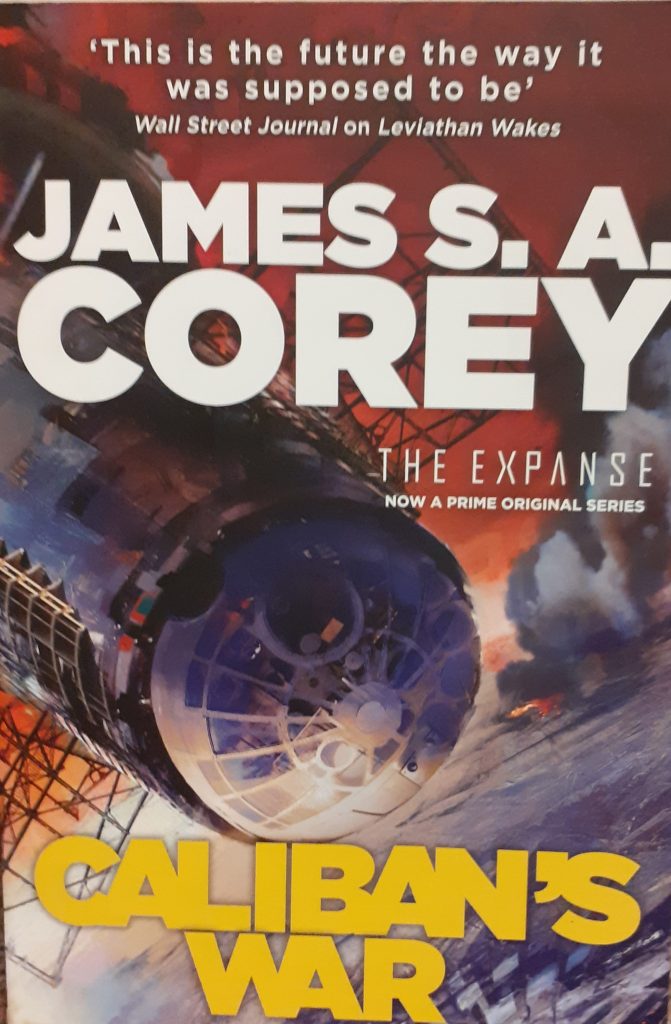
7. Book Two: Caliban’s War.

When I started reading the second book in The Expanse series, I was worried it would not live up to the first.
Even though I much preferred Leviathan Wakes, Caliban’s War is still a great follow-up.
Its opening action scene, with Bobbie’s squad being attacked by the Protomolocule hybrid, makes for a good first impression.
Despite this, I was still concerned when I learned the main storyline would revolve around the kidnapping of a little girl.
It just seemed too similar to the plotline from Leviathan Wakes.
Thankfully, Caliban’s War differentiates itself by introducing a bunch of interesting characters.
Prax’s search to find his daughter is compelling, especially with how it later ties into fabricated stories.
Even better are Avasarala and Bobbie.
They get their introductions in Caliban’s War, and they are some of the best female characters in the Expanse.
In particular, Avasarala is a highlight, with her constant sailor mouth delivering a lot of laughs.  
The only thing keeping Caliban’s War from being higher on the list is an element in the climax.
Holden is aboard a ship infested with the Protomolecule and runs into the ship’s last survivor, who we have never met before.
He then learns someone has to self-destruct the ship to stop the alien weapon.
Luckily for him, the character we literally just met has become infected and volunteers to sacrifice himself.
It felt like the authors wrote themselves into a corner and, to avoid their main character dying, they abruptly introduced this random survivor, who is never mentioned again. 
Otherwise, Caliban’s War is a fantastic follow up to Leviathan Wakes, introducing some of the best characters in the series.   

6. Book Four: Cibola Burn.

It seems like a lot of people rank Cibola Burn quite low among the other Expanse books.
This is a shame because I consider it to be a pretty underrated entry.
The first half of the book is a fascinating exploration of conflict between colonizers and corporations, while the second half goes full-on disaster novel.
We see this from the eyes of various interesting characters, like Havelock and Basia, who had appeared previously in the series but are now elevated to POV characters.
We are also introduced to Elvi, who will be very important in the final two books.
Speaking of Elvi, though, she also presents the funniest moment in The Expanse for me, when she realizes she was not in love with Holden, she just needed to get laid.
As for Holden himself, we get the last of his connection with the Protomolocule Miller for a while, and his conflict with the antagonist Murty is a lot of fun.    
Murty himself was the first antagonist in The Expanse I found truly interesting.
I perfectly understood his viewpoint, and why he saw himself as in the right.
The book even ends on an ominous note with Avasarala revealing that the expansion to different planets will be the death knell for Mars, perfectly setting up Nemesis Games.
Cibola Burn may be ranked low among a lot of The Expanse fans, but I really enjoy it for the characters and conflicts. 

5. Book Nine: Leviathan Falls.

The final book in The Expanse series, I began Leviathan Falls with my fingers crossed that James S.A Corey could conclude the story well.
Thankfully, for the most part, they definitely achieved this, but I will get my small criticisms out of the way first.
For starters, the book did remind me of Babylon’s Ashes at times, with how it would occasionally switch to the POV of a character whose head we had never been in before.
However, this problem was nowhere near as prevalent as in that book.
Secondly, I did not really care for Tanaka as one of the main POVs for the final novel.
I am not sure why, but I just could not connect with her, even as an antagonist.
Finally, while I was enjoying Leviathan Falls, it felt for a while like the events occurring were not really leading up to this being the final book.
However, once we reached that endgame point, the story locked in, and I was riveted all the way to the finish line.   
Leviathan Falls does a fantastic job of proving what is at stake.
Humanity faces the choice of either being forcibly incorporated into Duarte’s hive mind or being destroyed by the aliens who killed the Protomolecule.
Holden being Holden, finds a third option.
Following his final interaction with the Protomolecule Miller, along with his crew, he sacrifices himself to destroy the Ring Gates, separating various human colonies by light years.
Holden’s sendoff was very well done, although I do find it kind of funny that his last words were, “I don’t have a fucking clue.”
The epilogue then shows humanity millennia in the future, having developed its own means of interstellar travel.
And who should the expeditioner’s traveling to Earth meet but Amos, still very much alive and kicking, looking out for humanity, even after all of his old friends have died.
This ending felt perfectly fitting to me.
The only way for humanity to survive was to destroy the Ring Gates, and Holden’s sacrifice still meant humanity could connect thousands of years later.
Leviathan Falls is a worthy conclusion to this great series.  

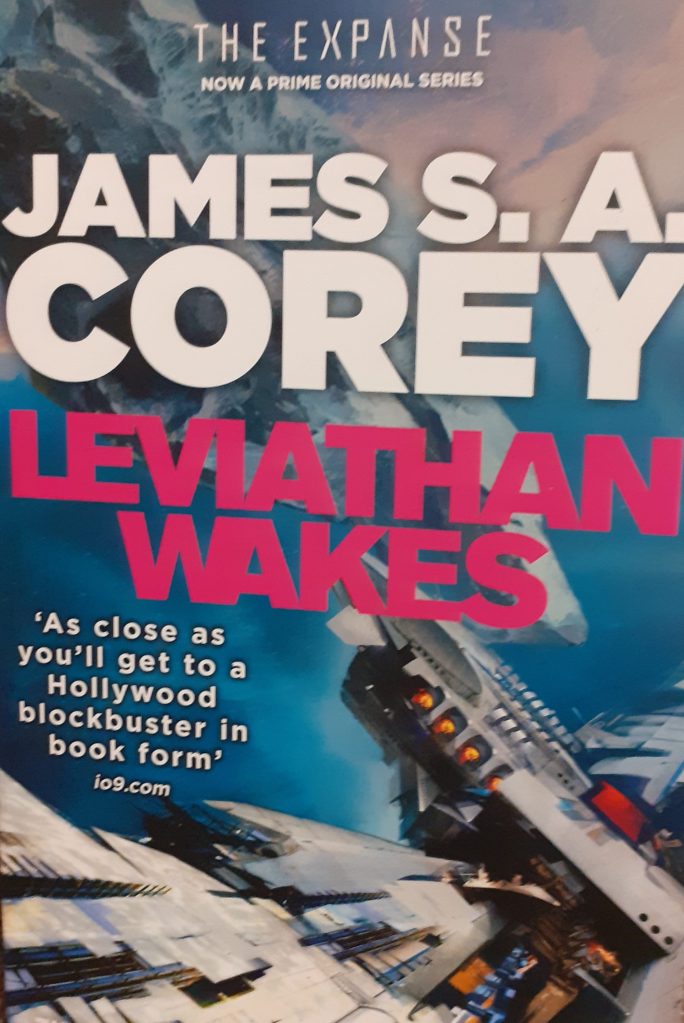
4. Book One: Leviathan Wakes.

Bit of a funny story before I get into my thoughts on Leviathan Wakes.
I happened to be reading this book in the same room as my parents, and they asked me what it was called.
For some reason, I stammered over my words and instead of saying Leviathan Wakes I said Leviathan Wanks.
So, yeah, that was embarrassing.
As for the first book in The Expanse, boy, did Leviathan Wakes make a first impression. 
The portrayal of how humanity had gone on to colonize Mars and the Belt felt so real, as did the numerous cultures and rivalries that emerged. 
These rivalries explode when Jim Holden’s ship is destroyed, starting a war which threatens the Earth, Mars, and the Belt.
At the same time Holden is searching for who killed his friends, a detective named Miller is searching for a missing woman with ties to a revolutionary organization, the OPA.
Both men are unaware that the mysteries they aim to solve are connected, and lead to a far more terrifying conspiracy, as Protogen plans to test the Protomolecule on a civilian population.
The events on Eros are horrifying to read and especially riveting through how Holden and Miller conflict in their values.
Miller is especially compelling, flaws and all, and he was by far my favorite character in this first book.
The way his story concludes, with him finally finding Julie and saving Earth with her, felt very fitting.
The quality of his character is so good that I got excited when he showed again at the end of Caliban’s War. 
Leviathan Wakes was a fantastic start to The Expanse.
The cultures and conflicts it created felt real to me, as did the characters, especially Miller.
It would not be until Book Five where a novel in the series beat Leviathan Wakes in terms of quality, but I am getting ahead of myself.

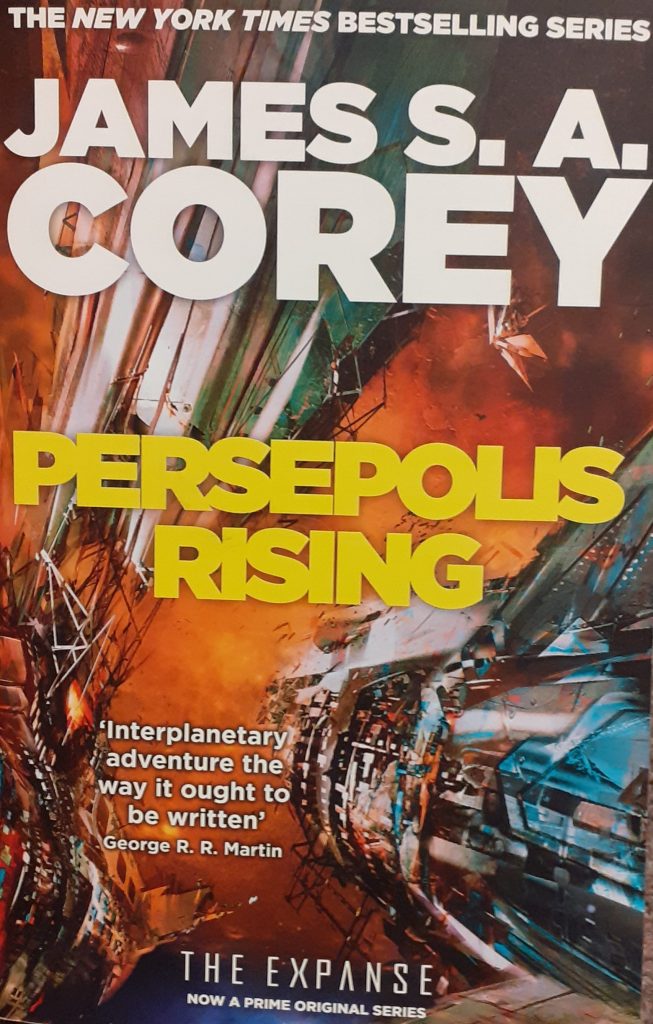
3. Book Seven: Persepolis Rising.

Persepolis Rising has my favorite prologue of The Expanse.
It had me immediately invested in Laconia through the brutal depiction of the Pen, and the grand aspirations of the empire’s dictator, Winston Duarte.
A large part of the reason I love Persepolis Rising comes down to Laconia.
In my opinion, it is easily the most interesting setting James S.A Corey created, and makes for an excellent antagonist for our heroes to fight against.
This is nowhere clearer than with Singh, one of our POV characters.
He only appears in this book but is incredibly compelling, as a family man who is a key part in an authoritarian regime.
This system gradually grounds him down, until even he goes too far for its standards, and he is put to death in a shocking moment that tells the reader a lot about Laconia as a society.
Our other new POV character is Drummer, whose struggles against the Laconian Empire shows their might and threat level.
Like Singh, her arc is also fantastic, as she eventually comes to draw comparisons between her own actions and the authoritarian rule of her enemy.
And then there is Holden and the crew of the Rocinante, who have aged 30 years since we last saw them.
Clarissa is now considered family among the crew, and she dies is in this book to save Naomi. 
I cannot deny her death is one of the best written in The Expanse, with it feeling like a gut punch, even though I still did not like her very much.
As for Holden, his heroics once again get him into trouble, since he ends the book captured by Laconia.
This leads to his first meeting with Duarte in the epilogue, which has one of the best lines in The Expanse, in my opinion. 
“When you fight gods, you storm heaven,” Duarte says, in the final line of the book.
What an awesome line, although it is made funny in hindsight with how that turned out for Duarte.
Persepolis Rising is an excellent read.
It introduces the most threatening human force of The Expanse, has some of the best character arcs of the series, and has an awesome final line.
And the next book would somehow be even better.    

2. Book Five: Nemesis Games.

Before Nemesis Games, I liked the crew of the Rocinante but I did not love them.
Well, that all changed with Book Five, where I was excited to see the three POVs aside from Holden’s were Amos, Naomi and Alex’s.
This excitement proved to be warranted because Nemesis Games not only made me appreciate these characters way more but it also turned out to be my second favorite books in the series.
The novel follows the Rocinante crew splitting up, where they each begin to uncover clues leading to a grand conspiracy.
We have Holden teaming up with Fred in probably my favorite depiction of their dynamic in the series.
Then there is Alex, who teams up with Bobbie, uncovering the Martian side of the conspiracy, leading to our first encounter with Winston Duarte.
We learn a whole lot about Naomi’s dark past, as she reunites with her former lover Marco and their son Filip.
Finally, there is Amos, who returns to Earth, reuniting with Clarissa, only for Marco and his Free Navy to shower Earth with asteroids, leading to a desperate attempt to escape the planet.
When I saw that Clarissa would be coming back, I immediately got nervous.
I was having such a good time with this book, and I did not want one of my least favorite characters to ruin it. 
Thankfully, Clarissa is not as insufferable as she was in Abaddon’s Gate, and her and Amos witnessing the devastation of Earth was gripping.
The best of the four POVS in my opinion though is definitely Naomi’s.
Watching her struggle between her love for her son and her newfound family in the Rocinante’s crew made for a great arc, creating a lot of emotional moments.
And then there is the epilogue, which both sets up the eventual Laconian Empire and introduces us to the new threat of the aliens which killed off the Protomolecule’s creators.
Overall, Nemesis Games is excellent.
It made me love the Rocinante crew, has a compelling mystery, and sets up a lot of events in the endgame of the story.
The only reason it is not at number one is that some of the things it sets up proves to be rather underwhelming in Babylon’s Ashes. 

1. Book Eight: Tiamat’s Wrath.

“Chrisjen Avasarala was dead.”
The opening line of Tiamat’s Wrath perfectly sets the tone, with a sendoff to one of The Expanse’s best characters and setting up a whole lot of sacrifice.
I loved the introduction of the Laconian Empire in Persepolis Rising, but their characterization truly shines in Tiamat’s Wrath.
We get to see how the Empire rules now that is has pretty much conquered the universe, in all of its authoritarian blemishes.
This perspective mostly comes through the POV of Teresa, Duarte’s daughter.
It is through her we get a fantastic look at what happens when a dictator with a cult of personality falls.
Those below him take charge in his stead, while attempting to maintain the perception that their dear leader is still pulling the strings, even as each strand gets cut no matter how hard they try.
Teresa is also an interesting character, especially due to her friendship with Amos, which actually leads to his unfortunate death… temporarily.
I say temporarily because this is where The Expanse introduces the concept of the alien technology resurrecting people.
Amos’ return is epic, although it does raise the question if this is actually Amos or a clone with his memories.
You be the judge of that.
While Amos’ death is temporary, Bobbie’s is tragically permanent.
That being said, her death is a victory because she sacrifices herself to destroy the Laconian Empire’s flagship, destroying their reputation as unstoppable.
Bobbie would have wanted to die fighting, and I cannot think of a better end for the character.
Along with a close look at how Laconia operates, we also get further insight into the Protomolecule via Elvi who makes her return, ending with her eventually realizing Holden’s grand plan.
The twist that he motivated Cortázar to try and kill Teresa, so that he would be executed, thus putting Elvi in charge of studying the Protomolecule was masterful, made even better by the fact that we rarely get Holden’s POV in this book.
I know it may seem strange, my favorite novel in the series being the one where the main character is mostly closed off from us.
But it all builds to this fantastic reveal, which ends with Holden, Teresa and the resurrected Amos escaping the planet.
There are just so many amazing moments in Tiamat’s Wrath.
From Naomi stepping up to lead the underground, to her reuniting with Alex on the Rocinante, to the battle around Laconia, it is all great.
With an in depth look at Laconia, gripping character moments and sacrifices, and an excellent twist, Tiamat’s Wrath is my favorite book in The Expanse. 

So, there you have it.
My Top Ten The Expanse books.
But this is not where the series ends, because a video game is coming, and there is, of course, the TV show.
I will be watching the show soon, and I might review it season by season, or do another ranking when I finish.
It depends on how I ultimately view the series.
Either way, you can expect another post on The Expanse in the future. 

Clair Obscur: Expedition 33 Review: A Stunning Exploration of Grief.

All of us, in some way, have experienced grief.
Whether it be over the loss of a family member or friend, grief is part of the human experience.
There are many ways we can deal with this grief, both healthy and unhealthy.
Yet, I have not seen a video game explore the concept in such a profound way before as Clair Obscur: Expedition 33.
With many AAA games falling below the mark recently, AA studios have risen to the challenge to fill in the quality gap.
Directed by Guillaume Broche. Expedition 33 is the latest video game to fill in that gap. 

The world will have truly gone mad if this game is at least not nominated for Game of the Year.

Set in an alternate universe, the island of Lumière is facing certain oblivion.
Every year, a mysterious gigantic figure, known as the Paintress, paints a number upon her monolith.
The people that age then disappear in an event known as the Gommage.
With the Paintress counting down, it will not be long before everyone in Lumière has passed on   
And so, every year, a group of expeditioners are sent out to kill the Paintress, so that the people of Lumière can hope to grow old again. 
The game follows, you guessed it, Expedition 33 on this mission.

“She’ll never paint again,” a character states, perfectly summarizing many of the character’s goals.

On the journey is our main character Gustave (Charlie Cox), his adopted sister Maelle (Jennifer English), the intelligent Lune (Kirsty Rider), and the optimist Sciel (Shala Nyx).
They are also joined by a mysterious former Expeditioner named Verso (Ben Starr), his hilarious friend Monoco (Rich Kebble), and the giant friendly creature known as Esquie (Maxence Cazorla).
Together, the seven travel across the land, befriending Gestrels and fighting Nevrons in numerous fantastic battles. 
Expedition 33 is a turn-based game, and it is already one of the best in the genre if you ask me.
Every character feels unique to use with their various different skillsets.
Not only that, but the dodge and parry mechanics are riveting.
There is a lot of challenge in getting the timing down for certain bosses strikes but, when you can parry an eight-hit attack you feel like a god.

It feels very similar to the boss fights of Elden Ring, in that way.

Speaking of the bosses, they are all mostly excellent, as are the soundtracks accompanying them.
This is made all the more impressive by the fact that the game’s composer, Lorien Testard, had never worked on a video game before.
This is a common theme with Expedition 33.
Many of its developers are newbies to the industry, with a lot of them having been discovered by complete chance.
This makes the existence of Expedition 33 nothing short of a miracle, and I would highly encourage you to look into the history of the game just to see how it all came to be. 
Much like the composer, the game’s main writer, Jennifer Svedberg-Yen, had also never written for a video game, and this makes the excellence of her writing all the more inspiring.
The reveal of why the Paintress does what she does is excellent and perfectly set up throughout the narrative.
That narrative also does a fantastic job of building up the characters, especially Maelle and Verso, who are already among some of the most morally complex characters in video games.

I am going to remember Maelle’s journey for a while.

And then there are the themes.
As I stated at the beginning of this review, Expedition 33 is a game that centers around grief and what it can drive people to.
This results in multiple emotional moments, the standout of which is the ending.
No spoilers here, but it had me questioning the morality of characters in such a way that I have not experienced since the ending of the original Last of Us. 
It is an ending I have already seen multiple debates about online, arguing over which character, if any, made the right decision. 

Expedition 33‘s conclusion really makes you think.

As of right now, Clair Obscur: Expedition 33 is my game of the year. 
The gameplay is enthralling, the music is spectacular, and the writing delivers an emotional and beautiful message about grief.
I cannot wait to see what Sandfall Interactive does next in the gaming world.
If their future titles are anything like Expedition 33, we may have another legendary studio on our hands.   

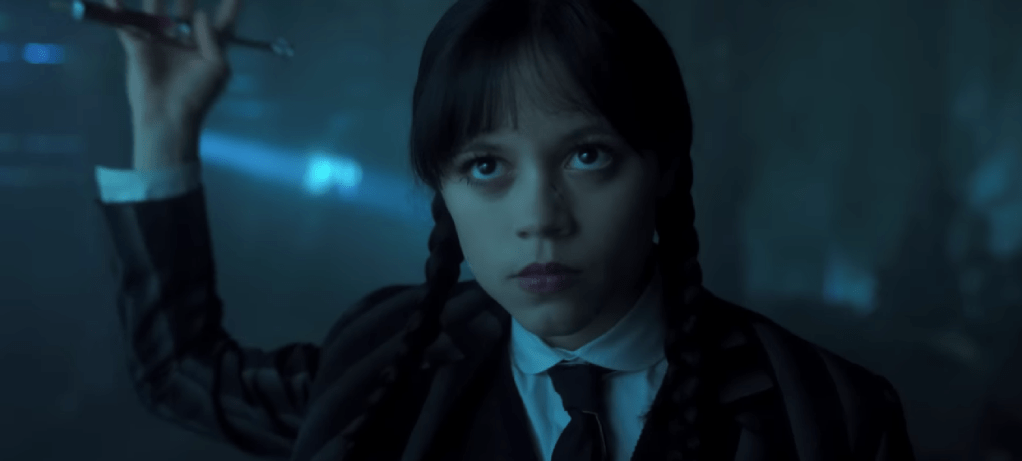
Wednesday Season Two, Part One Review: Let’s Play Dolls.

I quite enjoyed the first season of Wednesday.
The season told its story well, for the most part, holding everything together with great humor and a fantastic performance from Jenna Ortega as the titular Wednesday Addams.
And then we had to wait three years for Season Two.
Yeah, the long wait between shows is really starting to get annoying.
It makes sense for shows like Arcane, where there is a lot of animation to be done, but it feels like it should have been easier for Wednesday’s second season to release quicker.
Now that we do have it, the season has been split in two, which is equally annoying.
At least Season Two improves upon many of the criticisms I had of the first season.
The story picks up with Wednesday returning to Nevermore Academy for the year.
She is not alone this year, however, being joined by her mother Morticia (Catherine Zeta-Jones), father Gomez (Luis Guzman), and younger brother Pugsley (Isaac Ordonez).

Wednesday’s return to Nevermore is a family event.

Things predictably take a turn for the darker, when a new series of murders are committed, and Wednesday experiences a vision of her best friend Enid (Emma Myers) dying because of her.
Desperate to stop this vision from happening, Wednesday works to uncover the mystery behind the murders.
Starting with the positives for this season, Jenna Ortega once again does a great job as Wednesday, bringing a lot of dark humor to the table.
This dark humor persists throughout the season, with a lot of sequences leaving me chuckling.
One of these is Pugsley’s storyline, which sees him teaming up with Eugene (Moosa Mostafa) in a plotline that I am interested to see where it goes in Part Two of the season. 

Pugsley and Eugene make a surprisingly fun duo.

Along with the old characters, there are also a lot of good new ones.
With Principal Weems dying last season, Nevermore gets a new principal, Barry Dort, played by Steve Buscemi.
He is pretty much a ruthless version of the “How do you do, fellow kids?” meme, which makes for quite an entertaining character.
My favorite new character though is definitely Agnes DeMille (Evie Templeton), who is basically Wednesday’s number one fan, although more in the Annie Wilkes Misery fashion.

People online have described Agnes as “an evil version of Luna Lovegood.” Honestly, that is the perfect description for her.

Another positive for Season Two is that it fixes some of my negatives from Season One.
My primary criticism of the first season was that the mystery’s answer was so obvious it made the red herrings infuriating.
Thankfully, Season Two’s mystery is hidden a lot better, and I actually enjoyed its surprises. 
That being said, we still have another half of a season to go, so who knows how the remaining mysteries will be answered.
My second big criticism of Season One was the focus on a love triangle between Wednesday and two other characters.

My hope was that Season Two would focus more on her friendships and investigations.
Fortunately, the season did exactly that.
Unfortunately, the love triangle plotline was transferred from Wednesday to Enid.
Aside from one pretty good joke, this subplot was a complete bore, not helped by one of Enid’s love interests being as blank as a piece of white paper.
What makes this more bizarre is that Wednesday’s motivation this season is to solve the mystery to stop Enid from dying.
Yet Enid’s storyline mostly focuses around which boy she is dating. 

Enid is weirdly out of focus, when saving her life is the main character’s goal.

Hopefully, she will have more importance to the story in Part Two.
Overall, though, I would say that so far Season Two has been an improvement over the first one.
Jenna Ortega’s performance is still great, as is the humor, and the mysteries are handled a lot better.
I hope Part Two can keep the quality up we get it in September.

Weapons Review: A Creepy and Hilarious Mystery.

2025 has been quite the year for horror movies, with the likes of Sinners, 28 Years Later, and now Zach Cregger’s Weapons.
I remember the first piece of promotional material I saw for this film.
It was an over two-hour long video of security footage showing seventeen kids running from their homes and into the night, their arms spread out like airplanes, never to be seen again.
The footage creeped me out and made me wonder what the film would be like.
Then the first trailer floored me, along with most of the internet.
If anyone wants to know how to make a good horror movie trailer, I will point them to that first trailer.
It does an incredible job of building suspense for the film, without telling the audience what is going to happen. 

“Matthew, where are you?” Josh Brolin’s Archer states, showcasing the mystery of the film.

From there, I became obsessed, watching every piece of promotional material I could find about this movie.
Now, after months of waiting, I have finally seen Weapons.
Did it live up to the hype?
Well, yes, but, much like 28 Years Later, not in the way I thought it would.
The trailers made this movie look horrifying and, while I would argue that a lot of it is still pretty disturbing, Weapons is also much funnier than I expected.
I was anticipating some humor.
After all, Zach Creggor’s previous horror film, Barbarian, had a lot of comedy.
But even I was surprised by the amount of humor in this movie.
This is certainly not a bad thing because a lot of the humor is very good. 

And that is not to sell the horror short, either.

But I am getting ahead of myself.
As I said earlier, Weapons centers around the events following the disappearance of seventeen kids from the same classroom.
The film divides itself into various chapters, depicting different characters’ reactions to the tragedy.
We follow the kids’ teacher Justine (Julia Garner), grieving father Archer (Josh Brolin), police officer Paul (Alden Ehrenreich), drug addict James (Austin Abrams), school principal Marcus (Benedict Wong), and Alex (Cary Christopher), the only kid in the class who did not go missing.

Among all of the characters, Julia Garner’s Justine is the lightning rod for suspicion.

Each chapter, with one exception, uncovers part of the mystery, building up to where the storylines collide in an intense and highly cathartic climax.
Seriously, the ending is incredibly satisfying.
It got a lot of laughs and cheers in my theatre, along with quite a few groans of disgust.
The ending mixes perfectly with Weapons’ blend of horror and comedy.
There were quite a few jump scares which got me good, and plenty of unnerving scenes, supported by great cinematography.
What helps sell the horror and humor are the actor’s performances.
If I had to choose who my favorites were, I would say Austin Abrams is fantastic as James, and Amy Madigan may just steal the whole thing with her performance.

Abrams probably gives the best performance of the main POV characters.

That being said, what about the ultimate explanation of why the kids went missing?
Is that satisfying?
For me, it definitely was, but I can see this being a swing and a miss for some viewers.
Another potential issue is that there is some imagery that seems to be there solely for symbolism’s sake, rather than tying into the actual plot.
This may cause some to wonder what the point of these things happening are in the story.
However, although I could see these being issues for others, they were not for me.
Personally, my biggest problem with Weapons is that one of the chapters, the one centering around Paul, did not really seem necessary.
It felt like Justine and James’ chapters explained everything there was to know about him, and his chapter did not have anything to do with the mystery like the other characters.

Paul’s part of the story could have been skipped, to be honest.

That being said, I certainly did not hate his chapter.
It just felt like if you removed it, very little in the plot would change.
Paul would still end up where he needed to be for the climax.
Other than that, though, Weapons is a blast.
It has fun jump scares, creepy imagery, great performances, and an ending which mixes comedy and horror excellently.
As a certain character says in this movie, “Are you watching?”

Barbarian: A Prelude Review to Weapons.

Months ago, advertisements for Zach Cregger’s latest movie Weapons began dropping, and I quickly became obsessed.
The trailers did a perfect job of intriguing me, without telling me too much.
So, with the film releasing in a week’s time, I decided that the perfect way to prepare myself was to finally sit down and watch Cregger’s first horror film, Barbarian.
I had heard of Barbarian when it first released, along with the praise the movie was getting, but I had never watched it before.
After having seen it, I can say that it is a fun movie, which got me even more excited for Weapons. 

Since the movie has been out for a few years, I will be discussing spoilers in this review.

The movie follows Tess Marshall (Georgina Campbell), a woman who books an Airbnb, only to discover a man named Keith (Bill Skarsgård) has been booked in at the same time.
Forced to share a home with him, Tess quickly becomes suspicious, not only of Keith but of the secrets the house may be hiding.
The first half of the movie does a great job building tension, as the audience are left to wonder if Keith is the threat Tess faces or something else. 
This tension builds up masterfully to reveal of the Mother (Matthew Patrick Davis), a giant, naked, inbred woman, who brutally murders Keith and takes Tess hostage, wanting the woman to be her baby.
I had heard of this reveal before watching the movie, but I can still imagine how shocking it must have been for many going into this movie blind, expecting Keith to be the bad guy, only for it to turn out to be an incest monster.

Casting Skarsgård to play this role served as the perfect misdirect.

Speaking of bad guys, it is after Tess’ capture that we meet A.J (Justin Long), an actor who is exactly the kind of guy Tess was worried Keith would turn out to be.
Fleeing to the Airbnb to escape allegations of sexual assault, A.J quickly finds himself drawn into the same horror Tess is facing, albeit in a much more comedic way.
This makes sense given Cregger’s history as a comedian, making him similar to other directors who went from comedy to horror, like Jordan Peele.
The second half of Barbarian is much campier than the first, but it is thankfully the fun kind of campy, as both Tess and A.J are relentlessly pursued by the Mother.

Justin Long brings a lot of welcome comedy to the film.

Escaping to a water tower, A.J attempts to sacrifice Tess to save himself, only for the Mother to rescue her in a moment that I unfortunately found to be unintentionally comedic.
Really, though, that is my only big criticism of the film.
Otherwise, it’s a lot of fun, especially the ending.
Seeing A.J get his eyes gouged out by the Mother was great karma, and I ended up actually feeling sorry for the Mother at the end.
She never asked to be born a monster.
In the end, all she wanted was a baby to love and care for, and Tess had to kill her to save herself.
It honestly is a credit to Zach Cregger that he made me feel sorry for the giant, naked, incest monster.

Wow, that is a sentence I never thought I would say.

In the end, Barbarian definitely got me more excited for Weapons.
It has an intense first half, a fun and campy second, and a surprisingly sad ending.
I have already booked a ticket to see Weapons the day it releases, and I hope it lives up to expectations. 

Superman Review: Yet Another Superhero Movie.

Over the last few years, I have slowly been growing tired of the MCU formula.
I was, however, intrigued by the concept of a new DC Universe from James Gunn.
After how badly handled the last universe was, it needed new hands to shape it, and Gunn seemed like the right guy for the job with his Guardians of the Galaxy movies and The Suicide Squad.
The first film installment in the revamped DCU is Superman, starring David Corenswet as the titular hero.
The movie begins three years after Superman revealed his existence to the world.
In the aftermath of Superman preventing the invasion of another country from its hostile neighbor, Lex Luthor (Nicholas Hoult) begins deploying every scheme he can to ruin the hero’s and destroy him.
With help from various other heroes, his dog Krypto, and Lois Lane (Rachel Brosnahan), Superman works to uncover Luthor’s plot and save Metropolis.

Luthor will go to any extent to destroy Superman.

In terms of quality, Superman is, well, another superhero movie.
Given that Gunn is an MCU veteran, the film feels very similar tonally to various Marvel movies, with lots of humor during serious moments.
If you are not yet sick of this formula, you will really enjoy Superman.
If, like me, you have grown tired of the formula, your experience will be more negative.
However, I think it does Superman credit that, despite me being tired of the humor and tone, I still found myself enjoying the movie. 

There are some emotional scenes that are allowed to play out seriously.

For one thing, David Corenswet is great as Superman.
As a kid, I was never really a big fan of the hero.
I was more of a Batman fan.
Superman just seemed too perfect and one dimensional.
Corenswet sold me on the character, however, with his endless optimism, and the film actually does a great job of weakening Superman, making him more relatable.
Another highlight for me was Nicholas Hoult’s portrayal of Lex Luthor.
He does an excellent job of making me hate the petty narcissist.
But the big surprise for me was Edi Gathegi as Mr. Terrific.
I had honestly never heard of the character before I watched this movie but, after seeing it, I am more than on board for a potential Mr. Terrific movie. 

Terrific’s constant seriousness mixes oddly well with the lighthearted tone of the film.

Along with the fun characters, the movie also has plenty of feel-good moments, most notably between Clark and his parents.
The message is also good, mixing well with Superman’s optimistic outlook on life.
“You think everyone is beautiful,” Lois tells Clark at one point, and it really shows in this movie.
However, there is also some bad with the film.
As I said, I have long since grown tired with the constant humor during serious moments.
Superman unfortunately follows this formula for the most part.
Granted, I did chuckle a couple of times, and the humor is far from aggravating, but I do wish they toned it down a bit.
The CGI is also a bit iffy at times but that is to be expected with these kinds of films.
My biggest issue though is some of the subplots.
For example, there is this subplot with Jimmy Olsen (Skyler Gisondo) which ties into the main storyline, and that just felt bizarre to me. 
Overall, though, Superman is still a pretty fun time.

I mean, the film has Krypto the dog. How could it be bad?

The performances are good, and it made me willing to see other superhero properities in this new universe, like the Supergirl movie which is coming next year.
I just hope the other films in this new DCU have different tones, and it’s not all just quippy humor.
We need some variation.

Squid Game Season Three Review: The Games Conclude.

In 2021, the world was glued to the screen watching Squid Game. 
Now, in 2025, Hwang Dong-hyuk has brought his story to a close with Season Three.
The Second Season ended pretty abruptly, but this was forgivable with the knowledge that the final season would be coming quickly.

It would have been extremely frustrating if we had to wait years for Season Three after such a big cliffhanger.

Now that we have seen that conclusion, did I think it was a worthy one?
Absolutely. 
It is certainly not without its hiccups, but I think Season Three was a great way to end the story… well, this part of it at least. 
Season Three of Squid Game kicks off in the aftermath of Seong Gi-hun’s (Lee Jung-jae) failed rebellion.
Now blaming himself more than ever, Gi-hun is forced to take part in the rest of the games with the remaining players, all the while Jun-ho (Wi Ha-joon) continues to search for him on his boat, and soldier Kang No-eul (Park Gyu-young) attempts to get player Park Gyeong-seok (Lee Jin-wook) off the island. 
The remaining games of the final season are all intense, delivering plenty of tragedy, as the characters we met in the Second Season begin dropping like flies.

This game was definitely worth the Second Season’s post credit tease.

At numerous points, characters I expected to make it late into the games died early, and these deaths are just as tragic and tear-inducing as they were in Season One… for the likeable characters that is.
The best character of the season, though, is by far Gi-hun.
His arc and the conclusion to his character is both moving and fits in well with the theme of Squid Game. 

Lee Jung-jae is phenomenal as Gi-hun.

The ending, while being controversial among viewers, was mostly fitting, in my opinion.
It even seems to hint at a potential spinoff, maybe an Amercian Squid Game.
Personally, I think it would be interesting to see how such a hypothetical show would work with American commentary, especially in its current heated political climate.
Along with the controversial ending, another thing viewers did not like were, of course, the VIPs.
They were, by far, the worst part of Season One, with their terrible acting and writing.
This tradition continues in Season Three but, oddly enough, I actually found myself appreciating the VIPs’ presence this time around.
Don’t get me wrong, their acting and writing is still absolutely atrocious, but I actually found it hilarious in a so bad that it’s good kind of way.

I kid you not, one of the VIPs says, “This is the biggest twist since the resurrection of Jesus Christ!” The writing and delivery was so hilariously awful I could not help but laugh.

Less funny is Jun-ho’s continued boat subplot this season, which goes pretty much nowhere by the end.
I quite enjoyed his investigation in the first season, and it was extremely frustrating to see him relegated to boat duty these past two seasons. 
Choi Woo-seok (Jeon Seok-ho) is honestly a better detective than him, with his mission to investigate the suspicious boat captain.
I was even disappointed by the lack of interaction between Jun-ho and his brother In-ho (Lee Byung-hun).
The Frontman was one of the best parts of Season Two, so it was sad to see he got much less time to shine this season, even if his arc is still really good.

I wish we got more Frontman screentime with Gi-hun.

Overall, I would still stay Season Three is a great conclusion to Squid Game. 
It has a fantastic arc for its lead character, brought me to tears a few times, and teased a spinoff which I personally think might turn out for the better.
Or maybe I am wrong, and this potential spinoff will be just as tone deaf as the various reality shows and product placements Squid Game unintentionally inspired.
We will have to wait and see.  

28 Years Later Review: A Thrilling and Oddly Moving Return.

In my teens, I went through a zombie phase. 
The Walking Dead, The Living Dead franchise, and The Last of Us were all zombie properties I greatly enjoyed. 
And then there was 28 Days Later. 
The movie which introduced the concept of running zombies (I know, I know, they are called infected in the film), 28 Days Later truly scared me.
Despite liking other zombie movies, I always wondered how the zombies caused apocalypses when they walked so slow.
But the Rage Virus in 28 Days Later convinced me by introducing not only fast zombies, but ones with an almost instant turn-rate upon infection. 
Due to how much this concept frightened me, it took me a while to watch 28 Weeks Later but, when I finally got the courage to do so, I was met with one of the best horror openings in movie history. 

Watching Don abandon his wife to survive was shocking and riveting.

So, when it was announced over twenty years later that Danny Boyle and Alex Garland were returning to make a third installment, I was obviously excited.
My excitement only grew with the first trailer, which I consider one of the best trailers of all time.
It turned an already grim poem, Boots by Rudyard Kipling, and made it even more terrifying.
Now, after many months of waiting, 28 Years Later is finally here. 
Having literally just returned home from having seen it, what did I think of it?
Well, I am pleased to say that 28 Years Later is a great film… but not in the way I expected. 
Directed by Danny Boyle, and written by Alex Garland, 28 Years Later picks up, well, 28 years after the Rage Virus has decimated the UK.
Despite the mainland being full of infected, some have survived on a nearby island.
One day, scavenger Jamie (Aaron Taylor-Johnson) takes his young son Spike (Alfie Williams) to the mainland in the hopes of him getting his first infected kill.

The movie truly begins with Spike’s coming-of-age mission.

While out there, they encounter new kinds of infected, a body mysteriously hung up by the feet, and signs of other survivors. 
Spike learns that one of these survivors may be Ian Kelson (Ralph Fiennes), a doctor who could potentially help his sick mother, Isla (Jodie Comer).
That is all I will say about the plot, though.
The movie is well acted across the board, with the young Alfie Williams being the breakout star, in my opinion.
As for the cinematography and editing, both are stellar, delivering quick and frenetic shots of the infected, which make them just as scary as they were in the first two films, if not more so.
What makes this especially impressive is that 28 Years Later was filmed on an iPhone. 
I know the director did not just pull an I-Phone out of his pocket and start filming, there was clearly other technology involved in making this film look as good as it does.
But, still, it is impressive.

28 Years Later looking so good makes me wonder how other films made using iPhones and similar technology could look.

Moving onto the quality of the story now, what did I mean when I said the film was great but not in the way I expected?
From the trailers, I expected 28 Years Later to be a constant thrill ride, full of horror and tense scenes.
While those things were certainly present, what I was not expecting 28 Years Later to be was moving, with an especially poignant message about death and letting go. 

“There are many kinds of death,” Ralph Fiennes’ character tells us.

Speaking of the unexpected, though, what the hell was up with that ending?
It felt like the movie switched genres. 
That is not a complaint, however.
I thought the abrupt tonal shift of the ending worked brilliantly, especially with how it both paid off prior foreshadowing and also paved the way for the future.
That’s right, a sequel is on the way: The Bone Temple, which was shot consecutively with this film and is expected to release early next year. 
After how great 28 Years Later was, and the impact of its ending, I will definitely be checking the sequel out when it comes to theaters. 

The ending left me hungry for more 28 However Long Later.

So, I have had a lot of good things to say about 28 Years Later, but do I have any negatives?
Well, if I had to nitpick, I would say the CGI could be a bit noticeable at times, but that’s about it.
Otherwise, 28 Years Later is a fantastic film and more than worth the wait. 
It is gory, thrilling and, above all else, surprisingly moving, making 28 Years Later one of my favorite films of 2025 so far, alongside Sinners.
I am already looking forward to The Bone Temple.    

The Devils Review: Another Grim and Hilarious Tale from Joe Abercrombie.

One of my favorite fantasy series is Joe Abercombie’s First Law.
Full of amazing characters, extremely dark humor, and compelling prose, the series is beloved among many a fantasy fan.
So, when Abercrombie released the first installment of a new trilogy, The Devils, I was sure to pick it up.
Having recently finished it, I can definitely say I am on board for this trilogy.

As always, Abercrombie does not disappoint.
Set in an alternate version of Europe, the ruling church has become divided.
To unify it against a coming horde of man-eating elves, a monk named Brother Diaz is entrusted with ensuring a thief named Alex inherits the throne of Troy.
However, with many after Alex’s head, Brother Diaz requires the aid of the Chapel of the Holy Expediency.
Essentially a medieval Suicide Squad, the Chapel is a group of expendable monsters the church sends to do its dirty work.
The titular Devils includes Jakob of Thorne, the knight who cannot die; Babtiste, the woman of many previous professions; Balthazar, the egotistical necromancer; Rikard, the dumpling loving vampire; Sunny, the invisible elf; and Vigga, the nordic, sex obsessed werewolf.    
Naturally, this provides a wide range of characters for Abercrombie to explore across The Devils’ 500 plus pages. 

Abercrombie goes in deep with these characters, especially Balthazar, whose story truly goes full circle by the end.

Unfortunately, I would say some of the characters, like Babtiste and Rikard, do get the short end of the stick in terms of page time and exploration.
However, Abercrombie excels with the other characters, making them relatable, terrifying and often hilarious.
Speaking of the latter, The Devils is the most comedy driven Abercrombie novel to date.
Some readers have criticized this, saying that there is way too much humor, but I personally found it to be a good blend with the serious stuff.
Other criticisms include the book being a bit repetitious at times and some of the ending twists being obvious.
While I will admit these things were noticeable, the good far outweighed the bad, especially with the character interactions. 

I began reading The Devils expecting excellent characters and that is exactly what I got.

The growing bonds between Sunny and Alex, and Brother Diaz and Vigga were particular highlights for me.
Along with that, the commentary is also stellar, with Abercrombie once again showing the corruption of power, which works well with both the alternate Europe and his brand of dark humor.
Overall, The Devils is a lot of fun.
It is hilarious, gory, and has a lot of great characters who I would like to read about again in the future.
I look forward to reading the rest of Abercrombie’s new trilogy.