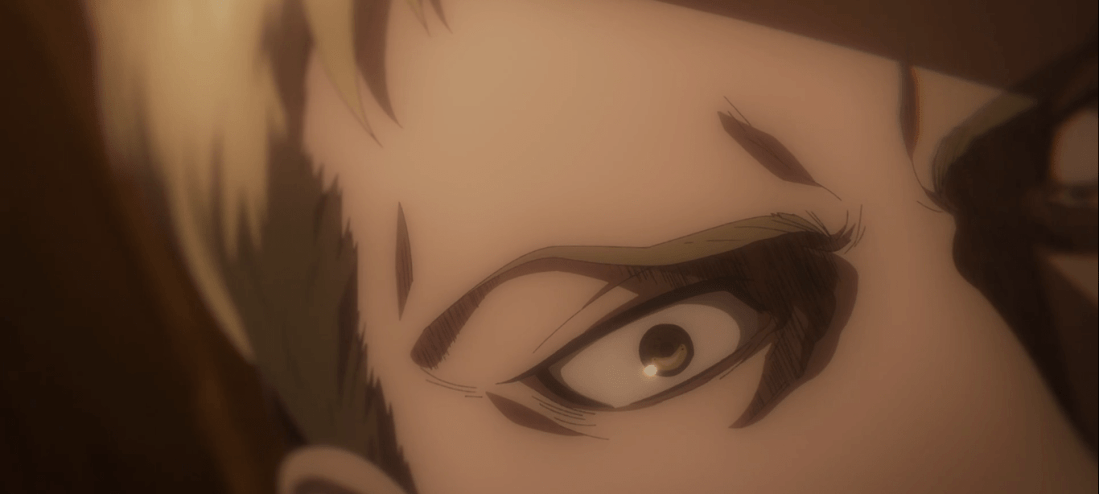
Attack on Titan, Final Episode Review: An Improved and Beautiful, yet Messy Ending.

Attack on Titan has taken us all on quite the journey.
Over the span of ten years, and with four seasons, Wit Studio and Mappa have animated Hajime Isayama’s story brilliantly.
Now, it’s over.
Going into the final episode of Attack on Titan, I was curious to see how I would feel about the ending compared to the manga.
When I first read the final chapter, I honestly went back and forth on whether I liked it or not.
Then, I sat down and read through it while thinking about what Isayama was trying to say, and I came to the conclusion that the ending was a mixed bag, with plenty of good and bad things about it.
It was for this reason that I was hoping the updated ending, which released months later, would fix some of my problems.
Unfortunately, the opposite happened, with the extra pages pushing my opinion on that final chapter into a negative direction.
I have re-read the series a couple times since then and, while I still love it, my opinion of the ending has only become worse with each read through.
All of this made me hope that there would be some changes to the anime’s ending.
I knew we would not be getting an anime original ending, but I had my fingers crossed that there would be extra scenes or dialogue to explain some things better.
After all, Mappa added an extra scene showing what happened to Grisha’s parents in the previous special episode, which I unfortunately did not get around to reviewing. 
Seeing that added scene gave me some hope that there would be new additions to the conclusion.
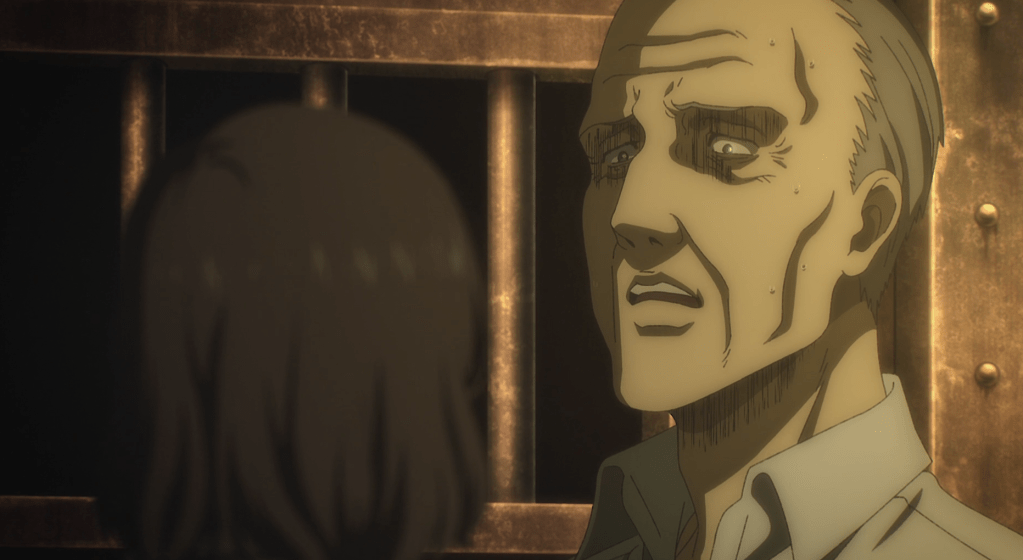
I was glad to see the fate of Eren’s grandparents confirmed in the anime, even if it was tragic.

So, having now seen the final episode of Attack on Titan, do I think the anime improved on the manga’s ending?
Yes!
Do I like it now?
Not exactly, no.
In my opinion, the ending still has a lot of problems.
However, most of these big issues only appear in the last half hour.
The rest of the final episode is mostly great, with incredible animation from Mappa and a fantastic score. 
This is going to be my largest review by a wide margin, so buckle up.
The episode begins where the previous special episode left off, with the Alliance landing on Eren’s gigantic Titan to confront him and stop the Rumbling.
Armin quickly realizes he has to transform into the Colossal Titan to try and locate Eren and Zeke but, before he can, he is kidnapped by an okapi Titan created by Ymir.
The panels of the okapi sticking its tongue down Armin’s throat to prevent him transforming were already disgusting in the manga, but it’s a million times grosser here.
As the okapi takes Armin away, the rest of the Alliance are surrounded by countless Titans, whom Pieck correctly speculates are copies of all the previous Titan Shifters.
Back when this happened in the manga, I criticized it for feeling out of nowhere, but in retrospect I think this was actually a pretty cool writing decision on Isayama’s part.
Realizing the danger they now face, Pieck goes to kill Eren quickly by attempting to detonate the explosives at his head, but she is stopped by a copy of the Warhammer Titan.
Following this, the Alliance are attacked by the copies, including ones of Porco, Marcel and Bertolt, in a thrilling action scene, expertly animated by Mappa.
This ends with everyone in the Alliance cornered, about to be killed, when who should show up to save the day but Annie, riding Falco’s flying Titan with Gabi.
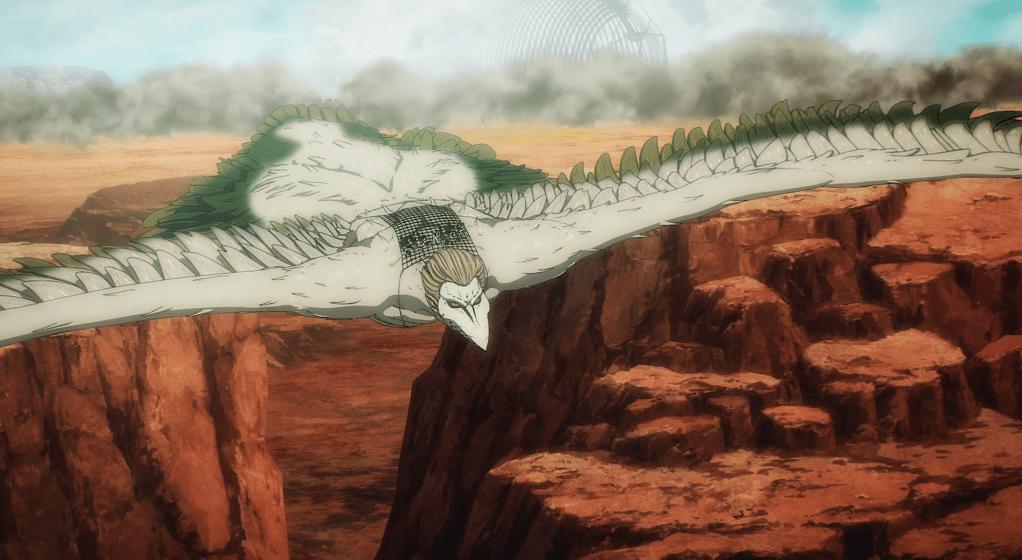
It was cool to see Falco flying after the previous episode foreshaodwed it.

Now safe on Falco’s back, the Alliance discusses their next move, and all regretfully agree that their only option is to kill Eren, much to Mikasa’s horror.
Circling back to Eren, the Alliance splits up, with Jean and Reiner going to detonate the explosives Pieck wrapped around Eren’s neck; Mikasa, Annie and Connie going to rescue Armin; and Falco, Levi and Gabi continuing to fly above.
More amazing animation follows, with the best parts of this section being Pieck’s jet-pack Titan skills, and Mikasa and Annie humorously arguing over which Titan it was that took Armin.
This second match goes about as well as first, however, with the Alliance on the ropes again.
Armin is watching all of this happen and, standing over his own unconscious body, screams at himself about how useless he often feels.
This is probably my favourite voice acting from the final episode, with Marina Inoue giving a fantastic and emotional performance.
Although, despite how emotional this scene is, it has nothing on the cliff scene that follows. 
When I watched the previous special episode, I was disappointed to see this moment was not adapted, and I was desperately hoping that it would be in the final episode.
Well, I was not disappointed because this scene is next and it is even more powerful that I imagined it being.
The scene shows a group of thousands of people trapped between two kinds of certain death.
They can either be crushed by the Rumbling, or they can fall off a cliff to their deaths.
As the Rumbling closes in, people are eventually forced off the cliff, one of these people being a mother.
With one last, courageous act, the mother passes off her baby before she falls to her death.
As the next person holding the baby falls, they also pass the baby on, and on, and on, and on.
Countless people all facing their inevitable deaths pass this baby on in what they know will most likely be a futile attempt to save its life.
It is one of the most beautiful and horrifying moments in the entire series, and seeing it in the anime made me tear up.
The visuals for this scene only add to the emotion, with everything being in black and white with the exception of the mother and her baby.
I am almost certain that the way this scene was animated was inspired by the little girl in the red coat from Schindler’s List.
This scene is, without a doubt, my favourite in the entire episode.

This is one of the most powerfully emotional scenes in Attack on Titan.

Back with Armin, after some perseverance, he realizes he is in the Paths Dimension and this leads to his meeting with Zeke, who has been trapped ever since Ymir chose to support Eren over him.
Zeke has completely lost all motivation to keep going, now believing life to be more pointless than he already did.
Armin, however, speaks against this, remembering a time when he, Eren and Mikasa ran to a tree on a hill, comparing it all the wonderful little moments in his life which made it worth living.
As a leaf Armin picks from the sand turns into a baseball before Zeke’s eyes, the Beast Titan remembers playing catch with Mr Ksaver and how this was also one of those little moments which made life worth living.
This somehow motivates the ghosts of past Titan Shifters to appear and help the two. 
Armin says this was Zeke’s doing but how Zeke achieved this is never really explained.
Unfortunately, there are quite a few things in this final battle which are never explained but I will get to those in a bit.
In any case, the past Titans, who knew the Alliance, come back from the dead temporarily to help stop the Rumbling.
Among these Titans are Grisha and Kruger, and some fans have questioned their reasons for doing so.
For Kruger, I think it makes sense.
Yes, he would want to free the Eldians of Paradis, but a full Rumbling would also kill all of the Eldians outside Paradis, which he would be against since he wanted to free them too. 
As for Grisha, I still find myself confused about his motives.
Yes, he did tell Zeke to stop Eren but Zeke later says that Eren showed Grisha something which made him hand over his Titan powers.
We never see what this was, and the reason for Grisha giving Eren the Attack and Founding Titans and then later helping the Alliance are a mystery.
I just wish there was more of an explanation for Grisha’s actions.
As for his son, Zeke decides that, even though he does not believe his euthanization plan was wrong, he would not mind being reborn again.
With this fitting decision, Zeke reveals himself to Levi, giving the Scout the chance to cut off his head and stop the Rumbling.
While I would have liked it if Zeke had more time to shine in this final episode, his ending is satisfying to me. 

It is fitting for Zeke to realize the beauty the world has to offer moments before his death.

Following Zeke’s death, we get another moment which does not make much sense, which is the stopping of the Rumbling.
The reasoning for this is that Zeke’s royal blood was key to the Rumbling continuing so killing him stops it, but the only reason royal blood was needed was because Ymir valued it.
However, Ymir disobeyed Zeke and sided with Eren so royal blood should not be a factor, anymore.
Yet, the Rumbling still stops?
Whatever the explanation for this, Armin is freed and Jean blows up the explosives, freeing the source of the Titan powers from Eren’s body, which seeks to reconnect with him.
To stop this, Reiner holds the creature down while Armin transforms into the Colossal Titan, blowing Eren’s gigantic Titan form away.
In the aftermath of the explosion, the Alliance lands at the fort and the Warriors reunite with their families, only for the creature to still be alive, and for Eren to transform into a Colossal Titan.
The creature then sends Titan smoke up to the fort to transform all the Eldians there so they can help it reach Eren.
And so, Mikasa, Levi, and the rest of the immune Alliance go to fight Eren, leaving Jean and Connie to their fates.
If this had been Jean and Connie’s final scene then it would have been a pretty tragic one, as would Annie reuniting with her father only for him to be immediately transformed.
This transformation also crushes a lot of the rapport Mr Leonhart was building with Secretary Muller, which could have had a lot of hope for the future.
As Reiner, Annie and Pieck hold the creature back from reaching Eren, Armin fights his old friend off, while Mikasa and Levi rush to them.
While they are doing so, Mikasa experiences another headache and seemingly remembers an alternate version of the future Eren showed her, where they ran away together.
Honestly, I do not believe Eren would have run away.
Sure, I think some part of him may have desired to, but he has always been the kind of guy to stand and fight so I don’t think him running away with Mikasa would have happened, even if she had offered.
Still, the scene is pretty emotional, with Eren using this as his goodbye to Mikasa.
After this goodbye, Mikasa somehow knows Eren is in the mouth of his Colossal Titan, which is something else I wish was explained but is not.
Levi blows a hole through Eren’s mouth and Mikasa leaps through to decapitate Eren and finally end the nightmare of the Rumbling once and for all.
Eren’s death is very emotional but I wish the following kiss with Mikasa had occurred in the alternate version of the future he showed her, and not when Eren is dead.

Seriously, the shot of Mikasa kissing Eren’s decapitated head is pretty uncomfortable.

Also, Mikasa remembering the alternate realtiy Eren showed her raises yet another plot hole.
In the manga, I was fine with this moment because I thought Eren was showing it to her in the present, but the anime seems to confirm that Eren showed her this alternate future and then erased her memory of it.
This should be impossible because Ackermans are immune to Titan powers.
As I have shown, there are quite a few plot holes with Attack on Titan’s final battle.
However, despite this, I would still say that the final episode has, up until this point, been very good.
The animation, soundtrack and action have all been spectacular, and there have been some emotionally powerful moments, most obvious of which is the baby scene.
Unfortunately, the episode then gets into adapting Chapter 139 and this is where I think the writing goes downhill.
This is mostly because I believe the following scene is the worst in all of Attack on Titan.
The scene is a flashback, revealing that Eren brought Armin into the Paths when he was on the boat.
The reason I consider this scene to be the worst is because it is full of so many last minute plot twists that are either poorly foreshadowed, problematically written, or recontextualize prior amazing scenes to make them worse.
The first of these twists is the reveal of Eren’s motivations.
Eren reveals that his plan this entire time was to commit the Rumbling so that the Alliance would kill him and become heroes to the world, allowing them to potentially save Paradis.
Was there foreshadowing for this?
Yes and no.
On the one hand, if you look at Eren’s actions from the previous special episode onwards, it makes sense.
Eren allowed the Alliance to come and fight him, rather than stripping them of their Titan powers, and there were multiple points in the final battle where the only explanation for why none of the Alliance died is that Eren deliberately let them live.
However, before the first special episode, there are many moments that seemingly contradict Eren’s supposed motives.
The most notable of these is at the end of Episode 87, where Eren states in his own inner monlogue that he will “wipe out every last one of ‘em.”
Along with these seemingly conflicting motives, Eren’s plan is just too similar to Lelouch from Code Geass for me.
In regards to Eren himself, personally, I think it would have been better if his main goal had been a full Rumbling all along.
I am not saying that Eren winning should have been the ending.
I do believe that the Alliance stopping him was the right call for the story.
But I think Eren would have been a much more compelling character if he had stayed true to what we all thought was his original plan.
Still, at least this twist had some foreshadowing, which is more than I can say for the next few ones.
Following the reveal of Eren’s motives, the next big twist is that the reason Ymir did all of this is because she was in love with her abuser.
I hate this reveal.
When I read it in the manga, it took what used to be my favourite chapter, Ymir’s backstory, and threw it far away from my top ten chapters.
Ymir loving Fritz makes absolutely zero sense.
He killed her parents, cut out her tongue, raped her, used her as a weapon in war and then, when she died, fed her corpse to their children.
And you are telling me Ymir loved this monster?
If we saw Fritz pretending to be kind to Ymir to manipulate her, maybe I could believe it, but we don’t seeing anything like that.
He is just completely horrible to her for all of their time together.
It really ruins a lot of scenes from Ymir’s backstory for me, like the moment when Fritz says he will “reward” Ymir with his “seed,” while she looks absolutely miserable.         
This moment made me feel so sorry for Ymir when I first read it, but now I just feel dirty watching it because it makes me wonder if Isayama is trying to say she was secretly happy about it. 

The reveal of Ymir’s love for the king is probably my most hated of the twists because of how it pretty much ruined my appreciation for Chapter 122.

In my opinion, there was another, perfectly good explanation which should have been used to explain why Ymir stayed in the Paths for 2,000 years.
She loved her children.
We see this later on in the episode when she imagines living on with them.
This should have been the explanation for Ymir’s actions, not this extremely problematic love for her abuser, which was probably only a twist to justify Mikasa’s abrupt connection with her.
This brings me to the next bad twist, which is that Ymir was waiting for Mikasa the entire time.
With the exception of Ymir smiling at Mikasa kissing Eren’s decapitated head, there was zero foreshadowing for this.
Not only is there no foreshadowing, but we also get no explanation.
What we get instead is Eren saying “only Ymir knows” which is a complete cop-out.
This was the anime’s chance to give us an answer for something which was missing in the manga and they blew it.
Not to mention that mirroring Eren and Mikasa’s relationship with Ymir and King Fritz’s abusive one is very problematic, since Eren and Mikasa are supposed to be the main ship here.
The final terrible twist in this scene is the reveal that Eren caused his mother’s death by making Dina walk past Bertolt.
There are so many things wrong with this twist.
For starters, it’s a retcon.
We already had an explanation for why Dina killed Carla.
Dina’s final words to Grisha before she was transformed into a Titan were, “No matter what form I take, I promise I’ll come find you.”
So, when we saw Dina walk past Bertolt, we were not wondering why she did so because we already knew.
Dina sensed Grisha in Shiganshina, went to his house, only to find Carla, and that is when her Titan instincts took over and she ate her.
It was a perfect explanation, and to change the meaning of it removes all emotional impact from Dina’s final words, all for the sake of a such a short twist.
This leads into my second big issue with the reveal, which is how brief it is.
Out of curiosity, I timed how long this twist is focused on before it is forgotten about forever.
Do you want to know how long it was?
Fourteen seconds.
Fourteen seconds spent on a twist which recontextualizes the entire beginning of the story and, as a result, it makes absolutely no sense.
Has Eren manipulated the past before?
Yes, but there was a very specific set of circumstances which allowed that to happen.
Zeke brought Eren into Grisha’s memories using the Founding Titan.
Both Eren and Grisha had the Attack Titan, whose ability is to see into the memories of its future successors.
This allowed Grisha to see Eren’s memories of visiting his own.
And so the two could communicate across timelines through memories.
There was no actual physical time travel.
Dina did not have the Attack Titan, she was just a regular Titan, so Eren should not be able to order her through memories.
Therefore, in order to control her, Eren would have had to physically gone into the past and used the Founding Titan to command her to walk past Bertolt, which is a power that has never been established.
Thus, the twist should be impossible, providing probably the biggest plot hole with the ending.

The reveal of Eren causing his mother’s death was just really unnecessary. If you remove it nothing else changes.

So, as I have shown, this scene has a lot of bad twists, but it’s not just the twists that I take issue with because, up next, is without a doubt the most memed scene in Attack on Titan.  
After Armin punches Eren for how he treated Mikasa and jokes about her finding another man, Eren cries about it, saying he wants her to pine only after him for at least ten years.
I knew this scene was coming, and I still cringed into the back of my seat when I watched it.
I think a big part of the reason this moment does not land with me is because of how Eren and Mikasa’s relationship has been handled.
Sure, there have been a few romantic moments between them.
Their final scene togethor in this episode, Eren saying he would wrap Mikasa’s scarf around her at the end of Season Two, and Eren asking Mikasa what he was to her while they were in Marley.
However, these three moments are the only times Eren ever showed romantic interest in Mikasa.
Otherwise, he’s either treating her like family or treating her badly.
Isayama once said in an interview that he wanted to have them kiss in Chapter 50 but he backed out because he was shy to draw it.
Well, I think he should have just bit the bullet and drawn it.
Have Eren and Mikasa be a couple up until the end of Season Three, then have Eren go off on his own in Season Four, pushing Mikasa away, and then reveal it was to protect her in the final episode.
It would have made Eren say how he really feels about Mikasa a lot less jarring.
What also would have helped is a change in dialogue because, to be honest, I just do not think I can take lines like this seriously. 
Another thing I could not take seriously was what happened after Eren’s outburst in the manga. 
Back in the original Chapter 139, one of the last things Armin said to Eren was, “Thank you. You became a mass murderer for our sake. I promise I won’t let this terrible mistake you’re making be in vain.”
This is, without question, one of the most problematic lines in Attack on Titan, since it makes it seem like Armin is condoning Eren’s genocide.
I know this is not what Isayama intended but it is what it comes across as, which is why I was overjoyed to find that this scene has been rewritten entirely by Isayama for the anime.   
Now, Armin actually accepts his role in the Rumbling through how he showed Eren his book, telling his friend that when they die they will both be in hell togethor.
It both managed to be moving and did not skirt around the horror of Eren’s actions, like the manga did.
So, despite this being the worst scene in
Attack on Titan for me, I think it actually ends pretty well in the anime. 

No matter your opinion on the ending, I think we can all agree that this line being removed was for the best.

Back in the present, Armin wakes up, remembering everything and learning of Eren’s death.
It is following this that we get my second favourite moment of the episode, which is Levi’s final salute.
He sees the ghosts of his former comrades and salutes them, a tear sliding down his cheek.
Out of all the characters’ endings, this is probably my favourite.
Levi is the last man standing of the old guard, living on to carry on the memory and sacrifices of his comrades.
More moving moments follow as Jean and Connie see Sasha’s ghost, and Reiner reconciles with his mother.
These happy moments do not last long, however, because, as Mikasa begins her journey back to Paradis to bury Eren’s remains, Muller arrives to hold the Eldians at gunpoint, now scared of them again thanks to their prior transformation.
It is in this moment that Armin steps up in his role as humanity’s saviour, proclaiming that the Titan powers have vanished and that he is the man who killed Eren Jeager.
As for Mikasa, while she is making her way back, she is confronted by the ghost of Ymir, and realizes that she is the one who has been causing her headaches.
To me, this is another blotch on Ymir’s character.
Not only was there no foreshadowing for Ymir causing Mikasa’s headaches, but it also makes her look bad because if she knew Mikasa would free her eventually then there was no need to subject the world to such hardship.  
With that, the story then skips to three years in the future, where we see Historia narrating what is happening on Paradis Island in a letter to the Alliance.
We see that Historia has married the farmer and had their child, a girl that I personally like to think she named after Freckled Ymir.
It is also revealed that Paradis’ army is led by the Jaegerists.
Over time, this was something I extremely disliked in the manga because it made Eren look like an idiot.
He trusts his friends to convince the rest of the world to make peace with Paradis and yet he left literal facists in charge of the island.
However, the anime makes a point to note that Eren was an idiot with too much power so I can let it slide.
What I cannot let slide is Historia’s treatment as a character.
She had so much potential in the final arc, and I hate how she was paired off with a nobody and then sidelined with a pregancy subplot which amounted to nothing.
In my opinion, the writing for Historia’s character post time skip spat in the face of her character development in the Uprising Arc.
Think about this, not only does Historia have less screen time than the Warriors’ families in the final arc, but she also has no scenes in the present timeline.
All of her scenes are flashbacks.
That is how little she mattered in the end.
I hated Historia’s role in the final arc back when I first read it, and I am pretty sure I will hate it forever.
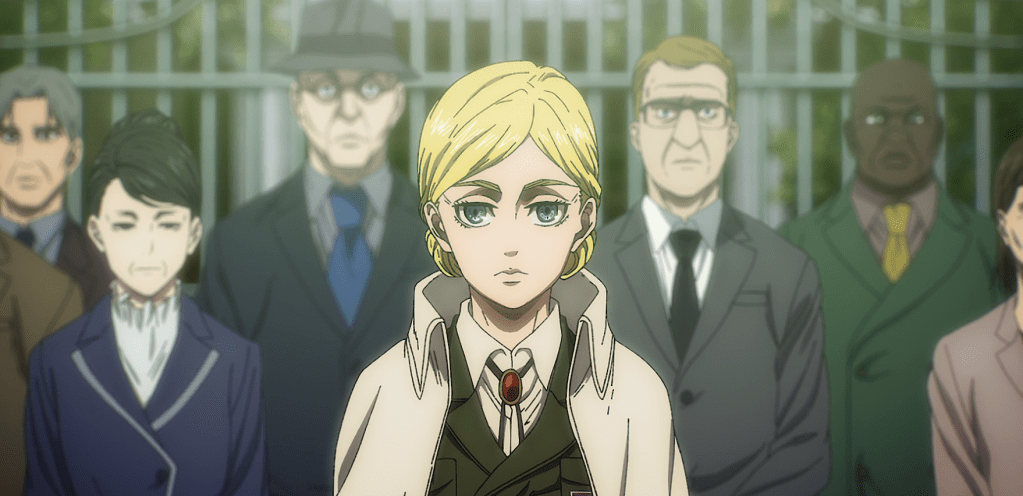
Historia deserved so much better than the horrible role she was given in the Final Season.

As for the letter Historia wrote to the Alliance, Reiner is clearly enjoying it, since he sniffs it like a creep.
Reiner liking Historia is not unusal for him, but did the final scene of a character who has had an emotionally powerful struggle with PTSD really need to be a joke?
Still, I am glad that he lived, along with the rest of the Alliance, who are now going to Paradis as peace envoys, fulfilling the role Eren gave them.
We then get what was, originally, the final scene of Attack on Titan, until the extra pages.
Mikasa is resting at Eren’s grave on Paradis, at the tree where the story started.
Her presence on Paradis is a bit confusing to me, I will admit.  
I mean, the Jeagerists know Mikasa killed a lot of them, right?
Plus, Mikasa is the only Asian person living on Paradis so she would be pretty recognizable.
Wouldn’t she be in constant danger?
Well, Mikasa clearly feels safe beneath the tree, where she weeps for the loss of Eren.
It is at that moment when a bird appears from nowhere and wraps Mikasa’s scarf around her before departing.
So did Eren reincarnate into a bird, or this is just a random bird doing it for no reason?
Whatever the reason, it does look a bit goofy to me.
In regards to Mikasa, as someone who once thought she was one of the best characters in the series, I have slowly found myself disillusioned with her.
I still like her, but there are so many missed opportunities to develop her.
From her Ackerman lineage, to her relationship with Louise, to her connection with Hizuru, these were all chances to give Mikasa character development.
Instead, she just constantly focuses on Eren, right to the very end, even bringing her new family with her to his grave as the years pass.
Speaking of this, I now have to get into the adaptation of the extra pages, which is another area I feel like the anime improved upon.
In the manga, I hated the reveal that Paradis was destroyed because it looked like it was only about 50 years since the Rumbling, making all of the characters sacrifices pretty pointless.
However, the anime updated it to so that the destruction of Paradis happens at least hundreds of years later.
This makes me feel a bit better about the whole thing.
What makes me feel less better is that the anime kept the implication that Titan powers were coming back, by showing a boy and his dog heading towards Eren’s tree, which has now grown to resemble the same tree where Ymir got her powers 2000 years ago.
While this does tie into the themes of the cycle of violence continuing, I personally don’t like that it removes the victory of Titan powers vanishing forever.
The cycle of violence continuing is fitting for the story, but I wish Titan powers stayed gone at the end.

In my opinion, hinting that the Titan powers will return takes away from the Alliance’s victory.

So, since my final impression of the ending is a negative one, I surely think the final episode of Attack on Titan is bad, right?
Well, no.
While there are a lot of things I dislike, the first 50 minutes of the episode are really good, plotholes aside, and there are quite a few improvements from the manga.
I even teared up twice, once during the baby scene, and a second time during Levi’s salute.
And, of course, the animation, score, and voice acting are all incredible.
Overall, I would still say that this final episode is good, despite its many, many short comings.
And, despite not liking how Attack on Titan ends, I would still recommend the series.
The themes, twists and characters are things I will remember fondly for years to come.
Also, having seen the reactions for the final episode from many anime only fans, I know my criticisms of the ending are in the minority. 
The vast majority of fans seem to have loved this ending, and I am happy that they do.
So, as fans of Attack on Titan, no matter our thoughts on the ending, I think we all owe a big thank you to Hajime Isayama, Wit Studio and Mappa for bringing us this amazing anime.
Truly, thank you.    
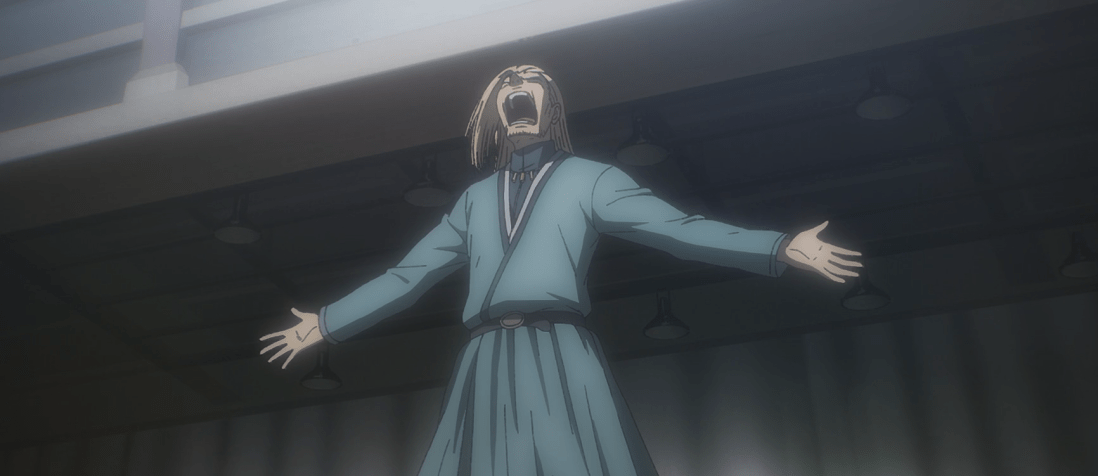
Attack on Titan Season Four, Episode Five, Declaration of War Review: The Moment We’ve All Been Waiting For.

5 stars
Chapter 100, “Declaration of War.”
Pretty much every Attack on Titan fan who has read the manga can easily recall this chapter.
I can still remember sitting in stunned silence after reading it because of what had just occurred.
So, needless to say, I was extremely excited to see one of my favorite chapters adapted in the anime.
Well, having seen it, I can say that Mappa and director Teruyuki Ōmine definitely pulled it off, providing a nail biting delivery for “Declaration of War.”
The episode starts off with a flashback to Reiner, Bertholdt and Annie’s time in the scouts, as was seen in Episode Three.
This time, we have a scene of Bertholdt wondering why the man who hung himself in the settlement chose to tell them his story before he did so,  believing it was because he wanted to be judged.
At this point, the scene perfectly transitions to Reiner about to be judged by Eren, as they meet for the first time in four years.
Falco, the sweet boy, has absolutely no idea about the absolute disaster he has unintentionally caused, completely unaware as Eren subtly threatens all the people in the building above them by showing his cut hand, threatening to transform if Reiner tries anything.
From here, we see the build up to Willy’s declaration, as he is visited by the mysterious Kiyomi Azumabito from last episode, who seems to know something, given that she leaves before the festival.
Another interesting scene is between Karina and Annie’s father, where Mr Leonhart insists that his daughter is still alive, which is basically just Isayama’s way of saying, yes, Annie’s in the story, even if she’s not important right now.
The final build up scene before the performance sees Zeke, Pieck and Porco being lured away by a mysterious guard who then traps Pieck and Porco in a hole to prevent them from transforming and trying to stop whatever is about to happen.
As a manga reader, it’s been pretty fun to see fan theories about who the mysterious soldier is.
I’ve heard theories about it being Jean, Connie, and, most often, Armin who has had an extreme growth spurt.
In any case, this trapping scene is very well done, building the tension up nicely, and even providing some humor when Pieck’s panzer unit get jealous over Pieck hugging only one of them.
With the threat of enemy Titan Shifters removed, Eren can now confront Reiner in temporary peace and Willy can begin his last speech.
Down in the basement, Reiner asks Eren why he came here and Eren chillingly replies “the same reason you did” and follows this up by telling Reiner multiple times that he is “the same as you.”
This shows just how much Eren has grown over the four year time skip, going from hot headed to calm, collective, and even reflective over his situation.
He is clearly not the same arrogant character who I couldn’t stand all the way back in season one, and Yuki Kaji does a fantastic job voicing this calmer version of Eren.
Another voice actor who deserves praise for their work this episode is Kazuhiko Inoue, who does a fantastic job with delivering Willy’s lines, during his epic speech.
This voice acting, accompanying the gruesome imagery of the performance, makes for a great use of exposition that keeps the viewer engaged while being fed information.
The information Willy conveys is that the Marleyan version of history is a lie (big shock), and that The Great Titan War was actually ended by King Fritz, who conspired with the Tyber family to make a Marleyan, Helos, a hero, and then fled to Paradis Island out of guilt for what his people had done.
Willy revealing this shows how masterfully he can manipulate a crowd because first he reveals the truth, before redirecting the crowd’s anger at a new threat, Eren Jaeger.
Speaking of, Eren knows full well how much of a threat he is, admitting that he might just end up destroying the world, like Willy fears, because of the millions of Colossal Titans in the walls, which he could potentially control.
Falco is horrified that someone he trusted would use him and becomes even more terrified when he realizes the letters Eren had him send were to his “comrades.”
For now though, Eren’s attention is entirely on Reiner as he proceeds to judge him just like the opening of the episode suggested that he would.
However, this judgement is not what we might expect.
Instead of condemning Reiner, like he did in earlier seasons, Eren is shown to have become more understanding of him, as showcased by Eren telling Reiner to forget his promise to make Reiner suffer, admitting that there is good and bad people on both sides of the conflict.
This is followed by the moment that breaks Reiner completely, Eren telling him that he did what he did because he was a brainwashed kid.
Reiner refutes this entirely, falling to his knees and tearfully admitting that he pushed on with the mission to attack Paradis because he wanted to be a hero and he is to blame for Eren’s mother’s death.
Reiner’s voice actor, Yoshimasa Hosaya, did such a great job with Reiner’s tearful repentance that it almost made me cry.
Reiner’s pleas for death are then juxtaposed by Willy saying he doesn’t want to die because “he was born into this world,” and this very line that Eren’s mother spoke years ago finally draws Eren’s attention away from Reiner, as shown by the subtle widening of his eyes.
Maybe Eren is experiencing some hope that he will not have to go through with his plan?
Unfortunately, any hope Eren might have for peace is shattered because Willy follows this up by proclaiming he wants everyone to help him fight the devils of Paradis.
Accepting what he must do and that he really is the same as Reiner, Eren pulls Reiner to his feet, as we get some anime original content of soldiers approaching the basement door, ready to attack Eren.
One might think upon hearing about this scene that it is a pointless attempt at diminishing Eren’s responsibility for what comes next but, thankfully, it comes across more as a way to build tension, rather than try to justify Eren’s horrific act of violence.
And horrific it is, as Eren transforms then and there, killing who knows how many civilians and even Willy Tyber himself, crushing him with massive his fist, before throwing him in the air to be devoured, like a piece of popcorn.
This scene is just fantastic with a great use of sound and music.
That said, some manga readers took issue with the OST in this scene, 2Volt.
Some took such a disliking to this OST usage that they even harassed director Teruyuki Ōmine over it, to the point that he felt depressed.
Critique a scene all you want but if you harass the people behind that scene, you’ve gone way too far.
Personally, I feel that the music worked great and the people who dislike the scene may have had their own preconceived ideas on how the it would go, making them be inevitably disappointed when it didn’t suit their envisioned scene.
Still, even though I thought this final scene was great, there is one issue I have with the episode but it is one I am not ready to deduct points for just yet.
This issue is that there is a cut scene between Willy and Magath that is crucial to understanding both their characters’ motivations.
There is a possibility that this scene could have been moved to episode six, so if we see the scene there then this won’t be an issue, however, if it’s not there, then I think we are missing some crucial development for both these characters.
Like I said though, I am not going to be deducting any points from the episode because there is always the chance of this scene appearing in the future.
Overall, “Declaration of War” is a fantastic adaptation of one of the manga’s best chapters, delivering the point of no return for Eren brilliantly.

Attack on Titan Season Four Episode Four, From One Hand to Another Review: Calm Before the Storm.

4 and a half stars
Even though I liked Episode Three of Attack on Titan’s Final Season, “The Door of Hope”, the one issue I had with it was the cutting of some pretty great scenes from the manga, like Reiner’s struggles in the beginning, Annie’s role in destroying the wall, and Reiner deciding to infiltrate the military.
However, cut content is certainly not a problem I have with Episode Four, “From One Hand to Another”, which adapts the manga chapters it covers amazingly.
Directed by Tetsuaki Matsuda, it even adds in scenes from previous chapters that we thought weren’t going to be adapted, like Pieck’s crawling gag, a scene that was memed to death by the fandom, after its absence in Episode Two.   
This joke came after the opening, which followed the cliffhanger from the previous chapter, where Eren Jaeger himself was revealed to have infuriated Marley, disguised as a traumatized soldier and fittingly using the alias of Kruger. 
It is in this opening scene that Eren begins his manipulation of the good natured Falco, having him deliver letters to his “family.”
Following this sinister moment, the rest of “From One Hand to Another” definitely gives off a calm before the storm vibe, with the build up to Willy Tybur’s speech at the festival. 
Speaking of, we finally got to meet the Tybur’s, the family who holds the War Hammer Titan. 
The head of the family, Willy, is certainly an interesting character because, despite being an Eldian himself, he is the secret leader of Marley, who is widely respected by the world’s other leaders. 
It creates a striking juxtaposition when, at a dinner party, Willy is treated with respect, while Udo, a fellow Eldian, is treated like trash by almost all of the world’s leaders.
Willy’s introduction also sets Magath on the path towards being an interesting character, since it is revealed he is trying to get Marleyans to realize the errors of their ways, in being a warmongering nation, by forcing conscription to show them the true horrors of war, which the Eldians they force to fight for them experience.
Magath and Willy seem to have come to accord to save Marley, as Willy talks of how Marley is in need of a new hero, like the mysterious Helos. 
Another scene also highlights this need because, while speaking to Wily in code, Magath reveals that their “house” has already been infiltrated by “rats.” 
And, poetically, the scene then cuts to said infiltrator, Eren, who thanks Falco for sending his letters and now has a baseball from his “family.” 
Eren even talks about how he needs to go back to his “hometown.”
Oh, the irony. 
However, their conversation is interrupted by an approaching doctor who is revealed to be Eren’s grandfather. 
Dr Jaeger talks with Eren, unaware that he is his grandson, telling him to stop having Falco run errands for him because, if the Marleyans suspect something, Falco and his family could be punished. 
Eren retorts by bringing up the regrets Dr Jaeger must have, already knowing those regrets full well from Grisha’s memories. 
This causes Dr Jaeger to have a complete mental breakdown in a creepy moment that reveals he is not a doctor at this hospital but a patient, having broken down from the pain of losing his children, which he believes to be entirely his fault.   
As the real doctors lead a traumatized Jaeger away, Eren turns to the baseball and tosses it into the air. 
After this strange moment, we get the dinner party scene where, as I mentioned, Udo is looked down upon because of his Eldian blood. 
However, what I didn’t mention earlier is that there is at least one person who looks out for him, a mysterious, older Asian woman, who Gabi says is from the nation of Hizuru. 
Once the party scene has concluded, we then get our final calm before the storm moment, as Gabi and the other warrior candidates enjoy the wonders of the festival. 
This resulted in quite a few hilarious moments, primarily thanks to Gabi’s voice actress Ayane Sakura who, I have to say once again, was the best possible choice for Gabi. 
Her delivery is completely on point, much like Yuki Kaji’s somber Eren voice, which will make it interesting to see how Bryce Papenbrook follows him up in the English Dub.
Back to the festival scene, we get another funny moment with Reiner.
The man has been abused physically and emotionally and now the time has come for him to be abused financially, as his wallet is all used to pay for the kids’ food. 
This does make Reiner smile towards the end though so his financial pain is worth it. 
What also makes it worth it is Pieck and Porco being present in this scene, as they were not there to enjoy the food in the manga. 
Their scenes with the kids help make the two more relatable, especially Porco who, in the manga, is just a massive jerk. 
Seeing him encourage the kids in Episode Two, and now enjoy the festival in Episode Four, really makes me like him more than in the manga, by this point. 
It’s not all happiness though because Gabi just had to jinx it by hopefully stating that it felt like things were going to change, before the credits rolled.
Well, yes, Gabi, things are going to change, just not for the better as you had hoped. 
No, the end credits scene crushes these hopes because Falco is manipulated into bringing Reiner down into a basement for another confrontation with Eren, four years after their last meeting. 
With that, the episode left us off on a two week break until the epic episode that will be “Declaration of War.”
Still, I’m sure that the wait will be worth it and I am glad the animators got a small break because I’ve heard making the final season has been absolute hell for them.  
Fingers crossed that they can perfectly adapt “Declaration of War”, one of the best chapters of the manga and, potentially, one of the best episodes of the anime, if done right. 
Episode Five cannot come sooner. 

Attack on Titan Season Four, Episode Three, The Door of Hope Review: A Doorway to Misery.

4 stars
Being Reiner sucks.
I’m sure that’s a thought that passed through many viewers’ minds upon watching the third episode of Attack on Titan‘s final season, “The Door of Hope.”
Directed by Kōki Aoshima and Hiromi Nishiyama, the episode details the many, many, many times that life has kicked Reiner to the ground and then spat on him for good measure.
If you hated Reiner in prior seasons for his actions, then you may find it rather difficult to hate him after what we see him go through, as “The Door of Hope” is primarily a flashback episode to Reiner’ time as a Warrior on Paradis.
Before the episode gets to that point though, it starts off with Reiner’s humble beginnings, as his mother revealed to him as a child that his father was a Marleyan and the only way they could all be together was if they became honorary Marleyans.
This motivates Reiner to become a hero to the world by slaughtering the “island devils” so that both his parents will be proud of him.
However, this is easier said than done because Reiner is by far the weakest out of all the Warrior candidates, as pointed out by Porco.
This causes Reiner to go full brainwashed indoctrination mode, accusing Porco of being a Restorationist sympathiser, which results in him getting punched to the ground, not the last time this will happen in the episode.
Unfortunately, it is also here that I have to state one of my criticisms of “The Door of Hope”, which is the soundtrack used for this scene.
The music itself is great but it doesn’t suit the scene at all, being more fitting for an action scene than a dialogue driven one and this drew me out of the moment.
Still, the scene makes up for it with its showcases of Annie and Bertholdt, and the symbolism.
Bertholdt helps Reiner to his feet, showing his good nature that would later be corrupted by what he does on their mission in Paradis as the fearsome Colossal Titan.
This is contrasted by Annie, who seems well suited for the Female Titan already, crushing a bug under her feet, just like she would go on to crush the numerous Scouts who got in her way when she tried to capture Eren both times.
With this characterization done, the scene then transitions into some fantastic symbolism when, while Reiner looks up at the Wall separating the Liberio Eldians from the Marleyans, on Paradis, presumably at the same time,  Eren looks up at the walls separating him from freedom.
Both are trapped by walls and both are now given the opportunity to move forward past them. Reiner now has the motivation to become a Warrior so he can achieve his goal of becoming an Honorary Marleyan, and Eren is being approached by Armin with the book that will create his motivation to strive for freedom, no matter how far he will have to go to achieve it.
Following this great piece of symbolism, showing how similar Eren and Reiner are, we then get the first of many scenes that are improvements from the manga.
The first of these is the recap of six of Marley’s Titans, as we see them destroy an enemy nation’s military with a display of each of their powers and a description of their users.
The way this scene is edited with the files of each Warrior, followed by their power being shown, and this all ending with the portrayal of the Colossal Titan’s nuke attack as a “god of destruction” is way more intense than it was in the manga.
Another step up comes when Marcel is eaten by Ymir, which is framed like a scene from a horror film.
This moment came after Marcel revealed to Reiner that the only reason he became a Warrior was because he spoke up for him while criticizing Porco to the military, which he did to save his brother from shortening his lifespan by inheriting a Titan.
Marcel revealing this before he dies saving Reiner is just another in a long list of Reiner being kicked while he’s down, both figuratively and literally.
Figuratively, when he first meets his father only for him to call him and his mother a devil and run away from him, and literally, when Annie almost kicks Reiner to death after they lose Marcel.
The latter scene is particularly brutal, with some fantastic work from Annie’s voice actress, Yū Shimamura, in a scene that tells us so much about Annie’s mental state, being the least brainwashed of the trio, recognizing that both Marleyans and Eldians are liars, and only wanting to get back to her father.
However, it is following this great scene that again tops the manga, that we get a scene where the manga is clearly better, this time because of cuts.
The moment where Reiner, Annie and Bertholdt destroy the walls is almost completely cut, with old footage from season one primarily being used.
Annie’s involvement in destroying the wall, Bertholdt looking up at it upon arriving, and Reiner’s desperate fight to protect them in the chaos, is all cut for the sake of time.
Yet, while it is disappointing to see that these scenes have been left out, they are not essential to understanding the story so it is not a massive loss.
Thankfully, other, more important scenes are not cut, like the one with the villager who kills himself in the settlement after telling the Warriors his backstory.
This moment with the villager is important because it is his backstory that Bertholdt uses as their cover when he and Reiner are first introduced in season one, creating another rewarding find for viewers upon rewatches.
Another cool moment comes with Kenny making a brief cameo, as Annie tracks him to try and find the Founding Titan, only to realize this was a big mistake because of how dangerous Kenny is.
With some quick thinking and some good old kicking, Annie manages to evade the Ripper and report back to Reiner and Bertholdt, causing Reiner to decide they need to breach Wall Rose, leading to the attack in Trost.
Before cutting back to the traumatic present, we get one more symbolic scene between Eren and Reiner, as Reiner, after realizing he sees himself in Erne, encourages him to keep moving forward, a piece of advice he will sincerely regret giving later on.
Then we get another improvement on the manga, in the most gruesome of ways, with Reiner’s suicide attempt in the present.
Coming into “The Door of Hope”, I was concerned that this scene would be censored based off the trailer.
Nope!
They showed the whole thing in disturbing detail and even add things, like Reiner’s gasping after he thankfully decides not to go through with it because of a miraculous unintended interruption from Falco.
And Falco’s reward for unintentionally saving Reiner’s life?
Well, running into the most dangerous person in the world of course!
The reveal of Eren in the final moments of this episode is fantastic, with some stellar voice acting from Yuki Kaiji and great added symbolism with the tree behind him.
The build up to this scene was also great, with the previous episode hyping up his appearance in a subtle way that some anime only viewers picked up on and others didn’t.
It is in his conversation with Falco that Eren lays out the very themes of the episode, as he speaks of those who push themselves into hell for hope or just for another hell, and that the only ones who know what lies beyond are those who keep moving forward.
Well, Reiner has been trying to push the door open on hope for a while now and got nothing but misery, yet Eren seems determined to find hope, even if he has to go through hell and drag everyone with him to get there.
Overall, “The Door of Hope” is a great Attack on Titan episode that does a fantastic job of showing the suffering of Reiner and what comes of it.
It looks like we have only one more episode before we get to the adaptation of the amazing Chapter 100 and I, honestly, cannot wait.
Hope you all have a merry Christmas.

Tokyo Ghoul √A Review: The Decline Begins.

3 stars
The first season of Studio Pierrot’s Tokyo Ghoul adaptation was a solid season, but one that had a few issues.
Despite this, the final episode of the season was incredible and a great ending for the next season, √A, once again directed by Shuhei Morita, to pick up from.
Yet, coming into √A, I had a lot of concerns because this is the point that many fans say that the Tokyo Ghoul anime began to decline in quality.
And right from the first episode, “New Surge”, I knew this was going to be the case.
To put it bluntly, “New Surge” is easily the worst Tokyo Ghoul episode of the first two seasons because of how badly it both adapts the manga and tries to add new scenes.
For example, the emotional goodbye Kaneki (Natsuki Hanae) has with Touka (Sora Amamiya) in the manga is replaced in this first episode with Kaneki just being a silent edge lord, which he unfortunately remains for most of the season.

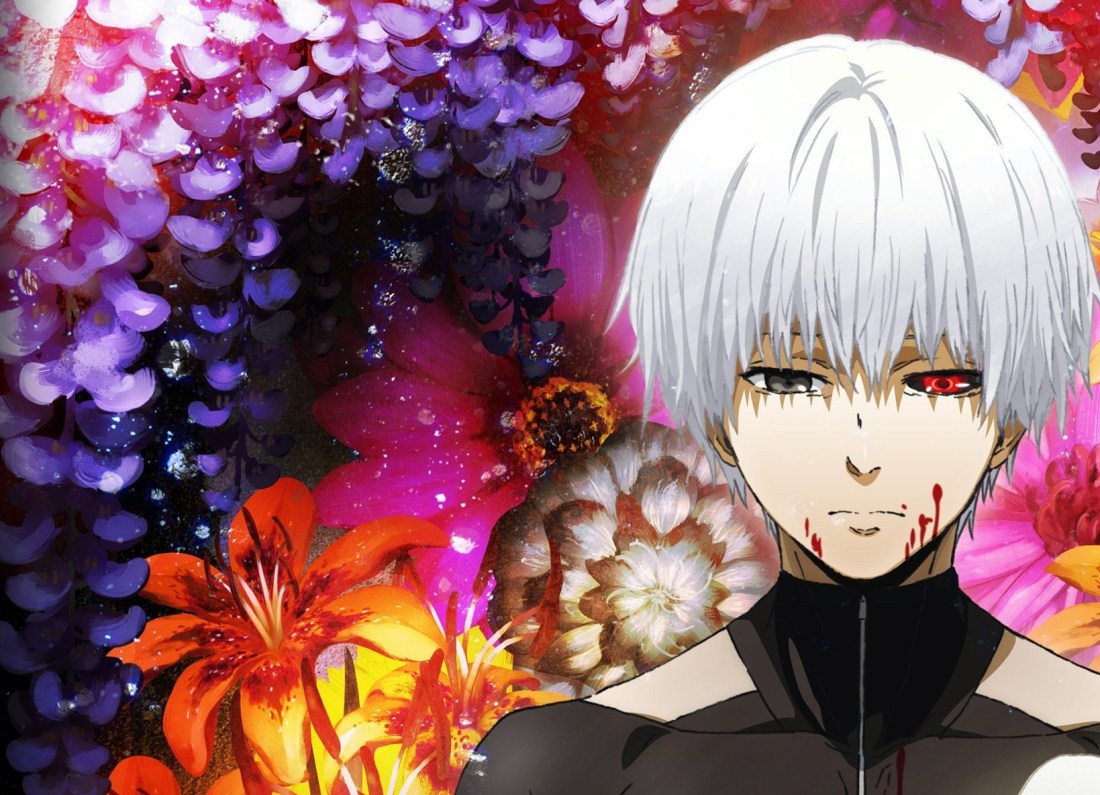
edge lord kaneki
Kaneki barely says anything to Touka when he leaves Anteiku, compared to the manga where he talks a lot, showing Pierrot couldn’t be bothered to write a different conversation.

Then there is Kaneki joining Aogiri Tree this episode, which is also atrociously done.
The anime decided to change the story in √A from Kaneki forming a resistance group to stop Aogiri to him joining them.
Sui Ishida, the creator of the series, envisioned that Kaneki would do this to secretly find and kill the One Eyed King but Studio Pierrot threw this, and his other ideas, out in favor of Kaneki joining Aogiri Tree to get stronger, which makes no sense at all.
This confusing plot line is on full display in the first episode with the scene that I think is supposed to show Eto (Maaya Sakamoto) convincing Kaneki to join Aogiri, which instead just has her giggling at him and then disappearing, without either of them saying anything.
Why would Aogiri Tree decide to let Kaneki join them anyway, when he is responsible for the death of one of their executives?
Not only this, but many important scenes like Kaneki breaking half the bones in Ayato’s (Yuki Kaiji) body are completely removed in this episode.
Unfortunately, the dip in quality of √A continues, with Pierrot trying to work in characters from the manga that just do not translate well to this new story.
The biggest example of this is Kurona (Aoi Yuuki) and Nashiro (Haruka Tomatsu).
In the manga, these two show up because both Kaneki and the CCG are actively chasing them down, forcing them to fight.
In the anime, however, they deliberately pursue Kaneki for absolutely no reason, making it feel like they were written in just because they were in the manga and not because they had a story based reason for being there.

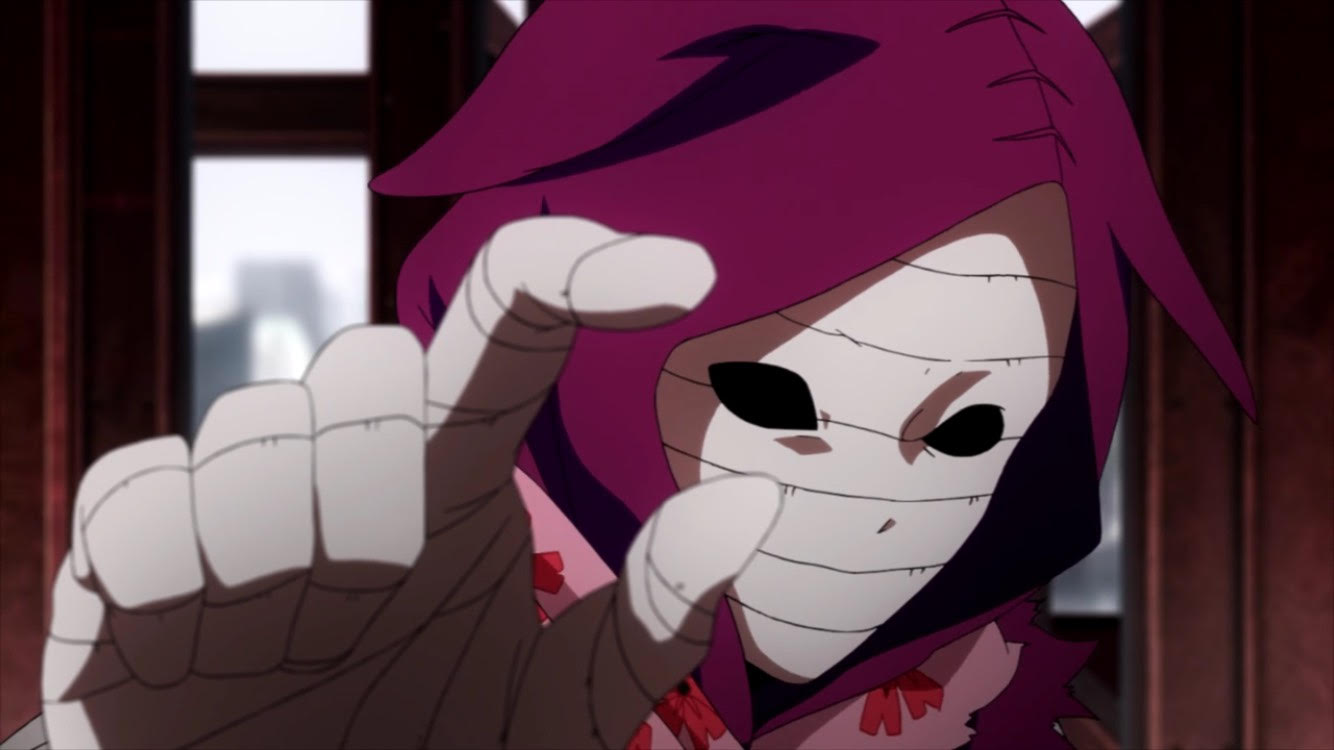
twins ghouls
Kurona and Nashiro should not have been in √A. Without Kaneki pursuing them it made no sense for them to be in the season.

These problems with the anime original content continue throughout √A, with even censorship being a problem.
Tokyo Ghoul is a dark manga so it should have been a dark anime.
Characters that lost their limbs just break bones here.
Studio Pierrot should have listened to Ishida’s ideas for the season or just followed his original story.
Sadly, the anime only events are not the only issues with √A because the animation and soundtrack are issues too.
While the animation isn’t awful, various fights in the first half of √A feel slow and more static than the first season.
As for the soundtracks, songs are repeated constantly to the point that I actually tired of hearing even the great ones.
I lost count of how many times “Glassy Skies” played.
Not only this, but the opening, “Munou”, is flat out terrible, with barely any effort put into the animation, with it just focusing on Kaneki’s face the entire time.
However, despite the many problems I have mentioned, I still do not consider √A to be a bad season.
It almost is but there are a few redeeming qualities the season has that cause it to miss the title of bad by the skin of its teeth.
For starters, even though I didn’t like many of the changes that were made to the original story, there are actually some good ones.
For example, there is an interaction between Kaneki and Naki (Hiro Shimono) in the first few episodes that I really enjoyed, and I liked some of the little quirks Eto was given, along with her interaction with Juuzou (Rie Kugiyama) and Shinohara (Yutaka Nakano), which explained some of her later actions.

eto bang
Despite all interactions between Kaneki and Eto being a complete waste of time, instead of interesting changes as they should have been, I still liked the little changes and quirks her character was given in the anime.

Along with this, when the anime actually adapted parts of the original story correctly, it did them quite well.
The raid on Anteiku was excellent, for the most part, with the fights being very enjoyable, especially Yoshimura’s (Takayuki Sugo).
Speaking of which, I really enjoyed the change of having Yoshimura hallucinate Ukina during this scene.
The animation of these fights was also a lot better than they were earlier in the season.
Not fantastic, but good.
The voice acting also remains solid and, even though I had problems with how repeated the soundtrack was, I liked the final, slower version of Unravel that was played at the end.
I may have not liked the four minute walk that accompanied it but it’s still a fantastic version of a fantastic song.
So, despite its plenty of faults, Tokyo Ghoul √A is saved by its redeeming qualities, barely making it a good season.
Unfortunately, this is not the case for Tokyo Ghoul: Re, which I am currently struggling to get through.
You can expect a review for that train wreck soon.

Psycho-Pass 3 Review: Incredibly Underhyped.

4 stars
I love the first season of Psycho-Pass.
It is a riveting anime with an amazing story, characters, and themes that just gets better every time I watched it.
The second season is, well, none of that.
The only thing I can give it credit for is that it succeeds in being the most disappointing follow up to a great season I have ever seen.
So, when the third season of Psycho-Pass was announced, and with new characters taking the lead, I was naturally concerned.
Sure, the original director was returning, but that did not guarantee quality.
And this was all I heard about the season for a while, until I saw one of the reviewers I had subscribed to on YouTube reviewing the first episode.
It was a definite, “wait, this came out moment?”, for me.
It felt like there was almost no hype behind this season, which is a shame because it is a vast improvement on the second one.
Yes, it is not as good as the first season but it was never going to be.
You just can’t top the level of quality in that season, especially with the great chemistry between the two main characters Akane Tsunemori (Kana Hanazawa) and Shinya Kogami (Tomokazu Senki), and the antagonist Shogo Makishima.
However, the characters of Psycho-Pass 3 are still excellent and, given more time, they could become just as beloved as the original cast of inspectors and enforcers.
I will start with the two lead inspector characters, the quirky Arata Shindo (Yuki Kaji) and immigrant Kei Mikhail Ignatov (Yuichi Nakamura).
The season follows these two as, under the Sibyl System, they investigate the mysterious organization known as Bifrost.
The two’s friendship, and how it progresses throughout the season, is perfectly handled and I am anticipating to see where it goes.

arata and kei.jpg
Arata and Kei’s bond only gets better as the season progresses.

As for the new enforcer characters, they are just as great, especially Tenma Todoroki (Akio Otsuka) and Kazumichi Irie (Junichi Suwabe).
I really came to respect these two characters, just as they came to respect Arata and Kei over time.
Then there are the old characters who are present, yet working in the shadows rather being active participants in the plot.
They are all integrated pretty well, which leads to my biggest surprise of the season, which is that I found Mika Shimotsuki (Ayane Sakura) tolerable.
I absolutely hated her in the second season because she was an absolute jerk for no reason.
Here, we can see why she is acting the way she is, which allows us, as the viewer, to sympathize with her.
She’s not just trying to backstab Akane because she doesn’t agree with her for no reason anymore.

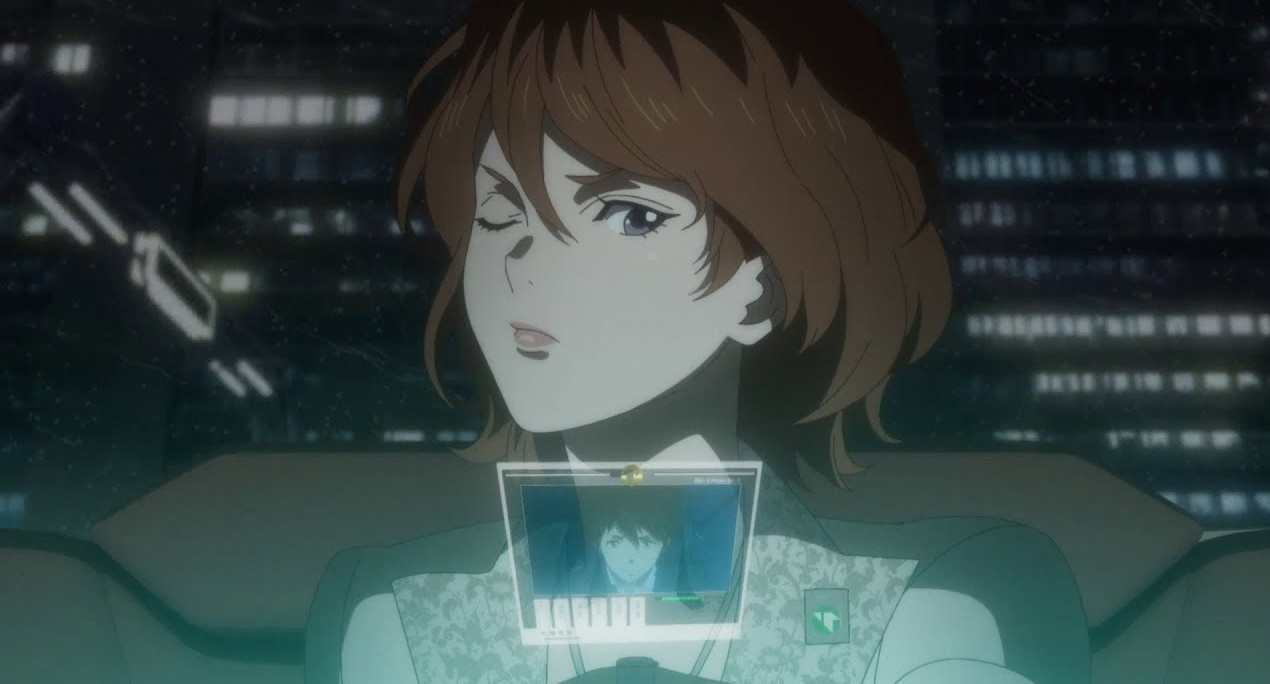
tolerable Mika.png
The most surprising thing about Psycho Pass 3 is how tolerable Mika is.

Although, I will say that this change in Mika does make it feel like we missed some character development from her, which is unfortunate.
Another unfortunate thing is that the villains did not really stick out for me this season.
I knew they could never be as fantastic as Makishima but I was still disappointed in how they failed to stand out compared to the main characters.
But, hey, at least they were not awful like Kirito Kamui from season two.
Along with having great characters, for the most part, the third season of Psycho-Pass also has a great story with a fantastic usage of themes and political commentary.
One feature I was very impressed by was how the season reflects and comments on how many celebrities are getting into politics nowadays and how this would work within the Sybil System.

karina.jpg
Psycho Pass provides great commentary through one of its main players being a pop idol who is trying to become Governor.

However, not everything was so amazing because there are some things that bring the season down slightly.
The biggest of these issues is easily Arata’s mental trace ability, which allows him to view crimes from a criminal and victim’s perspective in a supernatural way.
Now, I have never been a fan of the supernatural in Psycho-Pass, as evidenced by my extreme dislike for Kamui.
So, when Arata was revealed to have this ability, I hoped that they would give it some kind of scientific explanation.
But, no, they just have to implement some kind of supernatural ability when it does not fit in with the themes and commentary at all because why not?
Thankfully, Arata’s Mentalist ability was not enough to derail the season for me.
Psycho Pass 3 is an almost return to form, despite a few hiccups, and I am interested to see where the story goes from here, as well as how these new characters continue to grow and the world of Psycho Pass along with them.

My Hero Academia Season Two Review: Spectacular Fight Sequences Inbound.

5 stars
The first season of My Hero Academia was a good start to the anime and I saw a lot of potential in it.
Thankfully, this potential is fully realised in season two, which absolutely blew me away with its character development, animation, music, and downright phenomenal action sequences.
The season covers around three story arcs and each of them has a great mixture of all of these features I mentioned.
The first arc follows the U.A Sports Festival, where the training heroes compete in a tournament to be scouted by pro heroes.
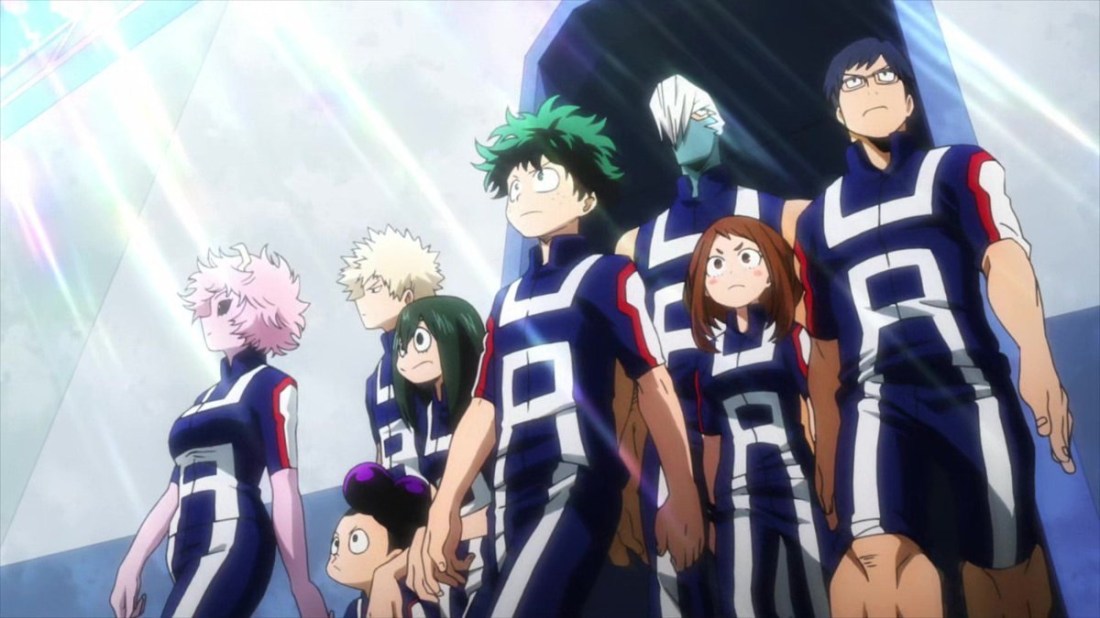
During this arc, we get amazing character development from many of these characters, most notably Shoto Todoroki, voiced by Attack on Titan’s Yuki Kaji.
Other than knowing that he is extremely powerful, Todoroki left little impact on me in the first season but this all changes here.
He is now probably my favourite character of the series.
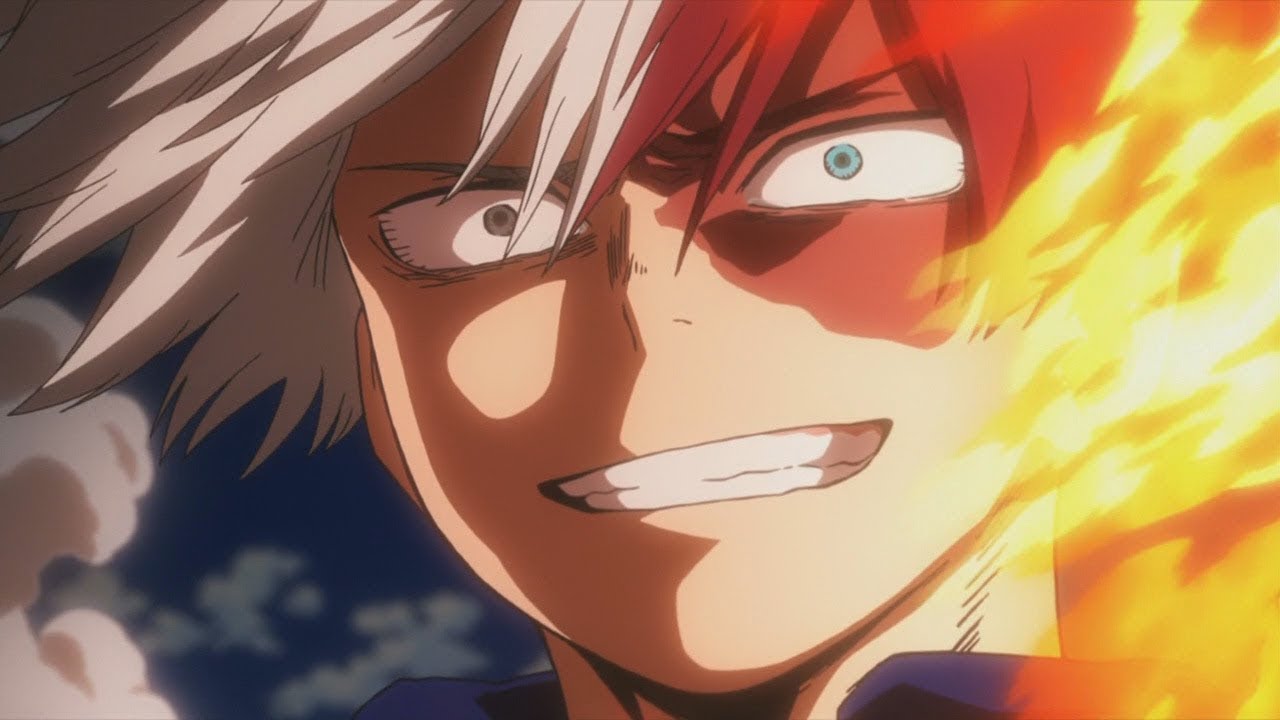
Along with this, his fight with Deku is one of the greatest fights I have seen, not just in anime but in everything that has been put to screen.

Todoroki.jpg
Deku’s fight with the scarred Zuko-I mean Todoroki, has to be one of the best fight sequences I have ever seen. 

Everything just combines in that battle to make it such an incredible moment from the character arcs, to the animation, music and shot composition.
This fight is not the only fantastic one, however, because there are two other phenomenal fights, with Deku and Bakugo having to face off against All Might for an exam and Deku, Todoroki and Iida facing off against the Hero Killer, Stain (Go Inoue).
Speaking of Stain, he is a fascinating villain with a complex ideology and moral code that makes him the series’ best antagonist so far.
I have my fingers crossed that we will see more of him in the future.

Stain.png
Stain is a very engaging villain, with his impact on the series looking to be very important compared to the other antagonists.

The season also goes into more detail about All Might’s backstory, and his rivalry with what looks to be the main villain of the series All For One.
We get to meet All Might’s teacher, Gran Torino (Kenichi Ogata) who I think may be named after the Clint Eastwood movie.
His introduction probably made me laugh harder than any joke in the anime so far.
As for the final episode, rather than the bombastic action one of the previous season, we get more of a meeting of the minds between our hero and villain that seems to set up their potential rivalry for future seasons.

nightmare fuel.jpeg
Tomura Shigaraki’s (Koki Uchiyama) meeting with Deku is especially tense, with Deku being literally one finger on his neck away from death.

Overall, the second season of My Hero Academia is downright fantastic, providing constant laughs, amazing character development and, of course incredible fight sequences.
If you can sit through the Deku vs Todoroki fight without your jaw dropping like me then I will applaud you.


Attack on Titan Season Three, Episode 22, The Other Side of the Wall Review. One of the Manga’s Most Impactful Moments Adapted.

5 stars

Spoiler Free Review:

Attack on Titan season three just ended and I miss it already.
It adapted the manga chapters excellently the entire way through, and the final episode, “The Other Side of the Wall”, is no exception.
Coming into this final episode, I was concerned that since only Chapter 90 would be adapted then the episode would need to add pointless scenes to lengthen the runtime.
Thankfully, all of the scenes that are added in “The Other Side of the Wall” serve a point and this all combines with the manga adapted scenes to create a somber and meaningful season finale.
“The Other Side of the Wall” adapts a scene I and many other manga readers have been waiting to see and it does not disappoint.
This moment almost brought a tear to my eye with its thematic weight, beautiful animation, and the way it continues to push Eren’s fantastic character development forward.
Eren is the standout of this episode with Yuki Kaji doing a fantastic job as per usual.
I am so excited to see Eren’s character arc continue in the final season because when I finished this arc in the manga Eren was a top 10 favourite character but the next arc makes him a top five favourite character, for me.
Along with Eren, other characters like Floch get their chance to shine.
Many people may not like him based on what he says this episode but it definitely makes you understand him as a character and what he stands for.
The episode also gives a look at how the society within the walls views the truth of situation and it is done very naturally.
The big scene of  “The Other Side of the Wall” though is still its impactful and almost tear inducing ending.
The credits sequence is also pretty surprising, blending images from season one, the future final season, and even some images that I have no idea what they mean.
Overall, “The Other Side of the Wall” is my favourite Attack on Titan finale so far.
It may not have any action like season two’s finale “Scream”, but what this ending represents for the series and characters as a whole going forward makes it one of the most impactful episodes of the series.

Spoiler Review:

As I said in the spoiler free review, I was concerned that “The Other Side of the Wall” would add scenes to lengthen the runtime, which would drag down the episode.
I feared this because another episode that adapted a single chapter, “The Basement”, did this and, as a result, I found that it lessened the episode’s impact.
Thankfully, this is not the case with “The Other Side of the Wall” because every single new scene adds to the character development.
This is most obvious in the scene right before the characters arrive at the sea, where they come across a Titan that can barely move.
Rather than kill it, Eren instead walks up to it and places a hand on its head, sympathetically calling it “a fellow patriot.”
This brilliant scene really shows how far Eren has come.
He has gone from wanting to kill all Titans at the beginning of the series to coming to understand them and even sympathize with them, understanding they are not the true threat.
In the manga, Eren just rode past the Titan while speaking that line so it was not portrayed as clearly how much Eren had changed.
After this great addition, the anime delivers the scene manga readers have been waiting forever to see, the ocean scene.
Watching this joyous moment where characters like Armin finally reach their goal of seeing the ocean is very emotional, even more so because of Eren’s undermining of it.
Rather than celebrating like the others, Eren realizes the threat they all face.
He knows now that reaching the ocean does not mean freedom for them but means they have an entirely new and more dangerous enemy to face.
This moment marks the first big separation Eren has with Mikasa and Armin.
While these two celebrate, Eren does not, and this divide will continue to expand in the final season, as shown by the separation of Eren and Armin in a small post credits scene.
Speaking of the credits though, they are full of many images from next season and even ones we have not seen yet.
There are two particular images I find to be of interest.
One is of a group of kids at some kind of school, and another is where it appears to literally be raining blood.
What the latter image means, I have no idea other than it must be terrible.
As for the image of the kids though, I have a few ideas.
The kid actually looks a lot like Gabi, a character we will meet in the next arc, but the lack of an armband, and with her friends nowhere in sight, makes me question this.
I have also heard people suggest a younger version of Willy Tyber’s sister, which would be interesting.
Whatever these shots may be of, they continue to how how excellent Attack on Titan is with its foreshadowing.
As for the other scenes of the episode, they are just as good, the other highlight being the ceremony where Eren and the rest of the nine survivors from the battle of Shiganshina are awarded medals.
Before this, Floch has a confrontation with Eren and Armin, declaring how he thinks Erwin should have been given the serum instead.
This not only gives us insight into Floch but Eren as well because we see this is the first time that Eren’s belief in the ocean representing freedom are questioned.
Just as he tells Armin he thinks they will be free if they reach the sea, he experiences a flash from his father’s memories of Fay’s dead body in the water.
This not only shows how they are far from free but is also an incredibly smart use of creative censorship.
Even though Fay’s body in the water covers up the gruesome image, it also brilliantly foreshadows that the water Eren and the others will see at the ocean means they are not free but rather in even more danger than before.
I usually criticize the censorship of Attack on Titan but this was such a smart use of it that it surprisingly manages to improve on the manga by adding new symbolic aspects.
“The Other Side of the Wall” is a fantastic season finale.
There may be no action, but the character development and symbolism of the episode is phenomenally handled.
With the final season being announced for 2020, it makes me wonder how long the manga has left?
I personally believe it will end around Chapter 130, which means 12 chapters left, and if I am right then Attack on Titan season four should start right after the manga ends, which would be cool.
Either way though, I just hope the series will get a satisfying conclusion that we all can enjoy, whether that ending is hopeful, tragic, or something in between.