
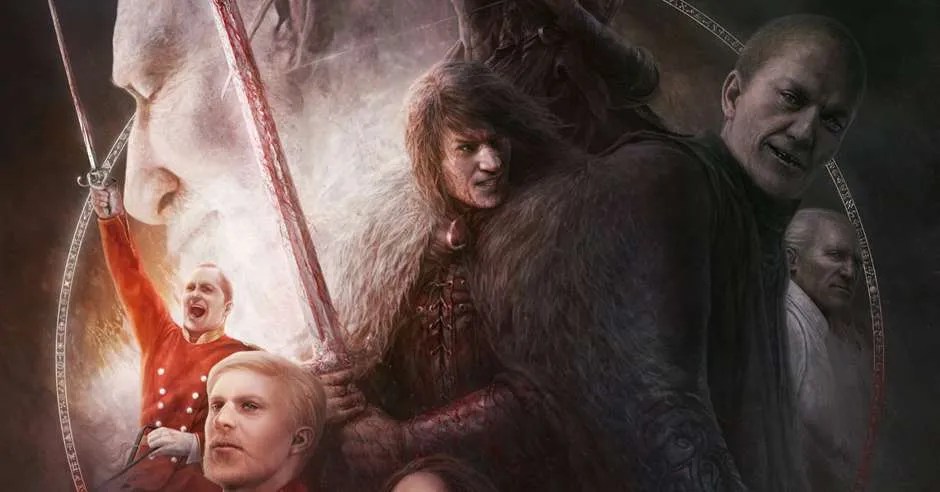
When I ranked the ten books in The First Law series, I kept bringing up how the author, Joe Abercrombie, excelled at writing his characters.
Not only do these characters have some of the most distinct voices in fiction, they are also mostly terrible people.
If they existed in real life, I know that I would hate many of them, and yet Abercrombie is able to make us like and care about them, despite all they have done.
With so many complicated yet stellar characters, I decided to rank my top ten.
However, even narrowing the series’ expansive cast down to ten was extremely difficult because of how good so many of them are.
So honourable mentions go to Temple, Ferro Maljinn, Collem West, the Dogman, Bremer dan Gorst, Whirrun of Bligh, Calder, Black Dow, and Leo dan Brock.
Yes, that is a lot of honourable mentions, but that should show how amazing the cast of The First Law is, since I considered placing all of these characters in the top ten.
In the end, though, I had to keep the list at ten, so now let’s get into the list of who I think are the best characters in The First Law, starting with…
10. Jezal dan Luthar.
Jezal had a pretty funny starting point, regarding my perception of him.
When I first read The Blade Itself, Jezal was my least favourite of the main characters, due to his over-the-top narcissism.
The reason this is funny is because the rest of the cast consists of mostly mass murderering torturors, yet Jezal is somehow more hateable than them.
Again, this shows off just how good Abercrombie is at getting us to like terrible people.
As for Jezal, his unlikeability does lead to some humorous moments.
I know I burst out laughing when Jezal started admiring his reflection in the mirror, with his inner monologue gushing about how handsome he was.
It was so over-the-top, I just could not help but laugh.
Jezal does not stay this way, though, because he has some of the most significant character development in all of Before They Are Hanged.
The moment he decides to be a better person, while recovering from an injury, is one of my favourite moments in that book, and it builds well into Last Argument of Kings, where Bayaz manipulates the Union into accepting Jezal as the new king.
Jezal could have actually been a pretty good king too.
He seemed to have plenty of good ideas, and his growth made him a much more caring person.
Unfortunately, it is at this point that Bayaz reveals himself to be the master manipulator, pulling all of the strings behind the scenes, including Jezal’s.
The chapter where he threatens Jezal into submission is one of my favourites of the series.
And so, Jezal ends the first trilogy as a pawn of Bayza, in constant fear of his life.
He has a few brief appearances later on in the story, before dying of mysterious causes at the end of A Little Hatred, the first book in the sequel trilogy.
Jezal ultimately lived a tragic life.
He became a better person, only to become a puppet king, one mistake away from being killed, unable to implement change, and married to a woman who could never love him.
Jezal’s journey from insufferable narcissist to tragic figure was one that I enjoyed reading.
9. Savine dan Glokta.
My first thought following Savine’s introduction was, “Yep, she’s Glokta’s daughter, alright.”
Born of the affair between Ardee and Jezal, Savine was raised under the belief that she was Glokta’s biological daughter.
Even though this is not true, she is still his daughter in every other way that counts.
Unfortunately, that results in a lot of suffering because Savine is almost as ruthless as Glokta is.
Right from the beginning, it is clear she is not a good person, as we quickly learn about the harsh conditions in her factories.
But then, much like Jezal, Savine is given an opportunity to change.
She gets caught up in the first uprising of the Breakers and the Burners, resulting in her seeing and experiencing the suffering she has caused.
This makes her resolve to be a better person… until she gets rescued that is because then she completely doubles down, in the worst of ways.
She becomes more ruthless, eventually resulting in her manipulating her husband Leo into rebelling against Orso in the hopes of becoming queen.
It is only upon seeing the devastation her actions cause, along with the birth of her children, that Savine changes for the better, if only slightly.
She is still as manipulative as ever, writing a letter to Gunnar where she pretends to be his wife to get him to save her.
However, she does attempt to do some good, like freeing Orso, even though that unfortunately does not pan out.
I do think Orso is right, in the end, though, as Savine is definitely a smart person to have in charge, considering that she has the power to reign in Leo’s destructive tendancies.
She will at least be able to keep the Union afloat with Glokta’s help, even if it does result in more abuse of the peasantry while Savine is painted as a saint.
Savine does admit to being the “villain” by the end but she remains charismatic throughout her time in the story.
8. Rikke
The Dogman’s daughter, Rikke immediately makes a strong impression with her first appearance.
Gifted or cursed with the power of the Long Eye, Rikke has obscure visions of the future, which causes seizures, and this is made clear from the moment she sees Stour Nightfall’s invasion before it happens, at the beginning of A Little Hatred.
Reading her flight from his forces was thrilling, and it is not long after Rikke is rescued that we get one of my favourite moments from her, when she tells the battle hardened Caul Shivers that he is still in there.
For Rikke to say this to such a hardened character and seeing the effect it had on him was especially moving.
Rikke also has some of the most creative chapters in the entire series.
There is the moment she uses her Long Eye to help Leo win his fight against Stour Nightfall at the end of A Little Hatred.
The depictions of her ability in The Trouble with Peace only get crazier, as Rikke has a vision of the events of a chapter before they happen, and, in another chapter, she witnesses events backwards.
Joe Abercrombie really went wild with her ability and it was a joy to read.
Just as joyous was seeing Rikke outsmart Savine and Stour Nightfall, by attacking while they were off rebelling against Orso.
Unfortunately, I found her storyline in The Wisdom of Crowds to be the weakest of the bunch, although that was mostly because of how obvious the twist of her tricking Calder was.
As for the twist of her betraying Orso, I also quickly saw it coming, but it still made for a crushingly tragic moment.
I can’t even blame Rikke for handing Orso over.
She needed a way to protect the North from Leo’s newfound bloodlust and handing Orso over was the only way.
Despite this sacrifice, the peace Rikke has created will definitley end at some point, with her final vision showing revenge coming from both Hildi and Calder’s hidden son.
Rikke keeps this vision to herself and this will almost certainly backfire whenever we get a follow up.
When we eventually do, I will be anticipating reading more chapters from Rikke’s POV again.
7. Monza Murcatto.
The main character of the best stand alone in the series, Best Served Cold, I was instantly on board with Monza’s revenge quest after reading the first chapter in a preview at the end of Last Argument of Kings.
Starting her story as a Styrian mercenary working for Grand Duke Orso, Monza and her brother Benna are betrayed by him because he fears they mean to replace him.
Benna is killed and Monza is thrown off a cliff but she survives, vowing to kill the seven men who hurt her and killed her brother.
This ultimately results in her dragging all of Styria even further into bloody conflict.
The main thing that I like about Monza so much is that we as the readers experience the issues with her revenge and the intent behind it, just as Monza does.
We see the cost of her vengeance, as multiple innocent people are killed in the poisoning assassination, along with Mauthis.
There is also Monza’s slow realization about how cruel Benna truly was, leading to her realising that he actually was intending to overthrow Duke Orso and put her in charge.
Some of these realisations come from other characters as well, with Shivers learning that Monza and Benna were actually lovers, yet another reveal showcasing just how toxic Monza’s relationship with her brother was, and how she was blind to his many faults.
These realizations lead to Monza actually softening somewhat across the story, as she tries to save Faithful Carpi, decides to spare Foscar (before Shivers kills him anyway), and kills Orso with decidely little fanfair.
In the end, Benna gets what he wanted posthumously, as Monza essentially becomes the ruler of Styria in all but name, before crowning her son Jappo as king after fighting off Union invasions.
Going into the Age of Madness trilogy, I was excited to see what Monza would be up to but, unfortunately, we did not get to see her.
We were introduced to Jappo, though, and his scene with Leo and Orso was excellent, but I do hope to see Monza again because there is a lot of potential for interactions with other characters, most notably Shivers.
Flawed, yet sympathetic, Monza is my favourite female character in the series and I hope the upcoming adaptation of Best Served Cold does her justice.
6. Nicomo Cosca.
Nicomo Cosca is a character who was first introduced in Before They Are Hanged, serving as the eccentric mercenary hired by Glokta.
Despite playing a pivotal role in the defence of Dagoska, and in the arrest of Arch Lector Sult, Cosca was still a character I was not particularly attached to.
I certainly did not think he was a bad character but he was far from being anywhere on this list.
Then, Best Served Cold happened and everything changed.
Cosca is one of the best characters in this novel, practically stealing every scene from the moment he is introduced, often managing to be hilarious, awesome, and pathetic all at the same time.
We even see him go on a parallel revenge quest to Monza, with him killing each of his traitorous companions in increasingly funny ways.
His unexpected friendship with Friendly is also one of the highlights of the book, with the two of them having many morbidly hilarious moments.
Unfortunately, their last scene serves as an indicator of what is to come.
Cosca tells Friendly that, “Sometimes men change for the worse. And often, very often, given time and opportunity… They change back.”
Well, Cosca certainly changes back and for the worse.
He started Best Served Cold as a drunken mercenary has-been, and he starts Red Country as a drunken pillager, terrorizing the countryside, having lost his way again.
Though, he is still hilarious, thankfully.
Cosca’s darkness is much more apparent, as his story ends when the author he hired to write heroic tales of him is so disgusted by his actions that he stabs him from behind with his own sword (ironically enough, this same author would also go on to be a terrible person in The Age of Madness trilogy).
I have heard many criticisms about Cosca’s depiction in Red Country, describing it as character assassination.
While I certainly understand this criticism, personally, I feel this character regression was well set-up and executed.
Cosca got his chance to change and yet, like so many characters in this series, he changed back for the worse and it all led to tragedy for him.
5. Orso dan Luthar.
If you were to ask me which character in the series has the most tragically poetic story, I would instantly say Orso dan Luthar.
The son of Jezal, Orso grew up extremely privileged, having everything handed to him, and had little to no ambition.
Orso is no Ladisla, however, as he is aware of his own flaws, shown through him knowing he could stop a hanging at the beginning of his story, yet doing nothing to stop it.
Orso eventually gains the backbone to try and stop more death, however, as he peacefully negotiates with the Breakers.
However, both Glokta and Pike are working against him, and cement his image to the public as a villain by executing many of the Breakers without Orso’s knowledge.
This negative depiction of Orso to the public continues in The Trouble with Peace, eventually leading to the bloody battle with Leo.
It is here that Orso is finally given the reigns to be a king and, much like his father, proves that he has the chance to be a very good one, outsmarting Leo and winning the day.
Unfortunately, he lacks the ruthlessness that one needs in the world of The First Law, and spares Leo, which comes back to bite him hard in Wisdom of Crowds when Leo betrays him again to take power.
He even gets betrayed by Rikke, leading to his poetically tragic last visit to the gallows.
His story began with him watching a hanging, and his story ends with him being hung.
At least he gets some of the best last words in fiction: “How’s the leg?”
I hope Leo was feeling the sting of that last barb for quite a while afterwards.
Despite Orso’s tragic death, his legacy lives on in characters like Hildi.
Sadly, this will only lead to more tragedy as, despite Orso’s wishes for Hildi to live her life, she has teamed up with Bayaz to get revenge for the brother who essentially adopted her.
Still, even if her negative turn is tragic, I will still enjoy whatever kind of suffering she brings to Leo.
With the poetic tragedy of his story, Orso is easily the best character in The Age of Madness trilogy.
4. Bayaz.
Right from the moment of his introduction in The Blade Itself, Joe Abercrombie makes it clear that Bayaz is not going to be a typical fantasy wizard.
Logen certainly seems to think so, as he approaches a wise looking man, only to learn that Bayaz is the man who he first thought was a butcher.
This impression of Bayaz as a butcher is aptly fitting, given what is later revealed about him.
The first two books spend a lot of time setting up this reveal, and I can distinctly remember thinking that there were too many horrible events helping Bayaz’s plans out, like Prince Raynault’s death, for it to be a coinicidence.
Sure enough, Joe Abercrombie finally pulls the curtain back in Last Argument of Kings to reveal Bayaz as the master manipulator, pulling the strings behind the scenes to give himself all of the power, without most of the population even knowing.
He killed his old lover Tolomei for power, likely killed Juvens, and sacrificed thousands of innocents using the Seed.
His subsequent interactions with the four main characters of Logen, Glokta, Jezal and Ferro are all chilling in their portrayal of him.
His conversation with Glokta finally reveals him to be the man behind Valint and Balk, while also setting up the means of his eventual downfall by appointing Glokta as Arch Lector.
As for his conversation with Jezal, as I have said this is probably my favourite scene in all of The First Law.
Bayaz is absolutley terrifying as he beats and terrifies Jezal into submission without even touching him.
I was excited to see what Bayaz would be up to in The Age of Madness trilogy but unfortunately he did not have much to do here.
The ending of A Little Hatred seems to hint that he had something to do with Jezal’s death but this is never confirmed, and Bayaz has the Union ripped away from him at the end, due to Glokta’s conniving.
Bayaz is certainly not going to take this sitting down though, as he has already recruited Hildi and Calder’s son, probably planning to set them up as big players in the next part of the story to take back the country he created.
Bayaz is a terrifying subversion of the wizard trope and I think we can expect him to do darker things whenever the story continues.
3. Logen Ninefingers.
The main POV character of The First Law trilogy, Logen starts the story as a man on the run from his violent past, hoping to be better.
This brings him into the company of Bayaz which has the opposite effect, as Logen’s horrifying alternate persona of the Bloody Nine begins to emerge more and more.
Still, there is hope for Logen to be a better person, as shown by his relationship with Ferro in Before They Are Hanged.
Like most First Law characters, Logen does change, only not forwards.
No, instead, he changes back to his worse self, travelling back to the North to fight Bethod.
Here we truly see how monstrous Logen can be, as he not only kills a close friend, Tul Duru Thunderhead, while in a state of bloodlust, but it is also revealed that he was the one responsible for making Bethod king.
Bethod only wanted peace but Logen keep disobeying his orders, murdering and butchering as he pleased, forcing Bethod to name himself King of the North.
This is backed up by the short story, “Made a Monster”, where we see Logen brutally murder a prisoner, throwing away any chance at peace Bethod had.
Logen may want to deny this but Bethod will not let him forget it, even when he defeats Fenris the Feared in the Circle, which is one of the best fights in the series, and then kills Bethod.
This causes Logen to take Bethod’s place as King of the Northmen and, of course, he immediately uses his newfound power to lead the North to war against the Gurkish to help the Union, resulting in more deaths for the Northmen.
Logen has one more chance at positive change, as he goes to talk with Ferro, only for her to be too affected from using the Seed’s power to notice him, making Logen think she is not interested in him anymore.
Upon realising Bayaz’s manipulations, Logen refuses his help and goes back to the North, only to be betrayed by Black Dow and flee, ending the trilogy as he began it, a man on the run from his violent past.
This is not the end for Logen, however, as, much to my surprise, he turns up again in the stand alone Red Country, having taken the name Lamb.
The book sees him go on a journey with his step-daughter Shy to rescue her kidnapped siblings, providing Logen with the excuse he needs to let the Bloody Nine loose once more, which almost ends disastrously when he nearly kills Shy and her sister.
Red Country has some of the creepiest Bloody Nine moments, so it is fitting that Logen realizes he is too dangerous to be around his adopted family after his confrontation with Shivers.
And so Logen rides off into the sunset to an unknown future.
If we will see him again in the story is unknown at this point but, if we do, I do not expect to see a happy ending for him.
We have to be realistic.
2. Caul Shivers.
Much like Nicomo Cosca, Caul Shivers was a character who I did not think much of in The First Law trilogy.
He approaches the Dogman to help fight against Bethod, only to be greatly displeased when he finds himself fighting alongside the Bloody Nine, who murdered his brother.
In the end, Shivers decides revenge is not worth it and leaves the North.
We see him again in Best Served Cold and, also just like Cosca, this is the book where he becomes one of the best characters in the entire series.
I would go as far to say that he is my favourite character in this book.
Watching his optimism slowly get beaten down while he accompanies Monza on her revenge mission, only to lose an eye and much of his dignity in the process was tragic to watch.
By the third act, he is just like Monza at the beginning, hungry for revenge.
He would have killed Monza had it not been for Friendly and Shenkt.
The book even ends with his POV, as he is allowed to live by Monza and decides to go back to the north, with the sky being the colour of “bad blood” signalling Shivers’ bloody future.
He goes on to become Black Dow’s right hand man in The Heroes, doing all of his dirty, bloody work and yet receiving none of the recognition.
This goes well for Calder, as Shivers betrays Black Dow for his mistreatment, killing him and taking the sword he stole from Logen.
In Red Country, Shivers is then sent on a mission to find out if rumors about Logen being alive are true.
He finally tracks him down at the end of the book but, after seeing the family he has found, decides to let go of revenge once more.
Although, to be honest, if Shivers had actually tried to kill Logen, I doubt this would have gone very well for him.
Shivers’ decision does create a positive change, however, as he switches sides to the Dogman, serving a surprisingly parental role to the chief’s daughter, Rikke.
This bond is touching in The Age of Madness trilogy, as Rikke tells Shivers she can still see his softer side inside his brutal exterior.
Speaking of that exterior, Shivers remains ruthless despite his bond with Rikke, as he even goes on to kill Calder for her later, which is fitting since he saved him at the end of The Heroes.
As for his future in the story, I hope Abercrombie decides to reunite him with Monza at some point.
It would be interesting to see how he would now perceive her, and how she would react to a changed Shivers.
He could also meet his son Jappo, which would be interesting.
Overall, Shivers is the character in The First Law series with the most appearances, and it is easy to see why with how excellent of a character he is, only being beaten from the number one spot by…
1. Sand dan Glokta.
Honestly, was it going to be anyone else?
It seems like most people rank Sand dan Glokta as their favourite character in the series, and for damn good reason.
He is the character who most epitomizes Joe Abercrombie’s skill at making us like terrible people.
Glokta started out as a confident, womanizing noble, who was a great fighter.
This can be seen in the “A Beautiful Bastard” short story, where he resembles Jezal quite a bit.
At the end of this short story, Glokta leads a charge against the Gurkish.
This results in his capture and torture, leaving him a crippled and broken man, in constant pain and often even unable to control his own bowels.
So, what does a man who lost everything he learned to torture do?
Use his newfound knowledge of torture from the horrors he experienced to inflict those horrors on others.
Glokta joins the Inquisition and tortures accused traitors for information.
It goes without saying that many of these people are not guilty of the crimes they are accused.
Despite this, Abercrombie is somehow able to make Glokta both charismatic and sympathetic, with his inner thoughts presenting some of the best cases of dark humor in the series.
His search for the truth across the trilogy is riveting, all building up to his confrontation with Bayaz, where everything is revealed and the first of the Magi leaves him in charge of the Union as his puppet.
Even Glokta’s relationships allow us to feel sympathy for him.
I was surprised to find myself happy for him when he reforged his friendship with West, after learning of the misunderstanding that separated them.
His relationship with Ardee is probably also the healthiest in the series, which leads into my point about Glokta being somehow likeable while also being an absolutely terrible person.
I remember reading the chapter in Last Argument of Kings where Ardee is looking after Glokta and feeling glad for him, only to be completely horrified in his next scene, where he threatens Queen Terez’s lover if she does not have children with King Jezal.
Glokta even finally admits to himself at the end of the trilogy that torturing people amuses him, and yet he is still somehow likeable.
Well, at least he is preferable to Bayaz, which is why his overthrowing of him in The Age of Madness trilogy feels so victorious.
After decades of working as his puppet, Glokta has done what no one else could for centuries: Get the better of Bayaz.
Although, as Savine points out, this essentially makes him the next Bayaz, rather than a representative of positive change and, even then, Bayaz is certainly not going to take this sitting down.
It will be interesting to see what role Glokta has to play in the future of the story, if he is still alive during the next book, given how old he is.
Regardless, Glokta is undoubtedly The First Law’s best character.
He is a person who I would absolutely despise in real life but because of Joe Abercrombie’s fantastic writing he is the most interesting of the bunch.






 THE REVIEW MONSTER