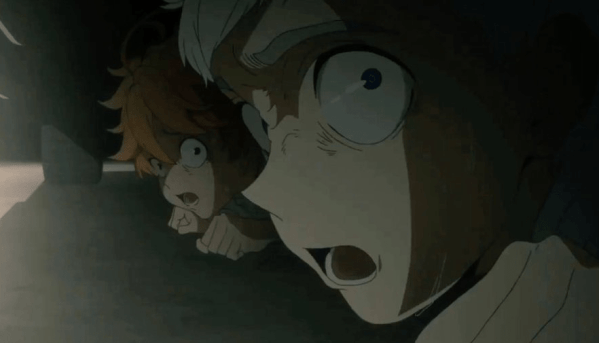
The Promised Neverland Manga Review: Basically Tokyo Ghoul Quality vs Tokyo Ghoul: Re Quality.

4 stars
I recently rewatched the first season of The Promised Neverland and was amazed by it.
I had honestly forgot how incredible of an anime it was.
So, knowing that the second season had been delayed to 2021 because of Covid-19, I decided to read the manga in its entirety.
After reading it, the best way I can describe it is Tokyo Ghoul quality vs Tokyo Ghoul: Re quality.
Essentially, the first half of the manga is fantastic, just like Tokyo Ghoul, while the second half is still good but it does have a lot of problems, just like Tokyo Ghoul: Re, creating an experience that is, overall, still a lot of fun to read.
Written by Kaiu Shirai and illustrated by Posuka Demizu, The Promised Neverland follows children Emma, Norman and Ray who learn that the orphanage they live on is in reality a farm made to provide food for demons.
They, and the other children, then plan to escape and embark into the world of demons, a world that contains many friends and many foes.
As I said, the first half of The Promised Neverland is absolutely fantastic, with many great twists and characters to cheer for.
As if the characters from the first season like Emma, Norman, Ray, Isabella and Phil weren’t already amazing enough, the manga offers many more interesting characters like Mujika, Yuugo and Lucas.
Yugo and Lucas in particular are great additions to the cast and probably tied for my favourite characters in the entire story.
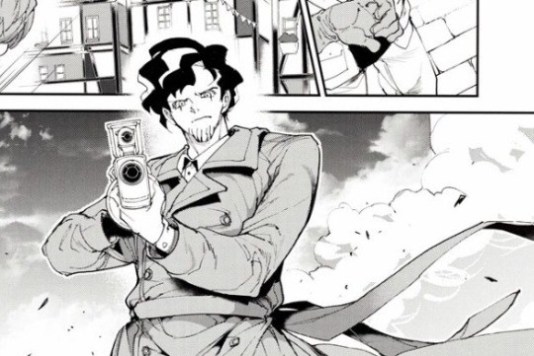
yuggo
Yugo is an amazing character and the conclusion to him and Lucas’ arc are fantastic, even if I do wish this conclusion had come later on in the story.

As for the old characters, they are just as great, with Emma standing out as a fantastic protagonist, especially in the Goldy Pond Arc.
Speaking of, Gondy Pond is definitely my favourite arc of the manga with it providing a lot of awesome fights, tension and character development.
The villain of that arc, Leuvis, is also just as intimidating as Isabella and Sister Krone were in the first season.
Unfortunately, this continued fantastic quality does not last as the story begins to have more and more flaws as it enters its second half.
One of these big flaws is character immunity.
It became quite clear towards the final stages of the story which characters were safe and which were not.
For a series that started off with the “anyone can die” mentality, it sure pulled a lot of punches by the end in regards to character deaths.

goldy pond
Although my favourite storyline is the Goldy Pond Arc, I can admit that this is the arc where it became clear that almost every character had plot armour.

Another problem is those characters themselves or, more specifically, the amount of them.
There are so many characters that a lot of them don’t get the screen time they deserved.
Norman, Isabella and Phil are missing from huge chunks of the story and Ray becomes kind of a stagnant character.
The worst example of wasted character potential though definitely goes to Ayshe.
She is introduced in the last few arcs of The Promised Neverland and is given a fantastic backstory and motivation that looks set to put her on a revenge path that will cause her to conflict with some of our main characters.
However, after this backstory is revealed, she never does anything.
All of that fantastic build up the reveal of her past had turned out to be for nothing and made wonder why she was introduced in the first place.

ayshe
Ayshe could have been a fantastic character if her backstory had actually been expanded upon.

There was also a complete deus ex machina towards the end that was very off putting.
As for the ending of the story, a lot of people have problems with it and, while I think those are valid, I still liked the ending and it did get me tearing up.
Which reminds me, I cried quite a few times when reading this manga.
Whenever the story ignored characters absurd plot armor and finally killed someone it almost always got a tear out of me.
So, I can definitely say that the good far outweighs the bad.
While the second half does have a lot of problems, The Promised Neverland is still a great manga that delivers a lot of emotional moments.

The Promised Neverland Season One Review: I am Hooked.

4 and a half stars
There has been a lot of buzz surrounding The Promised Neverland, both during and since its release.
I heard so much hype surrounding it that I started watching the anime half way through the season and I was not disappointed.
The series instantly hooked me with its gripping concept, characters and direction, resulting in an incredibly intense first season.
Based off the manga of the same name by Kaiu Shirai, and directed by Mamoru Kanbe, The Promised Neverland is set on an orphanage where 38 children live with their “mom” Isabella (Yuko Kaida), until they are eventually adopted.
Our three main characters are the energetic Emma (Sumire Morohoshi), the intuitive Norman (Maaya Uchida), and the sly Ray (Mariya Uchida), who are the smartest of all the children.
However, their happy life is completely shattered when they learn a dark truth about the orphanage and their so called mom.
The three then begin to plan an escape with some of their siblings, all while evading the ever watchful eye of Isabella, who will do anything to stop them getting away.

emma and isabella.jpg
Watching Emma, Norman and Ray desperately attempt to outsmart Isabella makes for a very intense viewing.

All twelve episodes are great and full of many intense moments.
Even something as simple as tag is made scary in this series.
What amplifies the tension is how much you grow to care for these children.
Emma, Norman and Ray are all very relatable and well performed by their voice actors.
As for the other children, their adorableness makes you feel instant horror at the thought of them staying at the orphanage with the manipulative Isabella.
Speaking of which, she is a very intimidating character, being able to switch between the personalities of a loving mother to a cruel warden in an instant.
As for the secondary antagonist Sister Krone (Nao Fujita), her nightmare inducing facial expressions will keep you up at night.

Sister Krone.jpg
Good luck getting this terrifying image of Sister Krone’s demented face out of your head when you sleep. Sweet dreams!

But what is most interesting about these two antagonists is also how relatable they become.
They are certainly twisted individuals, but are made much more sympathetic by the conclusions of their stories.
Their sympathetic sides do not make you forget the plight of these kids though, as you will be routing for them to escape every cruel step of the way.
Watching the effect the trauma of their experiences has on them is touching and makes you relate to them further.
This is also helped by the expert direction, with well thought out shots that both amplify the horror and make you care for the characters by placing you right in the middle of their plight.

tpn-direction.png
The cinematography of The Promised Neverland often places you right in the kids’ perspective, making the horror much more personal.

Combine all this with a great amount of twists and turns, it makes for a stellar season with only a few problems.
These problems are minor and, for the most part, do not hinder the experience.
For example, there was a scene in the first episode with a bit of bad editing, but the rest of the direction was so good that it more than made up for it.
Then there are the episode titles, which, while having no impact the story, are not memorable because they are just a representation of the date.
The final issue has to do with the intelligence of some of these kids, which does seem a bit outlandish at times, but I was able to push my suspension of disbelief above this.
The Promised Neverland is a fantastic anime that looks set to be one of the greats.
Season two has already been greenlit and I will be excitedly watching when it comes out in 2020.