
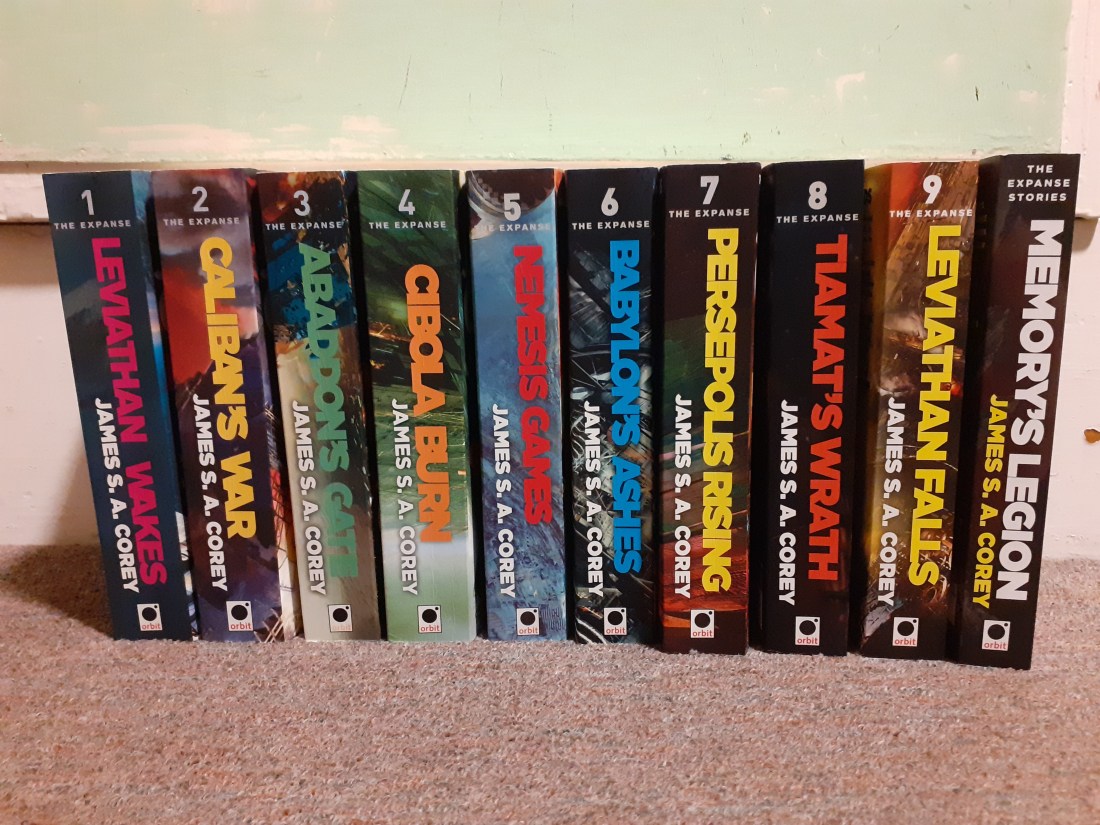
There are many different, highly praised sci-fi series out there, so many, in fact, that it is often difficult to decide which one to dive into next.
Sometimes, all you need is the right push at the right moment to get into another great series.
For me, the push to read James S.A Corey’s The Expanse was the reveal of the upcoming Osiris Reborn videogame by Owlcat Games.
I rocketed head-first into this spacefaring epic, ultimately finding the burn of the journey more than worth it.
And wouldn’t you know it?
The Expanse consists of ten books.
So, what better way for me to celebrate finishing this amazing story than to rank them from weakest to best?
Keep in mind before reading, this ranking will contain spoilers for the entire series, so only continue if you have read all of the books.
With that warning out of the way, here are my top ten books in The Expanse, starting with…
10. Book Three: Abaddon’s Gate.

The third book in The Expanse is the one I ultimately got the least enjoyment out of reading.
That is not to say the novel is completely without merit though.
Jim Holden remains an interesting protagonist, and his connection with the Protomolecule Miller is quite compelling, especially with how it leads to the Ring Gates opening.
It was Abaddon’s Gate which made me understand why this series was called The Expanse, with the doors to thousands of planets being opened.
For me, though, the best moment in this book was the death of Sam.
I found it to be an abrupt and disturbing moment, which left an impact.
Now we get into my negatives, most of which stem from the other point of view characters.
Bull and Ana make for fairly average POVS but they are nothing offensive.
The real problem emerges with the fourth and final POV character, Clarissa Mao.
Her whole shtick is that she wants to get revenge on Holden for locking her father away in the previous book.
The thing is, her father is a terrible person, who funded experimentation of an alien bioweapon which killed millions, including Clarissa’s own sister.
Not only that, but Clarissa intends to get revenge on Holden by framing him for a terrorist attack she commits, leading to many more deaths.
On paper, this makes Clarissa sound like a villain we could love to hate.
Unfortunately, she is supposed to be seen as redeemable.
This makes every single chapter we spend in her head insufferable to read through.
We have to suffer her murderous hypocrisy, all the while characters like Ana insist she can be saved.
Speaking of, this also makes the story predictable.
The moment Clarrisa joined Ashford’s coup, I knew the conflict would end with Ana convincing her to change sides, thus redeeming her.
Sure enough, that is what happened, removing a lot of the stakes since I could see where the story was going from a mile away.
Thankfully, Clarissa becomes tolerable in later books, but her introduction in Abaddon’s Gate was so unbearable to read through that it shot the book all the way to the bottom of this list.
Still, I would not say Abaddon’s Gate is a bad book.
It is just my least favorite in The Expanse.
9. Book Six: Babylon’s Ashes.

After loving Nemesis Games, I went into Babylon’s Ashes excited for the story to come.
Unfortunately, I finished the book rather underwhelmed.
For one thing, this was the first book in the Expanse to expand the POV chapters beyond four characters.
However, instead of expanding the story in interesting ways, it left the novel feeling bloated.
So often, Babylon’s Ashes cuts to a character we have never met before and then we never get their POV again, making it difficult to care.
Not only that, but the antagonists of this book, the Free Navy, are probably the most unthreatening force in The Expanse.
They were a threat in Nemesis Games, but it is made apparent from the beginning of Babylon’s Ashes that they do not really have a chance of succeeding at their long-term goals.
Their biggest success in this book is Fred Johnson’s death but, even then, they cannot claim that because he died of a stroke caused by overwork, rather than their attack.
Another disappointing thing was their defeat, since we had already seen the alien force disappearing ships at the end of the previous book.
All of that being said, there is still a lot I like about Babylon’s Ashes.
Although the amount of POV characters is annoying, some of them do have interesting chapters.
Along with that, the main POV characters are still good, with Holden’s standout moments coming when he attempts to bridge the gap between Earth, Mars and the Belt.
Some of the action is also pretty well written, and this is the book where Bobbie and Clarissa officially join the Rocinante (even if I was still not sold on Clarrisa).
Overall, Babylon’s Ashes is a fine book.
A lot of the action and character work is good but the sheer amount of POVs and the unthreatening antagonists hold it back.
8. Memory’s Legion.

When I realized that one of the books in The Expanse series was a collection of short stories, I was sure it would be at the bottom of my list.
After all, that is what happened when I ranked the First Law series.
Imagine my surprise when Memory’s Legion turned out to be so good I had to rank it at eighth.
Sure, there are some stories weaker than others, with my least favorite being the third story “Gods of Risk.”
The majority of tales told, however, are great, my favorites being “The Churn,” “Vital Abyss,” and “Strange Dogs.”
“The Churn” explores Amos’ dark past in Baltimore, expanding excellently on what we learned about him in Nemesis Games.
“Vital Abyss” reveals what happened to the sociopath scientists after Leviathan Wakes and even made me feel sorry for Cortázar because of what he was turned into.
As for “Strange Dogs,” it tells the tragic tale of how Cara and Xan were resurrected by Protomolecule technology, later leading to their experimentation.
Memory’s Legion even follows up on some characters who disappeared in the main story, like Erich and Filip, which was satisfying for me since I wondered what happened to them.
All in all, Memory’s Legion is a fantastic collection of short stories.
Most of them are great and add to the original storyline of The Expanse.
7. Book Two: Caliban’s War.
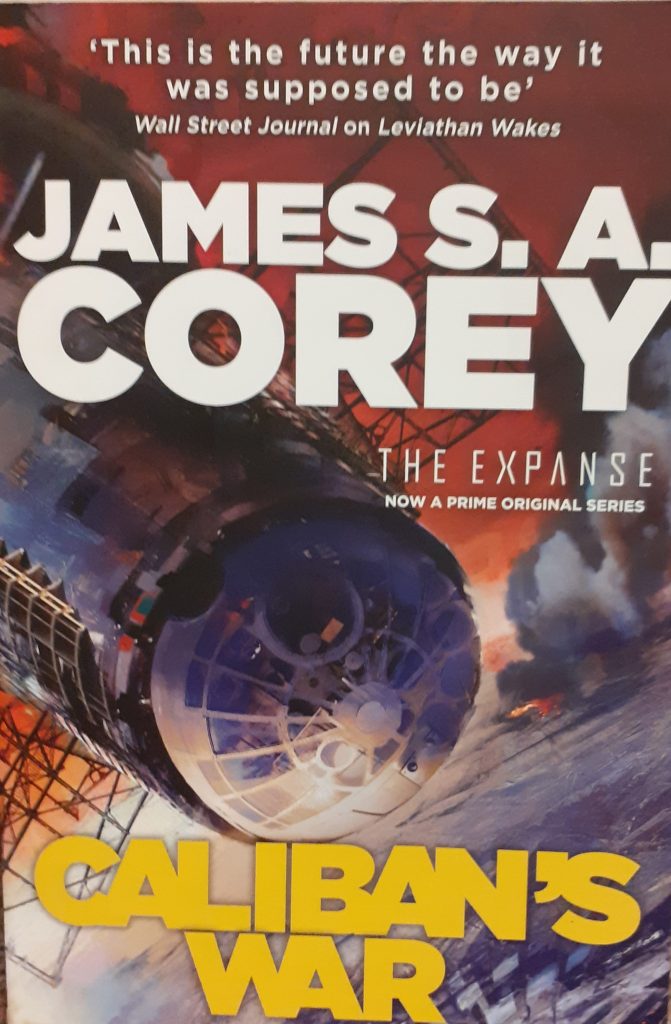
When I started reading the second book in The Expanse series, I was worried it would not live up to the first.
Even though I much preferred Leviathan Wakes, Caliban’s War is still a great follow-up.
Its opening action scene, with Bobbie’s squad being attacked by the Protomolocule hybrid, makes for a good first impression.
Despite this, I was still concerned when I learned the main storyline would revolve around the kidnapping of a little girl.
It just seemed too similar to the plotline from Leviathan Wakes.
Thankfully, Caliban’s War differentiates itself by introducing a bunch of interesting characters.
Prax’s search to find his daughter is compelling, especially with how it later ties into fabricated stories.
Even better are Avasarala and Bobbie.
They get their introductions in Caliban’s War, and they are some of the best female characters in the Expanse.
In particular, Avasarala is a highlight, with her constant sailor mouth delivering a lot of laughs.
The only thing keeping Caliban’s War from being higher on the list is an element in the climax.
Holden is aboard a ship infested with the Protomolecule and runs into the ship’s last survivor, who we have never met before.
He then learns someone has to self-destruct the ship to stop the alien weapon.
Luckily for him, the character we literally just met has become infected and volunteers to sacrifice himself.
It felt like the authors wrote themselves into a corner and, to avoid their main character dying, they abruptly introduced this random survivor, who is never mentioned again.
Otherwise, Caliban’s War is a fantastic follow up to Leviathan Wakes, introducing some of the best characters in the series.
6. Book Four: Cibola Burn.

It seems like a lot of people rank Cibola Burn quite low among the other Expanse books.
This is a shame because I consider it to be a pretty underrated entry.
The first half of the book is a fascinating exploration of conflict between colonizers and corporations, while the second half goes full-on disaster novel.
We see this from the eyes of various interesting characters, like Havelock and Basia, who had appeared previously in the series but are now elevated to POV characters.
We are also introduced to Elvi, who will be very important in the final two books.
Speaking of Elvi, though, she also presents the funniest moment in The Expanse for me, when she realizes she was not in love with Holden, she just needed to get laid.
As for Holden himself, we get the last of his connection with the Protomolocule Miller for a while, and his conflict with the antagonist Murty is a lot of fun.
Murty himself was the first antagonist in The Expanse I found truly interesting.
I perfectly understood his viewpoint, and why he saw himself as in the right.
The book even ends on an ominous note with Avasarala revealing that the expansion to different planets will be the death knell for Mars, perfectly setting up Nemesis Games.
Cibola Burn may be ranked low among a lot of The Expanse fans, but I really enjoy it for the characters and conflicts.
5. Book Nine: Leviathan Falls.

The final book in The Expanse series, I began Leviathan Falls with my fingers crossed that James S.A Corey could conclude the story well.
Thankfully, for the most part, they definitely achieved this, but I will get my small criticisms out of the way first.
For starters, the book did remind me of Babylon’s Ashes at times, with how it would occasionally switch to the POV of a character whose head we had never been in before.
However, this problem was nowhere near as prevalent as in that book.
Secondly, I did not really care for Tanaka as one of the main POVs for the final novel.
I am not sure why, but I just could not connect with her, even as an antagonist.
Finally, while I was enjoying Leviathan Falls, it felt for a while like the events occurring were not really leading up to this being the final book.
However, once we reached that endgame point, the story locked in, and I was riveted all the way to the finish line.
Leviathan Falls does a fantastic job of proving what is at stake.
Humanity faces the choice of either being forcibly incorporated into Duarte’s hive mind or being destroyed by the aliens who killed the Protomolecule.
Holden being Holden, finds a third option.
Following his final interaction with the Protomolecule Miller, along with his crew, he sacrifices himself to destroy the Ring Gates, separating various human colonies by light years.
Holden’s sendoff was very well done, although I do find it kind of funny that his last words were, “I don’t have a fucking clue.”
The epilogue then shows humanity millennia in the future, having developed its own means of interstellar travel.
And who should the expeditioner’s traveling to Earth meet but Amos, still very much alive and kicking, looking out for humanity, even after all of his old friends have died.
This ending felt perfectly fitting to me.
The only way for humanity to survive was to destroy the Ring Gates, and Holden’s sacrifice still meant humanity could connect thousands of years later.
Leviathan Falls is a worthy conclusion to this great series.
4. Book One: Leviathan Wakes.
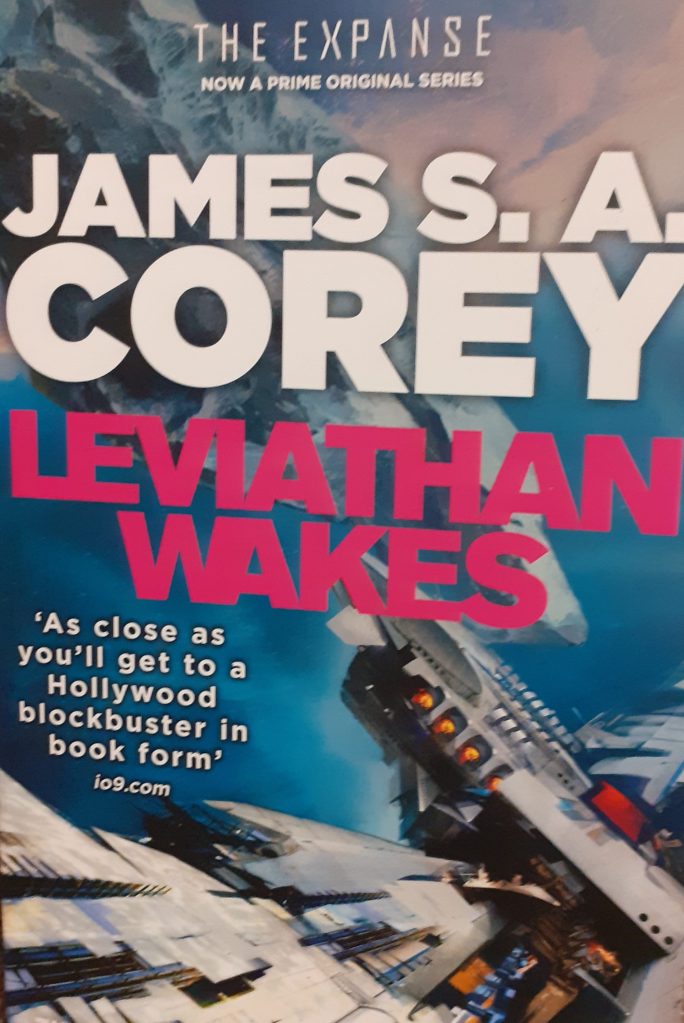
Bit of a funny story before I get into my thoughts on Leviathan Wakes.
I happened to be reading this book in the same room as my parents, and they asked me what it was called.
For some reason, I stammered over my words and instead of saying Leviathan Wakes I said Leviathan Wanks.
So, yeah, that was embarrassing.
As for the first book in The Expanse, boy, did Leviathan Wakes make a first impression.
The portrayal of how humanity had gone on to colonize Mars and the Belt felt so real, as did the numerous cultures and rivalries that emerged.
These rivalries explode when Jim Holden’s ship is destroyed, starting a war which threatens the Earth, Mars, and the Belt.
At the same time Holden is searching for who killed his friends, a detective named Miller is searching for a missing woman with ties to a revolutionary organization, the OPA.
Both men are unaware that the mysteries they aim to solve are connected, and lead to a far more terrifying conspiracy, as Protogen plans to test the Protomolecule on a civilian population.
The events on Eros are horrifying to read and especially riveting through how Holden and Miller conflict in their values.
Miller is especially compelling, flaws and all, and he was by far my favorite character in this first book.
The way his story concludes, with him finally finding Julie and saving Earth with her, felt very fitting.
The quality of his character is so good that I got excited when he showed again at the end of Caliban’s War.
Leviathan Wakes was a fantastic start to The Expanse.
The cultures and conflicts it created felt real to me, as did the characters, especially Miller.
It would not be until Book Five where a novel in the series beat Leviathan Wakes in terms of quality, but I am getting ahead of myself.
3. Book Seven: Persepolis Rising.
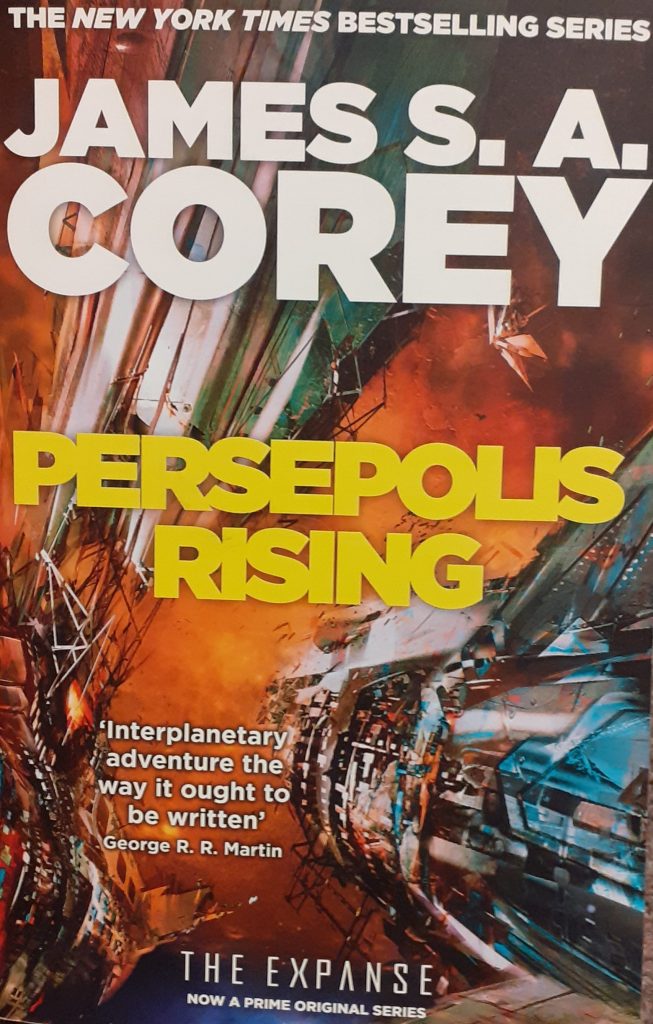
Persepolis Rising has my favorite prologue of The Expanse.
It had me immediately invested in Laconia through the brutal depiction of the Pen, and the grand aspirations of the empire’s dictator, Winston Duarte.
A large part of the reason I love Persepolis Rising comes down to Laconia.
In my opinion, it is easily the most interesting setting James S.A Corey created, and makes for an excellent antagonist for our heroes to fight against.
This is nowhere clearer than with Singh, one of our POV characters.
He only appears in this book but is incredibly compelling, as a family man who is a key part in an authoritarian regime.
This system gradually grounds him down, until even he goes too far for its standards, and he is put to death in a shocking moment that tells the reader a lot about Laconia as a society.
Our other new POV character is Drummer, whose struggles against the Laconian Empire shows their might and threat level.
Like Singh, her arc is also fantastic, as she eventually comes to draw comparisons between her own actions and the authoritarian rule of her enemy.
And then there is Holden and the crew of the Rocinante, who have aged 30 years since we last saw them.
Clarissa is now considered family among the crew, and she dies is in this book to save Naomi.
I cannot deny her death is one of the best written in The Expanse, with it feeling like a gut punch, even though I still did not like her very much.
As for Holden, his heroics once again get him into trouble, since he ends the book captured by Laconia.
This leads to his first meeting with Duarte in the epilogue, which has one of the best lines in The Expanse, in my opinion.
“When you fight gods, you storm heaven,” Duarte says, in the final line of the book.
What an awesome line, although it is made funny in hindsight with how that turned out for Duarte.
Persepolis Rising is an excellent read.
It introduces the most threatening human force of The Expanse, has some of the best character arcs of the series, and has an awesome final line.
And the next book would somehow be even better.
2. Book Five: Nemesis Games.

Before Nemesis Games, I liked the crew of the Rocinante but I did not love them.
Well, that all changed with Book Five, where I was excited to see the three POVs aside from Holden’s were Amos, Naomi and Alex’s.
This excitement proved to be warranted because Nemesis Games not only made me appreciate these characters way more but it also turned out to be my second favorite books in the series.
The novel follows the Rocinante crew splitting up, where they each begin to uncover clues leading to a grand conspiracy.
We have Holden teaming up with Fred in probably my favorite depiction of their dynamic in the series.
Then there is Alex, who teams up with Bobbie, uncovering the Martian side of the conspiracy, leading to our first encounter with Winston Duarte.
We learn a whole lot about Naomi’s dark past, as she reunites with her former lover Marco and their son Filip.
Finally, there is Amos, who returns to Earth, reuniting with Clarissa, only for Marco and his Free Navy to shower Earth with asteroids, leading to a desperate attempt to escape the planet.
When I saw that Clarissa would be coming back, I immediately got nervous.
I was having such a good time with this book, and I did not want one of my least favorite characters to ruin it.
Thankfully, Clarissa is not as insufferable as she was in Abaddon’s Gate, and her and Amos witnessing the devastation of Earth was gripping.
The best of the four POVS in my opinion though is definitely Naomi’s.
Watching her struggle between her love for her son and her newfound family in the Rocinante’s crew made for a great arc, creating a lot of emotional moments.
And then there is the epilogue, which both sets up the eventual Laconian Empire and introduces us to the new threat of the aliens which killed off the Protomolecule’s creators.
Overall, Nemesis Games is excellent.
It made me love the Rocinante crew, has a compelling mystery, and sets up a lot of events in the endgame of the story.
The only reason it is not at number one is that some of the things it sets up proves to be rather underwhelming in Babylon’s Ashes.
1. Book Eight: Tiamat’s Wrath.

“Chrisjen Avasarala was dead.”
The opening line of Tiamat’s Wrath perfectly sets the tone, with a sendoff to one of The Expanse’s best characters and setting up a whole lot of sacrifice.
I loved the introduction of the Laconian Empire in Persepolis Rising, but their characterization truly shines in Tiamat’s Wrath.
We get to see how the Empire rules now that is has pretty much conquered the universe, in all of its authoritarian blemishes.
This perspective mostly comes through the POV of Teresa, Duarte’s daughter.
It is through her we get a fantastic look at what happens when a dictator with a cult of personality falls.
Those below him take charge in his stead, while attempting to maintain the perception that their dear leader is still pulling the strings, even as each strand gets cut no matter how hard they try.
Teresa is also an interesting character, especially due to her friendship with Amos, which actually leads to his unfortunate death… temporarily.
I say temporarily because this is where The Expanse introduces the concept of the alien technology resurrecting people.
Amos’ return is epic, although it does raise the question if this is actually Amos or a clone with his memories.
You be the judge of that.
While Amos’ death is temporary, Bobbie’s is tragically permanent.
That being said, her death is a victory because she sacrifices herself to destroy the Laconian Empire’s flagship, destroying their reputation as unstoppable.
Bobbie would have wanted to die fighting, and I cannot think of a better end for the character.
Along with a close look at how Laconia operates, we also get further insight into the Protomolecule via Elvi who makes her return, ending with her eventually realizing Holden’s grand plan.
The twist that he motivated Cortázar to try and kill Teresa, so that he would be executed, thus putting Elvi in charge of studying the Protomolecule was masterful, made even better by the fact that we rarely get Holden’s POV in this book.
I know it may seem strange, my favorite novel in the series being the one where the main character is mostly closed off from us.
But it all builds to this fantastic reveal, which ends with Holden, Teresa and the resurrected Amos escaping the planet.
There are just so many amazing moments in Tiamat’s Wrath.
From Naomi stepping up to lead the underground, to her reuniting with Alex on the Rocinante, to the battle around Laconia, it is all great.
With an in depth look at Laconia, gripping character moments and sacrifices, and an excellent twist, Tiamat’s Wrath is my favorite book in The Expanse.
So, there you have it.
My Top Ten The Expanse books.
But this is not where the series ends, because a video game is coming, and there is, of course, the TV show.
I will be watching the show soon, and I might review it season by season, or do another ranking when I finish.
It depends on how I ultimately view the series.
Either way, you can expect another post on The Expanse in the future.
 THE REVIEW MONSTER