![]()
Coming into the final season of Attack on Titan, I wondered if Mappa would cut or rearrange certain scenes from the Manga, like Wit did with the Uprising Arc, in order to make the story flow better.
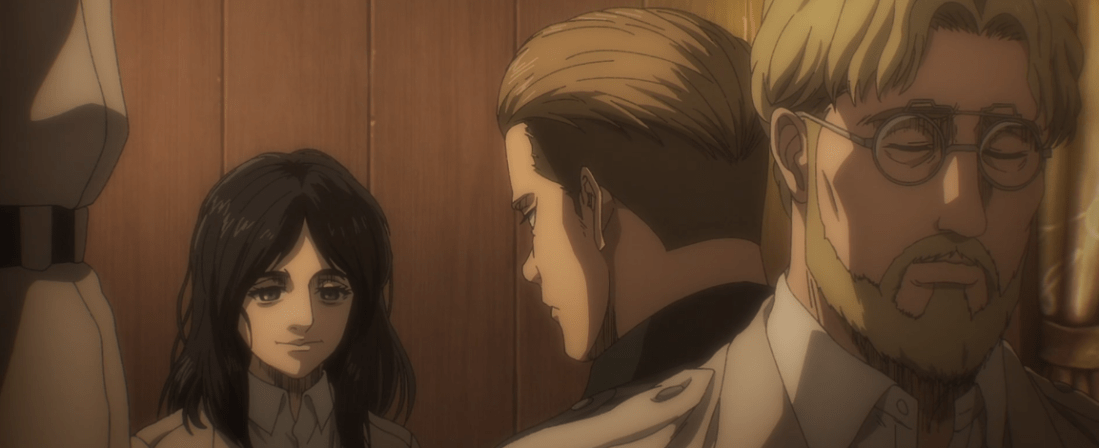
Well, this question has been confirmed with the season’s second episode, “Midnight Train”, which adapts Chapters 93 and some of 94 and 95, skipping over Reiner’s flashback, leaving that for next week.
Whether this rearranging of scenes will be problematic or not remains to be seen with future episodes but, so far, it appears to be working well if “Midnight Train” is any indication.
Directed by Daisuke Tokudo, the episode starts off by adapting Chapter 93, although having various cuts throughout.
Beginning with the meeting between the Marleyan generals, the first scene highlights once again how Marley is falling behind other countries technologically because of their reliance on Titans in warfare.
This leads to Zeke suggesting they attempt to retake the Founding Titan to buy Marley time to catch up, saying that he will do so because he should be the one to bring an end to the plans of Grisha Jeager, as his former son.
While also revealing that Zeke has one year left in his term, this scene also unfortunately highlighted my main criticism with the episode, it’s animation.
While certainly not bad, it did have a few questionable moments, like with Zeke in this scene where his face looks oddly emotionless, with only his mouth being animated to move.
This odd animation continued in the following scene when Zeke and Colt are walking up some stairs and when Udo starts talking about the threats Eldians face.
Apparently, these two moments were made using rotoscoping, which is an animation technique.
It is used during other scenes in the episode and those all look great.
However, these two scenes with Colt and Zeke, and Udo look a little janky compared to the rest of “Midnight Train’s” animation and they pulled me out of the story for a brief moment.
Still, these are only small instances and the technique usually looks good.
Besides, the Colt and Zeke, and Udo scenes are both well done in their own right, providing great humor with Zeke’s ass wiping technique gag, and also tragically revealing the full extent of Reiner’s PTSD when he imagines Gabi, Falco, Udo and Zofia as Bertholdt, Annie, Marvel and Porco from his training days.
Speaking of Porco (Toshiki Masuda), we finally got to meet him and Pieck (Manami Numakura) this episode.
Both of their voice actors do great jobs as the characters, with Pieck being the Cart Titan and one of my favourite new characters introduced during the Marley Arc, and Porco being Marcel’s brother and the new Jaw Titan, meaning he ate Freckled Ymir to get her power.
That’s right, Freckled Ymir still dies off screen.
It’s disappointing that we still don’t have a death scene for her but it’s not like I expected anything better for her character at this point anyway.
Following these scenes, we get the titular train the episode title is referencing as we see the Eldian Warriors on one, returning to their home internment zone of Liberio, resulting in the humorous scene of Colt lifting up Gabi so everyone, including Gabi herself, can cheer for her.
Yet, there also comes a serious scene here, as Falco criticizes Reiner for apparently allowing his cousin to inherit his Armoured Titan, thus shortening her life span.
Reiner uses this moment to test Falco, resulting in two interesting reveals.
One, being that Falco’s last name is actually Grice, the same name of the man who was with Grisha in the Eldia Restorationists.
And two, that Reiner wants Falco to surpass Gabi and inherit his Armoured Titan so he can protect her from the dark future they face.
With this, the adaption of Chapter 93 comes to an end and we get a merged adaptation of parts from Chapters 94 and 95.
Starting with the Warriors reaching Liberio, we get some interesting new scenes of Porco and Pieck interacting with Gabi and Falco, acting as older siblings looking out for them.
I really liked this addition because it helps make their characters more sympathetic, also helped by all of the shots of all the Warriors reuniting with their families.
We have Zeke greeting his grandparents, Gabi hugging her parents, Reiner awkwardly reuniting with his mother, and an anime original scene of Pieck’s father coughing as he welcomes her, which introduces his illness a lot earlier than the manga does, which is a pretty cool addition.
Along with this heat warming scene, however, we also get a reminder of how war is constantly on the horizon, as the Marleyan, Koslow, scares a bunch of traumatized Eldian soldiers suffering from PTSD.
This also allows us to see Falco’s good side because he is kind enough to help one of these soldiers, whose armband has been placed on the wrong arm.
The next scene proves as a great contrast to the horrors of war because, while the traumatized soldiers screamed and fall when Koslow yells “Boom!” at them, Gabi yells “Boom!” with glee to her family, showing the extent of her indoctrination in Marleyan propaganda.
This indoctrination is shown further by Reiner having to act like the Eldians on Paradis Island are devils, comedically turning something as innocent as Sasha eating a potato into something monstrous.
On an unfortunate note, many anime only viewers seem to have misinterpreted this scene as Reiner trying to fool himself into believing this, when he is actually trying to subtly tell his family that those on Paradis are no different from them.
This may have been lost in translation because of the removal of Reiner smiling under his hand, so I wish they had kept that.
One great addition is the a brief moment that comes after this scene, as one of the traumatized soldiers is shown killing themselves, again showing the harm the Marleyans are doing by forcing the Eldians to fight their battles for them.
I love how Mappa is adding all of these scenes to show the horrors of war.
From here, the episode goes into adapting parts of Chapter 95, with the meeting between Zeke and the other Warriors, as Zeke explains their plan to take the Founding Titan with help from the Tyber family, the holders of the Warhammer Titan.
Here, we get another indication that Reiner is now fully aware of the Marleyan propaganda and indoctrination, as he realizes Zeke is hinting that the room is bugged and saves Porco, who is voicing his dissent, from endangering himself by interupting him.
With this moment, the episode ends as Reiner wonders if he really has to go back to Paradis, setting up the next episode to adapt all of his flashbacks, which is kind of worrying.
I have heard leaks about the pacing of this next episode and it makes me scared the writers could cut a lot of pivotal moments for Reiner’s character.
Fingers crossed they can do these chapters justice with just a single episode.
Back to the episode itself, “Midnight Train” is a solid adaptation that is brought down slightly by its occasionally janky animation and cut content.
Still a good episode though and I hope everything turns out alight for the next one.
Tag: Anime
Eden of the East Review: A Fantastic Beginning That Falls Off Slightly at the End.
![]()
The last anime we watched at my university anime club this year, Kenji Kamiyama’s Eden of the East was an anime that instantly got my vote to watch for its hilarious and intriguing first episode.
This is probably the first thing that will strike you about Eden of the East: its mystery.
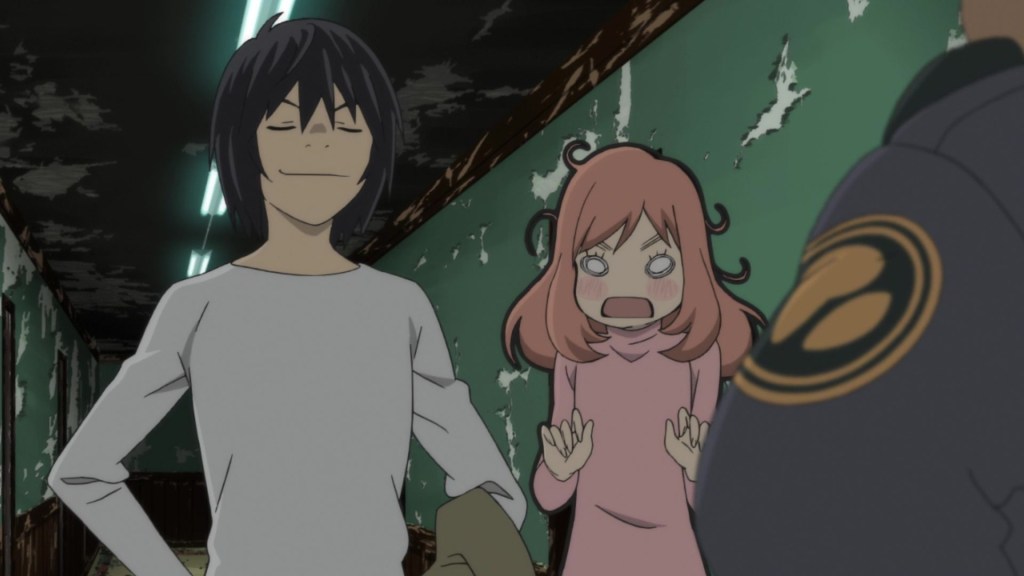
The anime follows Akira Takizawa (Ryōhei Kimura), who awakens with amnesia outside the White House, naked and holding a gun.
The first person he encounters is Saki Morimi (Saori Hayami), a woman on her graduation trip who is surprisingly helpful to the naked man with a gun.
This is the basic premise of the first episode and the situation is as hilarious as it sounds.

What was also a nice surprise of this first episode is its quality in the voice acting, especially from the English-speaking characters.
Whenever characters speak English in anime, they are usually voiced by people who don’t usually speak the language so it becomes rather hard to take it seriously.
Eden of the East does the opposite of this, having plenty of English speaking voice actors accompanying the Japanese cast and I appreciate the show for putting in the effort.
Another thing I appreciate is the great bond between Takizawa and Saki, which is kind of surprising since how they meet, with Takizawa being naked and with a gun, would result in any clear headed person running for their lives, but not Saki.
What most likely helps lessen the notion of improbability that their growing relationship has on the viewer is the two’s fantastic chemistry, with their bond being a highlight just two episodes in.

So, with these two great characters and an intriguing plot that could be particularly hilarious at times, I was all for seeing where the mysteries of this show would go.
And, honestly, I was slightly disappointed.
That is not to say the ending of the show is bad, it’s still pretty good.
But I much preferred the first few episodes, which set up the mystery, rather than the last couple of episodes that ended the show in a pretty rushed fashion.
For example, Takizawa does something in the final episode that Saki does mention in narration during the first episode, however, other than this initial narration, I don’t think there was any other setup for this happening.

Despite my problems with the ending of the show though, I know this is not the end of the story because there are apparently two movies I need to see to know how this whole mystery of the game that Takizawa has become involved in wraps up.
According to the people I’ve talked to, these movies weren’t particularly well received but I’ll have to judge that for myself when I get around to it.
In any case, I found Eden of the East to be a solid show, all in all.
The chemistry between Takizawa and Saki is great, the humor is top notch, and the mystery does keep you intrigued throughout, even if I felt the story did not work in places, especially with the end to the show.
Still, I have the movies to check out so I hope they can wrap up the mysteries that were laid out in the first few episodes well.
The Promised Neverland Manga Review: Basically Tokyo Ghoul Quality vs Tokyo Ghoul: Re Quality.
![]()
I recently rewatched the first season of The Promised Neverland and was amazed by it.
I had honestly forgot how incredible of an anime it was.
So, knowing that the second season had been delayed to 2021 because of Covid-19, I decided to read the manga in its entirety.
After reading it, the best way I can describe it is Tokyo Ghoul quality vs Tokyo Ghoul: Re quality.
Essentially, the first half of the manga is fantastic, just like Tokyo Ghoul, while the second half is still good but it does have a lot of problems, just like Tokyo Ghoul: Re, creating an experience that is, overall, still a lot of fun to read.
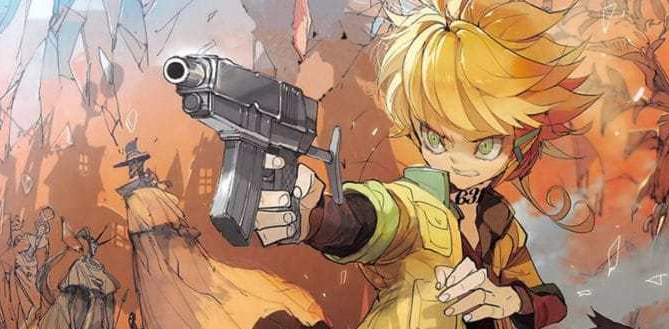
Written by Kaiu Shirai and illustrated by Posuka Demizu, The Promised Neverland follows children Emma, Norman and Ray who learn that the orphanage they live on is in reality a farm made to provide food for demons.
They, and the other children, then plan to escape and embark into the world of demons, a world that contains many friends and many foes.
As I said, the first half of The Promised Neverland is absolutely fantastic, with many great twists and characters to cheer for.
As if the characters from the first season like Emma, Norman, Ray, Isabella and Phil weren’t already amazing enough, the manga offers many more interesting characters like Mujika, Yuugo and Lucas.
Yugo and Lucas in particular are great additions to the cast and probably tied for my favourite characters in the entire story.

As for the old characters, they are just as great, with Emma standing out as a fantastic protagonist, especially in the Goldy Pond Arc.
Speaking of, Gondy Pond is definitely my favourite arc of the manga with it providing a lot of awesome fights, tension and character development.
The villain of that arc, Leuvis, is also just as intimidating as Isabella and Sister Krone were in the first season.
Unfortunately, this continued fantastic quality does not last as the story begins to have more and more flaws as it enters its second half.
One of these big flaws is character immunity.
It became quite clear towards the final stages of the story which characters were safe and which were not.
For a series that started off with the “anyone can die” mentality, it sure pulled a lot of punches by the end in regards to character deaths.

Another problem is those characters themselves or, more specifically, the amount of them.
There are so many characters that a lot of them don’t get the screen time they deserved.
Norman, Isabella and Phil are missing from huge chunks of the story and Ray becomes kind of a stagnant character.
The worst example of wasted character potential though definitely goes to Ayshe.
She is introduced in the last few arcs of The Promised Neverland and is given a fantastic backstory and motivation that looks set to put her on a revenge path that will cause her to conflict with some of our main characters.
However, after this backstory is revealed, she never does anything.
All of that fantastic build up the reveal of her past had turned out to be for nothing and made wonder why she was introduced in the first place.

There was also a complete deus ex machina towards the end that was very off putting.
As for the ending of the story, a lot of people have problems with it and, while I think those are valid, I still liked the ending and it did get me tearing up.
Which reminds me, I cried quite a few times when reading this manga.
Whenever the story ignored characters absurd plot armor and finally killed someone it almost always got a tear out of me.
So, I can definitely say that the good far outweighs the bad.
While the second half does have a lot of problems, The Promised Neverland is still a great manga that delivers a lot of emotional moments.
Grand Blue Review: 90% Nudity, 10% Diving.
![]()
The opening scene of Grand Blue, directed by Shinji Takamatsu and based off the manga by Keni Inoue, is quite the bait and switch.
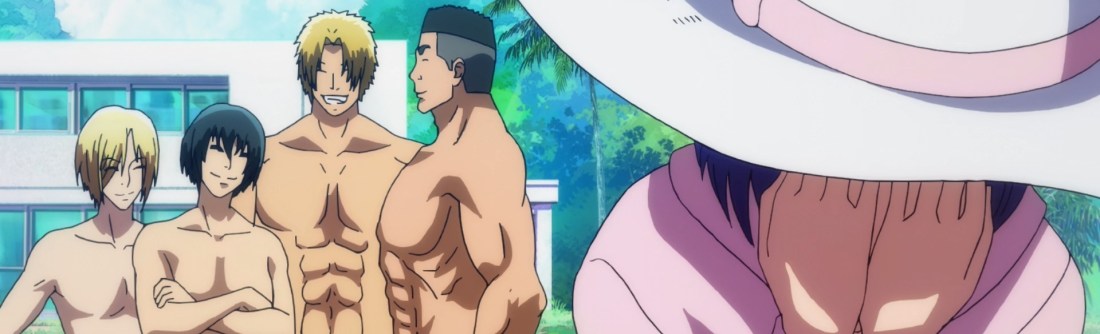
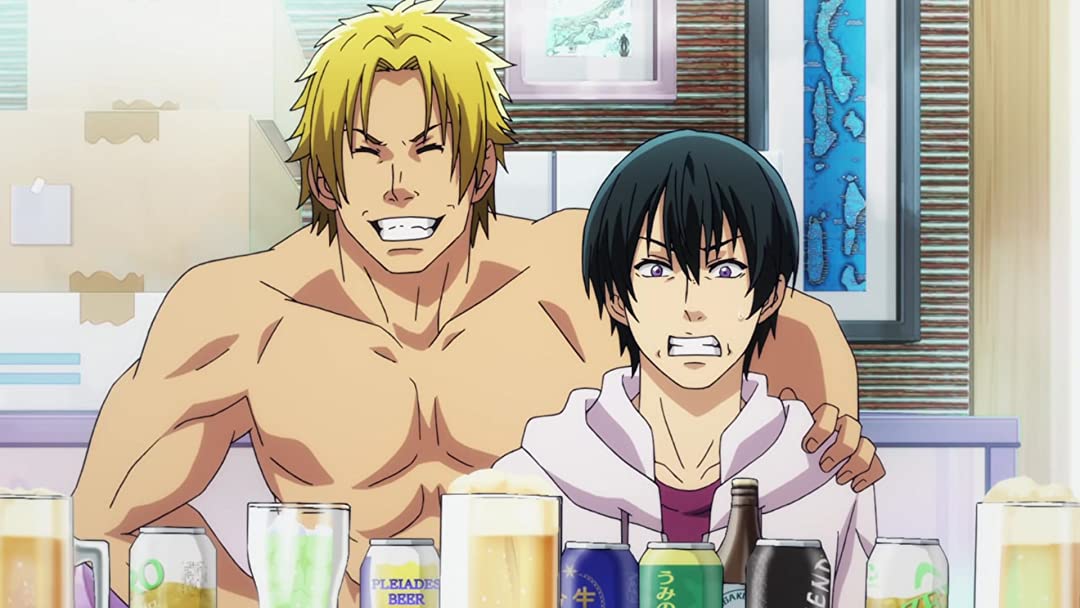
As Iori Kitahara (Yuma Uchida) heads to his uncle’s diving shop, we expect a light hearted slice of life story as he learns to dive… only for us all to be met with the sight of a bunch of naked men (with their privates thankfully covered) drinking like there’s no tomorrow, revealing Grand Blue for the racy comedy that it is.
This was quite the shock for my Anime Club, which burst into laughter at the reveal.
I’m pretty sure the person who chose this show deliberately mislead us about what the show was about so we could make the most out of the surprise.
I thought Grand Blue would be 100% about diving going in but it’s actually only about 10%.
The other 90% is spent on nudity, alcohol and sexual jokes that never fail to get a laugh.
Following the opening scene, the anime follows Iori’s misadventures with the diving club.

Among these characters are the practically nudist Shinji (Hiroki Yasumoto) and Ryujiro (Katsuyuki Konishi), and Iori’s cousins Nanaka (Maaya Uchida) and Chisa (Chika Anzai), who is both Iori’s and Nanaka’s crush.
Speaking of, incest seems to just be an accepted thing in this anime but it is thankfully played for laughs most of the time, so, whenever Nanaka is shown to be in love with her sister, it gets a laugh rather than a cringe.
Along with these characters, there is also the extreme anime nerd Kohei (Ryohei Kimura), who Iori drags into friendship kicking and screaming.
Their antics are of special hilarity, with many of the faces they pull reminding me of the Titans from Attack on Titan.

However, although these characters are hilarious, they can be especially hard to root for at times, considering the things they do.
From exposing Chisa to a crowd to try and win a beauty pageant, to trying to get one of their friends’ girls to break up with him so he will be single like them, Iori and his friends are first rate jerks.
If the way that they went about doing these things wasn’t so hilarious, I would probably despise them.
Thankfully, the humor saves them.
As for the animation it is solid, being nothing spectacular but serviceable.
The music is the same, except for the opening that shares the name of the anime, which I would always find myself singing to.
The best thing about it though, as I have already stated, is definitely the top notch humor.
The rest of Grand Blue is serviceable but the jokes will have you laughing so hard that your sides hurt, which makes it definitely worth a watch.
Tokyo Ghoul Season One Review: A Rush to a Killer Finale.
![]()
Before watching Tokyo Ghoul, many people suggested I should read the manga first because the anime was a bad adaptation.
In reading Sui ishida’s manga, I found a fantastic story and a solid yet flawed experience in its sequel Re.
Well, after watching the first season of the anime adaptation, produced by Studio Pierrot and directed by Shuhei Morita, I can see what people were talking about.
This is not to say that season one is a bad adaptation but it falls quite far from the successes of the manga.
The reason for this mostly comes down to how rushed the story is and the switching around of arcs.
Take the first episode, for example.
I was pretty surprised by how much was adapted in so little time.
Honestly, I expected the first episode to encompass the first chapter, with it ending when Kaneki wakes up, revealing his ghoul eye and noting that his life is a tragedy.
But the episode went ahead of this moment and adapted much more for the first episode, resulting in scenes going by much too fast to be as impactful as they were in the manga.

This rushed quality persisted right up until the end, and was not helped by the removal of entire scenes.
Season one should have been around twenty episodes instead of twelve.
The second big issue is the switching around of arcs with the Gourmet Arc happening before the Doves Arc, which came first in the manga.
The Doves Arc being moved behind the Gourmet Arc made certain things not make a lot of sense in the anime.
However, despite these problems, I still found the first season of Tokyo Ghoul to be a good adaptation.
Even though much of the story is rushed and some story arcs happen sooner than they are supposed to, certain scenes are adapted fairly well and the characters are all wonderfully brought to screen.
Kaneki (Natsuki Hanae), Touka (Sora Amamiya), Rize (Kana Hanazawa), Amon (Katsuyuki Konishi), Tsukiyama (Mamoru Miyano) Jason (Rintaro Nishi), and many characters are all done justice with their portrayals and voice acting.
The best example of this is Juuzou because both his Japanese voice actor Rie Kugimiya and his English voice actor Maxey Whitehead all do an incredible job as the character.
I remember hearing Juuzou speak for the first time in both sub and dub and thinking both were perfect.

Along with the great voice work, another quality of the anime that I enjoyed were some of its original scenes.
The anime hyped up Jason a lot sooner and that made the build up to his torture of Kaneki in the finale a lot better.
Speaking of that finale, I was considering this season an overall average adaptation, what with the rushed nature and switched around arcs of the anime but then, “Ghoul” happened.
“Ghoul” is a good season finale that perfectly adapted Jason and Kaneki’s epic fight.
The only problem I had with the episode was its censoring of numerous violent scenes and a couple of changes in Kaneki being immediate, rather than gradual.
Watching Kaneki take on Jason to the spectacular theme of Unravel made the entire season feel worth it and was the best way to end it.

As for Unravel, it is already one of my favourite anime openings of all time.
Everything from the music, visuals and symbolism is just incredible.
Unfortunately, the few incredible aspects of this anime, like Unravel and the final episode, would not be continued in the follow up season of √A, which has a lot more problems, but we’ll get to that later.
All in all, the first season of Tokyo Ghoul is a solid adaptation.
Sure, it has its problems, like the rushed story, switched arcs, and missing scenes, but the adaptation of certain scenes, voice acting, final episode, and Unravel make up for it.
My Hero Academia Season 4 Episode 22, School Festival Start Review: A Villain’s Love.
![]()
When Gentle and La Brava were first introduced in My Hero Academia, some anime fans worried that they would be impossible to take seriously because of their goofy nature, especially after the intensity Overhaul brought as the villain, last arc.
However, the 22nd episode of My Hero Academia‘s fourth season, “School Festival”, hopefully showed those who were concerned just how fantastic the two are, not just as villains but as characters.
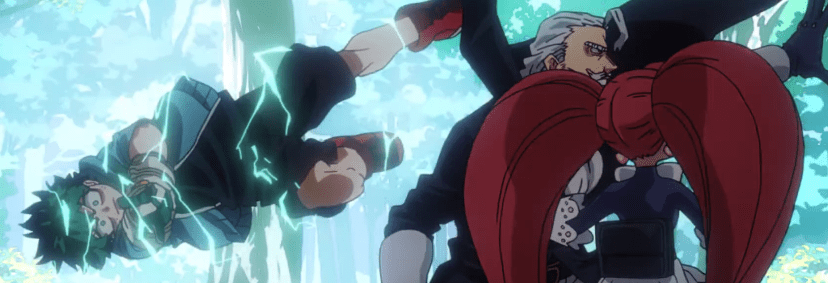
The Gentle and La Brava vs Deku fight did go by a lot quicker than I thought it would in the anime, lasting only two episodes, however this does not change how fantastic the conclusion of their fight is.
By far the best aspect of it is definitely the backstory and character growth for the two wannabe villains, resulting in a tragic love story ending.
Let’s start with La Brava.
Her backstory shows how the current hero society is unequipped to deal with unusual Quirks.
In La Brava’s case, her Quirk is highly reliant on the love she feels for another person and, because of this, her love was thought to be creepy and she was considered a stalker by the boy she loved.
This caused her to close herself off, clinging only to the internet, and contemplating suicide.
It was then, in her darkest moment, that her “light” appeared.
She stumbled across one of Gentle Criminal’s videos and fell in love with him, vowing to help him carve his name into history.
And Gentle accepted her wholeheartedly, to the point that he even drew dark circles under his eyes so La Brava wouldn’t feel self-conscious about hers.
This flashback expertly brings across many different tones, from dark, like when La Brava considers suicide, to sweet, when Gentle accepts her, and humorous, when the two are shown comedically sneaking away from a police officer.
Their love story then blooms into the reveal of La Brava’s Quirk, Love.
This ability allows her to temporarily power up those she loves by declaring her feelings for them.
The reveal of this, with Present Mic narrating it in a calm voice, as opposed to his over the top loudness, highlights its impact.
And what an impact it has, because it temporarily allows Gentle to overpower Deku.
Only temporarily though, as Deku is back on his feet in seconds, ready to take on a now overpowered Gentle.
From here, the episode transitions into Gentle’s backstory, which is as equally tragic as La Brava’s.
Once hoping to become a hero, Gentle failed every entrance exam he tried at.
One day, he saw someone about to fall to their death and used his Quirk to try and save them, only for this to result in him impeding a hero attempting to save them, resulting in the person being seriously injured.
Treated like trash and kicked out by his own family because of this, Gentle was alone for years, until he came across one of his old school friends who had become a successful Pro-Hero.
Gentle was happy for him, when his old friend revealed he didn’t remember him at all.
Wanting to be remembered, Gentle decided to become a villain instead of a hero.
It is apparent that Gentle has a lot in common with Deku, as both wanted to become heroes and are now fighting for someone’s bright future, Deku for Eri, and Gentle for La Brava.
Deku himself points this out before defeating Gentle Criminal as a sobbing La Brava ineffectively hits him.
Realizing that UA teachers are closing in, and wanting to protect La Brava, Gentle uses the last of his strength to push Deku away to make it look like the fight never happened to make La Brava’s role seem less serious.
Embracing her as the teachers approach, Gentle declares to them he wants to turn himself in, bringing a tragic end to the episode.
I say tragic because, if this episode tells us anything, it is that Gentle and La Brava are not villains.
They are just people who were dealt a bad hand by the society they live in and are trying to change their fates.
Granted, they’re not doing it in a good way but, even so, that does not make them villainous.
They are truly tragic characters and we will learn more about their fate next episode.
The build up to this end was great as well, with not only a fantastic backstory for Gentle and La Brava, but great action sequences as well.
It was not quite as spectacular as it was in the manga but, admittedly, the anime does have a budget to maintain, and it looks like they are actually going to be adapting part of the Pro-Hero Arc this season, which will need great animation, so that’s a reasonable excuse.
As for the beginning of the episode, it just shows the various students and teachers preparing for the festival, which we will also see next episode, along with a scene that I have been anticipating for a while.
“School Festival Start” is another great episode of My Hero Academia, which proves that, while Gentle and La Brava are a little hard to take seriously initially, they are some of the best villains of the series.
My Hero Academia, Season Four, Episode Sixteen, Win Those Kids’ Hearts Review: The Beginning of Endeavor’s Rise.
![]()
In the sixteenth episode of My Hero Academia’s fourth season, Todoroki, Bakugo, Inasa and Cammie began their provisional licence course and came up against the most dangerous, manipulative and evil foe they have had to face yet… children!
In all seriousness though, “Win Those Kid’s Hearts” is an average episode of My Hero Academia because it serves as a clear example of when the manga is better than the anime.
This is evident through a lot of the humor, which were much funnier in the manga, like when Gang Orca throws Todoroki, Bakugo and Inasa away while screaming, “disciplinary action!”
On top of this, the character development is not as good as the manga because a minor flashback that helps Bakugo grow is left out entirely.
And then, there are the kids whose hearts they are trying to win over.
While their oddly very good psychological manipulation is very funny, the episode acting like they are some kind of big threat with intimidating music is very cringey.
The saving grace of “Win Those Kid’s Hearts” is definitely the humor and Endeavor.
Now, while I did say that the humor is a downgrade from the manga, a lot of it is still pretty funny and will honestly be hilarious for anime only viewers.
And then there is Endeavor, who has excitingly begun the character arc that has made him one of the manga’s best characters.
When I made my Top 10 My Hero Academia Characters list, Endeavor barely missed out but, with all that’s happened in the manga since then and looking back on prior chapters, he is clearly a better character than I gave him credit for and should have been on the list.
If you are an anime only, you may be confused about this since Endeavor is an abuser and are probably wondering how any character arc could make him likeable.
Well, to you, I say wait until the end of the season and then you will understand.
As for the current episode, Endeavor’s scenes are definitely the best because we get insight into his character, and already see how he has started to grow through seeking All Might’s help by asking him what it means to be the symbol of peace.
Endeavor asking All Might for advice is something he would never have done when he was first introduced, showing the pressure he is now under now with his new title as the number one hero.
This growth makes him the most interesting character of the episode.
Also, him constantly shouting “SSSSHHHOOOOOTTTOOOO!!!!!” is just really funny.
Overall, “With Those Kid’s Hearts” is an average episode of My Hero Academia.
It is definitely down there with “The Scoop on UA Class 1-A” as one of the weakest episodes of the season.
Still, it is a good episode what with the humor and Endeavor’s character development.
My Hero Academia Season Four Episode Twelve, Unforeseen Hope Review: A Dark Future.
![]()
For an episode titled “Unforeseen Hope”, My Hero Academia’s twelfth episode of the fourth season is almost anything but hopeful.
The heroes just seem to get kicked down every time they get up this episode, with Overhaul utilizing his quirk in the most unique and disturbing of ways.
He actually destroys his and Nemoto’s bodies and then fuses them together to create an even more powerful form.
This goes to show not only how powerful Overhaul is but also how cruel he is, especially in comparison to the League of Villains.
Despite not being good people, the League actually do care about one another.
Overhaul, on the other hand, appears to not be capable of empathy at all, throwing his allies away like pawns and using them for his own gain.
This is taken even further with his treatment of Eri, as a flashback shows he cruelly dissembled and reassembled her every time her body got too tired to handle the experimentation.
Honestly, Overhaul is giving All For One a run for his money in terms of evilness.
Still, you cannot deny his intelligence in using his quirk the way he did, which even allows him to defeat Nighteye’s foresight, mortally wounding him.
Nighteye, a character who can literally see into the future, being defeated by Overhaul shows how much of a threat he is.
Not only this, but Nighteye’s foresight also predicts a dark future, as the hero says he saw that Overhaul would kill him and Deku before escaping with Eri.
Along with this, we also got more of an insight into Nighteye’s reasoning for not using his quirk, as he believes that by using it on All Might he has condemned his friend to a horrible death.
However, despite all this misery, I do suppose the episode title is right in one way as Deku promises to change the future and save Eri.
It will be hard for him to do so, though, because he will have to contend both with Overhaul’s over powered strength and his emotional manipulation of Eri, as shown when he uses Nemoto’s quirk to guilt trip her into coming back to him.
Poor Eri.
I just want to wrap her up in Lemillion’s cape and never let her go (epic foreshadowing).
In any case, alongside the great fight with Overhaul, we also got more insight into Rock Lock and the League.
Rock Lock’s development shows us why he was so tough on Deku and Mirio because he has a kid of his own and was just looking out for them.
As for the League, it appears they have made a new plan to make Overhaul “cry like a baby”, as Toga put it; something I will be very interested to see.
The episode ends with the party literally being crashed as Ryuko, Ochako, Tsuyu, and Nejire smash through the ceiling using the Eight Bullets member Rikiya Katsukame.
Overall, “Unforeseen Hope ” is another great episode of My Hero Academia.
My only big criticism is that I feel some of the shots of Overhaul’s new form look a bit off animation wise because of how static he is, which really drew me out of the action and drama.
Other than this, though, “Unforeseen Hope” is a crazy episode that is sure to lead to an even crazier one.
My Hero Academia Season Four Episode Nine, Red Riot Review: A Spear and a Shield vs a Shield and a Shield.
![]()
I have been anticipating the ninth episode of My Hero Academia’s fourth season “Red Riot” for a while because it was this moment in the manga that propelled Kirishima to one of my favourite characters.
Thankfully, the episode did not disappoint, adapting both Kirishima’s backstory and his and Fat Gum’s fight with Kendo Rappa and Hekiji Tengai perfectly.
“Red Riot” picks up from Tamaki’s battle with three of the eight bullets of the Hissaikai and sees Mimic send Fat Gum and Kirishima into a dark room where they are meet by Rappa and Tengai for a battle of spear and shield vs shield and shield.
In this case, Rappa and Tengai make for the perfect combination, with Rappa dealing out devastating blows as the spear and Tengai providing an almost impenetrable shield for them.
As for Kirishima and Fat Gum, their status as shields puts them at an instant disadvantage from Rappa’s punches, especially Kirishima who is hit so hard that his hardening starts to come undone.
Que, emotional backstory to inspire him to save the day.
In all seriousness, Kirishima’s backstory is one of the best in the series so far.
Kirishima always tried to help people but he lacked something to dive in head first.
In comparison, fellow student Mina Ashido had all the qualities of a hero in the making, protecting her friends from a gigantic villain (who will be important later) by giving him the wrong directions to a hero agency.
Kirishima witnesses this but is unable to act and this causes a massive blow to his confidence.
It is then that, as if by fate, he happens to see an interview from his favourite hero, Crimson Riot, who tells the story of how someone died because he did not act and now his biggest fear is being unable to act, which drives him forward.
Inspired by this, Kirishima set out to completely remake himself into a chivalrous hero, apologizing to the girls he did not help, (even though they have no idea who he is but that is not important) and even dyes his hair red, prompting playful teasing from Mina.
The scene between the two is very sweet and is what made me start to ship them when I read the manga.
Back to the situation at hand, upon remembering why he set out to become a chivalrous hero in the first place, Kirishima leaps in front of Fat Gum to protect him with a burst of inspirational music.
This allows Fat Gum enough time to transfer his quirk from a shield to a spear as he stores the power of the blows Rappa is unloading on him into pure energy, which he releases, along with all of his fat.
It is here that we get our first look at him without this fat and I am sure a number of Squidward “oh no! He’s hot!” memes will be generated from this.
In any case, it is with this release of energy that Fat Gum defeats Rappa and Tengai with the help of Kirishima.
Kirishima’s growth during this episode is fantastic, with his self doubt transitioning perfectly into his backstory, which then leads to his heroic return to the fight at the end of the episode.
Likewise, Fat Gum also gets his moment with the reveal of his spear attack.
It is not just Kirishima and Fat Gum that shines in “Red Riot”, though, as Rappa instantly stands out as the only member of eight bullets who does not follow Overhaul blindly.
The reasons for this will most likely be unveiled in the next episode and make him the most interesting member of the Hissaikai, with the exception of Overhaul himself.
Overall, “Red Riot” is the best episode of My Hero Academia‘s fourth season so far with Kirishima’s character arc being particularly exceptional.
My Hero Academia Season Four Episode Eight, Suneater of the Big Three Review: The Parallel of Hero and Villains.
![]()
After episode seven of My Hero Academia‘s fourth season “GO!” promised a followup, action filled episode with its cliffhanger, that episode “Suneater of the Big Three” delivers on this.
As the title suggests, the main character of this episode is Tamaki Amajiki, AKA Suneater, who goes on an emotional journey in his fight this episode, with plenty of parallels between him and the villains he fights.
These three villains are members of the eight expendable bullets, Toya Setsuno, Yu Hojo, and Soramitsu Tabe.
Thrown out and left for dead by society, these three were eventually taken in and brainwashed by Overhaul to fight for him to the bitter end.
“Even trash has its pride,” Yu states at one point, showing the extent that they have been influenced by their boss.
And, just as these villains are influenced by Overhaul, Tamaki is influenced by Mirio in a clear parallel.
As a child Tamaki had no self confidence until Mirio came along and inspired him to believe in himself, just like the villains were lifted out of their situation by Overhaul’s brainwashing.
This presents a two sides of the same coin parallel, where Tamaki has been correctly influenced and the villains negatively, leading to to conflict.
Tamaki’s battle with the villains is absolutely fantastic with both sides utilizing their quirks with ingenious tactics.
Toya and Yu make a great combination, until Tamaki uses his Chimera Kraken technique, forcing them to call in Tabe to even the odds again, only for Tamaki to outwit them and finally take them down.
The constant back and forth on who was winning this fight made for an intense battle where the viewer would have been unsure of who would win right to the very end.
As for other moments in the episode, they are also very well done, with another great display of Sir Nighteye’s quirk and plenty of heart warming flashbacks to Tamaki’s friendship with Mirio.
All in all, “Suneater of the Big Three” is the best episode of season four so far.
However, it will almost certainly be overtaken next episode, which will see an even more intense fight with Kirishima, along with revealing his backstory, which I am very excited to see animated.