Choujin X, Chapter Six, Apostasy Review: Full Bestification Time!

Sui Ishida is continuing to put out some great chapters for his latest manga, Choujin X, as Chapter Six, “Apostasy” centers around a fun action sequence with some excellent artwork and good character development.
After Chapter Five, I figured that the next chapter would start with a flashback explaining how Ely located Tokio and I was right on the money with that because this is exactly how “Apostasy” starts.
We first see Ely walking down a street with a shaded figure talking about her powers.
It’s revealed to have been less than ten days since we last saw Ely in Chapter Two, and whoever this new shaded in character who she had befriended is, she does not seem to be a Choujin based on how she does not sense the powers like Ely does.
It is this Choujin homing beacon that draws Ely to Tokio’s side, where she immediately accesses the situation before trying to save Tokio by using her smoke powers to blast off with him, away from Nari.
Unfortunately, still being pretty new to her powers, Ely cannot get them far and Nari quickly catches up, wondering if Ely is Sandaq’s trainee before launcing another attack at her.
Ely is ready though and, after a tense moment where her power temporarily seems to fail, she manages to blow a blast right at Nari, engulfing her head in flames.
However, this does not put Nari down because she has one more big trick up her sleeve: Full Bestifcation.
With these words, Nari transforms into a giant snake in a fantastic panel, which Ishida actually colours in with a red background, potentially highlighting Nari’s deadly personality.
In this form, she easily defeats Ely but at a cost because it is explained that in this form she is way dumber than she usually would be.
This results in her getting stuck in the cage to a monkey enclosure, giving Tokio enough time to react now that Ely is too injured to fight anymore.
So, what does our hero do?
Well, wonder what Azuma would do, of course!
It’s what Tokio always does when he gets in dangerous situations and it’s no different here, however, this may actually be the start of him breaking away from this mindset.
One reddit breakdown of the chapter I saw speculates that the title “First Apostasy” hints at the beginning of many instances of Tokio moving away from Azuma.
This seems to be the case in the chapter as well because, after Ely tells Tokio to run, he instead looks up at the sky and sees a vulture, apparently causing him to come to some inner realization.
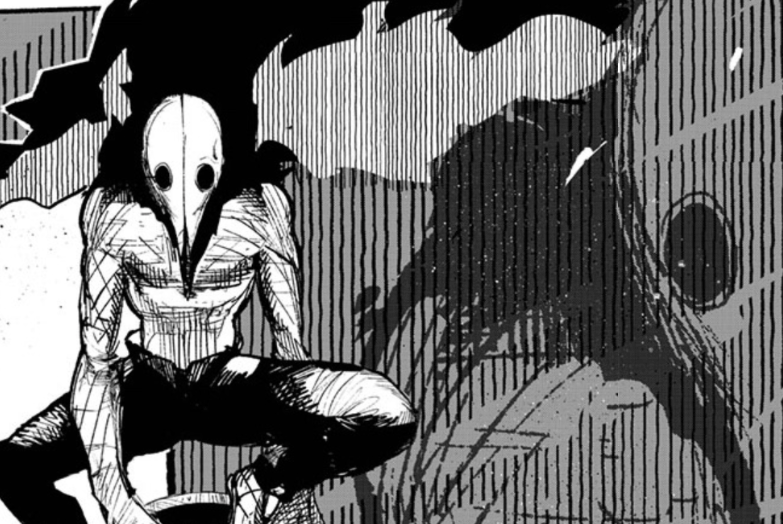
Not only does this moment show him going from thinking about what Azuma would do, to making his own decisions, but it is also another instance of great artwork from Ishida, as the vulture panel is coloured green, much like Nari’s was coloured red, potentially hinting at Tokio’s cautious personality.
Well, Tokio quickly throws this caution to the wind because, as Nari finally breaks free, Tokio makes his own effort to unlock his Choujin powers, trying to go Full Bestification in another really good cliffhanger panel.
So, next chapter we are most likely going to see what Tokio looks like in his full beastial Choujin mode.
It seems likely that he will look similar to the vulture monster we saw in the first panel of the story.
Another thing that will be interesting to see is if transforming will make him less intelligent, like Nari.
Speaking of, could this lessening intelligence for Nari be something similar to how the Johnny character went crazy after he became a Choujin?
Maybe it has a different mental effects on people.
Either way, I am excited to read Chapter Seven when we get it and see just how far Tokio will go with this new transformation.

My Hero Academia, Chapter 322, Great Explosion Murder God Dynamight Review: The Bakugo Moment We’ve All Been Waiting For.

I can remember beginning to read the My Hero Academia manga right after I finished Season Three, however, I have reviewed very few chapters since then.
This was because, with a very frequent release schedule, I was concerned focusing on it could put other reviews I had planned on the backburner.
So, I decided to only review chapters that really impacted with me.
One of these was Chapter 290, “Dabi’s Dance”, which is currently my favourite chapter of the manga and was so good it had me reviewing its follow up chapters for a few weeks until I stopped again.
Well, I just read another top ten My Hero Academia chapter, so I just had to review this one, which is Chapter 322, “Great Explosion Murder God Dynamight.”
The reason this chapter is so amazing is because of how it masterfully delivers a scene that Bakugo fans have been waiting years to see: his apology to Izuku.
Back when I watched the first season of My Hero Academia, I could not understand why so many people liked Bakugo.
I certainly understood his character and why he was so mean to Izuku but it in no way made him a likeable character.
However, as the series went on, I began to slowly realize why people loved Bakugo’s character and honestly I came to feel the same way as I watched him progress, realizing his own weaknesses and beginning to regret his past actions.
His breakdown in front of Izuku at the end of Season Three, showing how he blamed himself for All Might losing his power, really floored me the first time I watched it because I had no idea Bakugo was suffering internally like that.
As I read the manga, I continued to watch him grow as a character, liking his development more and more, especially the moment where he recreated Izuku saving him at the beginning of the story, with his body moving on its own to save him in the War Arc.
Well, in Chapter 322 we finally get the culmination of Bakugo’s character arc, which was all building up to this moment.
As the fight between Izuku and Class 1-A winds down, Bakugo explains to Deku why he saved him during the War Arc, following this up by explaining his horrible actions at the beginning of the story, how he came to realize his own weaknesses and how the time has finally come to tell “Izuku” his truth.
And yes, he does actually call Izuku by his real name instead of Deku, the name Bakugo has used to degrade him throughout the series.
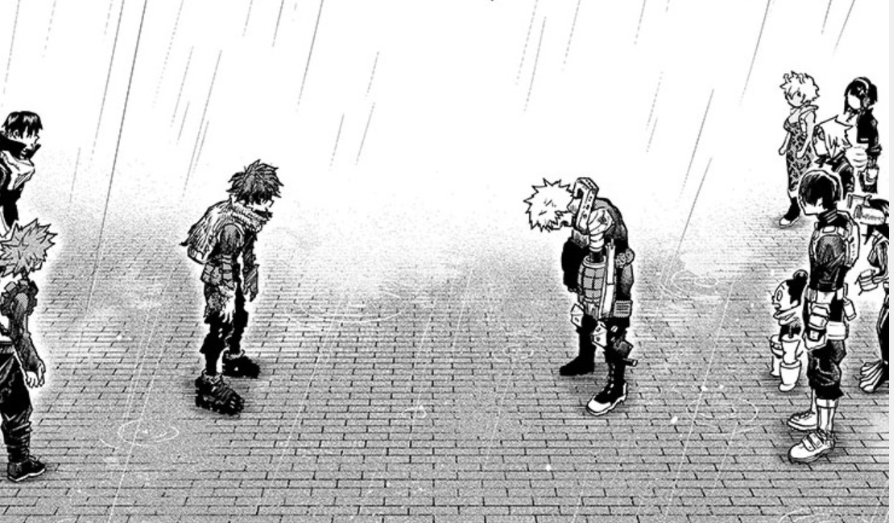
He follows this up by finally apologizing in a fantastic panel, even bowing slightly during his apology.
This, right here, is already one of My Hero Academia’s best moments.
It’s honestly baffling and kind of concerning how some people are against Bakugo apologizing to Izuku because they saw themselves in him when he was unrepentant.
Relating to a remorseless bully who doesn’t change… okay?
Thank goodness this is not what Bakugo’s character is actually like.
Not only is his apology to Izuku the culmination of his character arc up until this point, but it is also beautifully highlighted by Kohei Horikoshi how far both Bakugo and Izuku have come to get to this point.
As Bakugo prepares for his apology, explaining his actions and how he has changed to Izuku, the two symbolically change appearance throughout the panels.
First, we them as kindergarten students, then middle-schoolers, then in their UA uniforms, and finally their hero costumes.
Along with this, Izuku’s expression also changes across the panels, being as dead-eyed as Shigaraki before Bakugo brings him back to himself.
All of this comes togethor to create what is, again, one of My Hero Academia’s best scenes.
It is not the only moving moment in the chapter, though, because there are multiple parts like this throughout, like at the beginning when Mina tells Izuku to come back to UA because she cannot stand the thought of losing anyone else, obviously calling back to Midnight’s death.
Then there’s Kirishima calling back to Izuku saving Bakugo, Bakugo catching Izuku when he falls, and the final scene, where it looks like Uraraka is about to stand up for Izuku.
This scene happens when Class 1-A brings the unconcious Deku back to UA and are met by Thirteen, who we see unmasked for the first time.
What is more surprising than this, especially so for Izuku, is the state of U.A.
With its giant wall constructed to keep citizens safe, it looks a lot like Tartarus prison once did.
Let’s hope it’s even more secure than that was because, if it’s not, then we’re going to be in for a world of hurt once All For One attacks.
The citizens taking refuge at UA are just as concerned about this.
When they recognize Izuku as the one Shigaraki was after, they demand he leave for their own saftey, so Shigaraki will not attack.
Izuku is about to do so when Uraraka grabs his hand and assures him it will be okay.
She thinks about how Ida and Bakugo started to bring Izuku back, and now it might just be her turn because she again wonders who will will protect the heroes when they need it, as she appears to step towards the angered crowd.
I hope this means next chapter we will see Uraraka speak up for Izuku and convince the crowd to allow him inside.
After all, Bakugo and Ida both got their big moments in bringing Izuku back to UA and now I think it is Uraraka’s turn.
In any case, “Great Explosion Murder God Dynamight”, along with being a mouthful of a title, is one of My Hero Academia’s best chapters.
It has a lot of great moments but Bakugo’s apology scene just steals the show.
I wonder how his character will continue to grow from here?

Look Back, Oneshot Review: Tatsuki Fujimoto is Brilliant.

Ever since Tatsuki Fujimoto released his one shot manga Look Back weeks ago, I have found myself returning to it time and time again, finding new meaning in it every time.
It’s funny because, even though Fujimoto is the author of one of my favourite mangas, Chainsaw Man, I honestly wasn’t expecting Look Back to be all that much.
Just a fun little story to read once and then move on from.
Boy, was I wrong.
I came out of Look Back an emotional wreck and I have felt just as impacted every time I have reread it since then.
It’s clearly not just me either because I have seen so many other people who feel the same way and come out of reading it with different interpretations of what it all means.
Look Back begins with a simple, single page panel of a room with an empty desk and chair, the importance of which will be realized by the ending.
We then meet our main character, Fujino, through the four panel manga strip she entered as homework for her school’s newspaper.
Fujimoto does an excellent job presenting her to us, as first we see the teacher giving his class the newspaper, then them passing it down and laughing with and appreciating Fujino’s art, and next we actually see the comedic strip before we are finally introduced to Fujino herself.
However, despite the class’ praise of her artwork, Fujino is actually not too receptive to the idea of becoming a manga artist when she grows up, perferring the idea of becoming an athlete instead.
It is on the following page where we first hear of the character who will change all of this for her, Kyomoto, when her teacher asks her to give up one of school paper manga slots to her, since Kyomoto is a recluse who doesn’t come to school but wants to explore her own artwork.
This news causes Fujino to cockily wonder how someone who is afraid of coming to school could draw manga well.
Her arrogant claim made it all the funnier when I turned the page and saw her horrified reaction when she saw Kyomoto’s artwork next to hers and realized it was much better than hers.
Fujimoto is really good at drawing hilarious character reactions and he doesn’t disappoint with Fujino’s.
It is not just her who realizes that Kyomoto’s artwork is better because everyone in her class does as well.
Remembering how everyone first praised her, wanting more of that, and realizing that Kyomoto is so good because she practices all the time at home, Fujino decides to devote even more time than the “five minutes” she spent on her earlier manga strip.
Following this moment, we get the first of many montage panels where time passes as Fujino practices her drawing at her home, school, the library, the park, and other places, along with buying various different guide books to help teach her.
At least a year passes during this montage, with the snow on the roof being in one panel then gone the next highlighting this.
We then get confirmation on how much time has passed, when one of Fujino’s friends says they will be middle schoolers next year and rhen asks if Fujino thinks that she herself is too old for drawing because she doesn’t want to be thought of as a creepy otaku at her age.
This, her sister’s discouragement and urging to try karate instead, and her seeing that Kyomoto’s background art is still better than hers, causes Fujino to give up.
There even seems to be a slight tear when she does so, showing how much this decision hurts, but she turns this emotion away to instead join up with her friends and spend time with family.
She even has her old drawing guide books thrown out.
It would seem that she is distancing herself from the passion of drawing forever but fate has other plans, as Fujino’s teacher again asks her to go to Kyomoto and deliver her graduation certificate to her.
No one answers the door, so Fujino goes inside and finds the walls outside of Kyomoto’s room lined with journals for drawing.
Seeing one bare manga strip, a moment of cruel inspiration strikes Fujino, as she draws Kyomoto winning the shut-in world championship because she is dead.
Epic foreshadowing (only kidding).
Just as she is wondering what she is doing, she drops the strip, which slides under Kyomoto’s door, causing Fujino to flee in panic, only for a disheveled and awkward Kyomoto to pursue her outside.
The symbolism of this first meeting is pretty great, as Fujino’s feet are in the light and Kyomoto’s are in the shade of her house, showing their different standings in life, with Fujino currently being outgoing and Kyomoto an introvert.
It is then that Kyomoto nervously admits to being a fan of Fujino’s, followed by another great reaction shot of Fujino.
Although, while the previous reaction shot of her was comedic, this one is dramatic, as her face is bathed in light, the only panel in the entire page where a character’s face is not in the shade.
This shows the importance of Kyomoto’s confession to her, as it resparks her passion for drawing manga, only this time not to gain praise which I will explain later.
Kyomoto follows this up by getting Fujino to autograph the back of her shirt, and then asks why she stopped drawing manga after sixth grade, causing Fujino to expertly lie, highlighted by her refusing to look at Kyomoto.
Fujino claims that she hasn’t been drawing as much because she is preparing to create a story, which she will submit for a manga award and promises to show Kyomoto once she is done.
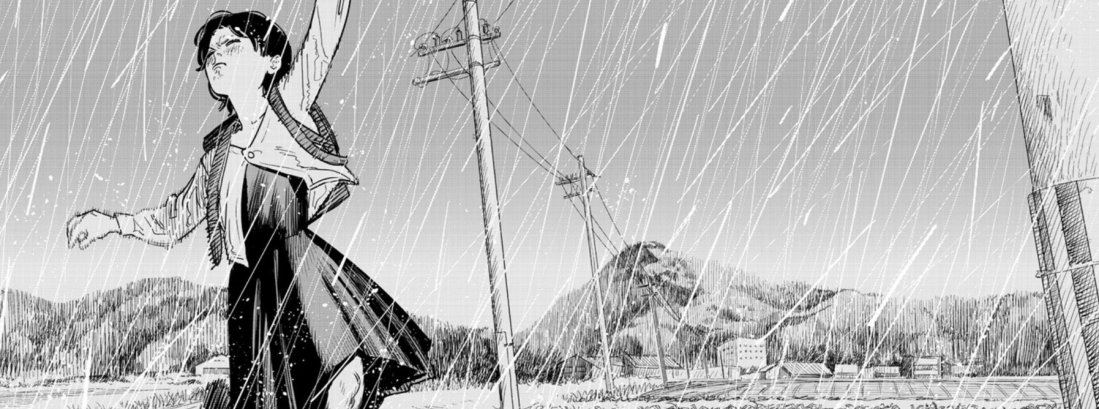
She then leaves as it starts to rain and begins to skip and dance, no longer having to lie to herself about lacking the passion to draw anymore.
The full page spread where she skips and dances through the rain in a way that is somehow both awkward and triumphant is excellently drawn by Fujimoto and one of my favourite moments in the one-shot.
Que another, much longer montage of panels, as the years pass and Fujino and Kyomoto grow closer, beginning to work togethor and inspire each other it their own artwork.
After a day out on the town, spending the money they earned from their manga, Kyomoto admits that, just like Fujino starting to draw manga because of the praise she got from others, she began drawing manga not for fun but because otherwise she was bored, thanking Fujino for bringing her outside.
Eventually, the two become successful enough to become seralized, however, Kyomoto cannot help Fujino with the new manga series because she wants to go to art school to hone her craft.
Fujino does not take this news well, using Kyomoto’s earlier confession to try and manipulate her into staying and helping her, saying she will become bored at art school.
This argument seems to cause a seperation between the two because, as time passes in the next montage, with Fujino becoming successful with her manga, Shark Attack, which is then set to get an anime adaptation, we don’t see them interact, which makes it all the more heartbreaking when it happens.
Fujino looks at the news one day and sees that an attack has happened at Kyomoto’s art school and unfortunately she did not make it.
This is clearly a representation of the tragic Kyoto Animation arson attack in 2019, which claimed 36 lives.
It is particuarly sad to then notice in hindsight that the first part of Kyomoto’s name is also the beginning of the name of the animation studio where the real life attack took place.
This all goes to show just how devestating the attack on Kyoto Animation and the loss of life was for many creators out there who had been inspired by their work, seemingly Tatsuki Fujimoto among them.
Kyomoto’s death affects Fujino especially hard, as she goes on a highatus afterwards, claiming an illness to be responsible.
She then visits her old friend’s house where she finds the manga strip she wrote which accidentally drew Kyomoto out of her room.
This causes Fujino to blame herself for Kyomoto’s death because, as she sees it, if she had never drawn that manga strip then Kyomoto never would have come out of her room and thus never would have died.
It is then that we see what appears to be a fantasy of Fujino’s of what Kyomoto’s life would have been like had they never met.
In this fantasy alternate universe, only the torn part of Fujino’s manga strip where the onlookers tell Kyomoto to not come out of her room slips under her door.
So, Kyomoto never overcomes her insecurities to interact with others but still gets into art school.
Then, the attack happens, only this time there is a hero to save the day.
It is none other than Fujino who, in this alternate universe, focused on karate like her sister asked, so was able to thwart the attacker and save Kyomoto’s life.
This leads the two to become friends in this fantasy as well, with Fujino offering Kyomoto a place as her assistant, inspiring Kyomoto to go home and draw more manga strips, one of which blows away in the wind and under Kyomoto’s door to meet Fujino, the fantasy ending.
Fujino reads the strip, which has the titular title Look Back, and is a comedic version of her saving Kyomoto, possibly something the shy girl imagined back when she was Funjino’s biggest fan.
Entering Kyomoto’s room, Fujino sees that Kyomoto indeed still was a fan of Fujino, as she had all of the volumes of her manga and still kept the shirt she signed with a place of honour on the hook of her door.
This all causes Fujino to admit to herself that she never really enjoyed drawing manga because of how unfulling it was and wonders why she did it all?
The answer comes in a flashback to Fujino gifting Kyomoto with the manga she promised back when they first met, resulting in an overjoyed expression from Kyomoto, along with all the times they inspired one another.
This all shows how Fujino’s passion for writing manga changed from first being to get the praise of her peers to then making her readers happy once she saw how happy it made Kyomoto.
And right there came the tears from me because this broke me the first time I read it.
If this is not a direct message from Fujimoto to his readers then I don’t know what is.
Especially considering the characters’ names of Fujino and Kyomoto, which makes up his name.
Looking at her Shark Attack manga, eerily similar to Fujimoto’s Chainsaw Man, and realizing what it all meant to Kyomoto, Fujino goes back home to continue her serialization.
The one-shot then ends on another single paged panel of Fujino sitting in her chair at her desk, continuing to write her manga, directly paralleling the beginning of the one shot where we saw Fujino’s chair and desk but no one was sitting in it.
Look Back seems to be detailing Fujimoto’s experience as a mangaka primarily through Fujino, as she starts off writing it for praise and to beat a rival but then starts doing it for the experience of the readers, as seen through how Kyomoto inspires her.
It’s also neat to note how the Oasis song “Don’t Look Back in Anger” is shown to be an inspiration through how it is placed by Fujimoto throughout the one-shot, with the opening black board saying “Don’t”, Kyomoto’s manga strip of Fujino saving her being titled “Look Back” and one of the books Fujino has on the final page being titled “In Anger.”
There are a lot of other subtle details to this one-shot, like the infamous Chainsaw Man door at one point.
It can take multiple read throughs to find many of these and some of them had to be pointed out by others for me to get, like the already mentioned “Don’t Look Back in Anger” reference.
Along with these details, there is the emotional power of Don’t Look Back, which hit me with the weight of a truck when I first read it.
It is a fantastic one-shot and I have the exact same thought every time I finish: Tatsuki Fujimoto is brilliant.

Choujin X Chapter Five Review: An Anticipated First Meeting.

Sui Ishida is still maintaining his quick pace with releasing new Choujin X chapters, and chapter five is another good one.
After last chapter’s cliffhanger, I thought the snake Choujin would try to eat Tokio, like Rize tried to eat Kaneki in Tokyo Ghoul, since both the snake Choujin and Rize cornered their prey in similar ways.
However, the opening panels of this chapter instead reveal that the woman, whose name is Nari, was hired by the masked man to hunt down Tokio and kidnap him if his abilities are dependable.
From here, the chapter cuts to the present, where Nari begins her testing of Tokio.
But first, she reveals an interesting tidbit about Choujins, that they can sense one another when their powers are used.
Nari used this to her advantage by allowing Tokio to sense her last chapter.
This technique is also probaly how Hoshi found Chandra attacking Ely in Chapter Two.
Once this information is revealed, Nari gets down to buisness and provides the rules of her test for Tokio.
He gets three attempts to prove his worth to her and if he fails then she kills him.
So begins yet another chase sequence, only this time Tokio is far less competent with his Choujin powers than Ely was in her chase scene, as he cannot find himself to muster any defence against Nari.
What results is a scene that is full of both great comedy and intriguing flashbacks.
First comes the comedy, with what is undoubtedly the funniest moment in the manga so far.
This moment comes when Tokio is fleeing from Nari and hears the birds surrounding him begin to make bets on who will win, him or Nari.
I laughed my head off at this gag.
Also, I do feel kind of sorry for the lone bird who bet on Tokio, the guy clearly was not going to win anything.
This is the same in the intriguing flashback as well, with a young Tokio shown to be losing a relay race for his team.
The reason this flashback is intriguing is because of Azuma.
Not only does this moment serve to again highlight his strengths compared to Tokio, as he wins the race single-handedly, despite Tokio holding him back, but it also potentially highlights his darker side once more.
As Tokio runs towards his friend, we get a close look at Azuma’s face and he does not look happy at all.
In fact, I would say his look towards Tokio is rather disdainful.
Yet, this look completley vanishes when he wins the race and goes to help Tokio.
Interrupting this flashback, which gives us further insight into Tokio and Azuma, Nari continues to torment Tokio, catching him twice and infecting him with toxic venom to motivate him in this chase.
Unfortunately for Tokio, this has no effect and he is captured for a third time and dubbed “ordinary” by Nari.
She goes to kill him, when suddenly an unexpected person literally falls out of the sky to help.
Ely bursts onto the scene, tumbling through her Choujin smoke before salvaging it with a suitable superhero landing.
She and Tokio look at each other and both with confusion ask,”a person?” bringing an end to the chapter.
This cliffhanger is interesting because not only does it finally result in our two main characters meeting but it also highlights how they are different from the other Choujin in the story.
The two of them have both been called Choujin constantly by others, Ely by Hoshi and Tokio by Nari, yet here they are the first ones to refer to the other as a person.
Along with this, Ely’s appearance does raise a few questions about what happened in between her being rescued by Hoshi and now.
I assume she was alerted to Tokio’s situation, either by his cries for help, her sensing Choujin powers or both, and rushed to help.
Now that she is finally here, I wonder how Nari will react to her?
Chandra said Ely was full of potential and Nari could see this and try to recruit her as well.
I also wonder where Hoshi is, since Ely was with him last we saw of her?
Not to mention the question of how much time has passed for Ely since Chapter Two.
If I am not mistaken, she is wearing the same clothes from that chapter and canonically speaking that was at least three days ago, unless the time difference between her story and Tokio’s is different, which could be elaborated on later.
Either way, I expect that what led Ely to Tokio will be explained in the beginning of the next chapter.
Overall, Chapter Five is another great chapter for Choujin X, as it provides another fun chase sequence, an interesting flashback, hilarious comedy, and the long awaited meeting between out two main characters.
I am intrigued to see how Tokio and Ely will interact with one another next chapter and in the future of the story.

Choujin X Chapters Two-Four Review: The World of Choujins.

I have been quite surprised at the rate of speed Sui Ishida has been releasing chapters for his latest manga, Choujin X. 
When I heard that there would be no set timeline for release dates so he could focus on his health this time, unlike with Tokyo Ghoul where he was really overworked, I thought that we could expect a few months between each chapter.
So, it was a pleasant turn of events to see Ishida release Chapter Four not long after Chapter Three.
I do hope he is continuing to keep healthy, though.
In any case, I have been falling behind on reviewing these chapters since I reviewed Chapter One, so now I’m going to review Chapters Two, Three and Four in one big post.
I will also be sure to write more reviews as the story goes on.

Chapter Two:

The second chapter of Choujin X picks up with our secondary protaganist, the little girl from the plane crash that happened in the first chapter.
Her name is revealed to be Ely Otsuta, and it is explained how she helped her adopted grandfather with farming tomatoes, showing that she is a child prodigy in that regard.
However, this backstory is interrupted by a tomato Ely picks up screaming as it bursts into flames, as she wakes up in a construction site with a concerned construction worker standing over her.
A dazed Ely asks for directions, only for the helpful construction worker to be burned to death right before her eyes by Chandra Hume, the Choujin who attacked the plane.
Que the big chase scene of the chapter as Ely makes a break for it after Chandra offers to escort her.
It is during this chase where we once again see how Ishida is going in a more comedic direction with this manga, as we get plenty of gags from Ely riding a skooter, to her miraculously finding a tractor and then using this to escape from Chandra and a group of gang members wearing sheep masks for some reason.
These comedic gags are quickly cut short when Ely and the gang members begin falling to their deaths and Ely uses her newly aquired Choujin powers to save them all.
She obtained these smoke powers through being infected by Chandra’s, or so he says, claiming this was just a “first attempt.”
It will be interesting to see why Chandra is so interested in creating other Choujins.
Not to mention that the way Ely became a Choujin seems to be a completley different from how Tokio did since he did so by injecting himself with the strange serumn.
Coming back to Chandra, he offers to teach Ely everything he knows about her power but she obviously does not accept this offer, thinking back on the kind elderly woman who Chandra murdered in the first chapter.
However, she does seem to hit a nerve with Chandra when she calls his power “worse than a turd.”
Chandra is clearly a very insecure person because this insult causes him to nearly go all Firelord Ozai on her face.
He would have succeeded too, had it not been for Hoshi Sandek, “Yamato Prefecture’s Choujin Protector,” or as I like to call him, Captain Chin.
Seriously, his chin is so freaking gigantic it takes up more than half his head.
Ely is clearly enamored by him, based off the heart eyes Ishida draws her having.
Not to mention that this guy resembles her imagined husband she talked about in the first chapter pretty closely, so of course she would have an instant crush on him.
Hoshi’s arrival on the scene also proves one of my previous theories to be false.
I predicted that because of what Azuma said in Chapter One there were no good Choujin, but there clearly are based off Hoshi.
We will probably get more information on the Choujin system when his character returns, along with Ely.
It would also be good to know what exactly his power is.
We seem to see him use it but I cannot quite tell what it is yet.
Following Hoshi and Ely’s first meeting, we get a pretty cool cut to Tokio’s story, as Hoshi asks Ely, “What’s your name, little Choujin,” only for us to then see Tokio’s sister calling her brother’s name.
Tokio has reached home after his transformation into the Beastial Choujin but his vulture-like appearance has not dissipated yet.
As he rests in the shower, Tokio wonders if he has become a Choujin, which should be pretty obvious to the guy, given what his face looks like.
This brings an end to what is a pretty good chapter.
The chase between Ely and Chandra is entertaining and quite funny at times, especially one joke where Chandra’s car is hit by a truck that says “we love saftey.”
Along with this, Hoshi’s appearance raises some questions about the Choujin system that I am interested to see answer.
One criticism I do have is that the action is a little bit hard to follow during the chase scene.
The artwork is still great, though, so it mostly makes up for that.
So, overall, Chapter Two does a good job of continuing Ely’s story and I am intrigued to see how it will progress further.

Chapter Three:

Out of these three chapters, Chapter Three is definitley my favourite because of how it handles the aftermath of Tokio becoming a Choujin and its impact on his and Azuma’s friendship.
The chapter begins with a flashback to Tokio helping Azuma after he collapsed due to the injection.
However, Azuma wakes up after Tokio falls over and looks horrifed at his friend’s appearance.
Tokio is just glad that Azuma is okay and says he will take him to the hostpital.
Azuma is quick thinking, though, and tells Tokio that if people find out he is a Choujin then he will never have a normal life, so he should just go home while he goes to the hostpital.
Tokio takes this advice, yet I am not so sure that Azuma’s actions were quite so innocent here, especially given how he acts later on in the chapter.
Also, keep in mind that the two still did not know if Azuma had Choujin powers here, so Azuma going to the hostpital could have exposed him to being a Choujin if he was one, yet he suggested Tokio go home.
From here, the chapter cuts to the present again where Tokio’s vulture face mask has still not come off.
Tokio fakes being sick so he will not have to go to school and be revealed as a Choujin to everyone and we get some really good artwork of what his face looks like now as he tries to eat breakfast.
This makes it really funny when, in subsequent panels, Tokio’s Choujin face honestly looks pretty derpy.
I am sure this is intentional by Ishida and it has great comedic affect.
Again, Ishida cuts the comedy short, this time by Tokio breaking down into tears because he is scared he will look like this forever.
This leads to him going to see Azuma for reassurance after he doesn’t pick up his calls, acting like he is going out shopping to his father and sister, while hiding his face.
He calls Azuma outside his house and this time his friend picks up but is very standoffish.
Azuma claims to have gone to the hostpital and got a bloodtest, only for nothing out of the ordinary to be found.
Azuma then makes the connection to Tokio looking like a vulture because it is the form he desires.
This leads to Tokio asking Azuma what he should do, only for Azuma to yell at him to think for himself for once.
Tokio hangs up and leaves, even more depressed, before Azuma can apologize.
Azuma says to himself that it isn’t Tokio’s fault, but his actions make me wonder if he is jealous that Tokio got these Choujin powers instead of him.
It seems many other readers are starting to suspect Azuma and Tokio may turn out to be rivals in the future of Choujin X and I am beginning to think so too.
Think of it as the opposite of Kaneki and Hide’s friendship from Tokyo Ghoul.
After this great scene, which may be hinting at a potential rivalry between Tokio and Azuma, we then cut to the Mr Fantastic Choujin, Johnny, and the masked man who gave him the injection.
It is here that I see what may be another Tokyo Ghoul refrence, since the man’s mask looks a lot like the ones the Clowns would wear.
The masked man learns about Tokio turning into a Choujin but not who or where he is, and kills Johnny when he refuses to say anymore.
His Choujin power seems to be related to cutting people up, since he decapitates Johnny fairly easily.
This looks to be the main antagonist of the story, or at least this part of it, as he seems to be preparing to hunt down Tokio, maybe for the same reasons that Chandra wanted to recruit Ely.
Overall, Chapter Three is a great chapter that does a really good job of characterizing both Tokio and Azuma, while getting us hyped for the future of this story, as we get more insight into the mysterious masked villain who is now after Tokio.

Chapter Four:

Okay, so Ishida had to have had a terrible first date, right?
I mean, first he has Kaneki nearly get eaten by Rize in Tokyo Ghoul, and now Tokio is currently being eaten by a snake Choujin in Chapter Four.
It can’t be a coincidence.
Jokes aside, Chapter Four is another good chater of Choujin X that starts off by continuing to expand on Tokio’s power set as a Beastial Choujin.
This comes through the comedic surprise of Tokio being able to talk to pigeons, who refer to him as the bread atelier, due to how much he feeds them.
It seems that talking to animals is not just a power only Tokio has, though, because the snake girl also appears to talk a snake in the chapter.
This makes me think that there are different categories of Choujin.
For example, the Beastial Choujins, which includes Tokio and the snake girl, would be in its own category and those who have it can talk to animals but only the ones that resemble their specific Choujins.
Tokio is a bird Choujin so he can talk to pigeons, and the girl is a snake Choujin so she can talk to snakes.
If only Tokio was observant about this, it may have saved him from becoming snake food by the end, as the girl lures him into a zoo and leans in to kiss him, only to take a bite, just like Rize did in Tokyo Ghoul. 
Again, it really seems like Ishida is trying to tell his readers how awful his first date was.
Much like Kaneki, I do expect Tokio to get out of this one, he is the main character after all.
Maybe he will be able to gain help from the vulture he couldn’t communicate with at the zoo.
Maybe he will unlock part of his Choujin powers to escape.
Or maybe he will be tracked down by the masked Choujin currently after him.
It will be interesting to see if any of these happen or if it will be something different entirely.
All in all, the fourth chapter of Choujin X is another solid one, with a great blend of horror and humor, which seems to be the norm for this manga.
If I had to rank the chapters we have got so far, I would probably go with Chapter One, Chapter Three, Chapter Four, and then Chapter Two.
They have all been really good reads so far and I am excited to read more of Choujin X and keep reviewing it.
So, you can expect a review for Chapter Five whenever that comes out.

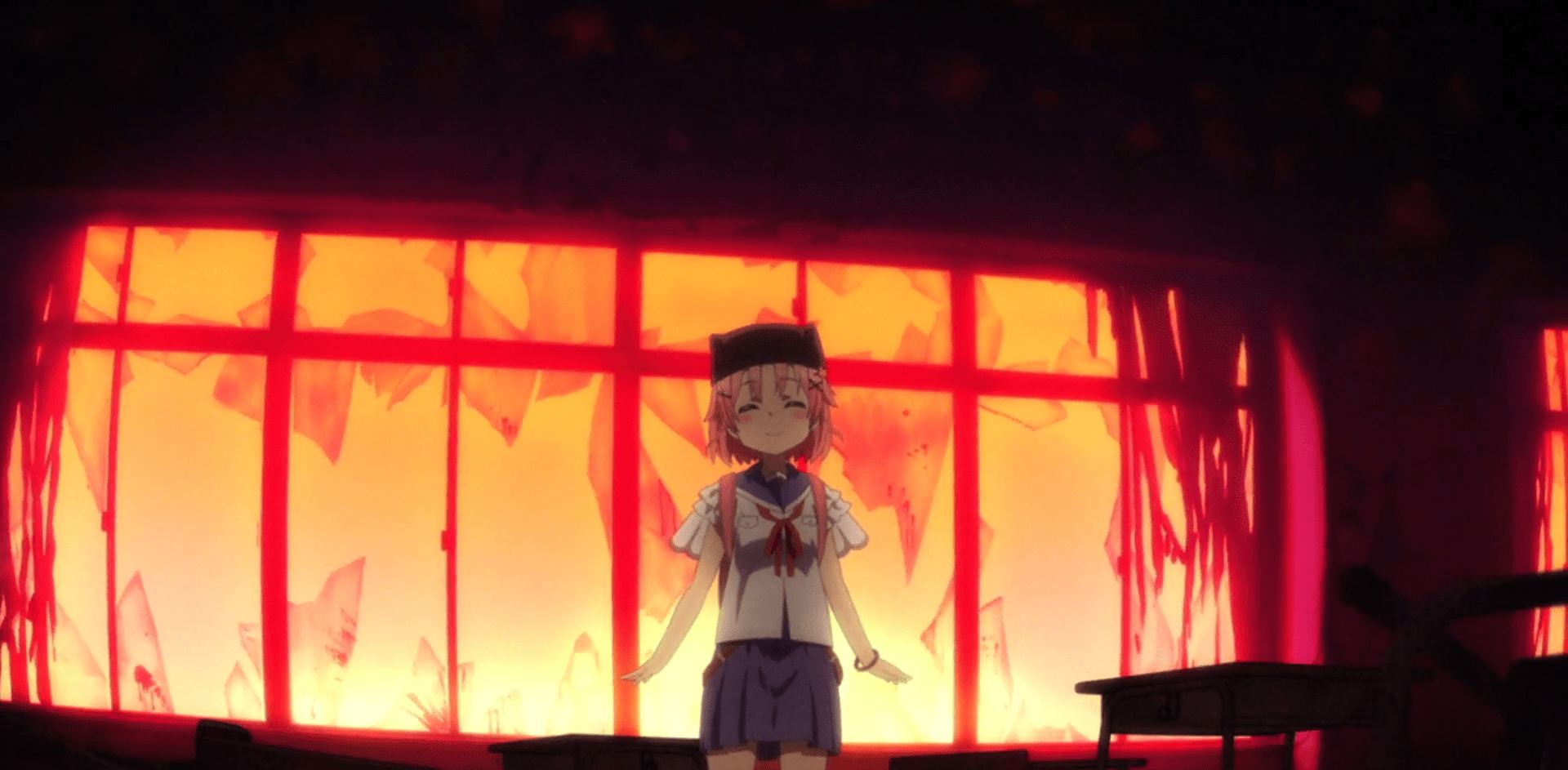
School-Live! Review: An Anime You Don’t Want to be Spoiled About.

Before reading this review, I would highly recommend watching the first episode of School-Live! if you have not watched it yet.   
Seriously, you do not want to be spoiled about what this anime’s plot before you see if for yourself.
I had no idea of what was going to happen going in so it made the surprise all the better.
If you have made it this far into the review, I will assume you have either watched it or do not care about spoilers.
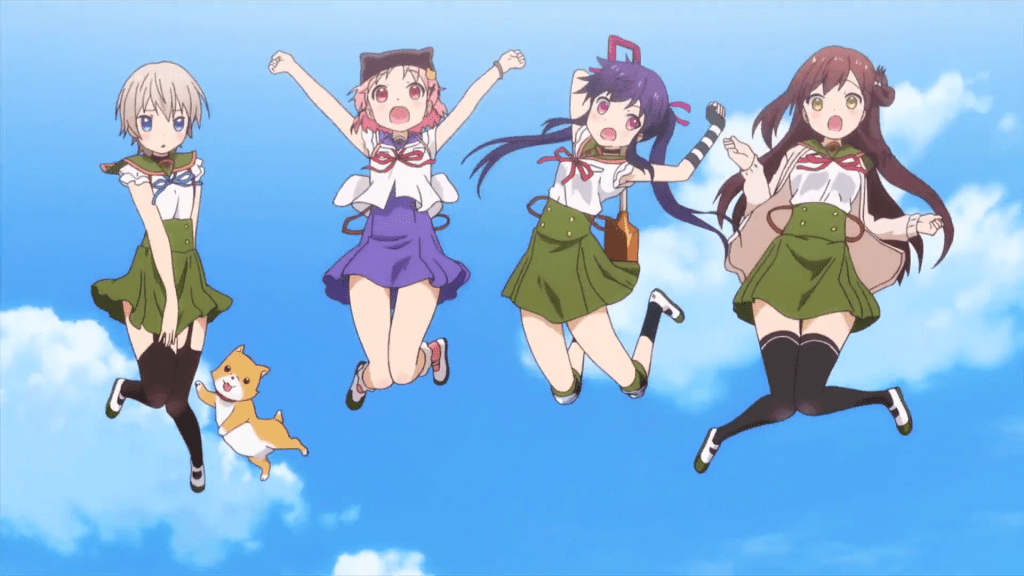
Based off the manga written by Norimitsu Kaiho, and directed by Masaomi Ando, School-Live! follows four girls and their dog, Taromaru, who have started the School Living Club, where they strangely stay at the bright and colourful school twenty-four hours a day.
These girls consist of the bright and bubbly Yuki Takeya (Inori Minase), the shovel wielding Kurumi Ebisuzawa (Ari Oazawa), the president of the club Yuuri Wakasa (M.A.O), and new member Miki Naoki (Rie Takahashi).

School-Live! follows the adventures of these four girls and their dog.

There is also their teacher and advisor to the club, Megumi Sakura (Ai Kayano), who is especially helpful to the dim witted Yuki.
However, this is where the twist comes in.
The “bright and colourful school” I mentioned?
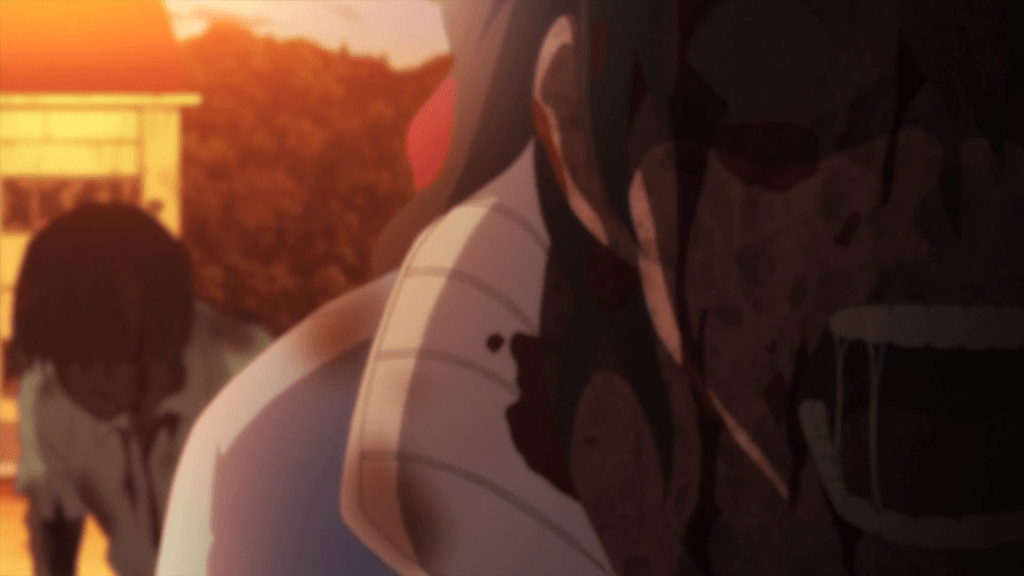
Yeah, turns out it’s not so bright and colourful because a zombie apocalypse has taken place, leaving the members of the School Living Club as the only survivors, and all the happy stuff is entirely in Yuki’s mind since she has basically created a fantasy world to cope.
So, we are really seeing this story through two lenses, the first being Yuki’s fantasy world and the second being the harsh reality of the zombie apocalypse.
This made for a fantastic cliffhanger in the first episode, which brought the show from looking like a by the numbers slice of life, to a slice of death with plenty of zombies.

I remember audibly gasping when I saw the zombie twist. I figured there was something weird about what was happening but I next expected that.

From here, the story continues detailing how the girls survive their terrible situation, while constantly trying to keep the fragile Yuki’s fantasy world intact for her betterment.
Unfortunately, this doesn’t really result in anything as interesting as that first initial twist.
This is not to say that School-Live! is bad but I did find it a bit hard to get engaged with the characters and events at times, which was not helped by how convenient and obvious some further twists turned out to be.

While the first twist is genuinely great, others feel too obvious or convenient. Thankfully, some of these twists are not saved for the final episodes and revealed quicker than I expected.

It wasn’t until the final few episodes, which racked up the tension, that I became truly invested in the plot and characters again. 
Although, this was also wrapped up kind of conveniently again by the end.

Despite these issues, I would still say that School-Live! is worth a watch.
It may not exactly live up to how fantastic its initial twist is, yet the interest generated by the twist and the intensity seen in the last few episodes do make it enjoyable.
Just don’t expect anything worthwhile and a bit of a slow pace and you will have fun.  

Berserk Review: A F###ed Up, Almost Masterpiece.

It would be difficult to find a manga that is more influential than Kentaro Miura’s Berserk.
The dark fantasy manga has been going ever since 1989, where the story of Guts, the Black Swordsman, the Struggler himself, began to unfold for many readers.
Miura continued this gruesome, tragic and reflective story for decades, all the way up until his tragic passing on May 6, 2021.
For whatever reason, I had never read Berserk before, despite knowing it had inspiried so many other stories that I loved from the mediums of manga, anime, movies, video games, and novels.
Well, I finally sat down and read the whole thing over the course of a week and it was quite the traumatic experience.
Joke’s aside, Berserk is quite the disturbing manga, one which provided some of the most horrifying scenes I had ever read.
I actually needed to take breaks when reading because some of it became a bit much.
However, gruesome is not all Berserk is because Miura was brilliant at crafting reflective and emotional scenes, as well as horrifying ones, resulting in what has to be one of the best protagonists I have ever read, Guts.
His struggle against his inner demons in the face of a monstrous world is one I will not forget.
I went from disliking Guts, to sympathizing with him, to being sympathetic but still horrified by his actions, to smiling at his redemption.
There are so many emotional moments with his character. 

Guts’ most emotional chapter for me would have to be the Chitch chapters. It was brief but incredibly tragic and heartfelt.

He is such an amazing character and his supporting cast is just as good.
The most noticeable of these if Griffith, who has been the subject of quite a few memes saying, “Griffith did nothing wrong!”
Well, after reading the eclipse chapters, I can say that, yes, Griffith did do something wrong, quite a few things in fact. 
You know what?
No.
He didn’t just do “quite a few things” wrong, he took the entire concept of wrong and became the freaking personification of it!
Seriously, what the f**k Griffith!?
Still, an incredible character who complements Guts quite well.

F**k you, Griffith. You’re a great character but f**k you.

Then, there’s Casca, who is also amazing, and her romance with Guts is fantastically written, especially with how it culminates in the brilliant “Wounds” chapters.
Honestly, pretty much every other character is fantastic as well.
Puck, Judeau, Pippin, Rickert, Schierke, Farnese, Serpico, Isidro, Roderick, The Skull Knight, Zod, Luca, Silat.
There is not a single weak character that I can think of… well, except for Nina, she sucks.
The story these characters drive is also both a horrifying and beautiful one, just like the world they live in. 
This results in some incredible arcs like the famous Golden Age Arc, and the Conviction Arc.
Accompanying this amazing story and these amazing characters (except for Nina) is some jaw dropping artwork.
So often, I would just stop reading and gaze at the beauty of what Miura had drawn,
I would go as far to say that, in my own personal opinion, Miura is the greatest mangaka of all time when it comes to artwork.
It feels like some of these panels could have gone into a museum, that’s how incredible they are.

Panels like this one are seen all throughout Berserk and they constantly leave you in awe at how beautiful they are.

So, with all this praise I have been heaping on Berserk, it would be safe to say that I consider it to be a masterpiece, right?
Well, unfortunately, I do think there are a few things which hold it back from taking that title, at least for me.
The first of these issues is minor, and it is that the story does drag a little bit at the boat arc.
Since this storyline lasted years when being written because of how long gaps were between the release dates of chapters were, I imagine it must have been agony waiting for this storyline to end for some fans.
Well, since this arc had been finished by the time I read it, it only took me a couple of days to read but it was probably the weakest part of the story for me.
Still, this is not a huge issue because Berserk is over 300 chapters long and, when you get a story of that length, it is almost inevitable that it will drag at some points.
The next issue, which I found to be a bigger one, is the treatment of Puck’s character.
I really enjoyed Puck’s role in the story for the first half of Berserk, with him basically serving as the angel on Guts’ shoulder, not that Guts really listens to him.
However, after the Conviction Arc, Puck becomes a complete caricature of his former self, his only role in the story now being to tell insufferable, fourth wall breaking jokes that do not even suit his character.
I remember a moment when I was reading through one of the final arcs in the story before Miura’s passing, where Guts was having an inner monlogue and he thought about Puck, and I realized I could not remember the last time the two of them had even had a conversation.

I would choose the good old Puck over Chesnut Puck anyday.

The final issue I have with Berserk is the most problematic and its the rape, or rather the constant usage of it.
Now, credit where it is due, I do think that Miura did an amazing job portraying the trauma of sexual assault, especially in regards to Guts and Casca,
How their trauma resulted in the “Wounds” chapters and Casca’s return in the Fantasia Arc was very emotional to read.

Guts’ unveiling his trauma to in the Wounds chapters is one of the most well written romantic scenes I have ever seen.

However, while I do like the depiction of the trials Guts and Casca face due to their trauma, I think Casca suffers from the threat of sexual assault way too much.
I honestly lost count of how many times Casca would go off on her own, comes across a group of random rapists, who would then rip off her clothes, followed by plenty of uncomfortable panels of her naked body, only for Guts to save her or for her to save herself.
The first few times this happened it was horrifying, but by the third, fourth, and how ever many more times it happened, I was completely tired of it.
Was there really no other way to show that Casca was in danger that wasn’t so degrading to her?
Well, at least Miura seemed to realize how repetitive this was because the constant danger of rape Casca was facing ceased in the last few arcs.
It was these issues I had that kept Berserk from the title of a masterpiece for me.
That said, I completely understand why this manga is a masterpiece to so many other readers.
It certainly has many masterpiece moments and characters, with Guts already being one of my favourite protagonists, and the artwork itself is a masterpiece all on its own.
When I reached Chapter 363, I immediately went to read the next one, only to realize that this was the last one released before Miura’s passing.
While it is sad to see that his epic story will potentially remain unfinished, what’s more important is the loss of a man who inspired a generation of creators.
Without Berserk many great stories simply would not exist.
So, may you rest in peace Kentarou Miura and thank you for gifting us with this amazing work that so many have loved and been inspired by. 


Wonder Egg Priority Review: Brilliant Beginning, Baffling End that Highlights Everything Wrong with the Anime Industry.

3 and a half stars
Oh, Cloverworks, you’re not having the best of years, are you?

First, we get The Promised Neverland Season Two, which is one of the worst manga adaptations I have ever seen, and now we have this whole Wonder Egg Priority fiasco.
It was truly a shame to see this anime go from something truly brilliant, to a downright bizarre show that is unnecessarily confusing.
Created by Shinji Nojima and directed by Shin Wakabayashi, Wonder Egg Priority follows Ai Ohto (Kanata Aikawa), a teenage girl reeling from the mysterious suicide of her best friend Koito.
As she sinks deeper into isolation, she is abruptly pulled into a series of trials in a dream world, where she must save the spirits of girls who have also ended their lives from evil manifestations of the ones who hurt them.
Learning this may provide a way to bring back Koito, Ai resolves to save as many of these girls as she can, alongside three other girls, Neiru Aonuma (Tomori Kusunoki), Rika Kawai (Shuka Saito), and Momoe Sawaki (Hinaki Yano), who are all also trying to bring back their deceased friends. 

Each of the girls are great, my personal favourite being Rika because of how emotional her standout episode was.

From here, the story takes on an episodic format, with each episode focusing on one or two of these girls trying to save the spirits that hatch from the Wonder Eggs, leading to some incredibly emotional moments.
Episode Seven, “After School at 14”, focused on Rika and her suffering from self harm, which was very well handled and left me a wreck by the end.
Then there’s Episode Ten, “Confession”, where the first half of the episode has the best interaction between one of the girls and a Wonder Egg spirit, with Momoe and the boy she is trying to save.

Momoe’s bond with Kaoru was very sweet, short as it was.

These fantastic moments and episodes are supported by amazingly good animation, a subtle yet quirky soundtrack, and solid voice acting.
With all of these contributing factors, it looked like Wonder Egg Priority was going to be a perfect anime for me by the half-way point.
However, there were signs in the initial episodes of the fall that was to come.
For example, in the very first episode, “The Domain of Children”, the magic system of the Wonder Egg world is settup, only for one aspect of it to be completely contradicted and never brought up again later.
Problems like this became more and more persistent as the show went on, as the story went from a simple one about a group of girls entering a dream world to save spirits, to full on ridiculous with plotlines revolving around things like artificial intelligence and parallel universes.
Episode Twelve in particular, “An Unvanquished Warrior”, was so confusing that even now I struggle to understand just what the heck was going on.
The show just became more needlessly complicated as it went along, culminating in the final, special episode which was just released, “My Priority”, and it was quite bad.
So many of the episode’s twists come out of nowhere, the characters are incredibly inconsistent, the anime’s handling around topics such as suicide takes a turn for the worse, the ending isn’t satisfying at all, and the animation is awful at times.

Oh, dear lord, no, this running animation!

Not to mention that the first half of this promised hour long special is a freaking recap, when we already got a recap earlier with Episode Eight. 
It is incredibly obvious that there were production issues for this anime.
However, Wonder Egg Priority’s production problems apparently go even beyond the show’s quality.
The anime is already pretty notorious for the suffering of its animators, with the producer reportedly needing to go the hospital because of overwork… twice!   
Unfortunately, unhealthy working conditions and bad pay seem to be the standard in the anime industry but the amount of stress and health problems the production of Wonder Egg Priority apparently caused really points to how badly animators are being treated right now.
They really do deserve better.
As for Wonder Egg Priority, it was sad to see this go from a fantastic show that handled difficult subjects to a bizarre, confusing train wreck, that caused those making it to go through the ringer.
I would still recommend watching at least the first ten episodes because, even when the questionable moments begin to seep in, the brilliant moments more than overshadow them.
The rest of the anime I would skip because it’s just not worth it by the end.
A second season could improve the story a bit more but, at this point, I’m not sure I even care any more and I think we can all agree the animators should not be put under the kind of pressure that they were here.
The anime industry needs to do better for its workers.

Chainsaw Man PV Reaction: All Aboard the Hype Devil Train!

Warning: This reaction will contain spoilers for the manga so if you haven’t read it then don’t read this. 

Chainsaw Man is one of my favourite mangas.
Written and illustrated by Tatsuki Fujimoto, the story is a constant mix of being endearing, hilarious, horrifying, and emotional.
I’ve reread it twice and I’ve only loved it more each time.
So, obviously, I was very excited for the PV for the upcoming anime from Mappa Studio.
Well, we got the PV recently and its safe to say that the fanbase lost its collective mind over how good it was.
Seriously, I really hope that we don’t get an Attack on Titan Final Season situation where the actual show’s animation doesn’t live up to Mappa’s PV animation.
Not saying that Attack on Titan’s animation was bad but the PV did look better, and this caused a lot of outrage when the actual CGI appeared, which went as far as some stupid people harrassing Mappa’s staff.
Now, was the Chainsaw Man trailer preanimated?
Almost certainly.
However, this doesn’t mean we won’t be getting the same outcome as Attack on Titan because apparently the same people working on this trailer will be working on the anime and also the schedule will probably not be as bad for these animators, hopefully.
As for what happens in the trailer, it has a lot of recognizable and unrecognizable moments interestingly enough.  
The PV starts and we see a young Denji standing in a bloody alleyway and a mouse nearby, as the shot pans out to reveal the city outside.
This works as great symbolism, both for what will be revealed about Denji as the story goes on and also the whole country and city mouse discussion that comes about.
From here, the trailer cuts to the Hayakawa household, with Denji, Aki and Power having a nice family meal.

The three of them look excellent and this is seen further with the following shots of Denji, Power and Kobeni at the beach and Aki and Himeno in bed.
Along with these moments leaving a smile on my face because of how well animated they are, they also had me intrigued because these scenes were not in the manga.
It makes me wonder if Mappa will be adding some anime only scenes or if these are just for the trailer.
Will be interesting to see.
However, the fact that the next shots reveals these idyllic settings are happening inside a TV screen means it is likely that these moments are not real and the disturbing stuff that follows is.
These disturbing things include shots of the Eternity Devil, a graveyard for devil hunters, a bloody Gun Devil bullet, Aki’s house exploding, Katana Man and Sawatari walking, Denji’s door, Denji resting with Pochita in an old shack, and Makima herself about to throw down. 
Once the horror side of Chainsaw Man has been shown with this, the trailer makes sure to show the action side, with bombastic music set to even more quick shots, this time of Kon, Aki drawing his sword, Kishibe rising up, Power attacking with a sledge hammer, and Denji facing off against the Bat Devil and Leech Devil.
The final shots of the trailer see Denji in his full Chainsaw Man getup, as he cuts down zombies left and right in a gory display.
Now, these last few shots do give more credence to the trailer being preanimated, since Denji is wearing his devil hunting outfit here, when in the manga he was shirtless.
Still, even if it is preanimated, I have hope that the anime can actually make this fight look as good as it does in the PV.
Overall, the PV is excellent.
It does a fantastic job of hyping up fans of the manga and also getting those who will be anime only viewers intrigued.
Also the director has been announced as Ryu Nakayama, who is a first time director but has been a key animator for anime like Kill la Kill and One Punch Man.
As for the composer, they have been announced as Kensuke Ushio, who has composed for
A Silent Voice, Devilman Crybaby, and Japan Sinks: 2020.
So, both of these people are promising people to leave Chainsaw Man in the hands of.
I hope that they and Mappa Studio can pull off adapting one of my favourite manga. 

Ghost in the Shell Review: One of the Most Influencial Anime of All Time.

5 stars
When someone asks for an example of an anime that had an impact on genres in the film industry, it’s hard not to think of
Ghost in the Shell’s influence on sci-fi.
It is constantly referenced whenever this topic comes up and, after finally watching it, I understand why.
Based off the manga by Masamune Shirow, and directed by Mamoru Oshii, the film takes places in a cyberpunk future where the lines between what constitutes as human have begun to blur, due to so many people being augmented with technology.
It seems that the only feature that it takes for one to be recognized as a person in this world is the human consciousness known as a ghost, with the outer body merely being a shell, hence the title.
Our main character is Major Motoko Kusanagi (Atsuko Tanaka), who has become so augmented that it appears only her ghost remains.
As she and her team track down a cyber terrorist known as the Puppet Master, we see how Kusanagi is struggling with her own questions about her humanity, leading to an ending that feels like a new beginning. 

There are many great scenes that build into this ending, like the diving scene.

This is achieved not so much through words but rather through the visuals, as we see Kusanagi traveling the city, her almost robotic gaze raising questions about the perception she has of herself, with the terrific score playing in the background accompanying the likewise terrific animation.
It is through means like this that Ghost in the Shell raises interesting questions about what it means to be alive and evolve… which it never really answers.
Although, this is not not a bad thing because rather than it feeling like a copout, it feels like the writer is trying to raise genuine discussion on this subject.
This clearly worked too with how many films and shows took inspiration from the film, from shortly after it was released all the way up to now.
For example, I saw features that would influence both The Matrix and Westworld in the opening credits alone.

The opening scene itself where Kasanagi’s cyborg body is created is practically projecting its influence on sci-fi as a whole.

It achieves all of this in a pretty short runtime too, which is surprising and really shows how good its messaging is.
Along with this, the film has a surpisingly positive outlook on the future of technology, and I say “surprising” because so many other sci-fi films seem to focus solely on the negative consequences of these advancements.
I get the feeling that Ghost in the Shell is a film that will take me multiple rewatches to fully appreciate all of its questions and implications, yet I still feel like I experienced something after watching it for the first time.
Ghost in the Shell is definitely a masterpiece anime, one where its influences can be seen in movies to this day.