Chapter 139 of Chainsaw Man, “A Chair’s Feelings” picks up right from the reveal of Sword Man’s arrival, with Denji still not having a clue who he is.
In an attempt to remind Denji (and probably the reader as well), Sword Man brings up the battle with Makima, only for Denji to inform him that it was Pochita fighting her, not him.
Denji leaves a dejected Sword Man, telling him he has to go to school, only to be dismayed when he sees Sword Man is joining his class.
Sword Man introduces himself as Miri Sugo to the class but it is unclear if that is his real name or just an alias.
Sugo informs the class that he is not there to make friends, only for a bunch of girls to take interest in him, much to Denji’s apparent envy.
Later in the day, Sugo attempts to talk with Denji, who is being a chair for Fumiko.
He tells Denji that he is here to invite him to join the Chainsaw Man Church, stating that “the weapons walk” with them.
This statement means there are probably many hybrids from within the Church who we will be introduced to soon.
We may have even been introduced to one of these “weapons” already.
Back in Chapter 107, we see a girl from the Devil Hunter Club fighting Yuko.
This girl has a cap over her eyes, hiding her identity, but she resembles the Whip Hybrid who was under Makima’s control, like Sword Man was.
Many readers noticed this similarity but the theory died off when the girl was implied to have left the club after Yuko’s attack.
Now, with Sword Man returning and claiming that “weapons” have joined the Chainsaw Man Church, it seems that this theory may have some weight after all.
Getting back to the chapter itself, Sugo and Fumiko begin arguing to convince Denji to stay on their side.
Sugo wants Denji to join the Church, while Fumiko wants him to stay living a normal life.
During their argument, my prior impression of Sugo attempting to manipulate Denji was seemingly proven wrong, as Sugo seems genuine in wanting to help Denji.
This is because he holds a lot of gratitude for Denji freeing him from Makima.
Denji, however, is content to live as a chair.
Sugo is disappointed, saying that he actually wanted to be Denji’s friend.
As he leaves, Sugo happens to mention that if Denji joined the Chainsaw Man Church he could sleep with all the women he wants.
And, just like that, Denji gains the power of instant teleportation.
Joking aside, Denji does not actually teleport.
We can see from little dash movements in the panels that Denji actually uses super speed to get in front of Sugo.
This is probably for comedic affect, though, rather than being an actual Chainsaw Man power.
It is also very funny, along with the potential implication that Fumiko fell over when Denji dashed to confront Sugo.
Denji tells the Sword Man that he has given what he said a lot of thought, as if hours had passed and not just a few seconds, before declaring he will join the Chainsaw Man Church, bringing an end to the chapter on this comedic note.
So now we have Denji, Asa, Fammi, Sugo, and Haruka as members of the Church, along with the hybrids mentioned in this chapter.
All of the important characters seem to be joining up with the Church, which will probably result in a lot of great and funny character interactions over the next few chapters.
It will be interesting to see which “weapons” are part of the Church.
We could see Reze, Quanxi, Katana Man, Whip Hybrid girl, and even some of the other unnamed Hybrids who fought Pochita under Makima’s control.
These characters could very well reappear in the next chapter tomorrow, or later in the story.
As for Chapter 139, it did a great job of building up this intrigue.
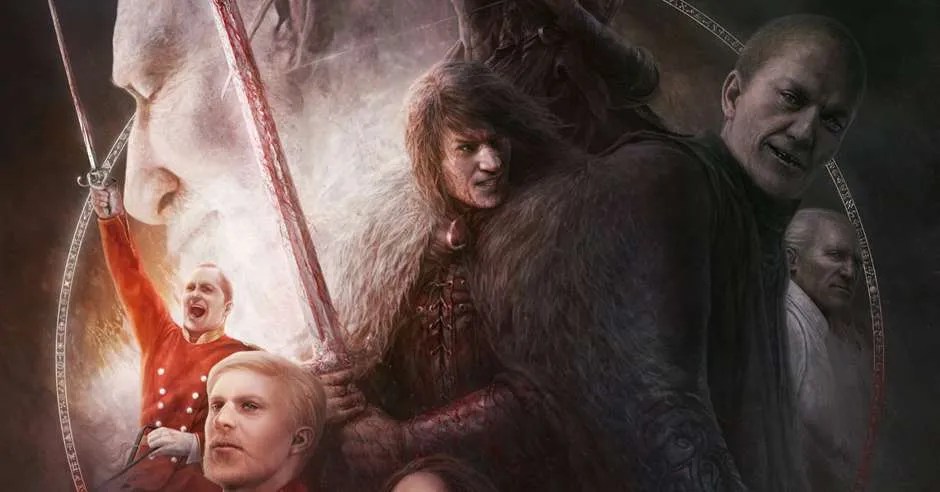
Whenever people rank their favourite fantasy series, I usually see Joe Abercrombie’s First Law books taking the top spot or at the very least near it. After seeing so much praise for the novels, I finally gave in and read them. Once again, the praise was warranted because this is now also among my favourite fantasy series. Abercrombie has created a riveting world with some of the most compelling characters in the fantasy genre. So, since there are ten books in the series at the moment, I decided to do a top ten list, ranking them from weakest to best. Although, I should note before I begin the list that weakest does not mean bad. I truly do not think there is a bad book in this incredible series, with even the tenth book on the list being very enjoyable, which is…
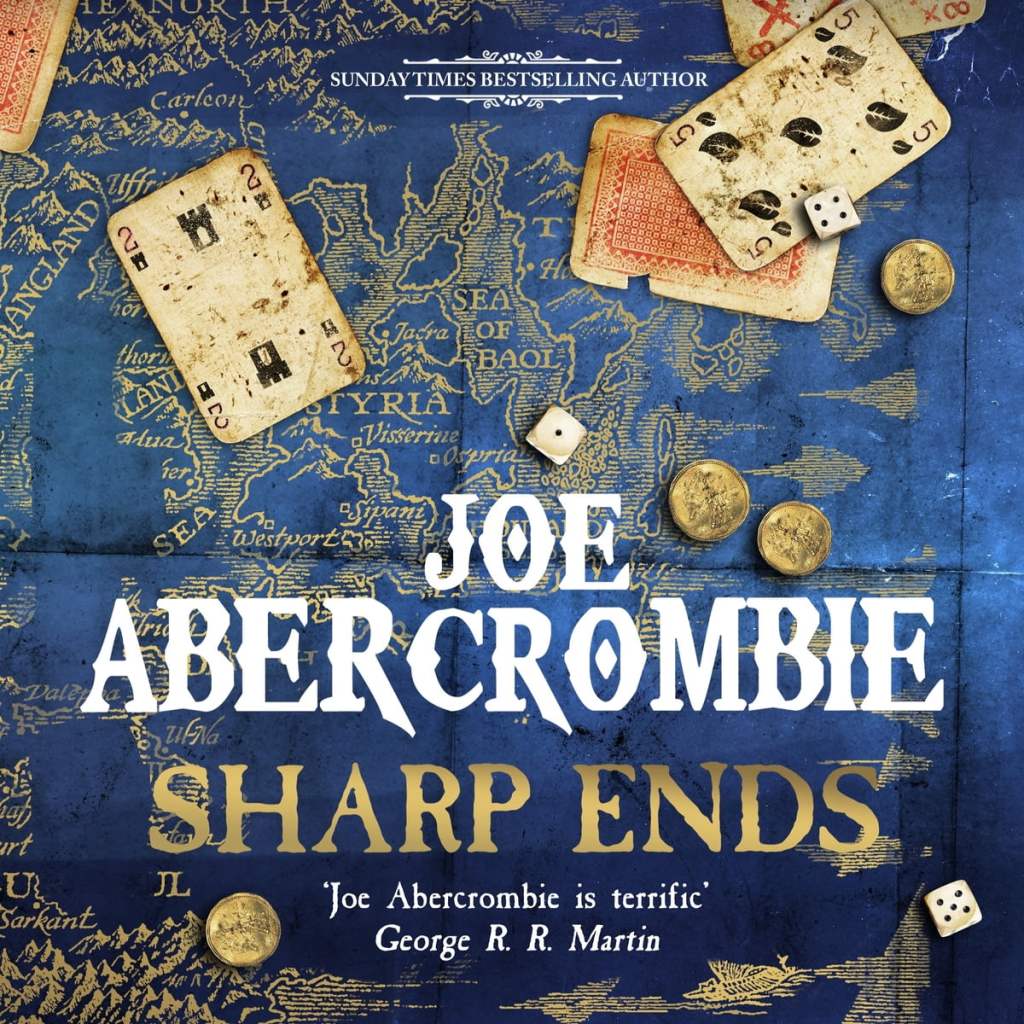
10. Sharp Ends.
I think that Sharp Ends would rank at the bottom of every First Law ranking list. This is because Sharp Ends is not technically a novel but a collection of short stories from the world of the First Law. That being said, these are some damn good stories. “A Beautiful Bastard” gives us a look at what Glokta was like before he was captured and tortured by the Gurkish. “Hell” provides Temple’s POV of the fall of Dagoska and the death of Kahdia. “Wrong Place, Wront Time,” tells the untold stories of those who suffer because of Monza’s quest for vengance. And, best of all, “Made a Monster” shows exactly what kind of monster Logen used to be while he was the Bloody Nine working under Bethod. All four of these stories are fantastic and my favourites of the book. Almost as good are the tales told about Shev and her friend Javre. These two are the continuous thread in Sharp Ends, with five of the thirteen short stories being about their journeys. The two make for a great comedic duo throughout, and the slow realization Shev has, that Carcolf is more of a snake than a love interest is great… until this is undone with their final story “Tough Times All Over” where it felt like all of the character development in “Three’s A Crowd” was undone. It is for that reason that “Tough Times All Over” is my least favourite of the short stories but it is more than made up for by the other fantastic ones. All in all, Sharp Ends is definitley the weakest of the books, due to it not really being a novel, but is has plenty to love with its collection of unseen stories. There is bound to be one that you like.
9. The Blade Itself.
The first book in the First Law series, The Blade Itself is a compelling start to Joe Abercrombie’s epic series. What puts The Blade Itself in the lower half of the list is that it is mostly a set-up novel for the adventure Abercombie is about to set his characters on. This first book is devoted to establishing these characters and their arcs going forward. There is Logen Ninefingers, a Northen warrior trying to escape his past as a mass murderer known as the Bloody Nine. Sand dan Glokta is a former soldier who was tortured to the point of being crippled and in constant pain, and now inflicts this pain on others as a torturor for the Inquisition. Ferro Maljinn is an escaped slave who is focused on her vengance, wanting to kill any Gurkish she can get her hands on. Finally, there is Jezal dan Luthar, a nobleman half-heartedly preparing for a jousting contest. Of all these characters Jezal is definitely the most unlikeable, given how narcissistic he is. This is surprising since the rest of the main cast consist of mass murderers and torturers but this highlights one of Abercrombie’s greatest strengths as an author. He is able to create characters who are absolutley terrible people and then, unbelievably, make us like them. This is most evident with Glokta who is torturing people more often than not in this first book, and he is easily the most entertaining character with his sympathetic backstory and hilarious dark humor. All of these characters fall under the thrall of Bayaz, the First of the Magi, who begins to subtly manipulate them in his grand plans, not that the characters or even us as the readers are aware of it at this point. This makes The Blade Itself great for second read throughs after finishing the first trilogy because, although there does not seem to be much of a story yet, Joe Abercrombie is planting the seeds for the big pay-off which will come by the third book. After reading The Blade Itself for the first time, I had no idea where the series was going but I definitely wanted to know.
8. A Little Hatred.
We go from the first book in the First Law trilogy to the first book in The Age of Madness trilogy. Abercrombie decided to follow up the first trilogy and three stand alone novels by focusing on the kids of the previous generation. This could have easily backfired but I think all of the characters he chooses to focus on are fantastic. Orso, Savine, Leo, Vic, Clover, and Gunnar all make great first impressions but, to me, Rikke of the Long Eye is the best of A Little Hatred. The Dogman’s Daughter, Rikke is either cursed or blessed with the Long Eye, which gives her visions into the future, and the way she gains control of this power during Leo’s fight in the circle with Stour Nightfall was a joy to read. Her telling Caul Shivers that he is still in there was also incredibly touching. Coming close behind her in likeability is Orso, a spoiled prince who struggles to do right in a world that is actively conspiring against him, although this would not become apparent until The Wisdom of Crowds. The rest of the cast is just as compelling, with A Little Hatred being much clearer than what the story is than The Blade Itself. Both the stories of Stour Nightfall’s invasion of Uffrith and the beginning of the Union’s own French Revolution were very compelling. Another interesting thing about A Little Hatred is that it has a couple swap. In the first act of the novel, Rikke is with Leo, and Savine is with Orso, but in the end Rikke gets together with Orso, and Savine with Leo. The reason I mention this is that, in any other book, I would be criticizing this as contrived and for the sake of drama. So imagine my surprise when I was reading this and found that Abercrombie had convinced me on the realism of this whole situation. The book ends ominously, with the death of King Jezal, which I definitley think either Bayaz or Glokta had to have some kind of hand in, although such is never confirmed. A Little Hatred was a great start to The Age of Madness trilogy but it is its focus on the story which put it above The Blade Itself for me.
7. The Heroes.
When I see people rank the First Law series, I usually see The Heroes in the top five, if not top three. As for why I have ranked it lower, it is through no fault of this novel. The Heroes is great and it just comes down to me liking the other books more. The novel follows the three-day battle at the titular Heroes, where the forces of the Union face off against Black Dow’s Northmen. One thing I like about The Heroes is how it turned Calder and Brenner dan Gorst into complex characters. In the first trilogy, Calder came across as a one-note villain, yet here he is one of the best POV characters, as Abercrombie focuses on his guilt, love and ambition very well. Then there is Gorst who seems like a hero on the outside, yet his inner thoughts reveal him to be a depressed, suicidal, murderous incel who is simultaneously sympathetic and detestible. His “August Fuck-Hole” letter is one of the most hilarious moment in the entire series, for me. This old cast is not alone in greatness, however, for the new characters are also fantastic, with Finree and especially Whirrun of Bligh being highlights. The only character POV I did not really care for was Tunny’s but I did like his role in The Age of Madness trilogy so this served as a good introduction for him. The Heroes also has the privilege of being the first book in the series to have a chapter where Abercombie goes over the perspectives of all the normal people in a battle. This begins with the “Casualties” chapter, which is one of the best in the entire series, and followed up by the “The Little People” chapters in The Age of Madness Trilogy. The ending of the book also builds perfectly into that trilogy, with Calder becoming the new leader of the North being key to understanding the contextual politics. This makes The Heroes the most important of the stand alones to read, even if its my least favourite of them.
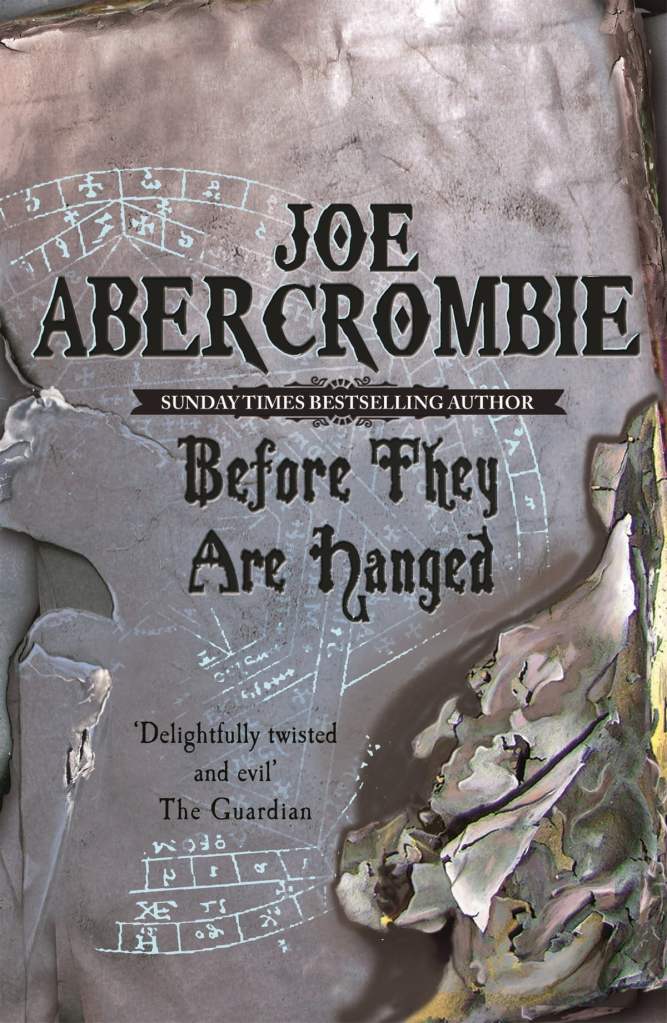
6. Before They Are Hanged.
The second book in the First Law trilogy, Before They Are Hanged is a great follow up to The Blade Itself, which continues to lay the seeds the first novel started. Before They Are Hanged follows three main storylines. First, we have Bayaz journeying with Logen, Ferro, Jezal, Quai and Brother Longfoot to the edge of the world to locate the Seed, a weapon Bayaz needs. All three of our POV characters in this storyline experience growth, with a relationship forming between Logen and Ferro. The character who grows the most is undoubtedly Jezal, as an injury he recieves causes him to reevaluate his life and narcissistic attitude, allowing himself to form a friendship with Logen. This growth is my favourite of any character in this book and made the narcissistic rants from him we had to endure in The Blade Itself more than worth it. This storyline ends in an anti-climax, where Bayaz and the others realize that the Seed is not there, making their journey mostly pointless, an interesting twist on the usual fantasy adventure but one that is pure Joe Abercrombie. The second storyline follows Glokta, who has been tasked by Arch Lector Salt with defending Dagoska from Gurkish invasion. Golkta’s POV is, as always, darkly humorous, and also horrifying during his first encounter with an Eater, the cannibalistic wizards of First Law. Upon Glokta’s return from Dagoska, we also get a hint of the character dynamic between him and Ardee, which will be an unusually endearing part of the third novel. The final main storyline of Before They Are Hanged is the combined one of Collem West and the Northerners rebelling against Bethod, among them Dogman, Threetrees, Black Dow, Tul Duru Thunderhead, and Grim. There are many highlights to this storyline, such as the first encounter between West and the Northmen, West getting the name “Furious” from them and then throwing Prince Ladisla off a cliff for attempting to rape Cathil. And then, of course, there is the first fight with Fenris the Feared, ending with Threetrees’ death and the Dogman becoming the new chief, a job he would retain for the rest of his life. All three of the storylines in Before They Are Hanged combine to create a great novel filled with plenty of surprise for the big pay off in the final book of the trilogy, which I will get to much later on in the list.
5. The Wisdom of Crowds.
The final book in The Age of Madness trilogy, The Wisdom of Crowds was an expectedly tragic close to this section of the First Law storyline. After the cliffhanger of The Trouble With Peace teased a peasant uprising against the nobels, The Wisdom of Crowds follows through on this promise, with the uprising ruining Orso’s victory against Leo, making him a prisoner of the Breakers and the volatile Burners. The story then follows Orso, Leo and Savine attempting to navigate this extremely dangerous political climate, so that they do not get executed for going against the Great Change, Joe Abercrombie’s version of the French Revolution. As this is happening, Rikke prepares for war against Black Calder, leading to what I feel is the most predictable storyline in all of First Law. This is not to say that the storyline was bad but I realized that Rikke was attempting to fool Black Calder’s spies into thinking she was throwing away her allies very quickly, and this made this part of her storyline drag a bit for me, which is the reason The Wisdom of Crowds is not higher. That being said, watching her defeat Black Calder was still great and her betrayal of Orso at the end was fittingly unfortunate. As for Orso, his ending is the most poetically tragic in the entire series, as he is hanged all so Leo can maintain his grip on power. Speaking of Leo, oh, my god, I absolutely hate him. The Trouble With Peace made me dislike him but The Wisdom of Crowds made me want to jump into the book and push him down a flight of stairs. Still, I cannot deny his downward spiral is amazingly written and he is still not quite a bad person as Savine. This again speaks to Ambercrombie’s writing ability, as he made me like Savine more than Leo, when she readily admits that she is the “villain” in her final chapter. She is probably not as big of a villain as her adoptive father though, as Glokta literally becomes the next Bayaz, wrestling control of the Union away from him. Bayaz is definitely not taking this sitting down, however, as he has recruited Hildi and Calder’s unnamed son to get his revenge and take back control. Rikke’s vision at the end foreshadows this eventual storyline, along with the return of an as yet unnamed character. Whatever storylines eventually follow, for now, The Wisdom of Crowds is a fantastic temporary conclusion to the series.
4. Red Country.
Red Country is, without question, the most divisive book in the First Law series. Most seem to either love it or hate it. Personally, I fall into the love it camp, as it is my second favourite of the stand alones. Red Country stands apart from the rest of the First Law series because, while all the rest of the books are strictly fantasy, Red Country is a western with a pinch of fantasy. The story follows a former outlaw named Shy South, who goes on a journey with her step-father, Lamb, after her siblings are kidnapped. Oh, and Lamb? Yeah, he’s Logen. I cannot tell you how joyous it was to read the first few chapters and realize Lamb’s identity through his dialogue and the the physical description of him. I also liked how Abercrombie never addresses him as Logen or even the Bloody Nine in this book, just as Lamb, yet both sides of his character are readily apparent in all of their darkness. As for Shy, sure, she is not the most interesting of Abercombie protagainsts, but where she lacks is more than made up for by the other characters, most notably Temple, a former lawyer who now works under Nicomo Cosca. Temple’s story of redemption with Shy was fantastic, making him a successful parallel to the tragic Cosca who has sunk low after the highs of Best Served Cold. His fall from grace and somewhat pathetic demise was sad to see play out, yet felt fitting. Just as fitting was how the few fantasy elements were incorporated into Red Country, with the reveal of the mechanical dragon made by Kanedias being a highlight scene. Red Country is also capable of being incredibly funny at times. The reveal that Lestek was acting as the Gurkish Legate had me laughing my head off. As for the ending, we get a final, satisfying confrontation between Logen and Shivers, before both ride off, Logen into an uncertain future. Will we ever see him again? Time will tell but if not this was a fitting end for the character. Red Country may be the most divisive First Law novel but I consider it to be a compelling story and one of the best western tales told in recent years.
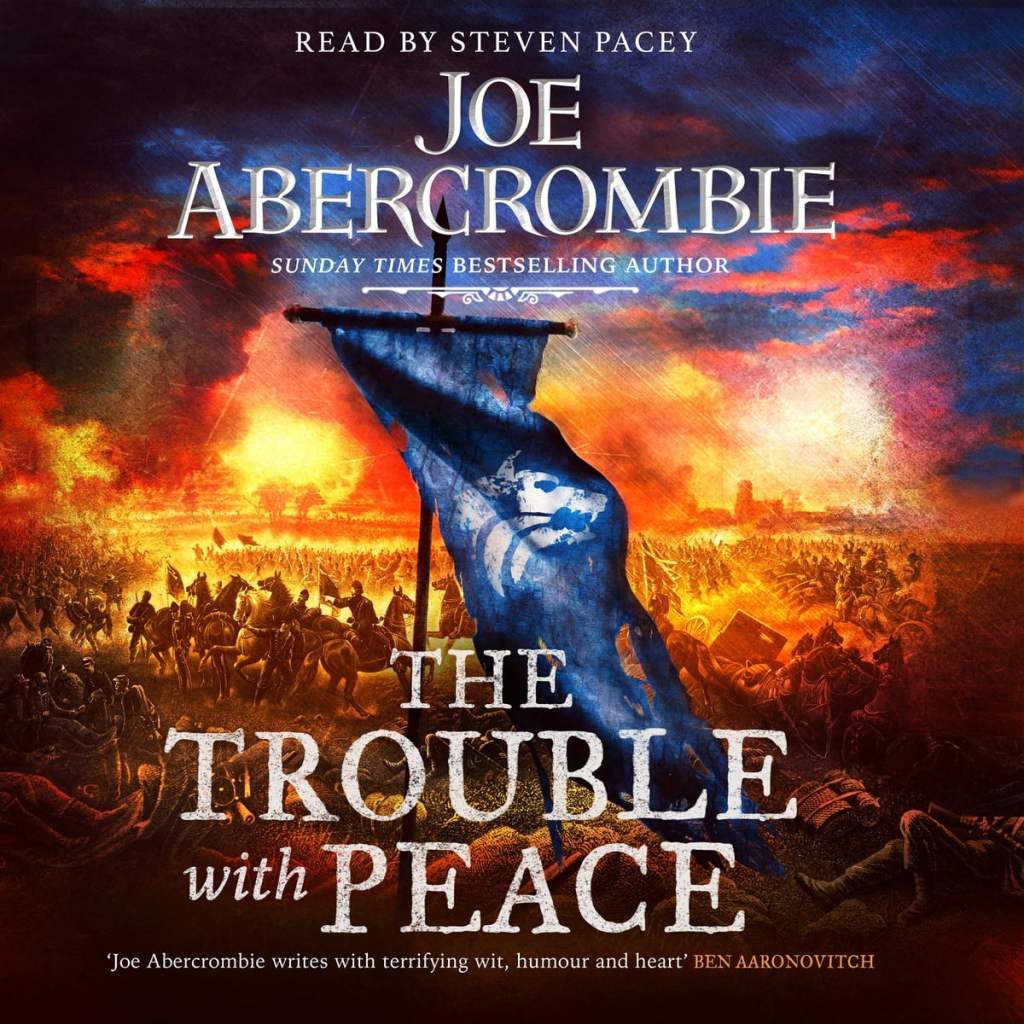
3. The Trouble with Peace.
The second and, in my opinion, best book in The Age of Madness trilogy, The Trouble With Peace depicts the aftermath of King Jezal, King Scale, and the Dogman’s deaths. As the leaders of their respective kingdoms, their deaths throw these countries into states of unrest, which all of the main characters have to deal with. This is especially the case for Orso, who attempts to step up as King, only to learn just how trapped his father was in the position. Orso is the highlight of this book, for me, as his attempts to do right are continuously sabotaged, leading to the eventual battle at Stoffenbrek, which allows him to truly become a leader, outsmarting Leo. If only he had the ruthlessness to execute him at the end. As for Leo, this was the book where I began to dislike him, although he is still very well written. Watching him be manipulated into starting a rebellion was frustrating but the good kind, especially when Savine got involved, doubling down on her own ruthlessness from A Little Hatred. And then there is Rikke who has some of the best chapters of the novel because of just how creative Abercrombie got with her Long Eye. There is a chapter where it is revealed that everything we just saw was Rikke’s vision of the future, and a chapter where the events take place in reverse as Rikke can no longer tell between the past, present and future. This leads to her getting her Long Eye contained, with her becoming cunning enough to eventually take her father’s place, outwit Savine, and take Stour Nightfall’s castle while he is away at war. Watching both her and Orso have the opportunity to become great leaders was thrilling to read. The Trouble With Peace also has some of the best chapters in the series. I have already mentioned the creative Rikke chapters, but the one where Orso and Leo have very different confrontations with Jappo is also a highlight. The book also ends on an intense cliffhanger, with the joy of Orso’s victory being crushed with the false reveal of Pike as the Weaver, and the beginning of the Breakers and Burners’ Great Change. The only issue I have with it is that Gunnar’s role in this book feels pointless but that is it. The Trouble With Peace is the best book in The Age of Madness trilogy and more than deserving of the third spot on this list.
2. Best Served Cold.
I can still remember reading the first chapter of Best Served Cold, which was used as a teaser at the end of the Last Argument of Kings book I have. That first chapter hooked me in on Monza’s journey of revenge and, when I finally read the rest of the novel, I was not disappointed. Best Served Cold follows mercenary Monza Murcatto, a woman hellbent on revenge after her brother Benna is killed and she is thrown off a mountain. She enlists a cast of colourful and morally dubious characters to help her, consisting of Caul Shivers, Nicomo Cosca, Friendly, Castor Morveer, Day, and Shylo Vitari. All of these characters are fantastic, especially Cosca, as this was the book which finally made me take notice of him as a character. His friendship with Friendly was an unexpectedly endearing one and full of hilarious moments, both light-hearted and dark. It is Shivers who is the best character in this book for me, though. Much like Cosca, this was the first book in which I truly took notice of him, and his own descent into murderous revenge was tragic to watch, yet highly understandable. As for Monza, her journey is also very compelling through what she learns about revenge. In most revenge tales, the author focuses on the cost of revenge, with the main characters often questioning whether they should abandon it altogether. This is not the case for Monza because the negative effects of her revenge are made clear from the first dozen murders, and she remains devoted to her goal of killing Grand Duke Orso. What makes Monza’s revenge tale unique for me is how she comes to learn the man she is seeking revenge for, her brother, was actually a bit of a jerk, to put it lightly. Across the novel, both Monza and the reader come to realise what a monster Benna was and how his actions lead to the chaos that Monza is now wreaking through Styria. This results in multiple stages of the novel, each dedicated to Monza taking out one of the seven men she has sworn to kill. Each of these instances of revenge stand out from the other, from Morveer poisoning dozens of people in a bank, to the fight with Ganmark, which is one of the best sword fights in the series. Then there is so-called grand finale with Duke Orso, who Monza takes out with fittingly little fan-fare. She is aided by Shenkt, who is revealed to be the one who saved Monza at the beginning of the novel in a great twist reveal. When Abercrombie decides to incorporate twists into Best Served Cold he absolutely nails them. There is of course Shenkt’s reveal and the twist of Benna’s true nature to the reader, but also the reveal that Monza is sleeping with the Duke of Delay. That last one was particularly funny, as I was getting uncomfortable with how much detail the sex scene between Monza and Shivers was getting, while wondering why the POV kept changing between them, only for Monza’s POV to finally reveal she was sleeping with Rogont as well. Best Served Cold has many twists and turns, along with fantastic characters, so it is no wonder that this is the first of the series to be getting a movie adaptation, which I hope they nail. Best Served Cold is my favourite of the stand alones and, in my opinion, the second best book in the whole series.
1. Last Argument of Kings.
It’s funny but, before I actually got to writing this list, I actually intended for Best Served Cold to be number one. However, the more I thought about it, the more I realized just how often I was going back to re-read the chapters in Last Argument of Kings, the final book in the First Law trilogy. Once I realized that, there was no doubt in my mind that this was the best book in the series. Remember how I kept mentioning that The Blade Itself and Before They Are Hanged were set-up books for the big pay off? Well, boy, does Last Argument of Kings ever pay off. Every single one of our main POV characters has an impactful storyline. Logen returns to the North to fight Bethod, only to fall further into the Bloody Nine side of his personality, resulting in more bloodshed. Bayaz manuvers Jezal to take the throne of the Union, putting Jezal’s supposed positive change in Before They Are Hanged to the test. Glokta is stuck between two masters who could both very easily destroy him, as he attempts to figure out the plans of both Sult, and the Valint and Balk bank. Ferro’s discovering of the Seed leads to her finally gaining the means to accomplish her revenge against the Gurkish, while also finally revealing the true evil behind the scenes this entire time, Bayaz himself. The First of the Magi reveals himself to be the power hungry overlord, controlling the Union from the shadows, and each of his conversations with the four main characters disclosing this are riveting. In particular, his conversations with Glokta and Jezal are standouts. In his talk with Glokta, Bayaz reveals all of his secret moves, paying off two whole books worth of foreshadowing. As for Bayaz’s confrontation with Jezal, this may be my favourite moment in the entire series. Watching Bayaz completely tear Jezal down, forcing him to be his puppet was devastating to watch in the best of ways. There are numerous other highlights in this book, from Glokta and Ardee’s relationship, to Logen fighting Fenris the Feared in the Circle, to Pike’s reveal as Salem Rews following the tragic death of West and, of course, how so many of the characters’ endings come full circle. Ferro is back on her revenge quest by the end, with the power to now actually achieve it, and Glokta continues to torture, only with much more power and now admitting to himself that it amuses him. Finally, there is Logen, whose story ends exactly as it began, word for word. Logen started the trilogy as a man on the run from his bloody past, and he ends the trilogy as a man on the run from his bloody past. Last Argument of Kings has probably one of the most depressing endings of the series, with Logen’s fate unknown and Jezal now a fearful puppet of Bayaz, yet it is the perfect conclusion to this dark and delightful trilogy of books. There is not a single bad novel in the First Law series and, in my opinion, Last Argument of Kings is Joe Abercrombie’s masterpiece.
After a two week break, Chainsaw Man has returned with Chapter 138, “Sword Man.”
The chapter begins by immediately disproving my theory that the creepy girl laid a trap for Denji because, instead of attacking him, she actually attacks an injured thug who was pointing a gun at him.
The girl then realises the gun is a fake, which did make me wonder why the guy even pointed it at Denji in the first place?
It was a bit of a weird detail.
Getting back to the creepy girl, Denji is surprised that the girl is not his enemy, and Yoshida shows up to confirm this, telling Denji that the girl is named Fumiko Mifine, a 22-year-old Devil Hunter.
So she is a 22-year-old making moves on a 16-year-old?
Well, Fumiko just got a whole lot creepier than she already was.
As for why Fumiko did not help Denji when he was being attacked by the group of thugs last chapter, she says that she did not want her song to be interrupted, looking embarassed.
Denji rightfully wonders just what is wrong with Fumiko and Yoshida, while Yoshida inspects the bodies of the thugs, finding no means to identify them.
So who sent these thugs to attack Denji and how they knew his identity is currently a mystery.
Denji is dejected that a girl was only acting interested in him as her job but Fumiko insists that she is into him because he is Chainsaw Man.
No, Fumiko, enough with the grooming, please?
At least Denji’s reaction to Fumiko saying this looks less than positive.
I hope?
The scene then ends with Yoshida promising to set Fumiko straight so Denji will not have to fight again.
The chapter then cuts to Asa, who is watching news about her exploits at home.
Asa seems happy when a commentator on the news calls her beautiful, yet completley contradicts this when she tells Yoru they are not doing this for praise.
Yoru agrees, saying that they are doing this to kill Chainsaw Man, while Asa says they are doing this to help him.
Yeah, they are definitley going to butt heads over this in the future.
After stating their goals, Yoru complains about the rush Asa is feeling, due to her newfound fame, to which Asa says fame creeps her out because people are invading her privacy.
Yoru looks likes she wants to call Asa a liar and the next panel proves her as one, with Asa sporting a tired and delirious grin at her fame.
This panel not only had me laughing out loud but also reminded me of Denji learning that people loved him as Chainsaw Man near the end of Part One.
Both he and Asa want to be loved, only now Asa is actually experiencing that while Denji gets none of the fame he had previously.
This is epitomized by the next panel, which sees Denji looking dejected as he stares at a poster of Asa.
He is then approached by a hooded man who is also angered by people overlooking Chainsaw Man for Asa.
Given the shape of this man’s hood, I thought he might be Violence before we saw the bottom half of his face in the following panels.
In these panels, the mysterious man confirms that people can see Yoru’s scars when she takes control of Asa’s body, meaning that Yoshida would have seen them when they first met in Chapter 99.
It makes me wonder what Yoshida’s actual plans regarding Asa are?
After the man finishes talking, Denji is annoyed, wondering why strangers keep talking to him.
The man seems disappointed Denji does not remember him but states that is okay because he does not remember him either.
When Denji insists to know who he is the man pulls back his hood and identifies himself as “Sword Man.”
Denji’s response is the one which many fans probably had reading this reveal, “Seriously, who is this loser?”
Well, turns out this “loser” is actually one of the Devil Hybrids Makima controlled to fight Pochita at the end of Part One.
He only gets a few lines and is killed pretty quickly in both fights, so he is not that memorable.
This makes it interesting that Fujimoto chose to bring him back, of all characters.
Perhaps Sword Man is the mysterious figure who healed Denji back in the Falling Devil Arc?
Maybe he was the one who sent those thugs to ambush Denji and Fumiko?
Whatever his role is, he clearly wants Denji on his side, as he appeals to his vanity by talking about Asa stealing his fame.
As for why he says he does not remember Denji, this is probably because he was under Makima’s control at the time.
Same goes for Denji, his body was being controlled by Pochita when he fought Sword Man and the other Hybrids.
Probably the most interesting implication of Sword Man’s return to the story, however, is the fate of the other Devil Hybrids.
If he is alive then that means the other Hybrids, like Reze, Quanxi and Katana Man are probably alive and could very well return to the story at some point, which is exciting to think about.
“Sword Man” is yet another great Chainsaw Man chapter.
It sets up Fumiko’s role as Denji’s creepy bodyguard, along with Asa’s enjoyment of her newfound fame, and the return of Sword Man has exciting implications for other missing characters.
It will be interesting to see what this set up amounts to in future chapters.
Tokyo Ghoul is one of my favourite mangas, so when I learned that Sui Ishida was writing a new one, Choujin X, I was very excited. I was so excited for it that I made sure to review the first chapter once it released, and did the same for many of the subsequent chapters. These reviews can still be found on my blog. However, while I did find Choujin X to be good, I slowly began to lose interest in it, for a reason that I have never been able to put my finger on, to the point that I dropped it some time after Chapter 21. I did not revisit it until recently, when I saw that the second part of Chapter 40 had released. I decided to re-read the entire manga from the beginning, all the way through the chapters I had not yet read, and up to the most recent chapter. After finishing Chapter 40.2, all I could think was that I was a fool for dropping this manga in the first place.
Choujin X is completley unique from other stories with super-powered characters.
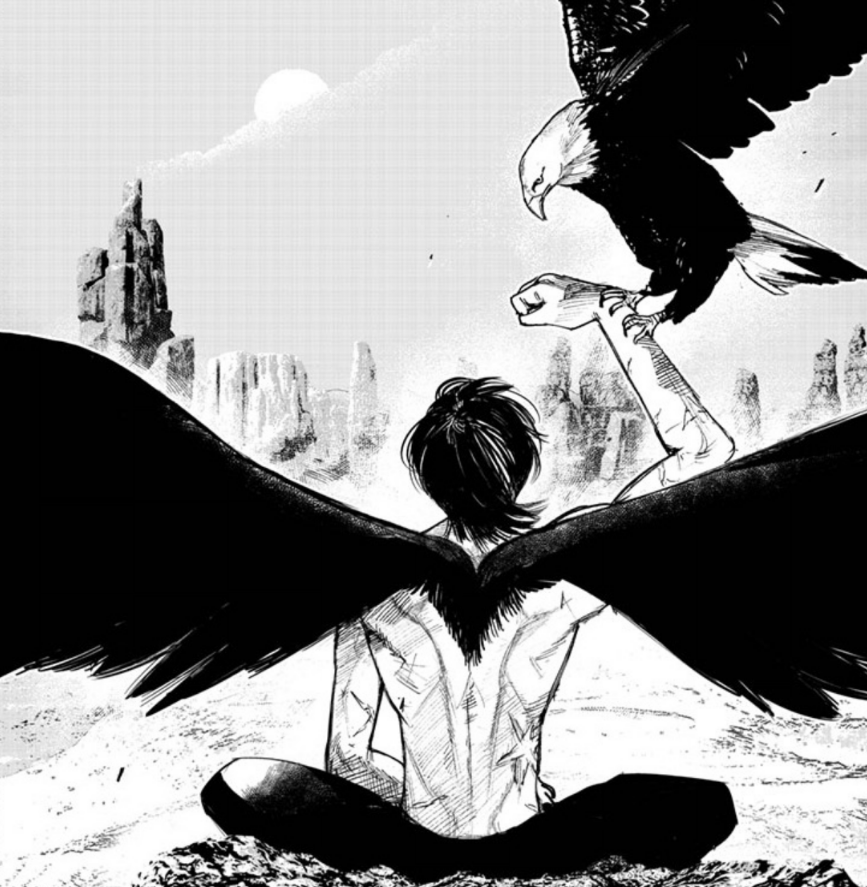
The manga finally connected with me in a way which it had not on my first read and I am so glad that it did. The story follows Tokio Kurohara, a teenage boy with seemingly no direction in life, who constantly lives under the shadow of his best friend, the confident and accomplished Azuma Higashi. When the two are attacked by a Choujin, a person with super-human abilities, they are left with no choice but to attempt to become Choujins themselves. This works for Tokio, who becomes a Beast Choujin resembling a vulture, while it seemingly does not work for Azuma.
Tokio becomes a Beastial Choujin in the first chapter, similar to how Kaneki became a ghoul in the first chapter of Tokyo Ghoul.
And so Tokio is forced into the world of Choujin, where he slowly begins to emerge from under Azuma’s shadow, alongside Ely Otta, a short teenage girl who gains her own powers after being attacked on a plane by the Choujin known as Chandra Hume. The thing that makes Choujin X so distinct is how it fits into the super-hero genre. This is certainly no My Hero Academia, as the powers many of these characters have fit in more with eldritch monsters, as is most apparent with the character of Sora.
Many of the Choujin in this series feel downright Lovecraftian.
Abilities like Raise and Chaos States make the Choujin entirely unique compared to super-powered characters from other stories. The characters of Choujin X are also pretty great, especially Tokio, with his arc of learning what his own dream is and trying to achieve that. It is this quality that makes Chapter 35 my favourite of the series so far, with the conversation between Tokio and his dad being a highlight, along with how the chapter itself ties into Tokio, Ely and Azuma’s growth as characters.
The conversation between Tokio and his father is one of my favourite moments of the manga.
The rest of the cast is also pretty great, with standout heroes, villains, and characters who may be somewhat both. There is also a lot of mystery in this series, most notably the identity of the titular Choujin X. I am highly intrigued to see the answer to these many mysteries, some of which I already have my own theories about. As for my criticisms of the manga, I do have a few, such as that there are a few times where characters recap everything that has happened in the story, which does feel a bit unnecessary. Also, of all the chapters, I would definitely say that Chapter Two is the weakest. Re-reading that chapter really reinforced how much of a mess it was. I probably had more difficulty trying to figure out what was happening during Chapter Two’s action on my second read than I did on my first.
Chapter Two’s action is pretty messy.
Thankfully, Ishida greatly improves on the action in the rest of the story, and I am looking forward to the rest of it, especially with the horrifying events of Chapter 40.2 seeming to lead into an epic and probably tragic fight. Overall, Choujin X is another great manga from Sui Ishida, which I regret falling behind on. If you dropped it, like I did, then I would highly recommend re-reading the series all the way up to the newest chapter. Hopefully, it will finally connect with you the same way it did for me.
I know I have found a good story when I decide to read the manga rather than wait week by week to see the anime version of it. This was my experience with the Hell’s Paradise Mappa adaptation. I loved the first three episodes so much that I read Yuji Kaku’s manga over three days, being rewarded by a compelling story with incredible characters and inventive fights that worked perfectly with the theme of accepting strengths and weaknesses.
It was this scene which ultimately convinced me to read the manga..
From that point on, I was watching the anime not as someone experiencing this story for the first time but as someone who had read the manga and was judging the anime based on how well it adapted the source material. This is where a lot of complaints from manga readers came in. I saw many critcizing the adaptation as it was airing for the quality of its animation. To be fair, I can understand why this criticism is happening. The animation is clearly not up to the par of Mappa’s other brilliant adaptations, like Chainsaw Man. However, the animation is still solid, with numerous excellently animated fights, like in Episodes Two, Nine, Twelve, and Thirteen.
While some fights do feel a bit lacking, some of them are fantastically animated, especially towards the end.
The story is also much the same as the manga, with Gabimaru the Hollow (Chiaki Kobayashi) travelling to a mysterious island with his executioner Sagiri (Yumiri Hanamori) to claim the Elixar of Life in the hope of receiving a pardon from the Shogun so he can see his wife again. Gabimaru, Sagiri, and all of the other prisoners and executioners are well voiced and just as endearing as they are in the source material. The themes are also well expressed, with signs of how they will eventually tie into the story in a big way in the coming seasons, how ever many there are.
I am excited to see how Tao is portrayed in future fights.
Hopefully, the following season will have a bigger budget and more time to develop its animation so that it can reach the heights of the manga. Again, the animation we got in this first season is very good but we know Mappa can do much better. Although, in saying that, good treatment of their animators should come first because this was one of those anime where I heard rumors about the animators being under a lot of pressure again. Overall, this was a good first season for Hell’s Paradise and I am anticipating its continutation.
The first season of Mobile Suit Gundam: The Witch from Mercury did a great job of getting plenty of people hooked for a second season. Ending on the cliffhanger of Suletta (Kana Ichinose) killing someone in front of Miorine (Lynn) and being completley unbothered by it, there were a lot of questions about what would happen next.
This dark ending hinted at grim things to come.
This is why it was surprising to see the second season have a slow start, with the first episode mostly being setup. Unsurprisingly, this caused a few complaints, but people should have been more paitient because, low and behold, the second episode gets right back to the grim story telling the first season left on from. The story follows Suletta, who is struggling to deal with the blow that has been dealt to her relationship with Miorine, who, in turn, now has to run her father’s corporation while also trying to get Suletta away from her conniving mother, Lady Prospera (Mamiko Noto). This leads to many a tragic moment, some of which are not even related to a character death, with the characters words alone doing the emotional damage.
This scene especially was hard to watch.
It is not just Suletta and Miorine who get the spotlight though because plenty of the other characters get time to shine, with Shaddiq (Makoto Furukawa) making his move, and an unexpected bond growing between Elan (Natsuki Hanae) and Norea (Aoi Yuki). It is Guel (Yohei Azakami) who really shines this season, however, as he deals with the trauma of accidentally killing his own father, while being held captive on earth. I have loved Guel’s arc, as he started off as a privileged bully at the beginning of Season One, only to grow into a humbled leader and friend of Suletta.
Guel’s arc in seasons one and two is fantastic.
Not all about his story is great though because this does lead into one of my issues with Season Two, that being Guel’s brother Lauda (Takeo Otsuka). Towards the end of the season, Lauda’s brain does a whole lot of mental gymnastics to blame Miorine for everything, leading to a conflict between him and Guel. It honestly felt like the writers just wanted Guel to have a fight at the end so they came up with a reason to have Lauda be his opponent, no matter how contrived it was.
Lauda’s reasoning ultimately left me scratching my head.
Unfortunately, that is not my only problem with Season Two because I feel that the ending is a bit lacking. Don’t get me wrong, the characters do get a satisfying ending but, as for the world The Witch from Mercury has built, it felt like everything was wrapped up too neatly. I think we could have got another season showing a conflict between earth and space, rather than it all being quickly wrapped up here. Sadly, it seems like this really is the end of The Witch from Mercury.
It is a shame if the show is truly over because I felt it had the potential to go further.
That being said, if this is the end then the show was highly enjoyable. Along with the story and characters, the animation and score were also great, with the OPs and ED being very well done. This is especially the case for Season Two’s ED “Red:birthmark” by Aina The End, which has banger singing, visuals and symbolism. All in all, The Witch from Mercury Season Two is a great follow-up to the first season, which provides a satisfying conclusion, despite it being a bit lacking. I hope we get some continuation, even if that seems unlikely at this point.
Christopher Nolan is one of my and many other’s favourite directors working today. His name attached to a project alone is enough to get my butt in a set. I have even liked some of his films which have received criticism, like most recently Tenet. Nolan’s Oppenheimer, however, has been getting mostly non-stop praise and, after seeing the film in Xtremescreen, I can say that this praise is entirely deserved. Oppenheimer is a biographical film following the life of the titular J. Robert Oppenheimer, called the father of the atomic bomb. Cillian Murphy plays Oppenheimer in his first leading role in a Christopher Nolan movie, and he does so flawlessly, conveying so much emotion with just his eyes.
This is Murphy’s best performance to date.
His performance is masterful, as we watch Oppenheimer go from studying abroad, to eventually leading the Manhattan Project, to his downfall during the shameful years of the McCarthy Era. I would not be surprised if we saw Murphy get at least an Oscar nomination for Best Actor. He should not be alone in getting a nomination, however, for there are other actors whose roles in Oppenheimer make them deserving as well. There is Emily Blunt as Kitty Openheimer, who steals the scene in an interrogation with Jason Clarke’s Roger Robb, which makes her deserving of a Best Supporting Actress nod. As for Best Supporting Actor, the nomination without a doubt has to go to Robert Downey Jr, who delivers what is one of the best performances of his career as Lewis Strauss.
I will be upset if Robert Downey Jr. does not at least get nominated for his role in Oppenheimer.
Matt Damon, Florence Pugh, Rami Malek, Gary Oldman, and Casey Affleck are some of the many, many big name actors who makes appearances in this film and they all do excellent. But what is good performances without good direction, and Christopher Nolan delivers that in spades with a stunning look into Oppenheimer’s mind in all of its beauty and terror. This terror especially comes into play with the Trinity Test, the first test of a nuclear bomb, which is the most intense moment I have seen on screen all year.
The build up to the blast had my heart pounding.
The way the cinematography (Hoyte van Hoytema), the editing (Jennifer Lame) and score (Ludwig Göransson) all combine during the Trinity Test creates such a beautifully haunting moment. This moment is maybe even matched by Oppenehimer’s reaction to the aftermath of the successful bomb drops on Hiroshima and Nagasaki, which killed hundreds of thousands. Nolan and Murphy portray the effect these horrible events had on Oppenheimer perfectly, leading an ending scene which gave me goosebumps. I think the last time a movie’s ending left me feeling so haunted was when I saw the ending to Bong Joon-ho’s Memories of Murder.
The ending of Oppenheimer will stick with me for a while.
After seeing Oppenheimer I would go as far to say that it is not just an excellent film but one of Christopher Nolan’s best, right up there with the likes of Inception and TheDark Knight. The film is three hours long and when it was over it felt like barely any time had passed and that may be the highest praise I can give it. I cannot recommend Oppenheimer enough. It not only provides a haunting look at the creation of nuclear weapons but a look at the flawed yet sympathetic man who fathered them.
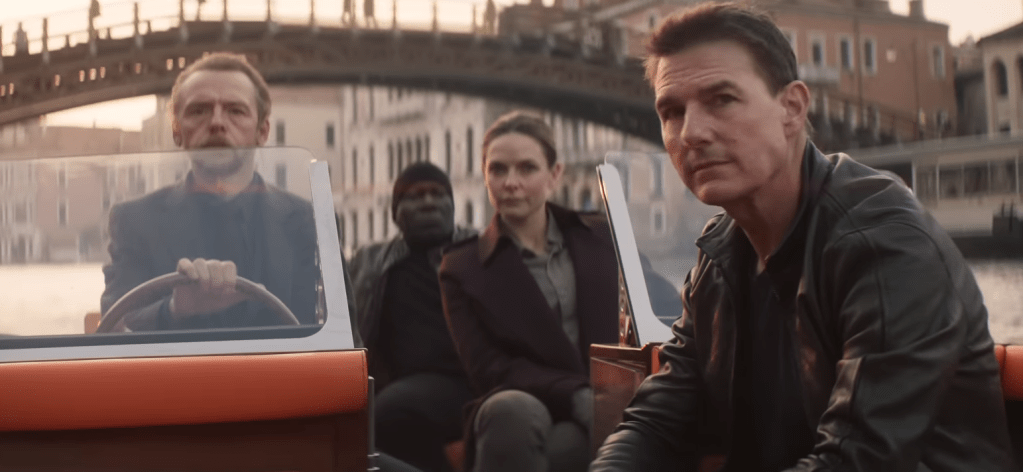
I first got into the Mission: Impossible franchise, not long after the release of the previous film Fallout, which I thought was one of the best movies of 2018. So, going into the seventh installment in the series, once again directed by Christopher McQuarrie, I was expecting a well-directed action film with a fun story and characters, and thrilling stunts from Tom Cruise, which is exactly what I got.
The latest Mission: Impossible movie captures everything great about the franchise.
Dead Reckoning Part One follows Cruise’s IMF Agent Ethan Hunt, who is tasked with collecting a key, which could be used to eventually control a powerful rogue AI known as the Entity. However, believing that the Entity is too dangerous, Ethan instead sets out to kill it, along with his fellow agents and friends Ilsa Faust (Rebecca Ferguson), Luther Stickell (Ving Rhames) and Benji Dunn (Simon Pegg). They are not alone in the search for the key, as Ethan has to enlist the help of a thief named Grace (Hayley Atwell), all the while being pursued by Gabriel (Esai Morales), a dangerous man from Ethan’s past. The story of Dead Reckoning Part One is a lot of fun, with its still surprising portrayal of espionage, and interesting take on AI with one reveal about the Entity being pretty intense.
The reveal surprised me quite a bit.
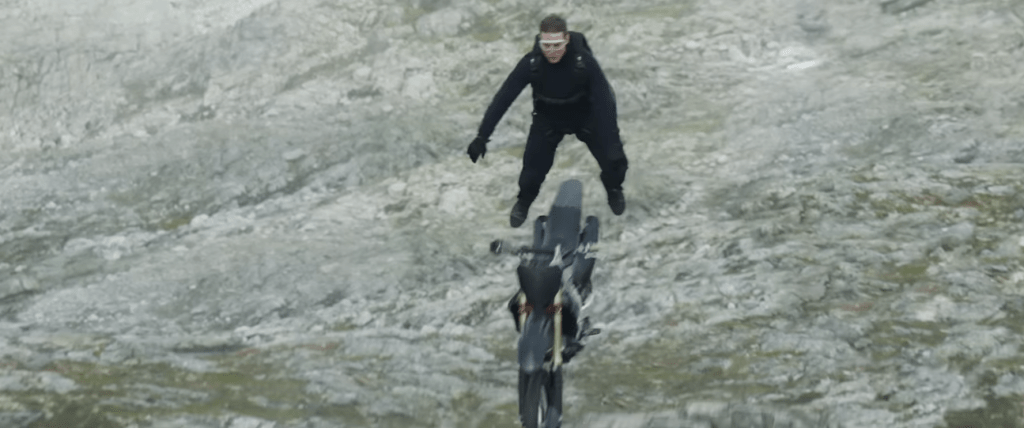
Speaking of intensity, the film is not all fun because there is some sadness to be had, due to specific events that I cannot get into because of spoilers. There is some good humor to balance the sad moments, though. One thing I was worried about going into Dead Reckoning Part One is the Part One of the title. Movies being separated into parts seems to be a returning trend in movies these days and this can lead to some frustrating experiences, most notably Across the Spider-Verse which, while still one of the best movies of the year, ends very abruptly with the rest of the story being continued in Beyond the Spider-Verse. Thankfully, this was not an issue for Dead Reckoning Part One because, despite being only the first part of the story, it still ends in a satisfying way, while making me want more. This “more” includes more amazing stunts from Tom Cruise. I honestly don’t know how the guy can keep doing these death defying scenes, with a cliff jump in the teasers being particularly nerve wracking.
Tom Cruise does it again with the amazing stunt work.
I just hope he doesn’t end up seriously injuring himself or worse with these stunts. Overall, Dead Reckoning Part One is a satisfying beginning for a two-part story in the Mission: Impossible franchise. Fingers crossed that they can pull off Part Two just as well but there is nothing which leads me to doubt that.
I honestly don’t even know where to begin with this review.
I know I have said that Tatsuki Fujimoto is an unpredictable writer but seriously I don’t even know what’s happening any more and I still somehow enjoy it.
Chapter 137 of Chainsaw Man, “Chu Chu Lovely Mini Mini Mura Mura” picks up right from where the previous chapter left off, with the creepy girl grabbing Denji’s crotch without his consent.
The girl offers to have sex with Denji if he licks the dead Devil in the theatre.
After she said this, I felt there was a 50/50 chance of Denji refusing and Denji accepting.
We know from what Denji has said in Part Two that he wants to actually think for himself and not be manipulated.
However, well…. this is Denji we’re talking about and the guy does want to have sex pretty badly.
This is why I was extremely proud to see Denji immediately call the girl out as sketchy, rightly calling her offer out as way too convenient.
He goes on to say that he is matured and that he will no longe mindlessly obey someone, so the girl should go and have some respect for herself aaaannnndddd it’s all in his head.
Yep, turns out that Denji standing up for himself was just his imagination, since he pretty much immediately starts licking the Devil’s head for sex while the girl laughs at him.
He even sucks the Devil’s head like a popsicle when she asks him to, which was just sadly pathetic to look at.
It was honestly disappointing to see Denji revert to this, although this is not a criticism because Denji has developed enough to know he shouldn’t be mindlessly obeying this creepy girl, even if he still does.
Afterwards, the girl takes Denji to a karaoke place, which Fujimoto literally names after himself.
The girl says that she has a friend who works there so they will turn a blind eye to her and Denji having sex in one of the rooms.
Denji is eager to get started but before that the girl wants to sing a song.
She starts the karaoke machine and starts singing what looks like a whole lot of nonsense.
Imagine my surprise when I look it up afterwards and found out this was actually a song, which the chapter is named after, “Chu Chu Lovely Muni Muni Mura Mura Purin Purin Boron Nururu Rero Rero” by Maximum the Hormone.
Listening to the song, I also cannot help but thing that it is perfect for the absolutely Fujimoto typical insanity that happens next.
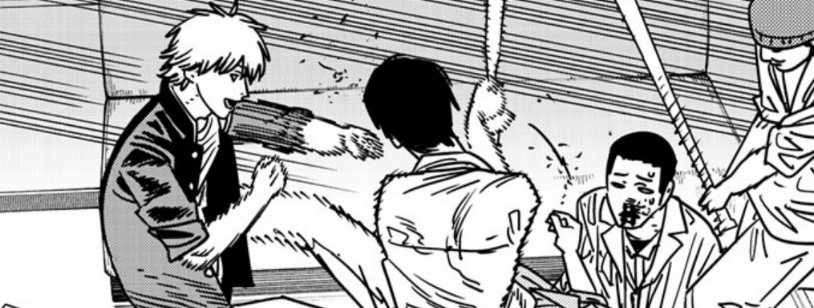
While the girl is singing the song, a man with a baseball bat enters and attempts to kill Denji.
Denji beats him but then another man enters, and then another, and then another.
Men are literally lining up outside the door to enter and attempt to beat Denji to death with baseball bats.
Denji eventually exits the room and beats up all of his attackers, actually looking pretty pleased with himself.
Although, this may just be some sort of self-depricating smile because here is yet another woman trying to kill him, as the creepy girl emerges from the room, baseball bat in hand, looking ready to fight him too as she declares that this looks funner than singing a second verse.
So, as expected, the girl making an advance on Denji was a trap.
I do wonder if the people Denji beat up were hired to do so or if the girl was controlling them, and is a Devil.
Also, if the girl was sent by Yoshida, does this mean this assassination attempt was set up by him?
Maybe Yoshida thought Denji might try to be Chainsaw Man again so tried to have him killed?
But if Yoshida is behind this then it is rather weird that he chose such a poor assassination method.
I mean, Denji has killed multiple powerful Devils at this point so a bunch of guys with baseball bats would obviously not succeed in killing him.
No matter what the meaning behind the attack on Denji was, Chapter 137 of Chainsaw Man was another completley insane chapter.
I had no idea what was even happening when I first read it.
We will have to wait two weeks so the next chapter can give us context.
But, knowing Fujimoto, I would not be surprised if we got more insanity, not that I would be complaining about that.
You know, I keep going into Chainsaw Man chapters expecting normal, predictable stuff to happen, and every time Fujimoto surprises me with the outright bizarre stuff he comes up with.
I should have learned my lesson after Chapter 105 but I clearly did not because I still ended Chapter 136 “Normal Life” wondering what the hell I had just read.
The chapter centers around Denji’s “normal life” after he quits being Chainsaw Man.
He is back at school, looking depressed as ever, while still wearing his Chainsaw Man t-shirt.
Another student notices this and informs Denji of the rumor that Chainsaw Man is actually taking credit for Asa’s Devil kills, and tells him that he should stop wearing the shirt of a “victimizer.”
If that was not bad enough, another student who loves Chainsaw Man overhears this and, believing Denji agrees with the other student, attacks him.
The chapter then cuts to the aftermath of the fight where Denji is admonished for beating up the student who attacked him, as the teacher automatically assumes Denji started the fight since he doesn’t have parents.
It’s sad but realistic considering how some schools treat those who defend themselves as bad as the actual bullies.
Denji is too depressed to protest his innocence and leaves the room, only to be met by Yoshida, who invites him out to a movie.
They are the only ones at the theatre, since a Devil showed up but it was killed quickly and Yoshida uses this to point out how Chainsaw Man isn’t actually needed, probably depressing Denji further.
It is then that Yoshida reveals he used this movie invite to set Denji up with a girl he knows.
Yoshida probably did this to further convince Denji to live a normal life, since one of the reasons Denji wanted people to know he was Chainsaw Man was so he could get a girlfriend.
Before Yoshida leaves, Denji asks him if this is what a normal life is supposed to be like, and Yoshida replies that it is, leaving Denji all alone in the theater in what is a pretty depressing panel.
The girl then approaches and sits next to Denji, who is not really into the idea of going on a date, given how depressed he is.
He is about to tell the girl he wants to be left alone, when he starts shrieking loudly.
At first, I thought he had got a look at the girl’s face and maybe recognized her but nope, if only.
Instead, what has actually happened is the girl has suddenly grabbed his wiener.
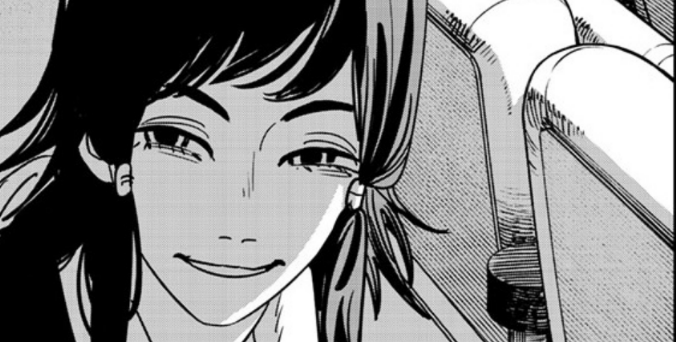
We then get a look at this girl’s face and, yep, she looks incredibly creepy.
The chapter then ends on Denji still in shock that the girl has grabbed his weiner, and once again I can confidently say that I did not expect the chapter to end this way.
The final scene with this creepy, sexual harassment girl felt so bizarre to read.
But that’s what I like about Fujimoto’s writing.
He is always pulling some weird plot development out of a hat that makes you wonder just what the hell you are reading.
He did it with Fire Punch and he is doing it now with Chainsaw Man. Already, there are multiple theories about who the sexual harassment girl is.
The Death Devil is a popular one but I doubt that since she does not have the spiral eyes of Makima, Yoru or Fami.
Another theory is the Octopus Devil Yoshida is contracted with and I find this much more likely, since it could be a way for Yoshida to keep an eye on Denji and make sure that he is living a normal life.
Or the girl could just be a random pervert, who knows?
As for how Denji will react to her next chapter, well, that is anyone’s guess.
He did tell Asa he wanted to have sex but this mysterious girl’s actions feel a lot like Makima’s sexual manipulation so I don’t know if Denji will fall for it again.
Then again, this is Denji we’re talking about so he very well might.
Either way, given that every woman in Denji’s life tries to kill him, I expect this girl to be no different.
Although, if there’s something I should have learned about Fujimoto at this point, it is to expect the unexpected when reading his works.















 THE REVIEW MONSTER