1917 Review: An Epic War Film That is One of The Year’s Best Films.

5 stars
I only have a few more films to watch and review before I make my top 10 films of 2019 list and, until yesterday, Sam Mendes’ 1917 was one of them.
Coming into the film, I expected it to be great from what I had heard, but I was curious to see if it could dethrone my current film of the year, Joker. 
Well, after seeing 1917, I can honestly say that it is an incredibly close call to say which of them is better.
Both are fantastic movies for very different reasons.
Set in the titular year of 1917, the film follows two soldiers, Lance Corporals William Schofield (George McKay) and Thomas Blake (Dean-Charles Chapman) who are sent on a dangerous mission to call off an oncoming attack on the enemy, which is actually a trap.
If they fail, 1,600 men will be killed, including Blake’s brother.
And so begins the two soldiers’ journey in an epic war film that is a feast for the eyes, with the entire movie being made to look like one shot, from the unnatural beauty of a burning building, to the disturbing no man’s land where countless men lie dead.
If Roger Deakins does not get an Oscar for his cinematography for this film, then it will be one of the biggest snubs in Oscar history.

burning
Give Roger Deakins the Oscar for 1917. Enough said. 

Another thing that impressed me about this film was how attached I became to both Schofield and Blake, even though we know only a few things about them.
This reminded me a lot of Christopher Nolan’s Dunkirk.
My one issue with Dunkirk is that I initially found it very difficult to care for the characters because we knew virtually nothing about them.
However, 1917 found a way to keep Schofield and Blake’s backgrounds vague enough, while revealing enough information about them for us to care at the beginning, and then allowing our admiration for them to grow through their actions.

blake and schofield
McKay and Chapman do great jobs as Schofield and Blake on their desperate mission to save 1,600 lives.

This all culminates in various intense war scenes that had me clenching the arm of the movie seat I was in like crazy.
Two particular scenes, one of them in a destroyed town and the climax of the film, will stick in my head for a while because of how intense they are.
I even came close to crying at a few points but managed to persevere.
My family, who I went to see the movie with, on the other hand, could not hold it in, which tells you how emotionally investing this film is.

run boy run
1917 may very well get the tears rolling because of its numerous, hard hitting scenes.

1917 is easily one of the best films of the year.
It has been getting a lot of Best Picture Oscar buzz and I can definitely see why.
I’m still considering if I like it more than Joker but, even if I decide I like that film more, you can expect to see 1917 high up when I eventually do my Top 10 Films of 2019 list.

My Hero Academia, Season Four, Episode Sixteen, Win Those Kids’ Hearts Review: The Beginning of Endeavor’s Rise.

3 stars
In the sixteenth episode of My Hero Academia’s fourth season, Todoroki, Bakugo, Inasa and Cammie began their provisional licence course and came up against the most dangerous, manipulative and evil foe they have had to face yet… children!
In all seriousness though, “Win Those Kid’s Hearts” is an average episode of My Hero Academia because it serves as a clear example of when the manga is better than the anime.
This is evident through a lot of the humor, which were much funnier in the manga, like when Gang Orca throws Todoroki, Bakugo and Inasa away while screaming, “disciplinary action!”
On top of this, the character development is not as good as the manga because a minor flashback that helps Bakugo grow is left out entirely.
And then, there are the kids whose hearts they are trying to win over.
While their oddly very good psychological manipulation is very funny, the episode acting like they are some kind of big threat with intimidating music is very cringey.
The saving grace of “Win Those Kid’s Hearts” is definitely the humor and Endeavor.
Now, while I did say that the humor is a downgrade from the manga, a lot of it is still pretty funny and will honestly be hilarious for anime only viewers.
And then there is Endeavor, who has excitingly begun the character arc that has made him one of the manga’s best characters.
When I made my Top 10 My Hero Academia Characters list, Endeavor barely missed out but, with all that’s happened in the manga since then and looking back on prior chapters, he is clearly a better character than I gave him credit for and should have been on the list.
If you are an anime only, you may be confused about this since Endeavor is an abuser and are probably wondering how any character arc could make him likeable.
Well, to you, I say wait until the end of the season and then you will understand.
As for the current episode, Endeavor’s scenes are definitely the best because we get insight into his character, and already see how he has started to grow through seeking All Might’s help by asking him what it means to be the symbol of peace.
Endeavor asking All Might for advice is something he would never have done when he was first introduced, showing the pressure he is now under now with his new title as the number one hero.
This growth makes him the most interesting character of the episode.
Also, him constantly shouting “SSSSHHHOOOOOTTTOOOO!!!!!” is just really funny.
Overall, “With Those Kid’s Hearts” is an average episode of My Hero Academia.
It is definitely down there with “The Scoop on UA Class 1-A” as one of the weakest episodes of the season.
Still, it is a good episode what with the humor and Endeavor’s character development.

Attack on Titan Chapter 126, Pride Review: A Rare Disappointment.

2 and a half stars
The past 15 chapters of Attack on Titan have been incredible, god tier levels of writing.
So, I was both surprised and saddened to find that I did not like Chapter 126, “Pride.”
Although there are some good things about the chapter, the majority of it feels rushed and there is one plot point that is a complete waste of time.
This plot point is, of course, the whole Connie trying to feed Falco to his mother situation.
Before actually reading this chapter, I was very excited to see how this storyline would pan out because I was certain it would lead to the return of Historia.
Now, I will admit that I did let my expectations get in the way, so that not happening is a big reason for my disappointment.
However, even if my opinion was not influenced by that theory, I am certain that I would still find this subplot pointless.
Absolutely nothing came out of this storyline.
The only interesting part was Armin’s attempted suicide, which I found intense for the brief second that it happened.
The rest of it is a waste because it is entirely predictable, with Falco being saved, and ultimately adds nothing to the main plot.
Seriously, how does Connie trying to bring back his mother tie into the Rumbling in any way?
It feels like a pointless side quest and should have been removed entirely.
If it had, then it would have given Isayama enough time to expand on Hange, Levi and the rest of the Scouts teaming up with the Warriors, which was sorely needed.
At the end of the last chapter, the two came across Pieck and Magath and this lead me to believe that much of Chapter 126 would be their conversation as they slowly and organically came to the conclusion that they should work together.
But, nope; instead Hange suggests working together immediately, despite the fact that they had all been trying to kill each other not two hours ago.
This rushed alliance is also evident with Annie, who Armin and Connie run into after their whole pointless subplot.
They find Annie eating a pie, which Connie makes an actually funny joke about.
However, while I did like the joke, it did not fit the situation at all as things should have been way more tense between the three.
Not only this but Annie deciding to team up with them is left entirely off screen and explained in a letter she leaves to Hitch.
Talk about disappointing.
On a completely unrelated note, Pieck’s last name is revealed to be Finger this chapter, which I hope is a mistranslation because that is just too funny to take seriously.
Another disappointing thing about the chapter is how some characters feel, well, out of character.
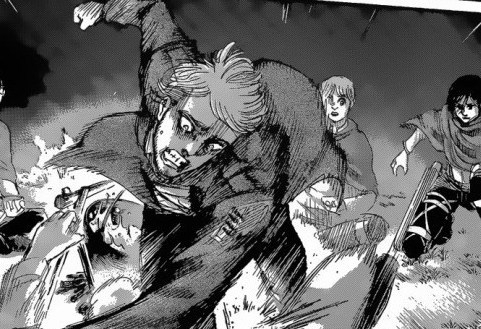
The most obvious of these is Mikasa who is unusually cruel to a dying Louise, who she retrieves her scarf from.
The girl who admired Mikasa is literally dying before her eyes and Mikasa just takes the scarf and leaves her to die without a goodbye.
This made her incredibly unlikable this chapter.
Some have speculated that the reason Mikasa was so cold to Louise is because she reminded her of a part of herself she has come to hate but, if that is the case, then it should have been explained way better.
And then there is Falco whose character is also treated badly through how he reacts to his brother Colt’s death.
There is literally only two panels of him reacting to the news and then he is shown to be completely fine throughout the rest of the chapter.
He even appears to be joking with Gabi when they run into Annie.
The kid just accidentally killed his brother and you wouldn’t even know it had affected him at all by the end of the chapter.
My disappointment in this chapter does not appear to be just me, though, as many other people are also criticizing it online as well about problems like this.
However, what people seem to be criticizing the most is the end of the chapter where Reiner is kicked awake by Annie and sees the Scouts and Warriors are now working together, with Connie telling him they are going “to save the world.”
Many people find this line to be cringy, however, this is one of the few things people say is a problem with “Pride” that I actually think is alright.
This is because of how it ties into Reiner’s arc.
Back in the Marley Arc, it is revealed that Reiner was obsessed with saving the world, which is one of the reasons why he destroyed the walls, kicking off the story.
Now, he has an opportunity for redemption by completing the goal he always hoped to as a child.
This is one of the few moments in the chapter that had any thematic weight so, despite its cringyness, I give it a pass.
Along with this, there are some parts of the chapter that I actually really liked.
The best moment of the chapter is definitely the rescue of Yelena and Onyankopon, with him and Jean being the standout characters of “Pride.”
Onyankopon continues to grow on me as he points out the Yeagerists’ hypocrisy in condemning others to death when they were the targets of this nine years ago.
As for Jean, his line that if he hadn’t rescued them, “the bones turned to ashes wouldn’t forgive me for that” is very moving because it shows he still remembers Marco.
Also, the moment when he splashes water in Onyankopon’s face is really funny.
There are a lot of funny moments in this chapter, even if the scenes they are in are not very good, like  Connie’s ridiculous excuse to Falco about why he brought him to see the Titan, Connie laughing at Annie for stuffing her face, and Annie kicking Reiner to wake him up.
Another detail I liked was Hange crying at the beginning of the chapter when she guns down the two Yeagerists, which was very touching.
There is also some intrigue building around set up plot points like why Magath wanted Yelena to be rescued and who the mysterious figure who saw Armin, Annie, Mikasa and the others escape, is.
My money is on either Zeke or Keith.
So, despite all of its problems, “Pride” does have some good moments that keep it from completing failing.
Back to the criticism surrounding it, a lot of people are taking one bad chapter to mean that the ending of the series is going to go downhill from here.
We have had 15 incredible, mind blowing chapters before this point and now we have one bad chapter and everyone assumes the series is doomed.
People need to calm down because there could be a number of reasons why this chapter is so flawed.
Hajime Isayama could have been rushed like with Chapter 119 or decided to bypass this stuff quickly to get to the good stuff.
We really don’t know and we should at least see a few more chapters before saying that Attack on Titan is in danger of having a bad ending.

BoJack Horseman Final Season Part Two Review: You do the Hokey Pokey and you Turn Yourself Around.

4 and a half stars
And so one of the greatest animated series of all time has come to an end.
What a wild, depressing, existential ride it has been.
Why Netflix decided to pull the pin on BoJack Horseman I will never understand but I am at least thankful that they gave creator Raphael Bob-Waksberg and the other writers enough time to end the show right.
And end it did, with the second half of season six bringing an end to the character arcs of BoJack (Will Arnett), Diane (Alison Brie), Todd (Aaron Paul), Princess Carolyn (Amy Seradis), and Mr Peanutbutter (Paul F. Tomkins) amazingly.
All five of these characters get great sendoffs that fit their storylines well.
As set up in the first half of the final season, many of BoJack’s past misdeeds catch up with him, especially the death of Sarah Lynn.
One thing I believed coming into this second half was that BoJack would have truly changed for the better and try to make amends for all he had done.
Well, now I can see that I clearly overestimated BoJack because he is still the painfully flawed, yet somehow still sympathetic, character he has always been.
We even learn some disturbing facts about some of the things he did that honestly made me feel a little guilty for sympathizing with him.

downer moment
Only BoJack could give horses a bad name while still being sympathetic.

But the way his story ends is perfect for him and can even be viewed as a punishment of sorts.
Then there is Diane and Princess Carolyn who both get fantastic endings as well that left me very touched.
As for Todd, he continued to be as insightfully wacky as ever in the conclusion of his story, making the simple nursery rhyme of the Hockey Pokey  inspirational.
The last of the main cast in Mr Peanutbutter, who I was honestly concerned about in the first half of the season.
I thought they were backtracking on his character arc but, thankfully, they follow through on it in this half, giving him a satisfying conclusion as well.
Then there is Hollyhock, with the way her relationship with BoJack developed in the wake of her learning about his horrible actions being realistic, yet heartbreaking.

pete repeat
BoJack and Hollyhock’s relationship does not really have a resolution but that’s the tragic point.

As well as the characters, many of the episodes are incredible as well, especially the last two.
The fifteenth episode, “The View From Halfway Down” is actually pretty horrifying at times and is easily one of the show’s best episodes.
And then there is the finale, the perfectly titled “Nice While It Lasted”, which wraps up all the character arcs and ends on a note that hits you right in the feels.

halfway down
The last two episodes of BoJack Horseman are haunting and conclusive.

There is a lot to love about the second half of the final season.
However, sadly, it is not perfect.
I, for one, was disappointed about how various characters got sidelined.
This is most obvious with Gina who it felt like the show was hyping up to be one of the people who exposed BoJack.
However, she and the trauma she suffered from her experience are never brought up again apart from a blink and you’ll miss it moment.
But, even though I was disappointed by this aspect, there is still so many amazing things about this final season and BoJack Horseman as a whole.
In fact, I think there is only one thing that I can say that will sum up my feelings about the show having ended.
BoJack Horseman is gone and everything is worse now.


My Hero Academia Season Four, Episode Fifteenth, Smoldering Flames Review: Is This Attack on Titan?

3 and a half stars
With the Overhaul Arc officially over, “Smoldering Flames”, the fifteenth episode of My Hero Academia’s fourth season, kicked off the next arc by introducing an important villain.
As Gran Torino and Tsukauchi succeed in capturing the warp villain Kurogiri, they unwittingly stumble across All For One’s most faithful servant, Gigantomachia.
I’m sure a lot of people got Attack on Titan vibes, due to the naked giant with a radio around his neck having a striking resemblance to that series’ Titans.
Along with this, I am also sure that a lot of people would have recognized Gigantomachia because this is not the first time we have seen him before.
There was a brief tease of him around the end of season two when the new members of the League of Villains were being introduced, and he was seen more prominently in Kirishima’s flashback during the “Red Riot” episode this season.
Although, many people may be expecting Gigantomachia to have a big role given this introduction, I’m afraid to say that this was yet another tease because there are still a few arcs to go before the massive villain becomes important to the story.
Next to Gigantomachia, the second most exciting thing about “Smoldering Flames” is the new OP “Star Maker” and ED “Shout Baby”.
I would say that both of these OP’s are way better than the ones for the Overhaul Arc with both of them having great examples of symbolism and foreshadowing for future events.
My one criticism of the OP is that I wish we had seen more of Gentle and La Brava, who will be the two big villains (although not-so sinister ones) of this arc.
Back to the episode, the rest of it is pretty standard with a few good laughs.
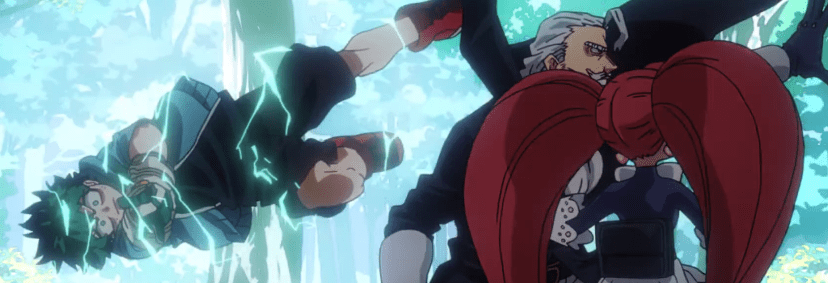
The best of these comes when Iida orders the rest of Class 1-A to leave Deku and the others alone, until Deku says they are fine, which Iida uses an excuse to scream that he was so worried about them while shaking Deku.
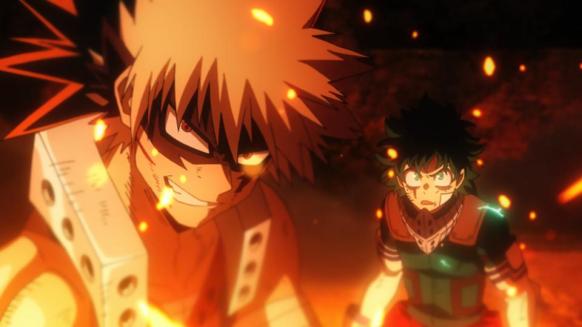
We also get the beginning of Bakugo and Todoroki retaking the provisional licence, along with Inasa and Cammie, who is definitely not Toga this time.
There is also Present Mic who provides some good laughs like always, with his repeated jabbing of Baukgo’s head and deciding to grab some coffee to get away from All Might and Endeavor’s conversation, which will happen next episode.
The one bit of the episode that I feel drags things down a bit is the repeated showing of events that we have already seen.
For example, there is an entire scene where Deku basically reflects on everything that happened in the Overhaul arc, and we are shown the whole thing in a quick flashback, as if the director thinks we did not watch the last 15 episodes.
Overall though, “Smoldering Flames” is another good episode of My Hero Academia that may start off tense but ends on a light hearted note that the rest of the season will most likely follow up on.
Unless, of course, we actually get the Pro-Hero Arc this season as well.
We are shown images from that arc in the OP so here’s to hoping it is not a tease for season five and we will actually see this storyline at the end of the season.

Marriage Story Review: Incredible Performances.

5 stars
I honestly thought that after Joker there was no 2019 film that could provide a performance that would rival Joaquin Phoenix’s.
However, after finally watching Noah Baumbach’s Marriage Story on Netflix, I can say he now has some stiff competition.
Every single actor does an incredible job in this film, which follows a couple going through a divorce and trying to make things easy for their son, only for their divorce proceedings to escalate.
Both Scarlett Johansson and Adam Driver are flawless as Nicole and Charlie Barber and are natural Oscar contenders, especially Driver who blew me away in so many scenes, like the one where he gives an impassioned song.

Driver sings
The scene where Charlie sings in front of a group of his friends is my favourite of the film.

Again, if Joker had been released any other year then Driver would have an Oscar in the bag with this performance.
Complimenting the actors’ performances is the character writing for both Charlie and Nicole, with the film showing both of them to be flawed people who the audience can sympathize with and decide who is more at fault for the failure of their marriage.
And it’s not just the actors that are great but the cinematography as well with both long, extended takes and quick cuts being utilized to for dramatic and thematic effect perfectly.

cinematography3
The closing of the gate shots coming together to create a fantastic scene. 

Baumbach did an amazing job directing this film.
The only minor criticism I can think of is that it did take me a little bit to relate to Charlie and Nicole because of their celebrity status, which initially felt slightly alienating.
But, this issue I was having did quickly dissipate because of how the story and character arcs played out, along with the great the performances and cinematography so I can hardly fault the film.
Marriage Story is an emotional, highly crafted film that is definitely one of the best of the year.

My Hero Academia, Season Four Episode 14, Bright Future Review: A Loss for the Heroes and a Gain for the Villains.

4 stars
Coming into My Hero Academia’s fourteenth episode of season four, “Bright Future”, I was very excited to see the adaptation of two fantastic scenes from the manga that had me feeling very different emotions.
However, unfortunately, while one of these scenes was perfectly adapted, the other lost a lot of its impact.
This scene is the League of Villains’ attack on the police transport that is taking Overhaul away.
After they stop the transport, and Dabi and Mr Compress kill the sand hero Snatch, Shigaraki and Compress amputate Overhaul’s arms, leaving him quirkless, and steal his quirk removing bullets.
The reason this scene is a downgrade in comparison to the manga comes down to censorship.
The moment where Compress amputates Overhaul’s arm is shot in a way that removes most of the violence, making many viewers not even realise that Compress had taken Overhaul’s arm.
As for the death of Snatch, if you missed Dabi’s comment about him probably being dead, you would have no idea that Snatch was killed from being compressed in the fire because it was done so tame.
Maybe they should have added a scene of Dabi crushing the compressed ball with Snatch in it to make his death more clear.
I was also a little disappointed that some of the manga panels did not make the cut.
Other than these instances, though, the scene is still done well, with great voice acting, especially from Koki Uchiyama who voices Shigaraki.
And, even though I was slightly disappointed by this scene’s adaptation, the adaptation of Nighteye’s death could not have been more perfect.
Everything from the voice acting, to the music is handled so well to the point that it almost made me tear up.
Shin-ichiro Miki does a great job as the dying hero, who makes amends with All Might and Deku, before telling his protege, Mirio, that he will be a fine hero and to keep smiling for a brighter future.
The moment the life fades from his eyes is emotionally palpable and a sad end to a very dark arc.
Thankfully, Nighteye’s hope for smiles will be fulfilled with the rest of the season because the upcoming Cultural Festival arc is very uplifting compared to the Overhaul arc’s darker tone.
I have watched the trailer for the second part of the season and it looks like it will be just as well as adapted as previous scenes in the season.
All in all, “Bright Future” is another good episode of My Hero Academia.
Yes, the adaptation of the League of Villains is a real downgrade from the manga, but the Nighteye death scene more than made up for this with its emotional weight.
Anyway, now that the sad times are over, we can move on to the happier times with the next arc, which I am really looking forward to.

The Irishman Review: Amazing De-Aging Effects in a Long Film.

3 and a half stars
Martin Scorsese has had a long career of fantastic crime dramas from Goodfellas, to Casino, to The Departed, to many more.
As such, coming into The Irishman, I felt like I was going to see another riveting film on par with many of his prior movies.
Honestly, though, this expectation may have been a bit naive.
That is not to say that The Irishman is bad because it is certainly a good film, but there was nothing about it that made it feel like I was seeing something new.
The most impressive thing about the film is its fantastic de-aging effects, which allows the characters played by Robert De Niro, Al Pacino, and Joe Pesci to age across the decades that the film depicts.
The only problem I had with the effects was that sometimes the actors’ eyes looked a little off but, Aside from this, it was flawless.

aging effects
The de-aging effects of The Irishman are so good that I cannot tell you at what time De Niro has no effects done to his face.

The Irishman follows the crime fueled life of Frank Sheeran (De Niro), a man who “paints houses”, a euphemism for murder in the criminal underworld.
Under orders from his friend Russel Bufalino (Pesci), Frank eventually comes to know and befriend the leader of the International Brotherhood of Teamsters, Jimmy Hoffa (Pacino).
The film then follows these three characters through Frank’s experiences in the criminal underworld and the fatal effects these experiences have.
For starters, the three actors all do a really good job with their characters, especially De Niro and Pacino because I could really feel the bond that their characters had.
The friendship between Sheeran and Hoffa, and what it ultimately culminates in, is the most interesting part of the movie for me; even if the outcome may not be true to life because no one really knows how these events really unfolded.

de niro and pacino
While probably not true, the way Sheeran and Hoffa’s friendship pans out in the film is tragic.

Another impressive thing about The Irishman is how it goes about portraying Sheeran’s supposed murders, with them often being quick and realistic, lacking an over dramatic feel, although this works in the film’s favor.
However, despite these good things, I still cannot say The Irishman is anything spectacular.
For one thing, the film is way too long, coming in at 209 minutes.
The over three hour runtime was not exactly warranted and I felt quite a few scenes could have been condescend or cut.
Also, as I said, The Irishman does not really add anything all that new to the crime drama genre.
I felt like I was watching just a typical crime film rather than one directed by Scorsese.
Still, the film is enjoyable and I would recommend it based off the great performances and amazing de-aging effects.
If you don’t mind the over three hour runtime then you should give it a watch.


My Hero Academia Season Four, Episode Thirteen, Infinite 100% Review: Exceeding The Manga.

5 stars
I remember reading the fight between Deku and Overhaul in the My Hero Academia manga and being absolutely blown away by it.
The creativity and intensity of the battle was just incredible and I could not wait to see it animated.
Well, that finally happened with episode thirteen of season four, “Infinite 100%”, and I was even more blown away than when I first read it.
Talk about exceeding the manga.
Everything was just incredibly done this episode, from the voice acting, to the animation, to the music.
I would actually say that this is now my favourite episode of My Hero Academia so far because of how emotionally epic it is.
The scene where Deku successfully grabs Eri is just magnificent with the fantastic OST MightU playing as he grabs her.
The greatness of this scene continues as Deku moves so fast that he can’t even be seen, and the resulting shock wave created by his speed happens in a spellbinding silence.
From here, the fight gets more epic as Overhaul merges with Katsukame in a last ditch effort to get Eri back.
Realising that Eri’s rewind quirk allows him to maintain One For All at 100%, Deku takes on his foe at full power in what can only be described as a slaughter.
Seriously, despite Overhaul’s strength he did not lay a finger on Deku who punched him to oblivion in what has to be the series’ greatest animation so far.
With Overhaul defeated, the episode ends with Nighteye realizing that Deku has changed the future he saw, leaving hope for All Might.
Along with Deku’s great fight with Overhaul, there is also a lot of development for the villains as well, with Toga tricking Uraraka and the other heroes to ambush Overhaul at the beginning of the episode.
We will see more of the League next episode in a scene that will be very intense and I am eager to see how it will be animated.
As for Overhaul, we also finally got to see what his full plan was and it was pretty ingenious.
He basically wanted to use Eri’s rewind quirk to create a bullet that could get rid of quirks and a bullet that would restore them, which they would sell both to the heroes and villains, creating a monopoly that only they could control.
Just one problem.
It would mean they would have to experiment on and torture an innocent little girl.
This fact is established pretty disgustingly, as we see how Overhaul began his experiments on Eri when he was trying to figure out what her quirk was,
Thankfully, the boss of the Hissaikai is not as monstrous as Overhaul, being horrified at the man’s callous nature.
Sadly, this does not end well for him because Overhaul uses his quirk to make him catatonic when he refuses to follow through on this plan, leaving Overhaul free to experiment on the girl.
Eri really has the most tragic backstory in My Hero Academia.
First she accidentally kills her father with her quirk, then her mother abandons her, and then she is tortured and experimented on by a complete monster who wants to use her for his own gain.
Well, now that she has been rescued, we can hope to see happy times for Eri.
There is one scene in particular in the upcoming Gentle Arc that I am especially looking forward to.
However, before we get to the happy times, we have to go through more loss in the next episode, which will certainly make for a sad viewing experience.
Overall, I would say that “Infinite 100%” is now my favourite episode of My Hero Academia with its fantastic fight scenes, character growth, music, voice acting, and animation.
It all just comes together to create a flawless episode.

Jumanji: The Next Level Review. Another Fun Time at the Movies.

3 and a half stars.png
Funny story.
As I was sitting through the first twenty minutes of Jumanji: The Next Level, an audience member in the row in front of me turned to the guy next to him and asked, “hey, this is Jumanji, right?”
He must not have seen the first film and not realised that the teenage characters would become the video game ones so thought he wandered into the wrong movie.
In any case, I’m sure the guy was glad not have walked out because of this mistake because Jumanji: The Next Level is a good time that is about on par with the first film.

the next level.jpg
The Next Level is just as good as Welcome to the Jungle.

Directed again by Jack Kasdan, the sequel continues to follow the adventures of Spencer (Alex Wolff), Fridge (Ser’Darius Blain), Martha (Morgan Turner) and Bethany (Madison Iseman) after Spencer goes into the game willingly and the others mount a rescue.
Unfortunately for them, the busted state they left the game in leads to some unforeseen consequences, most prominent of which is Spencer’s grandfather, Eddie, and his estranged friend, Milo, also being sucked into the game.
Taking on the roles of their Avatars, Smolder Bravestone (Dwayne Johnson), Franklin Finbar (Kevin Hart), Ruby Roundhouse (Karen Gillan), and Sheldon Oberon (Jack Black), the characters set off to rescue Spencer and save Jumanji again.
One of the things I really enjoyed about the film was how it went in new directions to shape the story.
Rather than a retread of the first movie, Jumanji: The Next Level tries different things, resulting in various hilarious scenarios.
The best of these is definitely Johnson and Hart playing elderly men stuck in heroic video game characters’ bodies.
This results both in many fantastic comedic moments and also a lot of growth for the two characters of Eddie and Milo.
These two elements combine with a joke at the end of the film that left me howling with laughter.

his whole left side is shutting down
There are so many great gags with Eddie and Milo being stuck in their Avatars’ bodies.

Another improvement from the first movie is the villain, who this time is Jurgen the Brutal (Rory McCann).
In Jumanji: Welcome to the Jungle, the villain was very forgettable to the point that I can’t even remember his name.
Granted, Jurgen is not much better here but the film knows this because, with the exception of the game cut scene that introduces him as the threat, it only places Jurgen in scenes with the characters.
The villain of the first film had entire scenes to himself that did not work, so only placing Jurgen in scenes with our main characters is for the better.
What is not for the better is some of the directions the story takes.
Like I said, I do like a lot of the new routes that are taken in this film but there are a few that just don’t work.
The biggest example of these is a storyline involving a horse that ends with revolving a character’s arc poorly.
I honestly imagined this character’s story ending another way after the movie was over and I thought it was way better.

horsey.jpg
The horse storyline is definitely the weakest of the film.

But, despite this problem, I still find the film to be a solid sequel that people will have fun with.
Jumanji: The Next Level is an enjoyable film that makes for a fun time at the movies.