The Wheel of Time, Episode Two, Shadow’s Waiting Review: Monsters of Men and the Shadow.

Episode Two of The Wheel of Time, “Shadow’s Waiting,” is, in my opinion, the best of the first three episodes released by Amazon Prime.
Directed again by Uta Briesewitz, it follows up the first episode much better, delivering a well-paced story that highlights many of the characters, both new and from the first episode, greatly.
These new characters who are greatly highlighted are the Whitecloaks, who we first see in the beginning scene, before the opening titles.
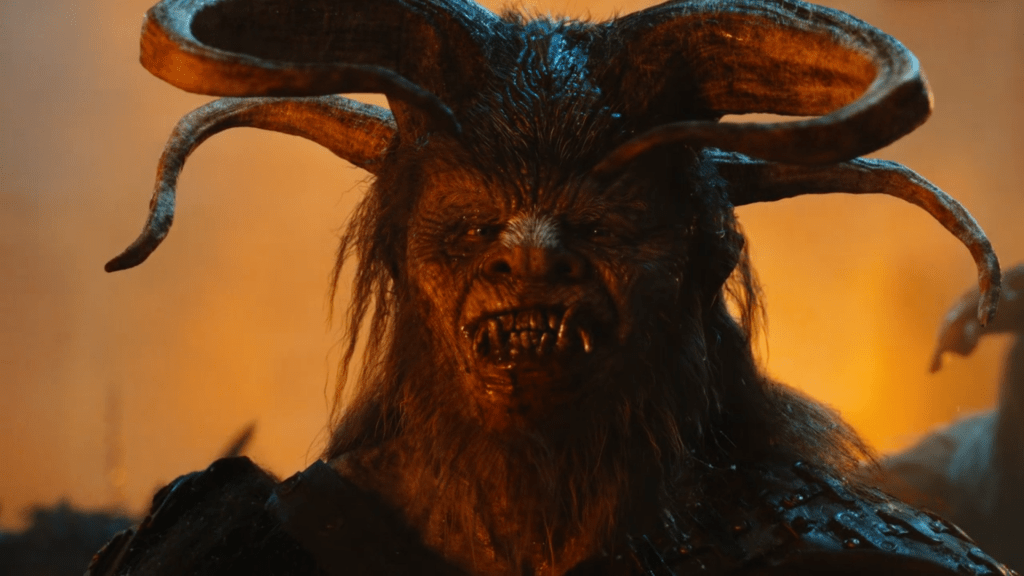
We are introduced to one of the Questioner Whitecloaks, Eamon Valda, whose actor, Abdul Salis, chews on the scenery, just like Valda chews on the cooked bird, which cuts up the inside of his mouth, all the while he monologues to the Yellow Ajah Aes Sedai he is burning at the stake.
“An Aes Sedai should know above all others that sometimes brutality is the only path to mercy.”
You can really see why the boy who brought him the dish was clearly terrified of him.

Salis is clearly enjoying playing the sadistic Valda.

Once this gruesome introduction to the Whitecloaks and Valda is done with, we get our first look at the show’s opening, and it is really good, showing how the weaves of the Wheel of Time create the pattern that shapes the world, with the Aes Sedai being woven as well.
From here, we go back to our main cast, with Moiraine and Lan leading Egwene, Rand, Mat and Perrin out of the Two Rivers, Trollocs in hot pursuit.
The Trolloc CGI still looks a little iffy at times but, for the most part, I like the way they are animated, with many Trollocs running on all fours.
It is only through crossing the river by paying a ferryman that they are able to temporarily escape from the army of the shadow.
Seeing the Trollocs advance towards the riverfront, hundreds in number, was a chilling sight, made even creepier by the arrival of the Mydraal as the Trollocs part for it, only for the creature to snarl as the main characters retreat.
The ferryman wants to go back for his son but Moiraine tells him she cannot allow it because that will give the Fade a way to get the Trollocs across to continue the pursuit.
Lan cuts the small ferry away, sending it adrift, and Moiraine creates a whirlpool to destroy it, only for the ferryman to jump after it and drown.
This shows just how ruthless Moiraine has decided she needs to be in this situation and really brings to mind Valda’s comment about brutality being the path to mercy.
Moiraine was brutal in creating the circumstances that killed the innocent ferryman, however, this was also merciful because it saved the five Emond’s Fielders and potentially the entire world because one of them is the Dragon Reborn destined to fight the Dark One.
Afterwards, we see the group resting now that they have put a distance between them and the Trolloc army.
Things are tense but that night Moiraine talks with Egwene, seeing the potential in her power and telling her about the Three Oaths of the Aes Sedai, making sure to note that the wording is important.
“One: To speak no word that is not true. Two: To make no weapon with which one person may kill another. Three: Never to use the One Power as a weapon, except in the last extreme defence of her life, or the life of her Warder, or another Aes Sedai.”
Using these oaths to show Egwene how serious she is, Moiraine offers her a place among the Aes Sedai and shows her how to channel.
No spoilers from the books, but I personally found this to be a perfect adaptation of Moiraine and Egwene’s interactions in Book One.
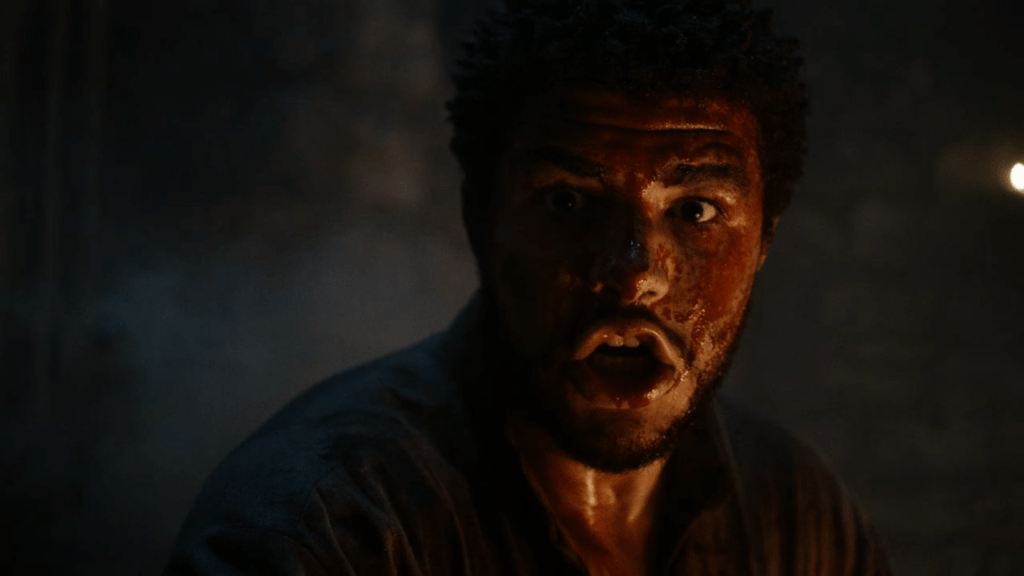
However, such an interesting and character building scene then turns into a literal nightmare when Rand dreams of coughing up a dead bat and then sees a mysterious man with eyes of fire
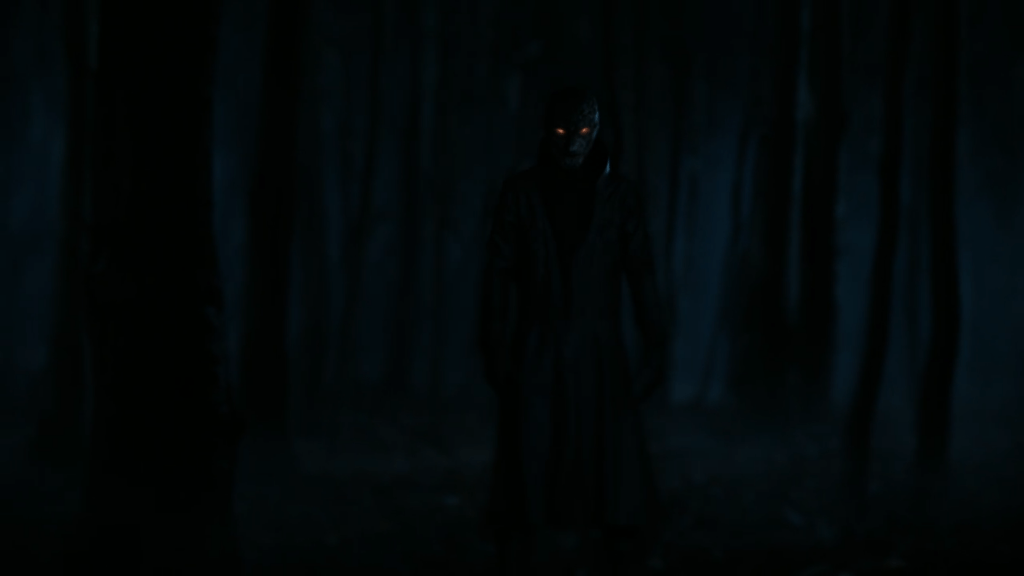
The ember-eyed man watches the Emond’s Fielders in their dreams.

Rand wakes up, only to find that this nightmare has influenced the real world, as dead bats now litter their campsite, with all three Emond’s Fielders having dreamed of the same thing.
Unfortunately, Rand thinks it is Moiraine who made them dream this and goes to confront her but Lan steps in the way and even the stoic Warder looks slightly afraid, showing how grim the situation is.
Rand continues to berate Moiraine as she commands that they leave, with some great acting from Josha Stradowski, and this creates a further rift between him and Egwene.
However, the tension is lifted slightly by Mat’s jokes: “The lady does shoot fireballs, so let’s try to stay on her goodside.”
Barney Harris is continuing to nail his performance as Mat.
Yet, as the group go to catch up with Moiraine and Lan, we see that Lan was hiding and watching them, proving Rand right that Moiraine would not willingly let them go with so much at risk.
And then who should show up but the Whitecloaks.
This scene is especially interesting when you consider Moiraine’s conversation with Egwene about her oath not to lie.
Watch this scene with that oath in mind and you will learn quite a few things about Moiraine in what is an excellent case of subtle exposition.
Things seem to be going well with this group of White Cloaks’ leader, Geofram Bornhald (Stuart Graham), until Valda walks up, intent on interrogating Moiraine.
As he’s searching her, likely looking for her ring that Lan is hiding, Lan admits to being from the Borderlands where he learned that men should keep their hands to themselves or risk losing them.
Valda then chuckles, probably remember how he cut off the poor Aes Sedai woman’s hands before he burned her alive.
However, Moiraine gets them out of this situation when Valda accidentally touches the injury she recieved in the battle during “Leavetaking,” diverting the Whitecloaks’ attention away from them to the Trollocs.
It is here we get an interesting piece of information about the Whitecloaks, as Bornhald suggests Moiraine finds an Aes Sedai to heal her, showing that not all of them are as fanatical as Valda.

This scene makes it clear that there are differences in the White Cloaks.

With the group being allowed to pass freely, Egwene confronts Moiraine about lying to the Whitecloaks but Moiraine points out that she did not lie, she just told a different version of the truth, showing that when you speak to an Aes Sedai you need to listen carefully.
Later, noticing Moiraine is looking worse, Mat seeks to lighten the mood, singing a song about someone named Manetheren, to which the others join in.
Moiraine then reveals that Manetheren was not a person but a place, and tells the story of how the city bravely fought in the Trolloc Wars for thirteen days before their army was entirely wiped out.
The king, Aemon, died and in anguish, Queen Eldrene used the One Power to destroy the Trolloc army but weilded so much that it killed her, with only the children and their keepers sent into the mountains surviving.
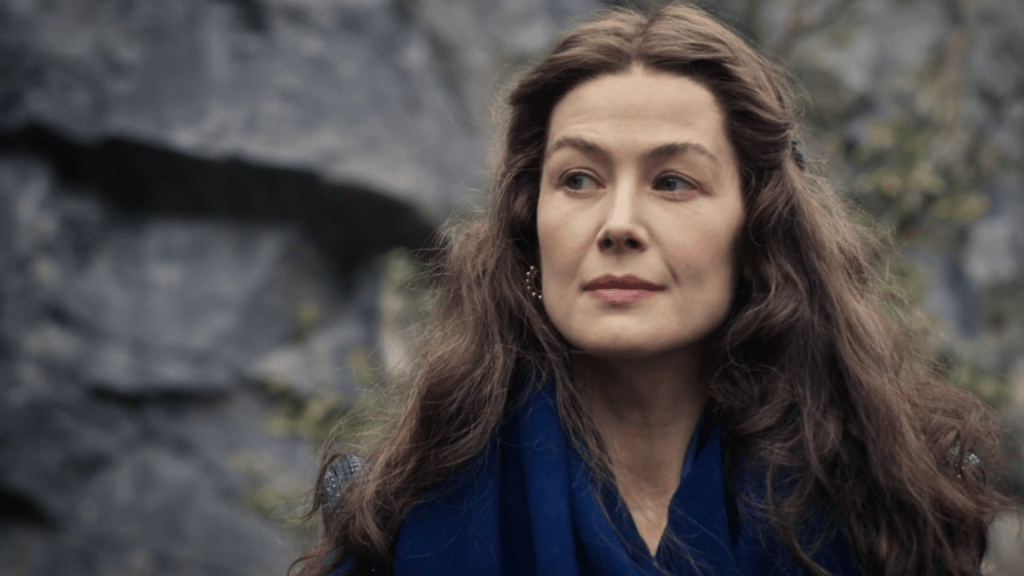
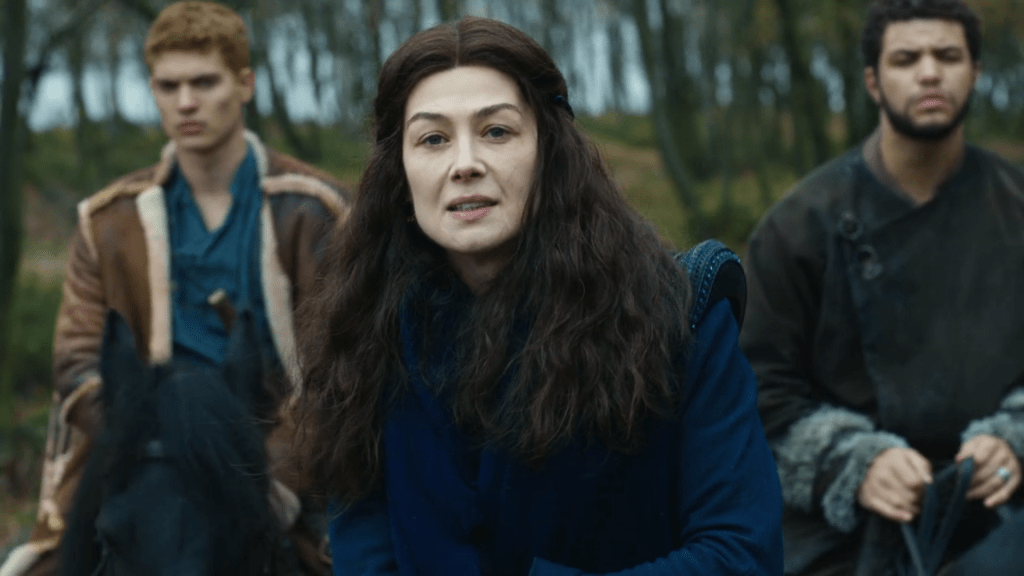
This tale was very harrowingly told by Rosamund Pike and a great adaptation from the books.
As the group once again stop to rest, Moiraine guesses that Lan is trying to guide them towards the cursed city of Shadar Lagoth to ward off the Trollocs.
However, Moiraine points out that this would be too dangerous.
As the group are gathering fire wood, Rand and Egwene start to reconnect, and Perrin goes off on his own, only to be confronted by a pack of wolves.
One would think this would spell disaster for Perrin, especially since he is wounded, but, no, the wolves only lick his wound and then leave.
Just like in Episode One, I have to commend the soundtrack of this show, with the OST “Golden Eyes,” which is played during this scene, being especially good.

I’m interested in how Perrin’s story will be adapted, especially because of the changes from the books.

The next scene shows the group hunkering down for the night, Moiraine’s condition continuing to worsen, only for Egwene to wake up, potentially from another nightmare about the man with eyes like embers, only to see the Fade and Trollocs have found them once more.
Left with no choice, Lan leads them all to Shadar Logoth, which the Trollocs refuse to enter.
Lan then explains the history of the city, the name of which means the titular “Shadow’s Waiting,” telling them of how it was one of the cities which promised Manetheren aid, only for the citizens to lock themselves behind their walls, yet they were supposedly consumed by the evil inside.
After Rand and Egwene observe the cursed city from a tall building, we get one of my favourite moments in the episode, as Mat sits next to Perrin and comforts him about Laila’s death, giving him a knife she made, probably thinking Mat could use it to help Perrin.
It is not just Barney Harris who is great in this scene, though, but Marcus Rutherford as well.
He brings a gentle nature to Perrin’s grief, which is really in character from the books.
Unfortunately, now Mat is without a knife, and it is at this moment when something leads him to a sketchy looking dagger, which he takes with him, disregarding Lan’s warning.
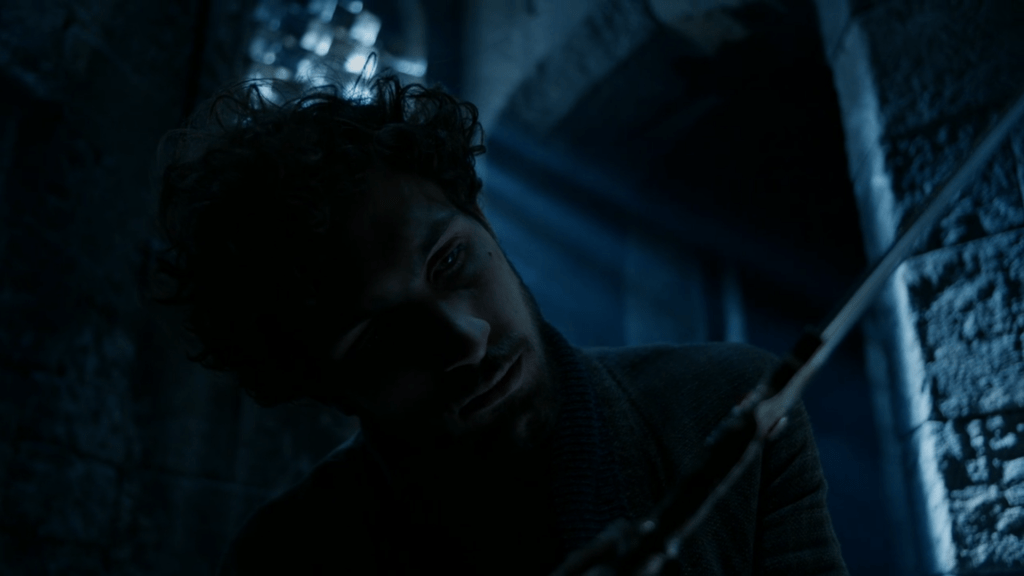
Mat, buddy, you’re a good character, but why, oh why did you stupidly take something when you were told not to?

It is then that they are attacked by the Mashadar, the evil which apparently consumed the city.
It kills one of their horses, and seperates the group.

Rand and Mat are stuck togethor, as are Egwene and Perrin, while Lan also gets an unconcious Moiraine out of the city, who has enough lucidity to wake up and tell him he has potentially killed them all by taking them to Shadar Logoth.
Thankfully, this story is just beginning so the characters all have plot armour.
That does not make the chase with the Mashadar any less engaging though, as the three seperate groups manage to escape Shadar Logoth, only for Lan to be taken unaware by Nynave, who says that if he doesn’t lead her to the others then she will slit his throat. 

Nynaeve is back!

This brings an end to the best of the three currently released episodes.
Does “Shadow’s Waiting” have the best moment of these episodes?
No, but it is the most consistantly good of the three, delivering both well adapted scenes from the book and interesting show original scenes, along with great performances from the cast.

Book Spoilers:
I don’t really have much to say, compared to the first review.
There were quite a few book changes but I actually enjoyed them for the most part.
Not saying that they were better than the book, as for some of these that still remains to be seen, but these changes were enjoyable to view playing out.
First of all, I quite liked how scarier the show Whitecloaks are compared to their book counterparts.
I could never take them quite seriously in the books because of how buffoonish they could be, but the show really raised their threat level, especially with Valda.
I like how he was introduced much earlier in the story as well.
Maybe he will be merged with other Whitecloak characters from the books so we can have a single antagonist in the Whitecloaks to focus on, rather than multiple?
Another big change from the books was the story of Manetheren coming during the main characters’ journey, rather than in the Two Rivers.
Moiraine tells the people of Emond’s Field their history before she leaves and the importance of this branches out into the other books. 
“Wheep for Manetheren” indeed.

It makes me wonder how the characters in Emond’s Field will learn of their history in the future.
Maybe Perrin will tell them about it when the show gets to adapting The Shadow Rising, another thing I cannot wait to see because Perrin’s story in that book is excellent.
Then there’s the changes to Shadar Logoth, with no Mordeth leading Mat to the dagger, which later becomes relevant to Padan Fain.
They’re probably going to switch this up for the show.
Finally, one detail I found funny as a book reader was when Mat talks of how Nynaeve would make Moiraine’s life a misery if she were here, which is funny because this is exactly what happens in the books since Nynaeve was not taken by the Trollocs there.
Cannot wait to see how the two women will interact in the future and how this will compare to the books.
Overall, “Shadow’s Waiting” is a really good episode that I thought made some good changes, or at the very least changes that can be shaped in different ways that will still make sense. 
The Wheel of Time, Episode One, Leavetaking Review: Winter Night, Bloody Night.

After much anticipation, Amazon Prime has finally dropped the first three The Wheel of Time episodes, and I could not have been more excited for them.
I am currently doing my first read through of Robert Jordan’s series and I just finished Towers of Midnight, so I only need to read the final book, A Memory of Light, to know everything.
Knowing that, I think it would be fair of me to separate show spoilers from book spoilers.
So, these reviews will have two sections.
Section one will only be discussing what happens in the episode, and section two will discuss the book changes and what I think of them. 


Episode Review: No Book Spoilers.
I can remember constantly checking the Amazon Prime website every hour on the day of release because I was so eager to see this show.
So, when I saw the episodes were out, I immediately clicked on the first episode, “Leavetaking,” sat back, and enjoyed.
Was “Leavetaking” a perfect episode?
No, there are a lot of issues I have with this first episode, but it certainly was not bad and had a lot of excellent moments.
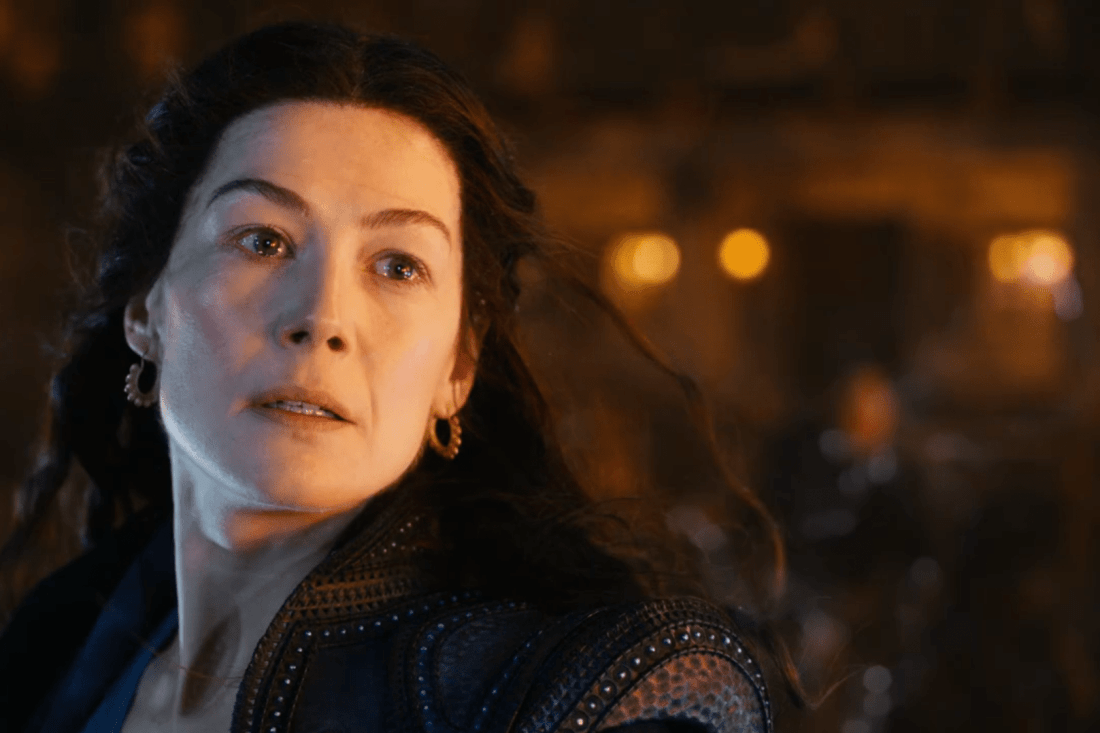
Directed by Uta Brieswitz, The episode opens with the Aes Sedai Moiraine (Rosamund Pike) and her Warder Lan (Daniel Henney) preparing for their journey to find the Dragon Reborn, the reincarnation of the man who caused the Breaking of the World and is prophesied to face the Dark One.
I, personally, did not really care for this opening because I think it would have been more interesting to slowly figure out why Moiraine is searching for this one person.
Plus, I think there was another scene that should have been the opening, which has not been shown yet, but that’s book spoilers. 

Kind of wish the show had more trust in the audience to slowly figure out things on their own rather than blatantly tell them.

Following this, we get a chase where two men are being pursued by a woman in red (Kate Fleetwood).
This woman in red, who is not named yet, is perfectly cast in my opinion.
Exactly how I imagined her from the book in all her cruelty.
We also get a good display of the madness the man suffers from, since his friend is revealed to have been in his head, before the women do something to him.
This is not shown and will likely be expanded upon later.
We also see that Moiraine and Lan were watching this happen and, unfortunately, this is the worst scene in all three episodes and it’s all because of one line.
Moiraine says they are going to continue their search at the Two Rivers because “there are rumors of four ta’veren there.”
This line makes absolutely no sense and opens a ton of plot holes.
It was just a really sloppy excuse to get them to go to the Two Rivers when the book justification for it was perfectly fine.
I will get into why this line is so bad in the book spoiler section.
The moment following this horrible moment, though, does a great job of respecting the lore, as we get a landscape shot as Moiraine and Lan ride off, showing what looks like remnants of destroyed buildings reclaimed by nature, showing that this is a post apocalyptic earth.
We then get the title, followed by the introduction to two characters, Egwene (Madeleine Madden) and Nynaeve (Zoë Robbins) at a river, where Egwene goes through a ritual to welcome her into the Woman’s Circle.
Following this, we get an introduction to Rand (Josha Stradowski) and his father Tam (Michael McElhatton), and also Perrin (Marcus Rutherford) and Mat (Barney Harris).
And this is the point where I praise the casting.
Even only after three episodes, I can definitely say that the casting directors chose the right actors to play these characters.
All of the performances are fantastic.
If I had to pick a favourite though it would be Barney Harris as Mat.
This sucks because he is being recast for Season Two for as of now unknown reasons.
Still, at least we have an entire season of his performance to look forward to.

I alrady like this Mat more than the one in the first few books.

Anyway, once the introduction to these characters has been done, we get the arrival of Moiraine and Lan.
The people’s reactions to Moiraine shows the fear towards the Aes Sedai in this world. 
A lot of people call this scene clunky but I did not have too much of an issue with it, personally. We then get a showcase of Rand and Egwene’s relationship, with them being romantically involved but there is also tension because of Egwene potentially becoming a Wisdom.

There is also a moment of Moiraine and Lan in a bathtub showing how close the Aes Sedai Warder bond is, with them being close but not in a sexual way.
All is not well, though, because we see the arrival of a mysterious and threatening figure in the night.
This is contrasted by the arrival of the cheery arrival of peddler Padan Fain (Johann Myers), as we get another look at the characters’ day to day lives.
We see Mat having to steal to provide for his sisters, Egwene telling Rand she has decided to become a Wisdom and Rand reluctantly accepting it, along with Moiraine subtly interrogating Nynaeve.
The latter scene involves a lot of great subtext, as we as the viewers can see that Moiraine is trying to gage Nynaeve’s candidacy for being the Dragon Reborn, while Nynaeve hits back with the story of the prior Wisdom who raised her, showing her fierce and stubborn nature.
Then, as Lan discovers symbols of a dragon fang made out of animal carcasses, he deduces that Trollocs are coming soon.
Sure enough, we get Winter’s Night, which is just as bloody as I expected it to be.
The moment Egwene started dancing with some random person and there were focuses on this guy, I was like, well, he’s gonna die.
Sure enough, an axe is thrown through his back, coming out of his chest, and the Trollocs invade.

Trollocs are amazing, some questionable CGI at times excluded.

Chaos ensues with great usage of shaky cam, as Egwene and Nynaeve take cover, Perrin and his wife Laila (Helena Westerman) shelter people at their forge, and Padan Fain leaves as the mysterious rider watches over the chaos.
We then get one of my favourite scenes of the episode, where Mat meets up with his terrible parents, only to learn that have lost his sisters.
After angrily demanding where they are, he runs through the bloody massacre in a thrilling tracking shot, all to find his sisters.
This is why I already like this Mat a lot better than the one in the first few books.
It wasn’t until Book Three that I came to like him but these first three episodes made him my favourite character in the show so far.
We then get a great fight with Rand and Tam being attacked by a Trolloc, with Tam retrieving the heron marked blade, a moment that gave me chills.
Tam’s fight with the Trolloc, short as it is, is enthralling and gives a really good sense of his experience with the weapon.
Unfortunately, the Trolloc wounds him and Rand has to save him before trying to get his father to safety.
Back at the village, the massacre is still ongoing, and a Trolloc runs up to kill Nynaeve and Egwene, Nynaeve meeting its roar with one of her own, which is a great moment for her.
Just as it seems they are done for, Moiraine and Lan arrive, killing many Trollocs, perfectly synchronised as an Aes Sedai and her Warder.

Moiraine and Lan working in tandem to defeat the Trollocs was a sight to behold.

It’s not just the action and choreography that are excellent here, but the music as well, especially with how it’s in the old tongue.
It’s not just Moiraine and Lan taking care of things, though, because we also see the Emonds’ Fielders fighting back, with a group of women taking down a Trolloc, showing just how tough Two Rivers folk can be.
All is not well, however, because Nynaeve is captured by a Trolloc and, in a brutal scene, Perrin gets so lost in rage as he kills a Trolloc that he accidentally kills Laila.
Is this a moment of fridging?
Yes, but it is sure to influence Perrin’s character arc in the future of the story.
Moiraine is also injured but pulls through in the face of a hoard of Trollocs, using much of her strength to throw chunks of buildings at them, eventually killing every last one.
Although, it is kind of weird how the Trollocs just walk towards Moiraine instead of rushing to kill her as they’re being slaughtered.
Another minor issue I had is that the Trolloc CGI could be a little off at times during the massacre.
It was mostly good CGI though.
Most of Winter’s Night was pretty on point, being a horrifying display, as it should be.
Then we get the last scene of the episode, as Rand arrives with Tam who Moiraine heals, before revealing that the Trollocs are after Rand, Egwene, Mat and Perrin because of them is the Dragon Reborn and they need to leave if they want to protect their families.
This moment is a little quick for my liking but it is serviceable.

I feel like we could have used a bit more time to see the characters leaving the Two Rivers.

Although I do like the episode overall, it does rush in quite a few places, so I wish this episode had either been extended or divided into two.
At least it ends with the iconic narration “The Wheel of Time turns and ages come and pass, leaving memories that become legend. Legend fades to myth. And even myth is long forgotten, when the age that gave it birth comes again. In one age, called the Third Age by some, a wind rose in the mountains of mist. The wind was not the beginning. There are neither beginnings nor endings to the turning of the Wheel of Time. But it was a beginning.”
All in all, “Leavetaking” was a good beginning to The Wheel of Time show.
It does have its issues, and does not quite live up to some of the story’s version of events, which I will get into in the book spoiler section below, but it is still a good start that had me excited to watch the other two episodes. 


Book Spoiler Section:
So, first I will get into why that scene where Moiraine says “there are rumors of four ta’veren” is such a terrible moment.
As I said, it raises many questions and plot holes, one of the biggest of which is just who in the light started these rumors and how they knew about Rand, Egwene, Perrin and Mat being ta’veren?
Ta’veren are extremely rare so it would take someone with a large amount of knowledge about them to recognise that Rand and the others were ones.
Not only this but why would someone so knowledgable spread rumors about the ta’veren?
Ta’veren are people who the Wheel of Time weaves into changing the world, so wouldn’t this hypothetical person who spread the rumors tell someone important about them rather than just telling random people?
Most baffling of all, how would this person even recognise Rand, Egwene, Perrin and Mat as being ta’veren in the first place?
Even if they were knowledgable about them, Rand and the others are showing no signs of being ta’veren at this point.
Look at Mat, for example.
Him being a ta’veren makes him extremely lucky, and yet in the episode he is shown to have terrible luck at this point, losing a gambling match.
What knowledgable person would look at Mat in that scene and go, “yep, that’s a ta’veren if I ever saw one!”
See what I mean?
They should have just used the book explanation that Moiraine and Lan tracked them all down after years of hard work, rather than a rumor that makes zero sense when you consider what being a ta’veren is.

Amazing how one line of dialogue can create so many plot holes.

As for other changes, I was a bit disappointed that the prologue which introduced Lews Therin, the original Dragon, and showed his death creating Dragon Mount was not the opening to the show.
That would have been a lot better than the opening we got where Moiraine just says exposition about what their mission is.
There are other things I wanted to see, like Rand and Tam’s discussion, Rand learning he’s not Tam’s son, Moiraine posing as a noble lady rather than an Aes Sedai to get more information.
I do get why some of these were not included though, most of all Rand learning he was adopted because they’re clearly trying to keep the Dragon Reborn identity a mystery.
It’s also pretty clear they’re using Egwene as a red herring before they reveal Rand is the Dragon Reborn, as can be seen when they cut to Egwene after Moiraine talks about who it could be.
As for Rand and Tam’s discussion, although I did miss it, I can’t deny that it’s replacement was fantastic, with it feeling so much like a reference to the ending of The Gathering Storm, a beautiful piece of foreshadowing whether intentional or not.
Other changes include Rand and Egwene being romantically involved, rather than just interested in each other, Mat’s parents being jerks and Perrin having a wife and then killing her.
When it comes to Rand and Egwene’s relationship, I think this works because it could make what comes after for them in the future of the story more meaningful and impactful.
For the Mat change, I actually like this because it gives Mat much more depth than in the books at this point, which he really needed.
As for Perrin having a wife and killing her, I think they added this to make his aversion towards his eventual wolf powers make more sense and feel fleshed out.
There is also am interesting theory about Laila being a Dark Friend, since she had her weapon raised when Perrin accidentally killed her.

It will be interesting how this massive change to Perrin’s character influences him in the show.

Another thing I wanted to mention in the spoiler free section but could not was Padan Fain.
They did a great job of hinting at his menacing nature.
I absolutely loved how we got the introduction to the Mydraal with the sinister music, only to cut to Fain whistling that tune as he enters Emond’s Field.
I’ve found Fain to be a bit of an annoying gimmick villain after Book Two, so I hope the show improves on him, like they are so far doing with Mat.
Overall, I like some of the changes and I dislike some of the changes.
“Leavetaking” is still a good episode and the next two are even better.          


Talentless Nana Chapter 67, Beginning of the Revolution Review: It Finally Happens.

I have been keeping up with the Talentless Nana manga, created by Looseboy and illustrated by Iori Furuya, ever since I finished the anime. 
While I have been enjoying the story, for the most part, I did feel that the plot was beginning to get a bit dragged out. 
Nana was constantly being framed for crimes she did not commit, followed by her innevitably proving her innocence, and there was even a cliffhanger where she promised to tell Kyoya everything… only to not tell him everything.
With moments like these, it made me wonder how much more story we would have to go through before Nana finally admitted to her crimes and we got to see some substantial fallout from that.
Well, turns out, we did not have to wait long.
I knew I was in for a treat as soon as I saw the title of this chapter, “Beginning of the Revolution”, an on the nose title that perfectly represents the events of the chapter both in reagards to Nana’s beginning revolution against Tsuruouka and Tsuruoka’s fake one to justify taking out the Talented. 
Chapter 67 begins with Moe having a dream about her grandmother, finally coming to terms with her death, saying she now has a vague sense of what life is about. 
Nana’s efforts to keep Moe from killing and to protect her have really paid off and this is further confirmed when Moe wakes up in the hostpital and Nana affirms their friendship. 
However, despite this happy start, “Beginning of the Revolution” quickly follows this up with an event that will clearly shape the story for some time. 
The cliffhanger from the last chapter was Nanao arriving to free Soma, and we get the payoff for that here, in gruesome fashion for Soma. 
After questioning Soma on his “friendship” with Saijo and the nature of his Talent, Soma admits that it would be dangerous to use his electricity talent in this room because it could cause a “phreatic explosion.”
Nanao says he wants Soma to do it and Soma calls him an idiot because that would kill them both. 
Unfortunately for Soma, this is exactly what Nanao wants, minus the killing himself part, just Soma. 
Using his Talent, Nanao orders Soma to create this phreatic explosion and cause a major incident to frame the Talented, which is Tsuruoka’s plan, before he leaves Soma to die. 
Soma can do nothing but scream for help as he activates his Talent, sealing his fate.
Before we see the result of this act, however, we get the moment Talentless Nana fans have been waiting for forever: Nana’s confession. 
Kyouya, Fuko, and Sachiko are wondering why no police invesitgation has been opened up for the numerous murders, including Saijo’s, and Kyouya speculates that the military actually approves of them killing each other. 
Nana then marches in and announces that he is right stating, “Talented individuals are the ‘Enemies of Humanity.’ They should be killed off secretly.”
I got chills when I read this moment. 
For so long, I and many others had waited for the moment when Nana would confess her to murders and how the military wants to kill all of the Talented and she finally did it. 
She leads them all outside and gives a full confession, even taking the blame for Ryuji’s death by creating the environment where was killed, which I never thought of. 
Fuko and Sachiko are stunned by this, but Kyouya is as level-headed as ever, taking control of the situation by deducing that Tsuruoka put Nana up to murdering the Talented. 
Nana, relieved that Kyouya believes her, offers to tell everyone else about her crimes to get them to evacuate, however, Kyouya points out that they are more likely to swarm her and order her execution for everything she did. 
With a panel above showing all the people she murdered and whose deaths she indirectly caused, Nana says she knows this but still looks determined to risk it to protect the other Talented students, showing just how far she has come since the beginning of the story. 
Kyouya considers this and then agrees to work with Nana, not because he is on her side, but for the good of all. 
They will not have to work alone though because who should show up but none other than Jin, who followed them as a cat before revealing himself. 
He tells Kyouya and the others that he can testify about the military’s crimes because of what he went through five years ago. 
Kyouya and the others are naturally shocked to see Jin appear as if from nowhere, but what I find most interesting is the actual first interaction between Kyouya and Jin… well, their first interaction where Jin isn’t disguised as a cat.
The reason I was excited to see these two meet is because I am a firm believer in the theory that Jin is secretly Kyouya’s sister. 
We know that Jin is not who he appears to be, due to him keeping the real Jin safe because he is in a coma.
So, since Jin’s identity has been built up as a mystery, he is most likely someone important, like Kyouya’s sister.  
There have even been some signs that Jin is actually a girl, like when he jokingly asked Tsuruoka if he was inviting him on a date in their first interaction, and he refrences religion a lot, just like the girl in his story who killed people for religious reasons. 
Ignoring this, the only other person Jin could be that would have a significant impact on the reader is Nana’s brother but Jin actually mentions him in this chapter, telling Nana he found out some information about him, so that would seem to eliminate that theory. 
Speaking of Nana’s brother, though, we will have to wait to find out exactly what it is that Jin discovered about him because, before he can say, he is interrupted by the massive explosion caused by Soma.
The blast is so huge that it looks to have taken out some of the city as well. 
So Nanao has graduated from killing Talented people, to apparently innocent civilians as well, which is way worse than anything Nana did, so it will be interesting to see how Nana reacts to have causing Nanao’s descent. 
Just as Nana realises that the explosion came from the warehouse Soma was kept in, Tsuruoka arrives, declaring Nana a suspect in this terroist act and placing her under arrest, ending the chapter. 
This was a great cliffhanger, unveiling Tsuruoka’s plan to frame the Talented for a terrorist attack to get the public on the side of executing them all so they won’t have to do it covertly anymore. 
Sure, this is yet another instance of Nana being framed for something she did not do, but at least it has the variety of coming with her confession to the crimes she did commit and this being the biggest framing of all, considering its for a terrorist attack not just murder.
I wonder if this will end in a fight with Nana and the Talented against the soldiers, or if Nana will go quietly, giving her allies the chance to escape? 
Either way, it really feels like we are approaching the final arc of this story, if we’re not in it already.
Nana has confessed to her crimes, Jin has also introduced himself, and Tsurukoa and Nanao have initiated their master plan to frame the Talented for a terrorist attack. 
I am eagerly anticipating the next chapter after all of this,  

Parasyte: The Maxim, Review: Are You Really Izumi Shinichi?

I remember when I first got into anime years ago and one of the shows I considered watching because of the praise it recieved was Parasyte: The Maxim.
I intended to watch it but I got so caught up watching other anime that I eventually forgot all about it, until it was chosen at the anime club I go to.
It was not long ago that we finished the final episode and I have a lot of thoughts about the whole series.
Parasyte: The Maxim is directed by Kenichi Shimizu, and is a modern adaptation of the manga Parasyte by Hitoshi Iwakka, which ran from 1988 to 1995.
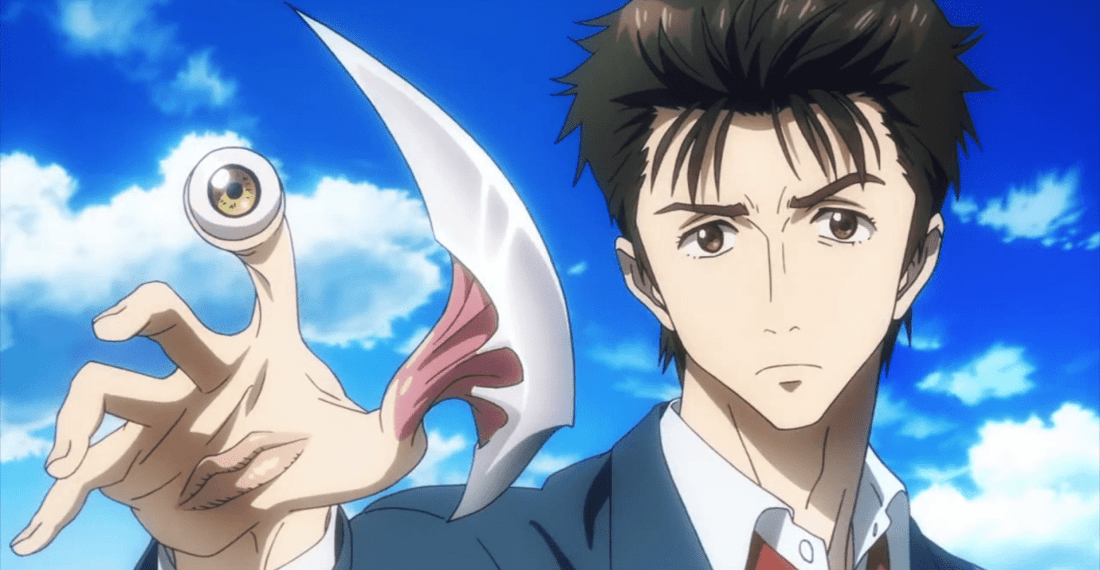
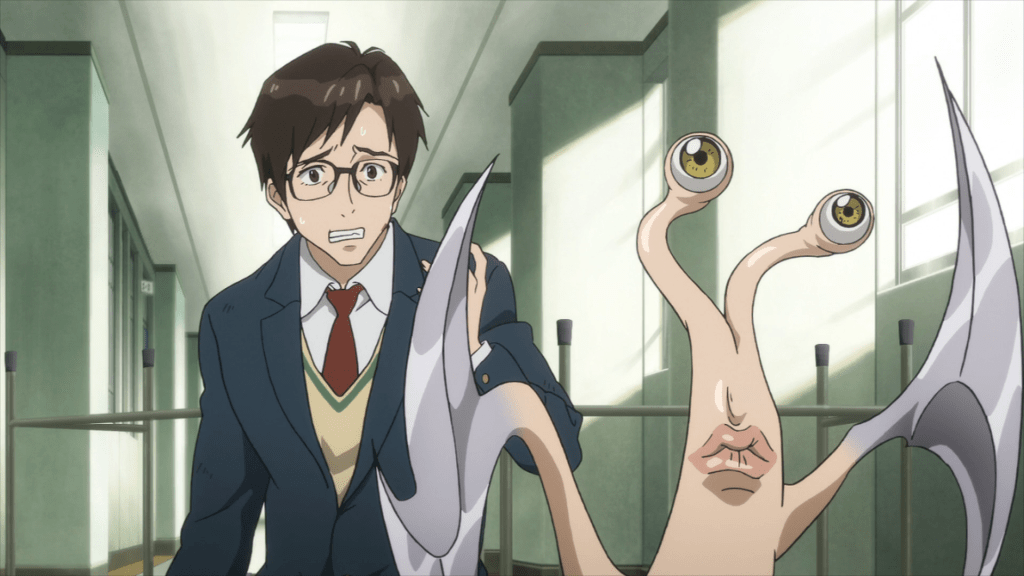
The story follows high school student Izumi Shinichi (Nobunaga Shimazaki), who wakes up one night to discover a strange alien-like worm burrowing its way into his arm and moving towards his head.
In a panic, he cuts off the circulation in his arm, causing the worm to settle there and eat it, taking its place as the Parasite Shinichi names Migi (Arya Hirano).
However, Shinichi has very little time to deal with the new guest in his body before Migi makes him aware of other Parasites, ones who successfully took over their hosts’ brains and are now regularly feasting on humans.
Viewing the two as a threat, the Parasites go on the attack, forcing Shinichi and Migi to work togethor in a tense partnership that draws many of the people Shinichi cares about into the bloody crossfire.

Shinichi and Migi battle multiple Parasites across the series, each more dangerous than the last.

This reluctant alliance between the human and Parasite grows magnificently across the story, with both Shinichi and Migi getting some excellent development, as Migi becomes more human and Shinichi less so, much of which ties into the themes of the story about what being human is and the effect we have as a species on the planet.
It is not just Shinichi and Migi who are interesting though, because there are also a plethora of interesting supporting characters, like the Parasite Reiko Tamura (Atsuko Tanaka) who’s growing humanity was engaging to see progress.
Of course, with quite a few characters in such a bloody series, it is inevitable that many of them do end up meeting tragic ends, creating numerous emotional and gut wrenching scenes… unless the character is being stupid.
I say this because Parasite is a show where a few of its supporting cast make excellent candidates for receiving the Darwin Award.
Seriously, the decisions some of these characters make are the most idiotic I have seen in a show. 

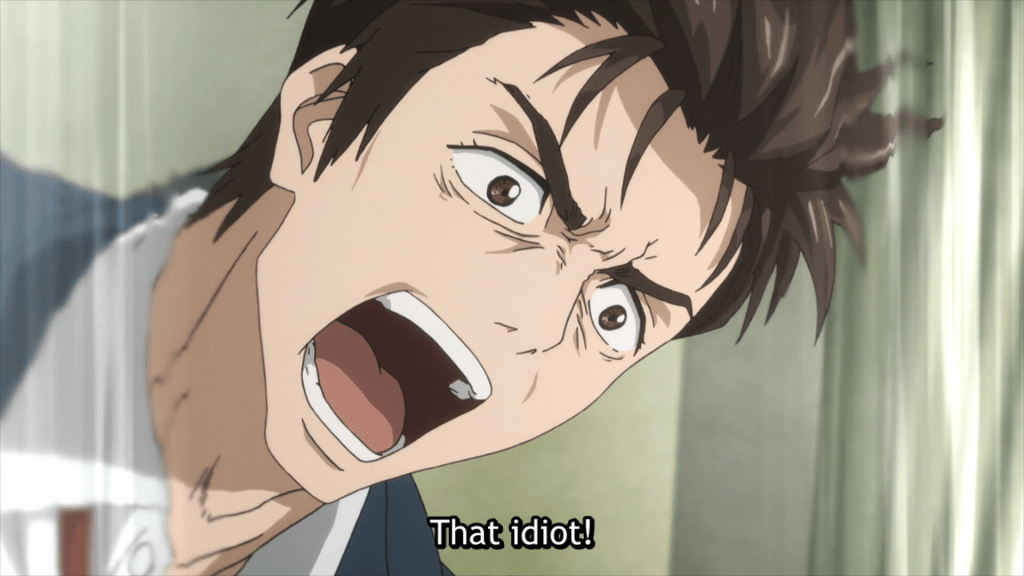
Yes, I agree Shinichi. Yuko really is an idiot.

Thankfully, these instances of stupidity, although extreme when they do happen, are few and far between and it do not come from Shinichi or Migi.
No, these two remain consistent in their intelligence and development, as they take on their opposing Parasites in many well done fight scenes, accompanied by a good score and animation.
This quality extends to the OP as well, Let Me Hear by Fear, And Loathing in Las Vegas, which was such a great choice because the lyrics coincide perfectly with the events and themes of the show all the way to the end.
Speaking of that ending, there is one aspect of it I am still a bit unsure of and this is the resolution to Shinichi and Migi’s relationship.
It just felt a little abrupt to me and I think it could have used a bit more time.
Otherwise, I actually loved this ending.
The final conflict Shinichi has was one I did not expect but I think it made perfect sense with the story’s themes about human nature.

I don’t think the final conflict of the story could have been done better to be honest.

Overall, all of this adds up to anime which does live up to the hype behind it.
There are some issues, like characters occasionally making absurdly stupid decisions and part of the ending feeling a bit rushed. 
However, the rest of it more than makes up for these minor problems, presenting an anime that has intriguing themes and a compelling dynamic between its two main characters.

To Your Eternity Review: A Bleak, Beautiful Masterpiece.

I had heard how emotional of a ride To Your Eternity was before watching it, but I only became aware of what I was getting into when I heard that the manga which the anime is based off was written by Yoshitoki Ōima, the writer of A Silent Voice.
I still find myself rewatching the anime adaptation of A Silent Voice from time to time and I always cry at certain points, whether its tears of joy or happiness.
So, I knew coming into To Your Eternity that I was probably going to end up crying… I was still not prepared.
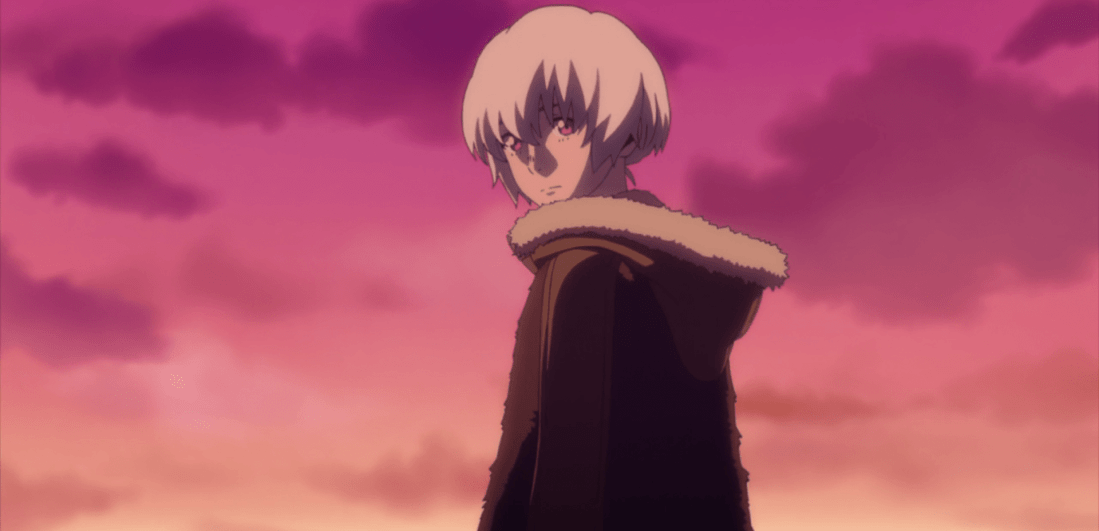
Directed by Masahiko Murata, To Your Eternity begins with a seemingly cosmic being (Kenjiro Tsuda) releasing an orb which can take the forms of those it encounters to earth.
At first, the orb takes the form of a mere rock, until a dying wolf stumbles across it, and the orb takes the wolf’s form, then coming across the young man who the wolf belonged to.
And so begins the orb’s journey to learning what being human means in all of its beauty and suffering. 

The meeting between the orb and the boy begins this emotional, tragic adventure.

Eventually being given the name Fushi (Reji Kawashima), the orb encounters many different people over the years, from the young March (Rei Hikisaka) and her sister-figure Parona (Aya Uchida), to the masked Gugu (Ryoko Shiraishi), to the elderly Pioran (Rikako Aikawa).
Each of these characters leave an impact on Fushi’s immortal life, leading to many tear inducing moments when some of these characters meet tragic fates.
What makes it hurt all the more is how excellent these characters are.
Even the ones I was sure I was going to hate, like Pioran and Tonari (Eri Ingawa), I came to love.
Except for Hayase (Mitsuki Saiga), that crazy witch can burn in the pits of hell and you will certainly agree with me on that when you see the horrific things she does.
Although, we are supposed to despise her so she makes for a great villain.
The characters whose stories affected me the most emotionally would definitely be Gugu and Pioran.
Their stories are beautiful and tragic, resonating greatly with me.

Gugu’s story made me tear up multiple times. His was by far the most hard hitting story for me.

In fact, every storyline resonated with me, that is how great To Your Eternity is.
I already consider it to be a masterpiece because of that and how it gave me so many feelings.
The only criticism I even have is that the OP, “Pink Blood” by Hiraki Utada, does spoil some big events that happen, especially later on.
This does nothing to affect the show’s quality, though, and the OP itself is great.

Although the OP does have spoilers, it also has many fantastic subtle hints at what will happen, creating a much bigger gut punch when you realise the context.

Along with this, the score and animation are also quite good and there was never a moment where I was brought out of a scene.
No, I was gripped from beginning to end through all twenty emotional, gut punching episodes.
I cannot recommend To Your Eternity enough.
Just be prepared to cry until you’re all out of tissues when you watch this masterpiece of an anime. 
Season Two cannot come soon enough.

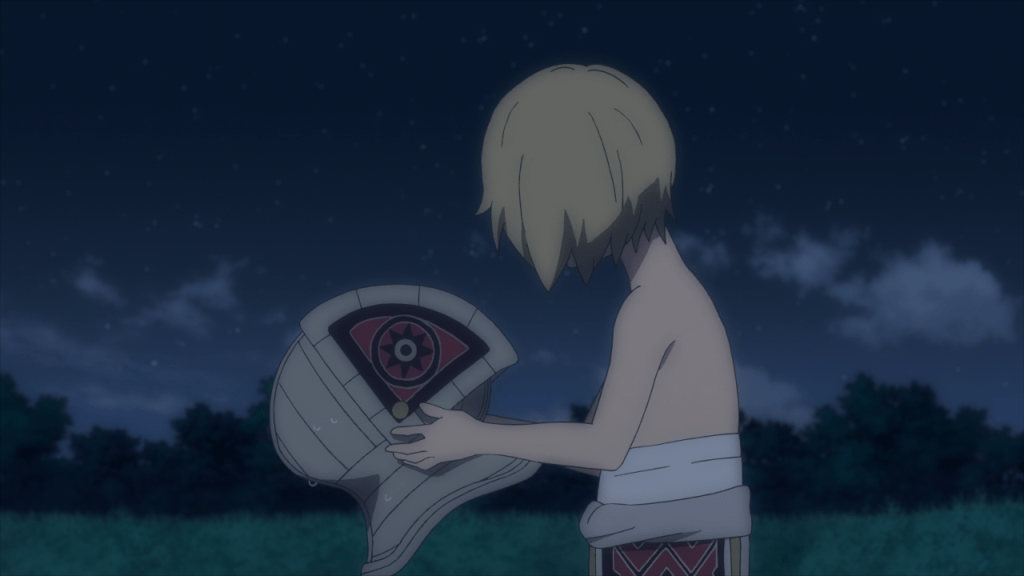
Overlord Anime Review: How to Take Over the World… Unintentionally.

After watching and loving Tanya the Evil, I decided to be more open to watching isekai’s and my first stop was Overlord.
I had actually tried watching this anime about a year or so ago but, for whatever reason, only got to episode three before I gave up.
This time, I actually committed to watching all three seasons and I enjoyed each one.
Adapted from the Light Novel by Kugane Maruyama, and directed by Naoyuki Itō, Overlord follows the story of Satoru Suzuki (Satoshi Hino), a salaryman in the future who is playing his favourite video game YGGDRASIL on its dying day.
Role playing as the skeletal overlord Momonga, Satoru decides to stay logged in until the game shuts down for good, only for him and the game’s NPCs from his tomb of Nazarick to be transported to another world.
Trapped in the body of his player character, Satoru takes on the name of his guild, Ainz Ooal Gown, and seeks to spread his name throughout this new world in the hopes of discovering other players trapped with him.
It’s just too bad that the NPCs, now very real monsters, see this as an attempt at world domination and now Ainz has to act like he is this all knowing overlord to keep their trust.
This makes Overlord different from many other anime out there because our main characters are quite literally evil.
And by “quite literally evil” I don’t mean, “oh, they’re just morally grey characters.”
No, what I actually mean is, “Jesus Christ, Ainz! Did you really have to go THAT far?”

That said, I am surprised that many people were surprised by the terrible things Ainz does in the third season, when he had been doing terrible things in the first two as well.

It’s a good thing that many of our central characters are so entertaining because, if they weren’t, then we would hardly be able to stomach their evil acts.
There’s Demiurge’s (Masayuki Katō) constant and humurous overestimating of Ainz’s abilities, Albedo (Yumi Hara) and Shalltear Bloodfallen (Sumire Uesaka) fighting over Ainz, Cocytus’ (Kenta Miyake) warrior code, and Sebas (Shigeru Chiba) the butler who is the one good guy of the bunch.
All of these characters are incredibly overpowered, which could have been a big problem because, in most shows with characters like this, their power makes it obvious that they will win any fight they have, resulting in zero tension.
However, because of the characters’ evil status, this is not the case with Overlord, though, as the ones our main characters face off against actually are good people and likeable.
Thus, the tension of these fights come not from us wondering if our main characters will win, but through us wondering if the likeable side characters will survive.

Every time a relatable character goes to fight Ainz, you will find yourself hoping that someone or something can come along to save them.

Despite the overpowered characters not being an issue because of how their fights are handled, I do hope that in the future of this story there is a point where Ainz has to actually struggle in a fight, without secretly having it all in the bag.
Maybe he could finally come across another YGGDRASIL player trapped in the world with him and they could offer him a real challenge?
Well, even if that does not happen, at least there will still be the entertaining characters with great humor accompanying Ainz’s continued unplanned takeover of the world.
These elements really do hold the show together though because the animation is nothing special.
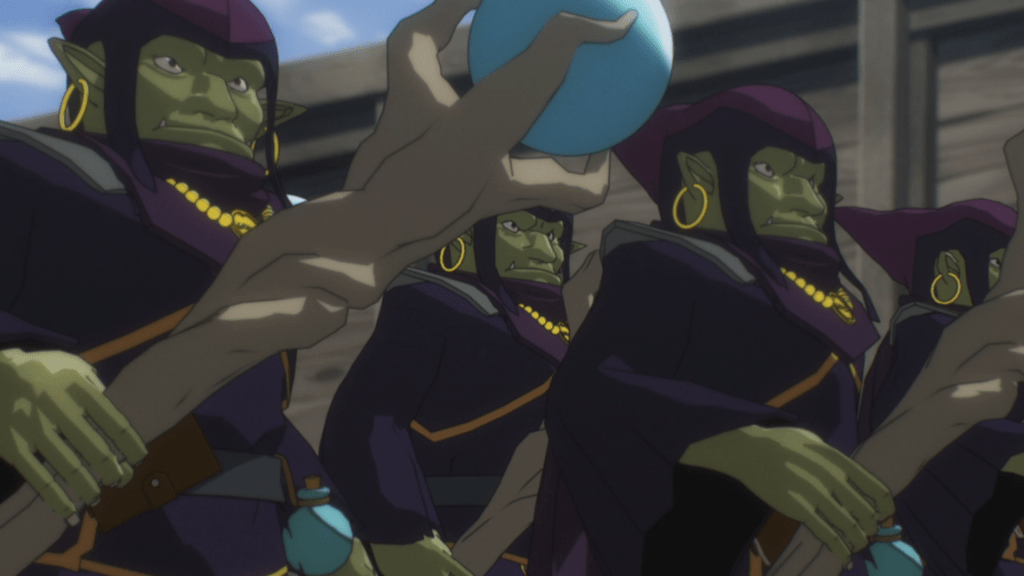
It’s usually pretty good but there are some atrocious instances of CGI, especially in the third season.

Please. No more CGI goblins in the fourth season.

One thing that stays consistently great about Overlord, though, is its openings.
“Clattanoia,” ‘Go Cry Go,” and “Voracity” are all top notch openings that do a great job of showing what you can expect from their respective seasons.
I’m glad I picked up Overlord again.
I may have given up on it the first time after episode three, and I also felt like the first season did not grab me very well, but from season two onwards it’s been an enjoyable time.
Fingers crossed that Season Four can be just as good when that arrives, maybe with some improved CGI too.

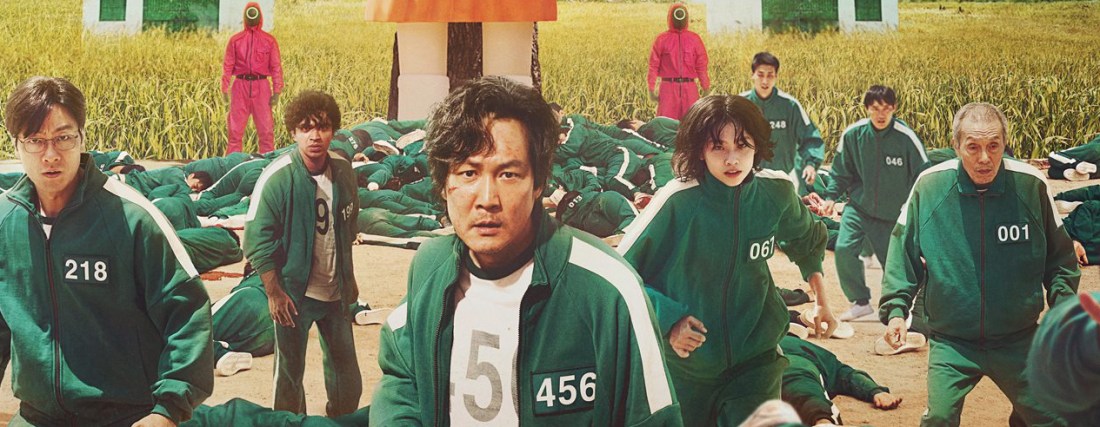
Squid Game Review: Most Intense Show I’ve Seen in a While.

I doubt there’s anyone who has not at least heard of Squid Game yet.
The South Korean series, distributed by Netflix, has become a worldwide phenomenon, in the short time since its release.
This review is probably not going to be any different from the numerous other ones you may have heard, heaping praise upon the show.
However, like many other viewers, I was so enthralled by Squid Game that I couldn’t just not talk about it.
Created and directed by Hwang Dong-hyuk, the series begins with Seong Gi-hun (Lee Jung-jae), a gambling addict, who is in debt to loan sharks, desperately trying to salvage his relationship with his daughter who lives with his ex-wife.
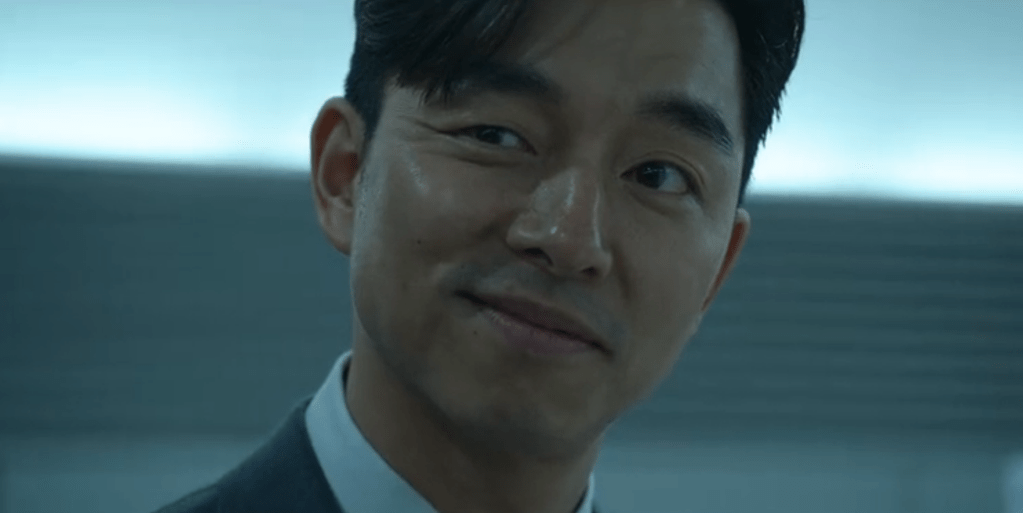
After a strange encounter with a salesman (Gong Yoo) at a train station, Gi-hun is invited to take part in a series of children’s games where the winner will win a substantial amount of prize money.
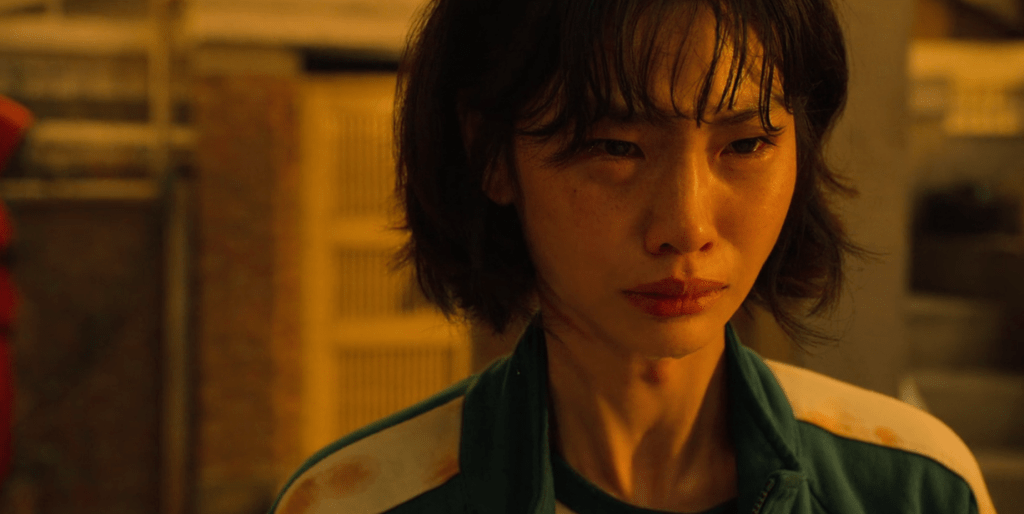
Joining him in the games is Gi-hun’s childhood friend Sang-woo (Park Hae-soo), an elderly man with a terminal illness (O Yeong-su), the good nautred Pakistani Ali (Anupam Tripathi), North Korean refugee Sae-byeok (first time actress Jung Ho-yeon) , murderous gangster Deok-su (Heo Sung-tae), and 450 others, who also all have crippling debt.
However, the supposed kids games take a turn for the horrifying when the players learn the hard way that this is a death game, where most of them will probably be “eliminated” by the guards for losing before all six challenges are completed. 

Gi-hun and the 450 players will have to survive first if they want a chance to win the prize money.

And so begins the desperate struggle of the players to survive and win, with numerous instances of heartbreak and betrayal.
Squid Game is, without a doubt, one of the most intense experiences I have had with a show.
Almost every single episode had moments that left me shaking with anxiety out of fear for what could happen to these characters.
Speaking of, the characters are another thing this show excels at.
I came to care about so many of them, including some of the ones who are only around for a few episodes.
Even the characters you are supposed to hate are well written, with me literally screaming at the TV in disgust at their actions a few times.
They are all just so well crafted.
Squid Game may be centered around the death game, but it is the character drama that is the heart of the show.
This brings us to episode six, “Gganbu,” which I am sure we can all agree is the best episode of the entire series.
It is an absolute masterpiece that left me an emotional wreck after it was all over.

Be prepared to cry when you get to episode six of Squid Game.

It’s not just episode six, though, because all nine episodes are incredibly well crafted, with numerous excellent examples of foreshadowing and symbolism that make it great for a rewatch.
Apparently, Hwang had been trying for well over a decade to get approval to make Squid Game and, in my opinion, this was a good thing because it allowed him to plan out his story expertly.
The end result is various reveals that recontextualize a lot of moments as the story goes on, which left me feeling shocked and sometimes even betrayed (in a good way).
Accompanying this is the excellent commentary on capitalism, which South Korea just seems to be the best at, considering how well this commentary has been handled in other shows and films from the country, like the Best Picture winning Parasite.
Then there’s the score by Jung Jae-il, which is also great and helps improve on the already emotional and intense scenes.
It’s not all perfect though because there are a few hiccups here and there.
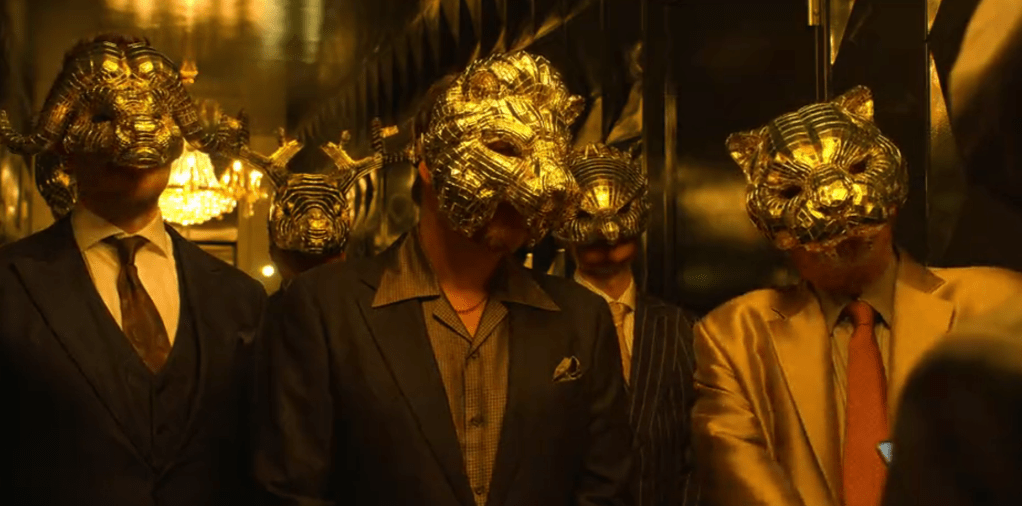
The most obvious issue, which is something everyone else has criticized, is the acting of the VIP characters.
I’m not sure if it’s the actors or the direction they got but their parts were mostly atrocious, with awful acting and dialogue.

The VIPs are easily the worst part of Squid Game.

Although, I’m sure our reactions to the VIPs are how most foreign viewers react whenever an English speaking film has someone acting in their language terribly.
Another thing I have seen people criticizing is the final episode, Episode Nine, “One Lucky Day.”
Honestly, I wasn’t sure how I felt about this ending at first either, however, after thinking about it and hearing other interpretations of the ending, I actually came to enjoy it quite a bit.
There’s plenty of foreshadowing for what happens and it stays consistent with the characters and their progression, while leaving the story open for a season two.

The ending of Squid Game is certainly not a happy one, although concerning the subject matter it is rather fitting.

Some are already eagerly anticipating this potential second season, while others are afraid they might ruin it if they continue.
Personally, I will be okay if they decide to leave it at one season but I do also want another one just to see where they will take it all from here.
A second season is almost guaranteed at this point, though, because of how high the viewership for this has been.
Squid Game is a fantastic show, despite a few issues, and it made me experience so many emotions throughout.    

Vivy: Fluorite Eye’s Song Review: What it Means to Sing With Your Heart.

The past year has sadly not been kind to the great WIT Studio.
Apparently they have lost 501 million yen, or 4.5 million dollars, in the fiscal year.
This is extremely unfortunate when you consider not only what they have put out before, like Attack on Titan for example, but also what they put out after such a loss.
One of these anime was Vivy: Fluorite Eye’s song, probably one of the year’s best anime.
Created by Tappei Nagatsuki and Eiji Umehara, the story is set in a world where AI technology has progressed to the point that many of them appear human.
One of the most advanced AI is Diva, called Vivy (Atsumi Tanezaki) by one of her young fans, and her reason for existing, or her “mission” as the AIs call it, is to make people happy with her singing.
However, this may not be so simple because she suddenly finds herself being recruited by an AI named Matsumoto (Jun Fukuyama), who was sent from the future to stop an AI takeover where all of humanity was slaughtered.

Preventing rogue AI from killing all of humanity is hardly an original concept, but Vivy: Fluorite Eye’s Song tells it extraordinarily well.

Reluctantly joining Matsumoto, Vivy goes on a series of missions to prevent the AI uprising and learn what it means to sing with your heart, all in the span of 13 amazing and emotional episodes.
What makes these episodes so great is how they not only build upon Vivy’s character, and her growing partnership with Matsumoto, but also develop the many different side characters in their own side narratives, whether they be human or AI.
The emotion produced from these scenes is helped by the excellent animation and soundtrack.
This standard of animation also extends to the action sequences, which are nothing short of spectacular, with their constant fluid movement.

If you pause at any point in an action scene of Vivy, you will most likely find plenty of detail, showing how much effort was put into animating all of this.

As for the soundtrack, there are many amazing songs that I have found myself constantly listening to ever since I finished the show.
From the OP “Sing My Pleasure,” to its counterpart track by Grace, to the titular “Fluorite Eye’s Song,” which got me tearing up when I finally heard it.  
All of this combines to create a spectacular anime that I would highly recommend.
I cannot think of a single weak episode among the lot.
They all either bring an emotional moment or an interesting twist to the story, with fantastic development for Vivy, Matsumoto and the side characters, alongside an excellent soundtrack and vibrant animation.

Vivy: Fluorite Eye’s Song is a complete package anime. I’d call it a masterpiece.

I hope that Vivy: Fluorite Eye’s Song can help get WIT Studio’s profits up, along with whatever anime they go on to produce in the future.
Check out this emotional rollercoaster ride of an anime if you have not already.   


Berserk Chapter 364, A Tear Like Morning Dew Review: The Final Chapter(?).

When I first read Kentaro Miura’s Berserk and reached Chapter 363, I remember excitedly going to read the next chapter, only to realise it was the last one released before Miura’s tragic passing.
I was sad to see that I and many other fans would not know how Miura intended to continue the story, especially after the cliffhanger of the Moonlight Boy meeting Guts again.
This is why I was very excited to hear that there was one final chapter Miura completed that would be released, Chapter 364, “A Tear Like Morning Dew.”
After eagerly anticipating the chapter for a while, I finally read it and am pleased to say that what may be the final chapter of Berserk we ever get did not disappoint.
Picking up from the end of the previous chapter, “A Tear Like Morning Dew” begins with the first of many father and son antics, with the Moonlight Boy instantly climbing atop Guts’ Berserker Armour to rest on his head.
Guts brings him inside so he can be with Casca and what follows is a humorous sequence where Schierke mistakes the child for a disguised Danann.
The face she pulls when she realises she was wrong is so comically out of place with the rest of Miura’s artwork that it heightens the comedy of the moment.
After this scene, we get our reunion between Casca and the Moonlight Boy, only now Casca has all of her memories.
The connection between the two is obvious and Danann quickly picks up on it, along with the boy’s connection to Guts.
The following panel of Guts sitting outside while everyone reunites with the Moonlight Boy is both beautifully drawn and also highlights his purposeful distance from Casca, due to her trauma, as illustrated by the bottom panel of Casca lying in bed with the Moonlight Boy, seperated from Guts.
Once this distance is illustrated, we get many more wholesome moments between the seperate parents and their child, as Casca continues to bond with him while Guts trains.
This training does not last though because the Moonlight Boy quickly interrupts, sneaking into Guts’ Berserker Armour in a downright adorable moment.
After helping the boy out of the armour, Guts then leads him back to Casca, telling him to go be with them, once again keeping a respectful distance from Casca.
Their relationship is truly tragic and it is a sad thing we may never know how it ends for them.
Even sadder is the scene that follows, the final scene of this potential final chapter, which serves to punch us all in the gut.
This is Berserk after all, so we all knew there just had to be a catch to the numerous wholesome scenes with the Moonlight Boy in this chapter.
Turns out that catch is the brutal confirmation of the theory that the Moonlight Boy and Griffith are connected.
As Casca has a dream remembering her connection with her mutilated ghost baby and how this saved her during the Conviction Arc, she seems to awaken with a realization and runs outside to see Guts standing before the Moonlight Boy.
The child begins to speak, however, as he does so, their body begins to change.
“I had a dream. Under the fool moon, I was a child embraced by a nostalgic warmth. But when I wake from the dream, only a vague sense of longing remains… that too, will soon disappear… with a single tear like morning dew.”
With these fittingly poetic lines, the speaker turns, revealing the Moonlight Boy to have transformed into a Griffith, tears spilling from his eyes, bringing the chapter and potentially the story of Berserk to a close.
This was a fantastic chapter, full of both wholesome moments and gut punches.
If it really is the final chapter of Berserk, then I think it is a fitting one.
Is it frustrating for it to end on such a massive cliffhanger?
Certainly, however, it is important to take into account whether this story should continue without Miura’s guidance.
What were his wishes concerning the future of the story in case of his passing, if he had any, and will anyone be able to take over the story until its conclusion?
It is not unheard of.
For example, Brandon Sanderson took over the Wheel of Time after Robert Jordan’s unfortunate passing due to a terminal illness.
Maybe there is someone who could take over Berserk and end it for Muira.
Again, though, Muira’s wishes do need to be considered here first and foremost.
He is the creator of Berserk and his wishes for his series should be respected.
Whether this magnificent story ends here or continues, “A Tear Like Morning Dew,” is yet another brilliant Berserk chapter and Muira deserves all the thanks for gifting this great story that has influenced so many other creators.

Choujin X, Chapters Eight and Nine Review: Dreams of the Choujin.

Chapter Eight: My Benefit.
The eighth chapter of Sui Ishida’s Choujin X, “My Benefit,” is another solid chapter that picks up well with the aftermath from Tokio and Ely’s fight with the Snake Choujin, Nari.
It starts off by immediately dismissing my theory that Tokio’s name being mistaken for Zaven in the last chapter would allow him to hide his true identity from the Choujin organization, while continuing to help them.
It actually turns out that whole Zaven thing was just a gag because the organization of Yamato Mori knows who Tokio is and have given him the story that he is now a witness for a secret agent, so his family and people at school will not learn that he is a Choujin.
The only one who does know from Tokio’s life is obviously Azuma, who takes the time to apologise to Tokio for yelling and not helping him when he needed it.
Tokio forgives him and admits Azuma was right about him constantly relying on people.
Things seem good between the two but the next panel displaying the light reflecting off Azuma’s glasses, hiding his eyes, does raise some suspiscion.
I wonder what is truly going through Azuma’s head?
After this, Tokio goes to Yamato Mori to learn about his registration.
It’s here that he meets up with Ely and two other Choujin, Simon Kagomura, who was the Choujin who saved them from Nari last chapter, and Maiko Momoma, the woman seen with Ely in the last few chapters but who had her face hidden previously.
The two inform Tokio and Ely about the registration system.
Simon and Maiko, along with others at Yamato Mori, have Class A registration, meaning they can use their powers for research or the betterment of society, like protecting people from Choujin attacks like Simon did with capturing Nari.
Tokio and Ely are about to receive Class B registration, which will only allow them to use their powers if they or others are in danger, or by accident since Choujin powers are connected to emotion.
Tokio does express some interest in getting Class A registration but Simon’s scolding gets him to meekly relent.
We then get our first look at Maiko’s powers when she uses super strength to clear a fallen tree.
She makes Tokio and Ely look away when she does this though, so she must be shy about it for some reason.
Either that or there is a practical reason for her trying to hide her power, which could be revealed later.
Following this, Tokio and Ely are interviewed by Sandaq, who drills them on what they consider to be good and evil, and who they consider their allies and enemies to be.
He then hits them with the impotant question that shapes the chapter and possibly Tokio’s life going forward: what do they hope to benefit from their lives?
For Ely, the answer is easy: money.
That’s right, we got another Ochako Uraraka on our hands here.
Although, the dream for money to make them and their loved ones happy is pretty much the only similarity between the two.
On another note, I’m interested to see what the other character’s thought about Ely’s declaration, since it could be interpreted as not being noble and the reaction panels we get from Tokio, Sandaq, Simon and Maiko are interesting.
Yet, this bit is cut short for a comedic moment when Sandaq questions if it will make all of her wishes come true and Ely says most of them, reminding us again of her crush on Sandaq.
I wonder if this will become a running gag or if Ely’s crush on Sandaq will become disillusioned in the future?
Maybe like how Tokio and Azuma’s friendship could become broken if their bond is going the way I think it is.
Once this comedic moment is over, Sandaq turns to Tokio and asks him the same question but, unlike Ely, Tokio has no idea what he hopes to benefit.
It is interesting how most other protaganists in manga have some kind of goal or dream to achieve at the beginning of their stories.
Izuku from My Hero Academia wanted to become a hero, Eren from Attack on Titan wanted to exterminate the Titans, Denji from Chainsaw Man wanted a good life and to touch some boobs.
Tokio, on the other hand, does not know what he wants and it is a pretty good change of pace.
He and Ely really are complete opposites.
Whereas Ely is already certain about what she wants in life, Tokio is hesitant and uncertain.
Ely later confronts him about this, asking what’s the point of living without a dream, probably coming off more insulting than she intended.
With this scene expanding on the opposites dynamic of Tokio and Ely, it also offers a possible character arc for Tokio in the future, as he could slowly begin to sperate from needing Azuma and discover his own dream and strive towards it.
This could also be foreshadowed in the next scene where a news report states that a vulture and a tiger remain at large, having escaped from the zoo Tokio and Ely fought Nari in.
Tokio is definitley being represented by the vulture and Azuma most likely the tiger.
Whatever Tokio decides his dream is though, there will probably be complications to achieving it, no doubt mostly caused by the enemy Choujin out there.
We get our first look at two of them after the zoo symbolism, and these Choujin are revealed to be named Ririka Umezawa, or Ume, and Richard, or Ricardo, in the next chapter.
These two dangerous Choujin have been sent to clean up after Nari, probably by the masked Choujin who started this whole thing.
But, because this is Choujin X, there has to be some comedy so, instead of ending on this ominous note, the chapter instead ends with Tokio curiously asking his sister what dreams she has, only for her to shout that it is to marry into money.
I guess her and Ely would get along then.
Overall, “My Benefit” is another solid chapter for Choujin X. 
It formly introduces us to some interesting characters and excellently sets up the future of Tokio’s character arc, wherever that may take him.

Chapter Nine: Sinker, Part 1 – Grounder Boy.
Chapter Nine picks up from “My Benefit” in an interesting way because, while it continues to expand on Tokio’s lack of a dream, it seems to contrast this with a new character whose dream was destroyed by him becoming a Choujin.
This contrast starts with two sets of characters, Tokio at his home, and the Choujin Ume and Richard in what appears to be a motel, watching Azuma’s baseball match on TV.
On a side note it is intriguing to see how this world differs somewhat from our own through the portrayal of baseball, with the bases seemingly being in the shape of a hexagon.
The main focus is on how this sets up the introduction for the new character though, with Azuma’s skills being compared to that of a student who was even better than Azuma.
However, Richard says that he had to quit because he turned into a Choujin in the middle of a match.
This student is then revealed as Tezuya Shiozaki, who will clearly be a big focus of the next chapter, if the Part 1 in the title refrencing him is any indication.
From his introduction, we cut to an expansion on Richard and Ume, as Tokio sees their wanted posters.
Noticing this, another new character, Ichiro Sato, who is explained by Simon to be Sandaq’s protege, tells Tokio that Ume is the Paper-Cutout Choujin who is responsible for numerous bank robberies.
As for Richard, he is a Tentacle Choujin who works as a bodyguard for criminal organizations, but also betrayed one of these groups, killing all of the members.
Since we have seen Richard working with Ume, I wonder if that means she hired him to help her in whatever job she has been tasked with?
Back to Tokio, he sees Ichiro taking Tezuya for his latest Choujin evaluation and Tokio becomes intrigued when Simon tells him that Tezuya used to go Tsuru High, like him.
This intrigue is interrupted by anoter great gag when Ely wonders aloud if Yamato Mori could make her some cash, and her eyes become coins, much to Tokio’s exasperation.
From here, we get a brief look at Ichiro’s evaluation of Tezuya, during which he claims to not be interested in baseball anymore, and afterwards has a brief interaction with Tokio.
Following this, Tezuya goes home to his siblings, only to take part in a bank robbery later.
It would seem losing his dream of baseball thanks to his Choujin powers caused Tezuya to go down a dark path.
Once this is displayed, we get another showcase of Tokio and Ely’s days at Yamato Mori, with them watching a presentation on what the consequences can be if they lose control of their Choujin powers.
Maiko also falls asleep during this, which is comedic since it seems she was supposed to be supervising.
In the next scene, we then get an expansion on Tokio and Ely’s growing friendship, with Tokio teaching Ely how to use a phone so she can call her grandfather.
The two then walk out, with Ely consoling Tokio, telling him it does not matter if he does not have a dream, motivating Tokio begin trying to find his own dream .
This causes Ely to ask if he can help her find something, but we don’t hear what.
Then, for the last scene, we cut back to Tezuya, who discovers one of Ume’s cutout dogs, which shocks him when he grabs hold of it.
This is concerning because if Ume and Richard learn of Tezuya’s darker side then they could try to recruit him, maybe even blackmailing him.
Yamato Mori certainly would not be pleased if they learned of Tezuya’s nightly activities, after all.
Still, Tezuya has a chance of redemption from Tokio and Ely, as the chapter ends with the two of them seeing him illegally use his Choujin Powers to steal a soft drink when the vending machine won’t accept his money.
How fitting that the chapter ends with the Choujin whose dream was destroyed by becoming one about to have a conversation with the Choujin who does not have a dream and the one who does.
This could lead to some interesting growth for all three characters, so I am intrigued to see where Chapter Ten will go.
The ninth chapter of Choujin X is another solid one from Ishida.
He has yet to release a bad chapter for this series.