Chapter 231 of Chainsaw Man left me concerned.
Instead of continuing the story naturally, it felt like author Tatsuki Fujimoto had just decided to abruptly end the story.
I started reading Chapter 232, “Thank You, Chainsaw Man,” with my fingers crossed that this would only be the conclusion of Part 2 and not the entire story.
Unfortunately, my fears were warranted.
Fujimoto really did get burned out and decided to end the story here.
I am not surprised, considering how aimless Part Two felt in comparison to Part One.
That is not to say Part Two did not have fantastic moments.
Asa and Yoru are great characters, I enjoyed their bond with Denji, and the Death Devil Twist was brilliant.
But Part One just felt way more cohesive because Fujimoto had a clear end goal.
If he had an end goal for Part Two, he definitely decided to abruptly scrap it.
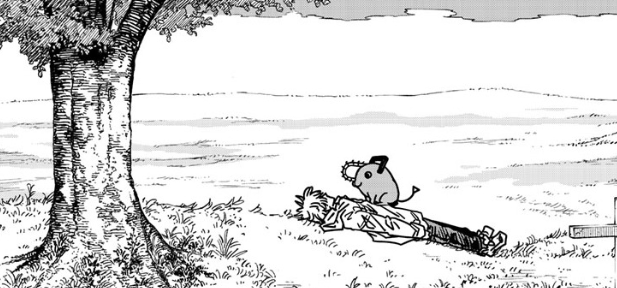
The chapter begins with Denji, after Pochita reset the timeline, dying of the blood disease and being attacked by the Yakuza.
Pochita really did not think the whole eating himself thing through because of what it would mean for Denji.
Luckily for him, Power shows up to save Deni’s life for some reason, making the contract with him instead of Pochita.
The Control Devil then arrives to recruit them but, fortunately for Denji and Power, it is Nayuta not Makima.
How Nayuta is the current Control Devil, I do not know.
What makes even less sense is that she is supposedly a good Devil in this timeline, despite being taken in by Public Safety instead of Denji.
The entire reason Nayuta had good qualities was because Denji raised her like his little sister.
Public Safety would not do that, so it makes zero sense
What also makes little sense is Denji using a chainsaw to kill a Devil, but I suppose you could explain that away as humanity reinventing chainsaws, the same way they did nuclear weapons in the old timeline.
The Devil Denji kills is at Asa’s school, and it also kills her teacher, so at least we know he will not try to groom her in the future or anything.
In a moment that admittedly does bring Part Two full circle a little, Denji saves Asa from tripping and crushing Bucky.
The full page spread of him doing this is oddly touching for the last time we see the two interact, although their following conversation is brief.
Asa calls Denji “Chainsaw Man” because he fights with a chainsaw, making Denji’s heart flutter as we realize a part of Pochita is still in there.
Power misinterprets this as Denji’s disease, promising to cure him of it, and the two go to grab a meal… or at least go to scam some people for a snack.
And so, Chainsaw Man ends with a somewhat happy ending.
Denji has reunited with Power and Nayuta in a new timeline (although we do not know where Aki is), and Asa was saved from crushing Bucky, meaning she can make friends in her class.
Therefore, the ending is good, right?
Nope.
While this ending is happy, it is just way too abrupt.
Fujimoto probably sat down one day and decided he was too burned out to continue the story, so decided to end it early and quickly to potentially move onto other things.
What makes this obvious is how many unanswered questions Part Two leaves us with.
What happened to Yoru, Kishibe, Kobeni, and Reze?
What exactly was Public Safety’s plan for the entirety of Part Two?
Not to mention that the resetting of the storyline all the way to Part One makes Part Two feel pretty pointless in retrospect.
If I had to sum up my feelings about Chainsaw Man’s ending with one word, it would be “disappointment.”
The story ended out of nowhere, left so many questions unanswered, and reset the timeline to make a lot of things pointless.
If there is any consolation, it is that at least Denji and Asa got a happy ending.
And regardless of my frustration with Chainsaw Man‘s abrupt ending, I will still read whatever Fujimoto does next.
I just hope that whatever he goes on to write it will be in a way that avoids burnout.
Maybe give him the Sui Ishida treatment, where he can release a chapter on his own schedule, rather than weekly.
If that happens, then a well-executed ending for his next work will hopefully be assured.
As for Chainsaw Man as a whole, I still love this series, even though it suddenly ended out of nowhere.
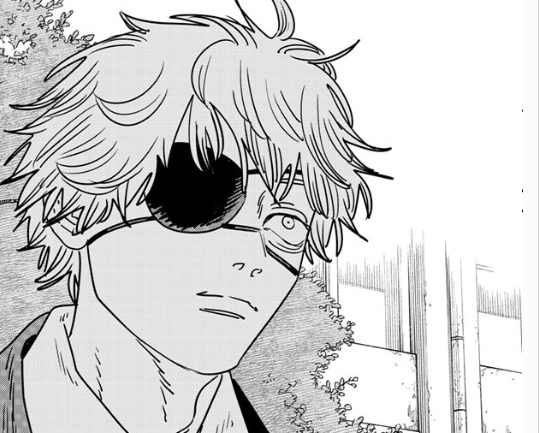
In my review for the previous chapter of Chainsaw Man, I speculated on the story’s future. It seemed like Fujimoto may have been gearing Denji and Asa up for a fight with Fami, powered up by the growing fear of insects and vermin. Well, once again Fujimoto did the unexpected by delivering us an abrupt penultimate chapter to Chainsaw Man Part Two. Yes, the next chapter of Chainsaw Man will be the last chapter for a while, maybe forever if Fujimoto decides not to make a Part Three. Chapter 231 opens in the immediate aftermath of the previous one, and I was immediately struck dumb by the title, “Goodbye Pochita.” To me at least, nothing prior seemed to be hinting at Pochita’s death. Well, this is apparently what just happened. The chapter begins with Pochita appearing before Denji, revealing they were eaten by the Devil that just attacked them. Denji is horrified because he no longer has the chance to have sex, but Pochita says this is a good thing because some part of Denji was still unhappy, even when he connected with Asa. Transforming into Chainsaw Man, Pochita tells Denji that he is, “One that can only find heaven when you’re in hell.” While this is a compelling quote, I am not sure if I like its implications, considering that Pochita is now saying Denji would be happier being back under the Yakuza’s thumb. After hugging Denji as Chainsaw Man, something Pochita always wanted, Pochita proceeds to eat his heart, erasing himself and Chainsaw Man from existence, seemingly creating a world where he and Denji never met. The final panel takes us back to Denji’s rundown shack, where his story began. So, Denji is seemingly back to square one. He will probably be indebted to the Yakuza, dying of a disease that makes him cough up blood, and with no Pochita to help him. Seriously, why did Pochita think Denji would be better off? I guess we will see next chapter, along with whether this is the last chapter of just Part Two or the entire series. The reason the latter might be a possibility is because this does feel like the setup for an ending, just not a good one. If this is going to be the conclusion of Chainsaw Man, there will probably be many questions unanswered. What happened to Asa and Yoru? Does this mean Denji and Power will never reunite? What was the point of this entire last fight if everything just gets reset? Granted, we do not know for certain that this is the end. Fingers crossed it is just the conclusion for Part Two. Although, even if is that, I do not think it will be completely satisfying either. This whole Pochita-eating-himself-and-sending-Denji-back-to-the-beginning ending just feels really out of nowhere, and not in the usual good way Fujimoto is able to pull off. Pretty funny how the last chapter restored my faith in Fujimoto, only for this one to make me doubt him again. On the day Chapter 132 releases, I will be anxious to see if my concerns are warranted.
It is hard to believe that a decade ago it seemed like Resident Evil might be a dying franchise. The last mainline installment, Resident Evil 6 in 2012, had not been well received by the fans and, even worse, Capcom had released Umbrella Corps in 2016, one of the most reviled games in the series. Then Resident Evil: Biohazard arrived like a godsend in 2017, returning the series to its survival horror roots and revitalizing the brand. This was the game that first got me into series, and what a time to become a fan because ever since then, Capcom have been on a roll. Over the years, they have released Resident Evil: Village and numerous remakes, which are considered among the best video game remakes of all time. Well, now we have another banger with Resident Evil: Requiem, the ninth mainline installment.
Resident Evil goes back to the Umbrella well with RE9.
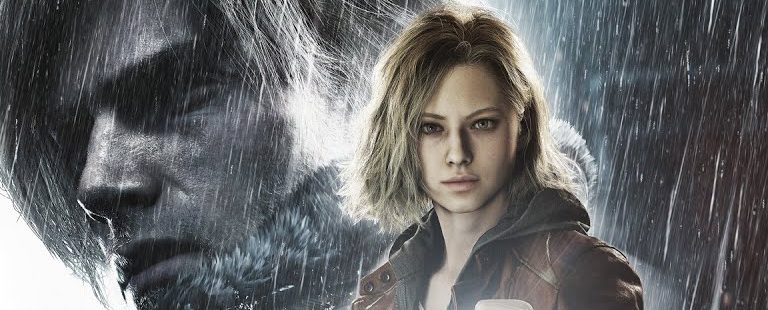
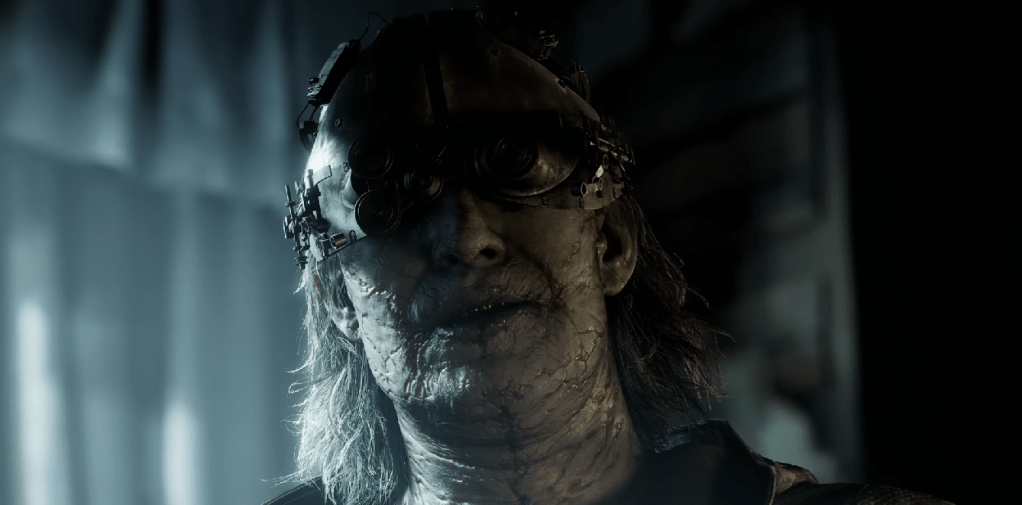
After finishing my first playthrough, I am excited to say that Requiem is definitely in the top five best Resident Evil games. It does a truly fantastic job of blending the survival horror of Biohazard with the over-the-top action of 4. The story follows FBI Agent Grace Ashcroft (Angela Sant’Albano), the daughter of one of the previous game’s protagonists, Alyssa, Tasked with investigating a mysterious disease tied to the Raccoon City Incident, Grace finds herself kidnapped by Umbrella scientist Dr Victor Gideon (Antony Byrne) and must survive his care facility of horrors.
You have to wonder how these crazy looking, mad scientists keep getting people to help with their potentially world ending experiments.
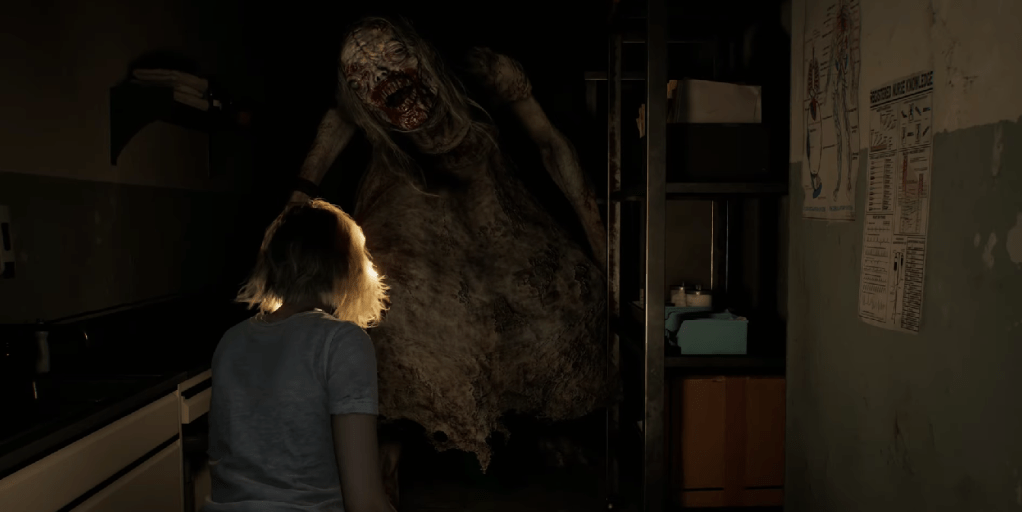
Grace’s segments of the game are pure survival horror, and I found myself screaming many a time when faced with terrifying zombies. What makes these zombies so unique is that they retain parts of their personalities from when they were alive. A massive zombie chef tries to cook human flesh, a maid cuts herself repeatedly on glass trying to keep everything clean, and some zombies even apologise for trying to hurt you when they are killed. It makes them not only scary but also pretty pitiable. But the true horror of Grace’s segments is The Girl, a hag-like monstrosity with a weakness to light that pursues Grace throughout the facility.
The Girl is Resident Evil‘s scariest stalker enemy since the baby in Village.
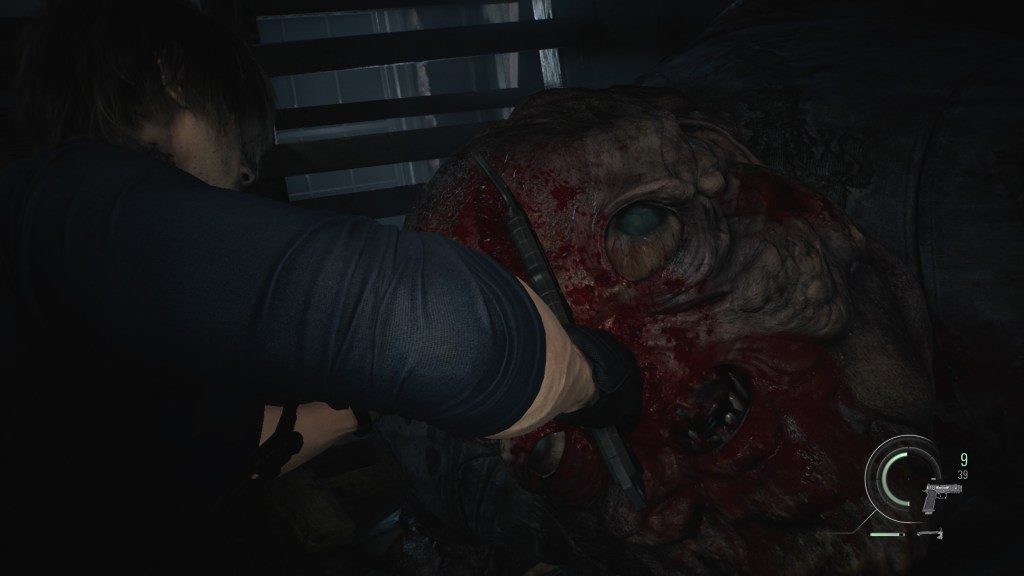
With Grace’s limited stock of weapons, every fight with the undead could be her last. It is a good thing then that she is not alone because the one-man army Leon Kennedy (Nick Apostolides) is also investigating Gideon, with Sherry Birkin (Eden Riegel) acting as his handler. Leon’s segments of the game are when the over-the-top action comes into play and, I have got to say, after a few hours of hiding in the dark terrified as Grace, it is such a relief to kick zombie ass as Leon, shooting them, hacking them up, and cutting them apart with a chainsaw. I never thought the survival horror of the series could blend so well into the action and yet Capcom achieved this.
How Leon is still doing roundhouse kicks on zombies in his 50s is unknown to me. Not complaining though. Rule of cool, and all.
They even provided different styles of gameplay for different playthroughs, with the choice between first or third person for both Grace and Leon. I went with the recommended first-person for Grace and third-person for Leon, which felt perfect for their playstyle’s differing atmosphere. Just as perfect was the game’s use of nostalgia, which can be a slippery slope. Too much and it will feel like the game is just pandering to fans for cheap points, rather than doing something new. Thankfully, Requiem offers plenty of new with that old, and the old content is lovingly handled.
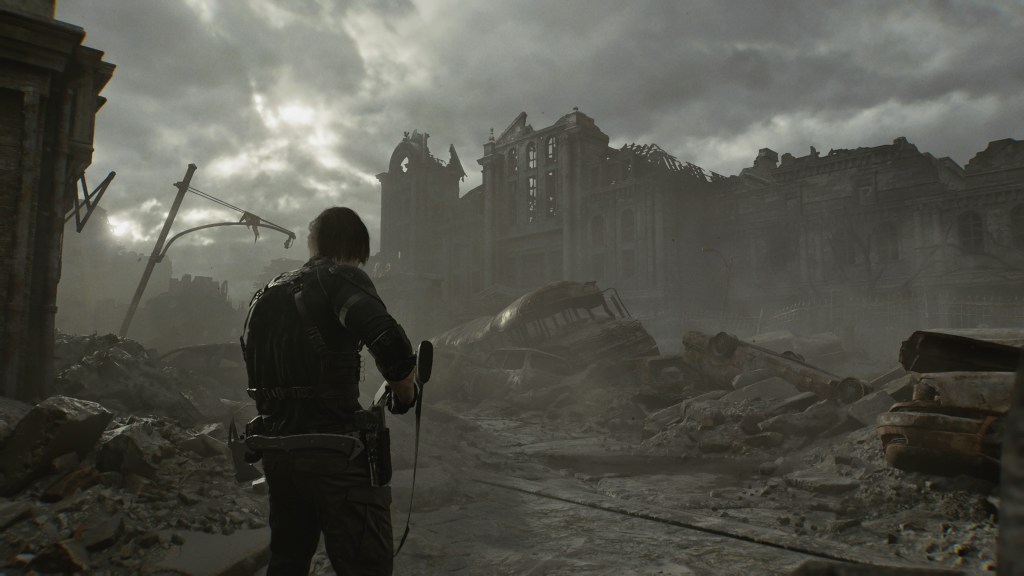
Returning to the RPD was just one of many nostalgic moments in Requiem.
Well, I have spent so long lathering this game with praise, you have to be wondering if I have any problems with it. A few, but I really had to think about it for a bit. For starters, I think we can all agree that there was one antagonist who deserved a boss fight but did not get one. Along with this, there is one segment of the game which reminded me of the cannon section in the Resident Evil 4 remake. Since that was my least favorite section of that game, you would be right in assuming it was my least favorite part of Requiem as well. Finally, there is one reveal towards the end that feels like a bit of a copout, but it was a convenience that made me smile so I can let it go. And that is it for my issues. The rest of the game is so good that it overwhelmingly overshadows any bad.
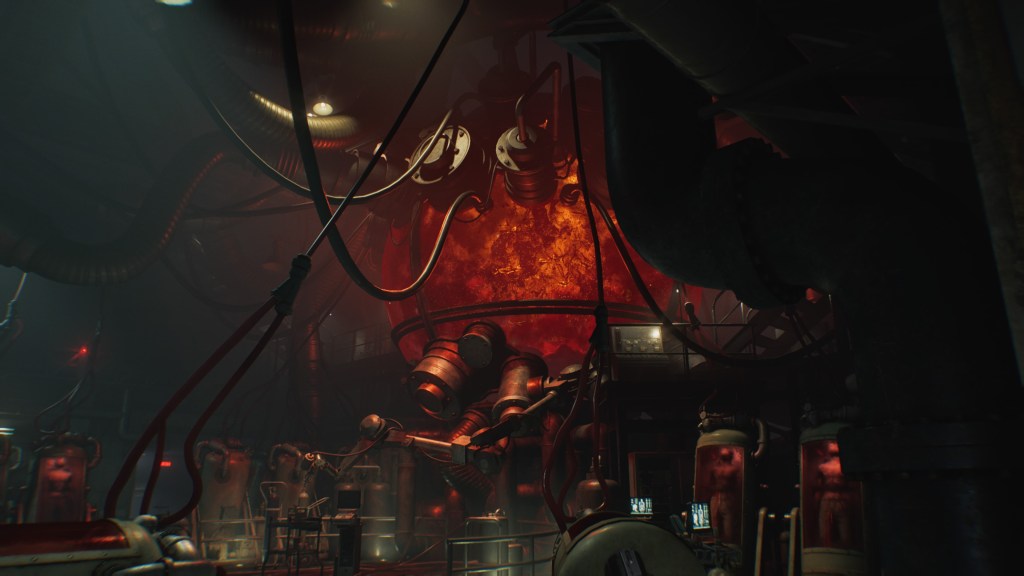
The game looking fantastic also helps matters.
Resident Evil: Requiem is one of the best Resident Evil games. The story is investing and the gameplay styles of Grace and Leon blend perfectly. I know it is only March, but it would not surprise me if Requiem ended up topping a lot of best games of 2026 lists. And, with new story DLC probably dropping at some point, the game is only going to get better. If you are a Resident Evil fan and have somehow not played this yet, hurry up and do so. It is one of the series’ best.
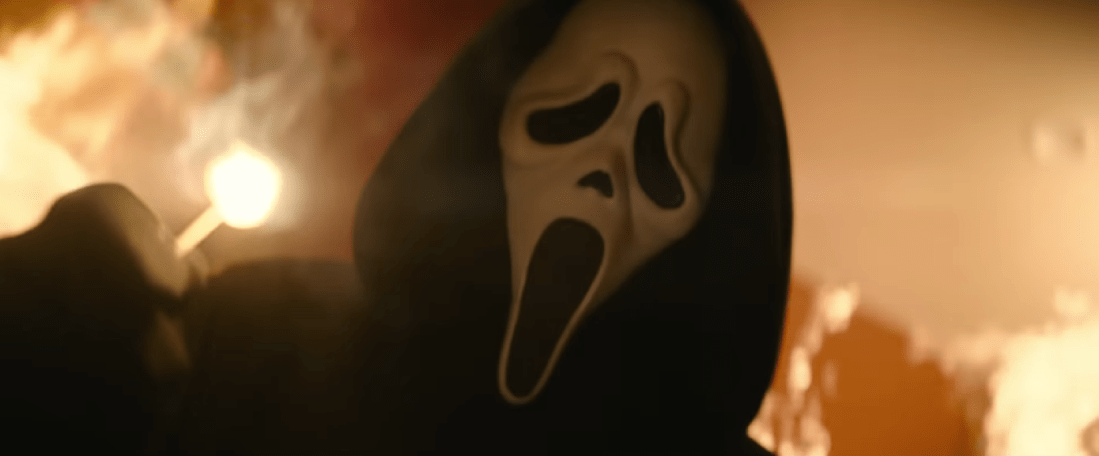
I am a fan of the Scream franchise. I enjoyed the first four movies as a teenager and got back on board with the fifth and sixth film. While in retrospect Scream 6 had some issues, I was still looking forward to the conclusion of the new trilogy to see how the Carpenter sisters’ story would end. Then Melissa Barrera was unjustly fired for her comments on Palestine. Then Jenna Ortega also dropped out. The director bailed and the script for the seventh film was thrown out. Needless to say, these events had me extremely worried for Scream 7’s quality. Unfortunately, these concerns were justified because, after seeing the seventh film, I can say that the Scream franchise has finally had a bad film.
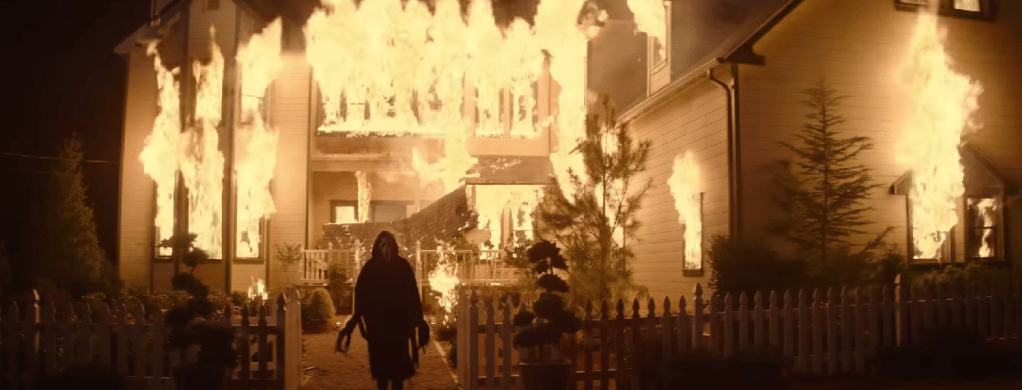
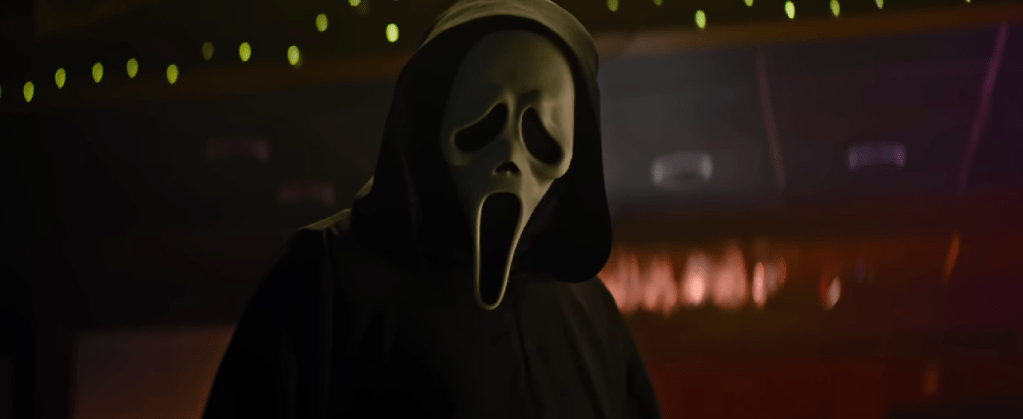
Ghostface walking away from torching the Scream franchise.
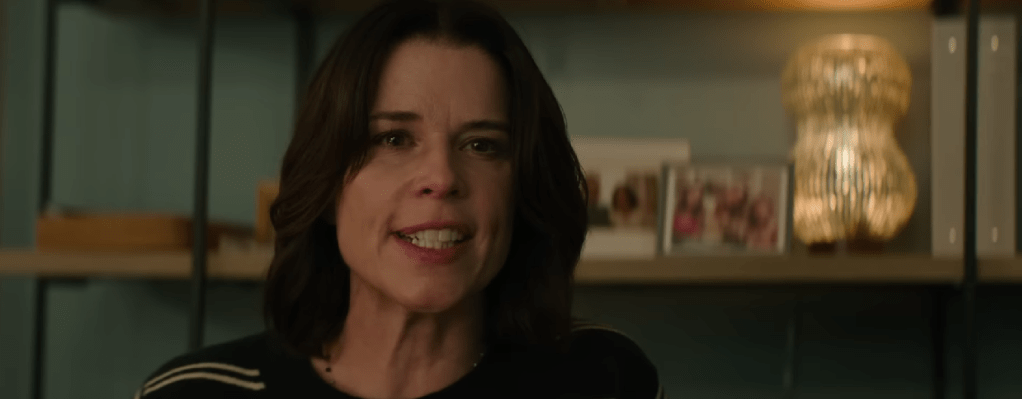
Before this, the weakest film in the series was Scream 3, but even that had its fun with campy moments and good characterization. The seventh film has none of that, with an extremely boring and forgettable cast overall, twists that are somehow both predictable and completely stupid, and an eye-rolling amount of callbacks. The story once again follows Sidney Prescott, as her daughter Tatum (Isabel May) and husband Mark (Joel McHale) are threatened by the return of Ghostface. With a cast of boring suspects, she must stop the killer before it is too late, all the while trying to determine if Stu Macher (Matthew Lillard) has really returned. Neve Campbell is back as Sidney and, while it is good to see her return, after a pay dispute caused her to leave Scream 6, her character does no have much meaningful development.
Although Neve Campbell does a good job, as expected.
Her character’s husband and daughter also feel bland, and the latter is supposed to be the secondary main character. Sidney is not the only returning character however because Gale (Courtney Cox), Mindy (Jasmin Savoy-Brown) and Chad (Mason Gooding) also return but, for the life of me, I cannot understand why. I mean, I get why Gale would try to pursue the story of another Ghostface killer, but she does not have enough presence in the film to warrant a return. Neither do Chad and Mindy, since the two could have been absent and nothing about the story would change.
It feels really weird that the Meeks siblings are back but not Sam and Tara.
So, the characters are a bust, but what about the mystery? It is always fun to watch a Scream movie and guess who the killers are before the big reveal. Well, not this time. The hints towards the killers are so blindingly obvious, I guessed it from their first appearances. What makes it worse is that in practically every Scream movie, there is a killer with a deep connection to our main cast. Either that or their motive ties into the themes. Not this movie. No, instead the characters playing the Ghost Face killers are barely in the movie before the reveal, and their motivations make zero sense. In my opinion, these are the worst Ghost Face killers of the entire series. They have so little screen presence, their plans are dumb and I cannot for the life of me even remember their names.
The killers who got murdered at the beginning of Scream 6 were better characters than these clowns.
The only memorable thing about this film’s killers is their frequent nostalgia baiting, but that is not the kind of thing I want to remember. The callbacks to prior films made my eyes roll so far to the back of my head, I was worried they would get stuck there forever. The only redeeming qualities to this film are that the performances are admittedly decent, some of the action is well-done, and the gore made me wince.
If you are a fan of gory horror movies, you might get some enjoyment from the horror. Some.
Other than these few positives, Scream 7 is a disaster. The new characters are dull, most of the old ones do not have a reason to be here beside nostalgia, said nostalgia is handled in an extremely annoying way, and, to top it all off, the film has the worst killers of the franchise. Scream 7 is the worst Scream film and it is not even close. They should have gone with the original plan for this movie and never fired Melissa Barrera. It would probably have been good and not… whatever this was. If I were to rewatch the Scream movies, thisis one I will undoubtedly skip.
Despite my continued enjoyment of Chainsaw Man, I had been wondering recently if Tatsuki Fujmoto knew where he was taking his story. It just seemed like a lot of random things were happening in the story. Well, random for Chainsaw Man anyway. For example, a few chapters ago, a mysterious and extremely powerful bug Devil interrupted Denji and Yoru’s fight. This bug was then immediately defeated in the following chapter, with no explanation why it was so strong. Well, I should not have doubted Fujimoto because he provided an answer in Chapter 230, “Sex and Selection.” The chapter begins with Yoru continuing to laugh at Denji’s desperation to have sex with her. After Denji compares her to Power (good to know Fujimoto has still not forgot about her), Yoru agrees to sleep with him, saying Asa consents as well. Given that Yoru gave Denji a handjob without Asa’s consent a few arc back, I think it is safe to say that Asa really needs to get a say before the deed is done. Denji will have to wait for any potential deeds, however, because the moment he begins to celebrate, an army of powerful bug Devils ambush them. Through the communications between various Fumiko’s around the world, we learn that because death has been erased bugs, bats, and other types of animals with a high fertility rate no longer have a large culling of the young to counteract that. The end result is a large population of predatory insects which will feast upon humanity forever, thus making the Devils representing them extremely powerful. This is a unique and horrifying consequence to the removal of death, which I had not thought of. It also has an interesting implication for the future of the story. After all, what horrifying concept are bugs like locusts associated with? Famine. Prior to her erasure, Death was the most powerful Devil, but with people now unable to die and facing the torment of an eternal famine where they are also devoured by insects, Fami may very well take her place. Since Fami is all about seeing death as salvation, I can see her fighting Denji to force him to throw up Death and return balance of the world. That being said, Denji is not going to go down without a fight since Yoru promised him sex. We see this at the end of the chapter when he is determined to stay and fight the bug Devils. In an excellent callback to the first Chainsaw Man chapter, all of those years ago, Denji declares, “If you’re going to get in our way, then… how’s it go again?” Denji preparing to deliver his first badass statement of the series, only to fail because he can no longer remember death as a concept is textbook Fujimot humor. I look forward to seeing Denji and Yoru face off against the Bug Devils and a potentially overpowered Fami in the following chapters. As for Chapter 230, it restored a lot of my faith in the story. It paid off the mystery of the powerful bug Devil, had a humorous ending and, not to mention, put the idea of a council of Fumikos in my head. It would be pretty funny if Fujimoto paid that off by showing said council discussing the events, after everything is said and done.
Long before he entered the realm of superheroes with his Spider-Man trilogy and, much later, Dr Strange movie, Sam Raimi was a master of horror comedy, most commonly known for his Evil Dead trilogy. Well, with his latest film Send Help, Raimi has returned to his horror comedy roots, delivering both a funny and gory movie following two highly questionable people.
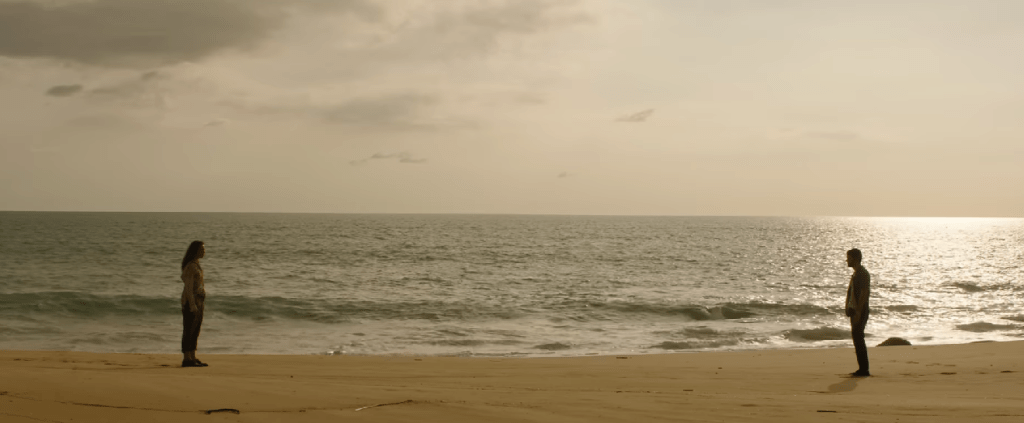
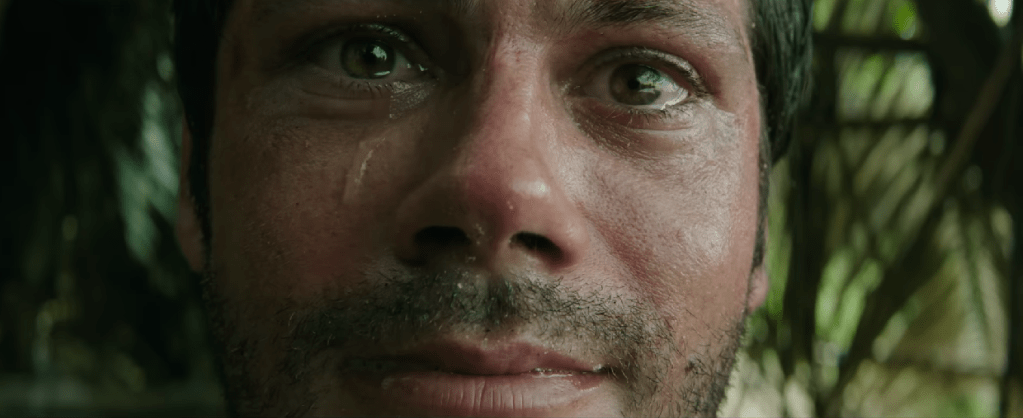
Prepare for your opinion on the characters to switch a bunch in this film.
Send Help stars Rachel McAdams and Dylan O’Brien, and tells the story of Linda Liddle (McAdams), a socially awkward yet hard working woman who has more than earned a promotion at the company she works for. These hopes are cruelly dashed with the arrival of her new boss Bradley Preston (O’Brien), a petulant man child who only has the position of CEO because he inherited it. When the two are stranded on an island as the sole survivors of a plane crash, they find their positions reversed, with Bradley now at the mercy of his cruel boss, Linda. What follows is a battle of wills between the two, improved by great character writing and fantastic performances from both McAdams and O’Brien.
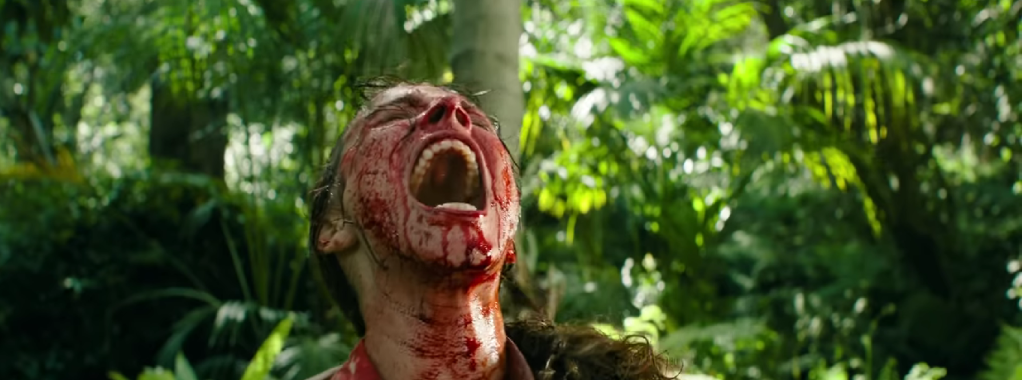
Not to mention a whole lot of fake blood.
The script does a great job of flipping the initial situation on its head. After the crash it is extremely cathartic to see the immature Bradley be put in his place by Linda and have to count on her survival expertise to survive. However, as the movie goes on and we get more insight into Linda’s psych and the actions it drives her too, Bradley becomes more pitiable. This culminates in the most uncomfortable scene of the entire movie, which will have every man who watches cringing into the back of their seats.
This scene had me experiencing Misery flashbacks. If you know, you know.
Speaking of, this movie is very gory. The first moment of bloody violence on the island had me sitting back and thinking, ‘Oh, yeah, this is a Sam Raimi film!” His style is all over the movie, from its great dark humor, to the gory sequences, delivering a pretty enjoyable movie overall. Granted, I do think the ending felt kind of lackluster, but that does certainly not destroy the film. The film maintains a great conflict between its two lead characters, both of whom are backed up by excellent performances from their actors, delivering a funny, disturbing, and all around good time at the movies. I recommend checking this one out, especially if you are a fan of Sam Raimi’s horror comedies.
28 Years Later was one of my favorite films of 2025. I found it to be a gripping post-apocalyptic coming-of-age story, which carried a touching message about the acceptance of death. That being said, the film was divisive among general audiences, mostly due to its bizarre ending. While I did enjoy said ending, I can definitely see how a group of ninja, Satan worshipping, Jimmy Saville cosplayers showing up out of nowhere rubbed people the wrong way.
The wackiness of 28 Years Later‘s ending is instantly dropped for a brutal reality.
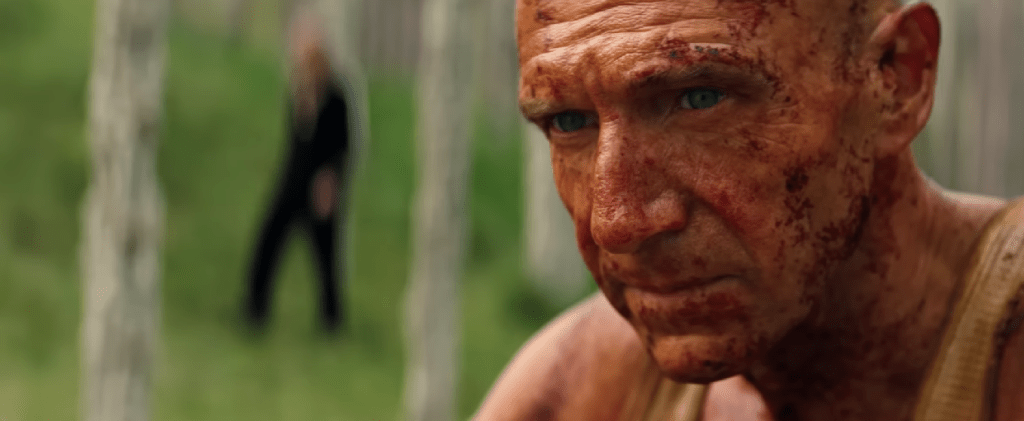
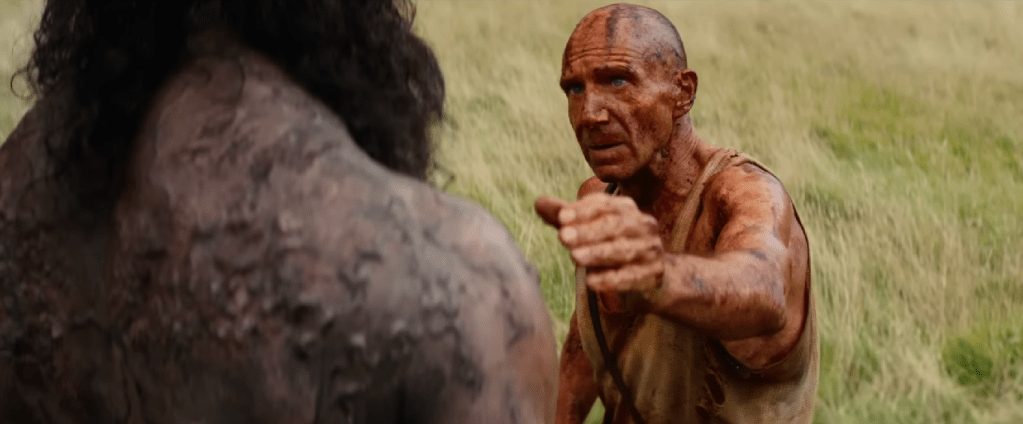
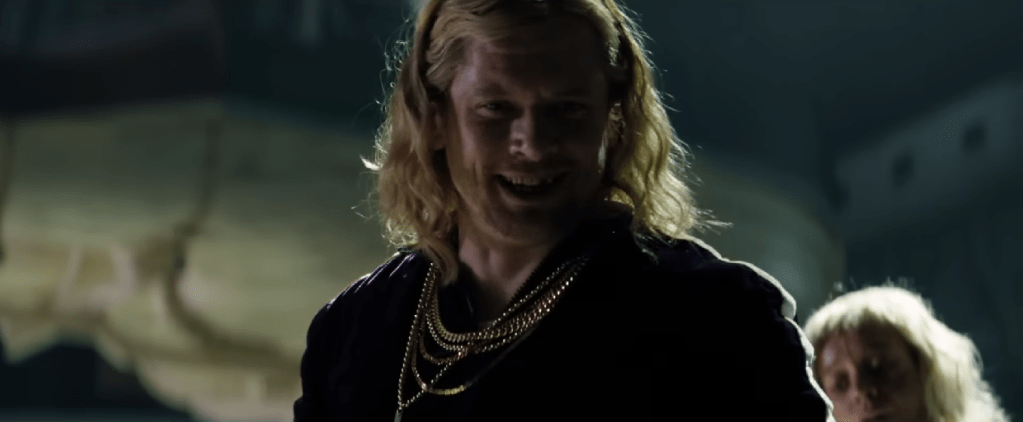
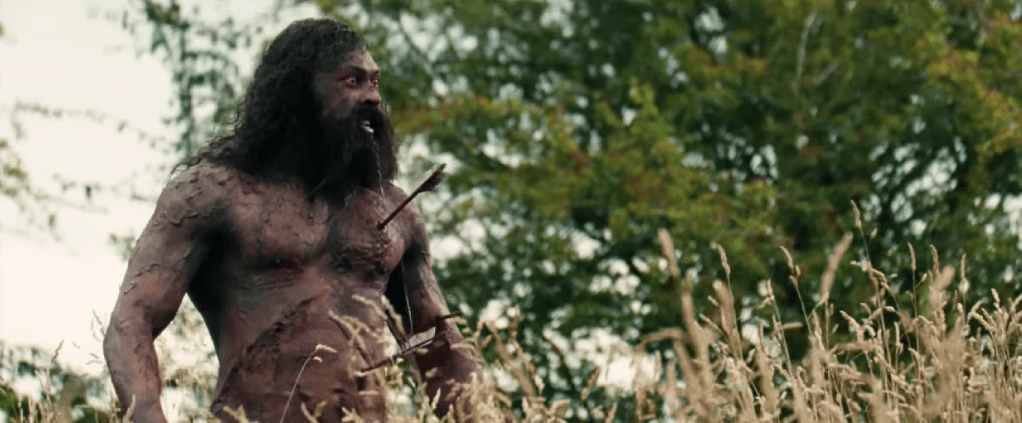
Nevertheless, after the film ended, I was immediately on board for its follow up, The Bone Temple. Being shot back-to-back with 28 Years Later, we thankfully did not have to wait two years to see it, like most sequels these days. Having seen the film on the day of release, I can say that The Bone Temple definitely lived up to my expectations, even if I do prefer the previous movie. Picking up from 28 Years Later’s cliffhanger, The Bone Temple sees the young Spike (Alfie Williams) violently inducted into the Jimmy gang, led by the charismatic and deranged sadist, Jimmy Crystal (Jack O’Connell). At the same time, Dr Ian Kelson (Ralph Fieness) finds himself forming an unusual bond with the Infected Alpha he has named Samson (Chi Lewis-Parry) and begins to wonder if treating the Rage Virus is possible. As the film progresses, the two storylines converge, resulting in a confrontation between Jimmy and Kelson at the titular Bone Temple and the conflict of their embodied ideals: peace vs chaos, kindness vs brutality. These two opposing characters with their opposing beliefs are the focal point of the film.
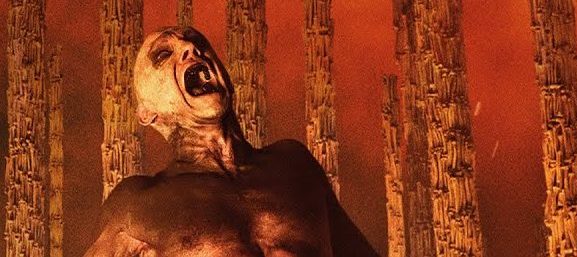
Pure good meets pure evil in The Bone Temple.
I already loved Dr Kelson’s character from 28 Years Later. Spending over two decades in isolation and building a temple of bone to memoralize the deaths of millions, Kelson kept his humanity, helping to ease the suffering of Spike’s mother. He continues his humanitarian efforts in The Bone Temple through his aid of Samson, with Ralph Fieness playing the role to perfection. In times of despair and chaos, we need a man like Dr Kelson.
Kelson’s humanity is a shining light in a world of darkness.
What we certainly do not need is a man like Jimmy Crystal. Played brilliantly by Jack O’Connell, the traumatised young survivor of the outbreak has transformed into a demented cult leader, hellbent on bringing as much pain and suffering he can in the name of his imagined father “Old Nick.” His cult members are almost as demented, gleefully indulging in Jimmy’s idea of “charity.” Their childlike nature is just as disturbing, with it being abundantly clear that these violent lunatics were once ordinary children before Britain fell.
O’Connell has a knack for playing unhinged villains.
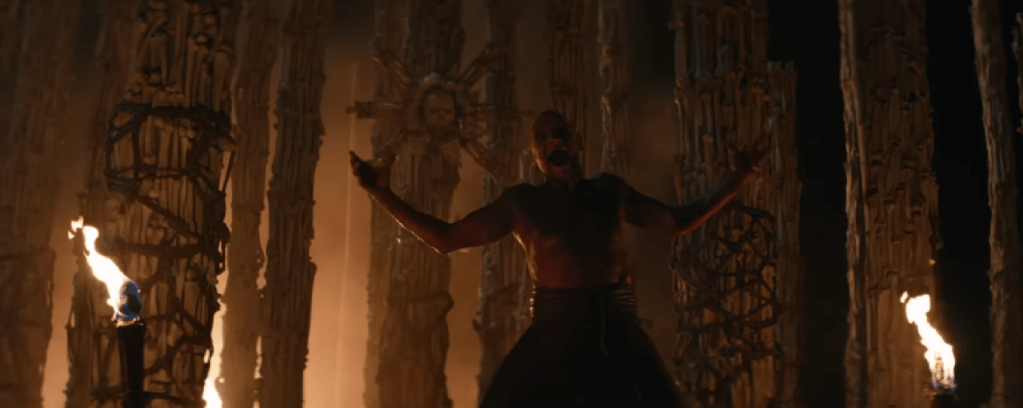
This makes the characters obvious visual similarities to notorious predator Jimmy Saville all the creepier. Just as he twisted the innocence of children in real life, so has this brutal world the Jimmys grew up in. And, boy, is it brutal. 28 Years Later was violent but The Bone Temple is on another level. Brains are eaten and skin is flayed in numerous wince inducing scenes which, again, made the humanitarian efforts of Dr Kelson all the more important. If the Jimmy gang are the children destroyed by the world, Samson is the child Kelson hopes to restore. Chi Lewis-Parry brings both a sense of brutality and innocence to the role of the Infected Alpha. Samson is a complex character, whether he is ripping someone’s head off, remembering the past or, more often than not, running around butt naked with all 28 inches flopping around in the wind…
Sorry, could not resist making that joke.
However, while I do think the characters of Kelson, Jimmy and Samson are all great, I unfortunately found Spike’s to be a bit limited in this move. He mostly just stands around looking horrified at what the Jimmys are doing which, fair enough, but I kind of wanted to see him do more after the first film. There is also the character of Jimmy Ink (Erin Kellyman), by far the most humanized of the Jimmys, due to her sibling-like bond with Spike. While I think she was well acted, the writing let her down a little because, even after the movie ended, I was not entirely sure what her goals were, or what she had planned after those goals were met.
I feel like I needed a little more detail to fully understand Jimmy Ink’s character
Along with this, while I liked the style of director Nia DaCosta, I missed the unique flair of Danny Boyle’s from 28 Years Later. My final criticism is that there was one scene hyped up in the trailer that was absent from the film. Although this is more the trailer’s fault than the movie’s. All of that being said, these are only minor issues, and the rest of the film more than makes up for them, especially the third act. As I stated, the conflict between Kelson and Jimmy is the highlight of the film, culminating in a tremendous climax, which needs to be seen in theaters.
Prepare to get Iron Maiden’s The Number of the Beast stuck in your head.
Although I prefer 28 Years Later’s emotional journey, The Bone Temple offers a more than worthy sequel, with a compelling battle of ideals between its protaganist and antagonist. I look forward to seeing the third film in this trilogy, where an iconic actor is poised to take center stage… or, at least, he will in about two years when that final film comes out. Yeah, since the third movie was only recently greenlit, we are unfortunately going to have to wait a while for its release, unlike The Bone Temple. So, until then, memento mori.
2025 has been a spectacular year for indie gaming. Games from smaller studios like Kingdom Come: Deliverance 2, and Clair Obscur: Expedition 33 captured the attention and hearts of gamers everywhere. Clair Obscur (deservedly) won Game of the Year, so that is proof enough. One of the games released by a smaller studio later in the year was Dispatch, a superhero comedy in the vein of Telltale. This description was enough to sell me on it and, after completing my first playthrough, I can say it is well worth the money.
I highly recommend this game is you are a Telltale fan.
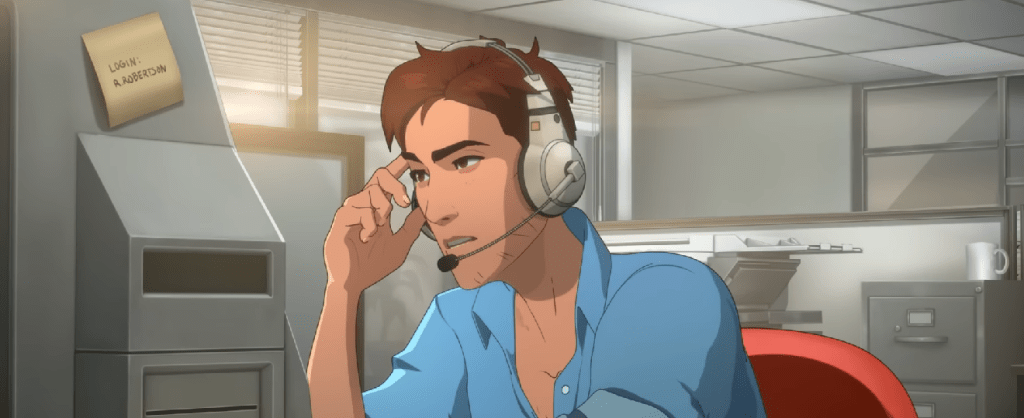
Dispatch follows Robert Robertson The Third (Yes, that is his actual name), the superhero Mecha-Man. After his suit is destroyed, Robert is left driftless, until superheroes Blonde Blazer (Erin Yvette) and Track Star (Jeffrey Wright) come to him with an offer: Work as a dispatch worker, coordinating a team of former super villains turned heroes, and they will help him rebuild his suit. And so, Robert has to work to transform the Z-Team from a group of combative, squabbling children, into heroes the public can trust.
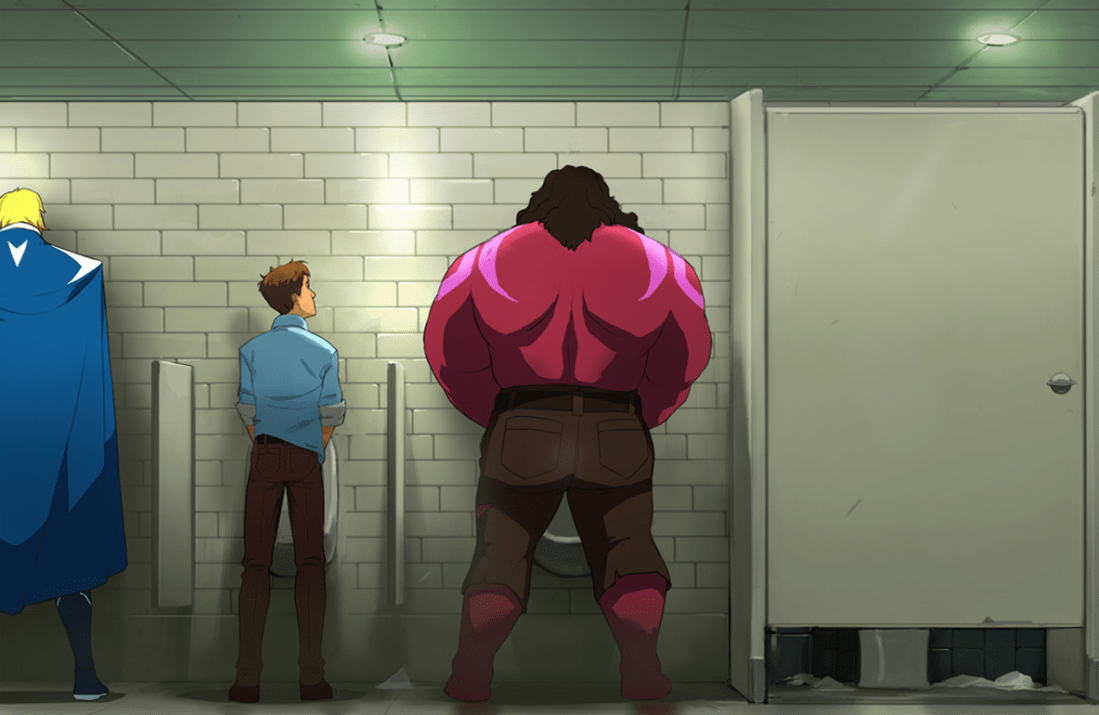
The Z Team are all great characters, but the HR Department’s worst nightmare.
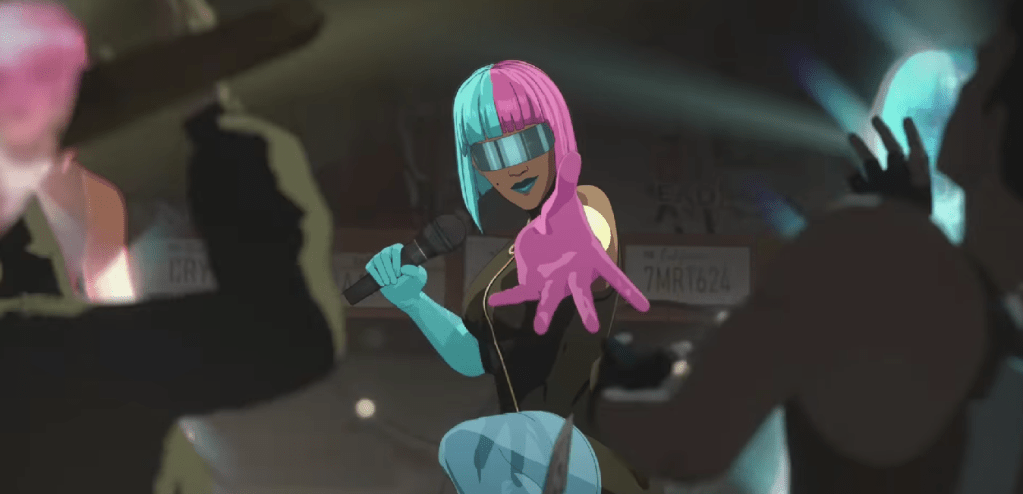
Each of the characters you dispatch are interesting in their own way, from the Crypto-Man-Bat, Sonar (MoistCri1tiKaL), to shortie Irishman, Punch Up (Jacksepticeye), to the rebel Invisigal (Laura Bailey). The latter in particular takes center stage, with the player’s decisions determining how Robert’s relationships with both her and Blonde Blazer progresses. All of the performances for these characters are great, especially Aaron Paul’s as Robert. Usually whenever I hear him in a voice-acting role, I associate his character with the actor. For Robert, however, he felt completely his own person, showing how good of a job Aaron Paul did for this game from the serious moments to the humorous ones. Speaking of the humor, this game can be incredibly funny, and I broke out into laughter multiple times. Probably one of my favourite jokes was delivered by Prism (Thot Squad) in a bar fight.
The bar fight has many great gags.
But enough about the characters, what about the choices? Dispatch does have quite a few after, all. Well, overall, the story does not change too drastically. The current end point of a few characters changes depending on your choices, along with who Robert decides to romance but, otherwise, the storyline is generally the same. That being said, the quality of the story more than makes up for it. One thing Dispatch has over Telltale though is its gameplay. Dispatch’s is strategy based, with you sending different combinations of heroes on different missions and then leveling their stats with their successes while learning from their failures. After Episode One, I thought this would make the gameplay a bit of a chore, but Dispatch quickly proved me wrong. The banter between the characters, the time limits to send characters on missions, the suspense over whether I had made the right choices, and even the sheer randomness of outcomes created a lot of fun moments, even if I did a really good job one episode and a terrible one the next.
Who knew dispatching heroes could be this fun?
All in all, Dispatch is a great time. The story is fun and often hilarious, the choices, while not incredibly impactful, are cool to see play out in the moment, and the gameplay is engaging. I really hope we get a Season Two because I want to see the continuation of Robert’s story, alongside his dispatch team.
Despite never getting around to reviewing Ghost of Tsushima, it is a game I have found myself returning to again and again over the years. With its great characters, excellent sword combat and some of the most beautiful visuals in all of gaming, it has slowly climbed the list of my favourite videogames of all time. Needless to say, I was excited to see how Suckerpunch would continue the story of Jin Sakai and his friends. So, you can imagine I was slightly disappointed to learn the sequel, Ghost of Yotei, would focus on a different main character centuries ahead of the first game. Despite this, I still had faith that Suckerpunch would deliver a compelling story and, even if that tale did not live up to the original, the gameplay and visual style would more than make up for it. Sure enough, this is exactly how I felt about the game by the end of my first playthrough.
The sequel to Tsushima has many great qualities.
Ghost of Yotei follows Atsu (Erika Ishii), a woman whose family was murdered when she was a girl by the notorious Yotei Six, led by Lord Saito (Feodor Chin). After many years away, Atsu returns to Ezo, determined to see revenge. Aided by a mysterious wolf and other allies, Atsu’s reputation grows with each member of the Six she executes, earning her the title of Onryo, a vengeful spirit. I would say that the story of Yotei is an enjoyable one, although not as compelling as Tsushima’s. Jin’s struggle with the samurai code and the necessity of the Ghost is just more interesting that Atsu’s standard revenge quest.
The game does have a great side quest centering around Jin’s story though.
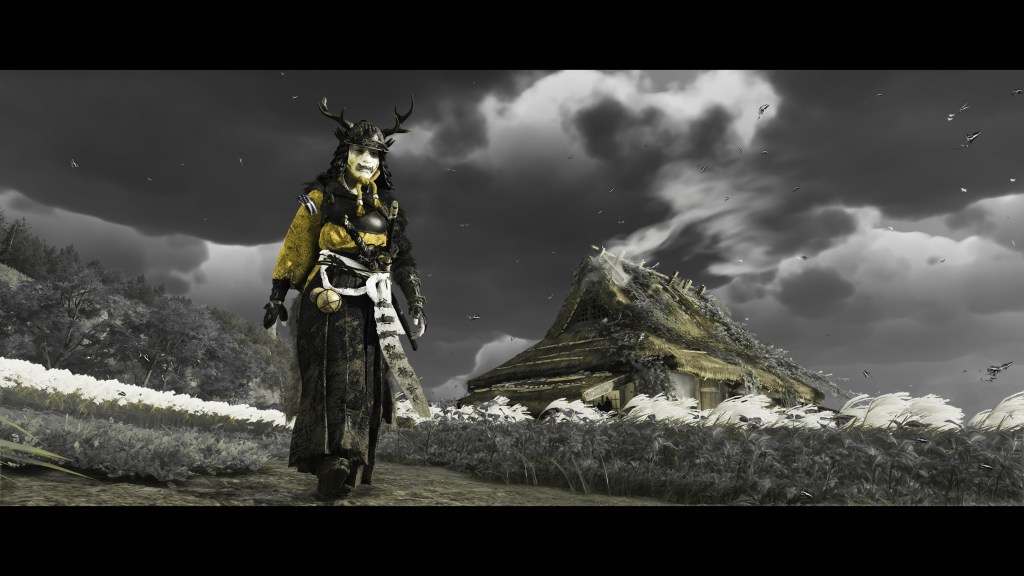
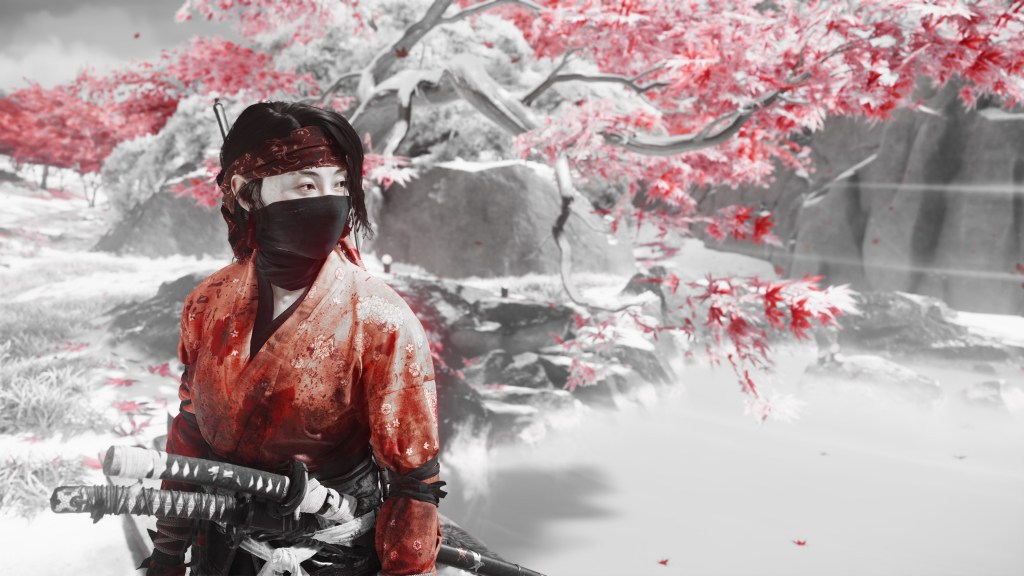
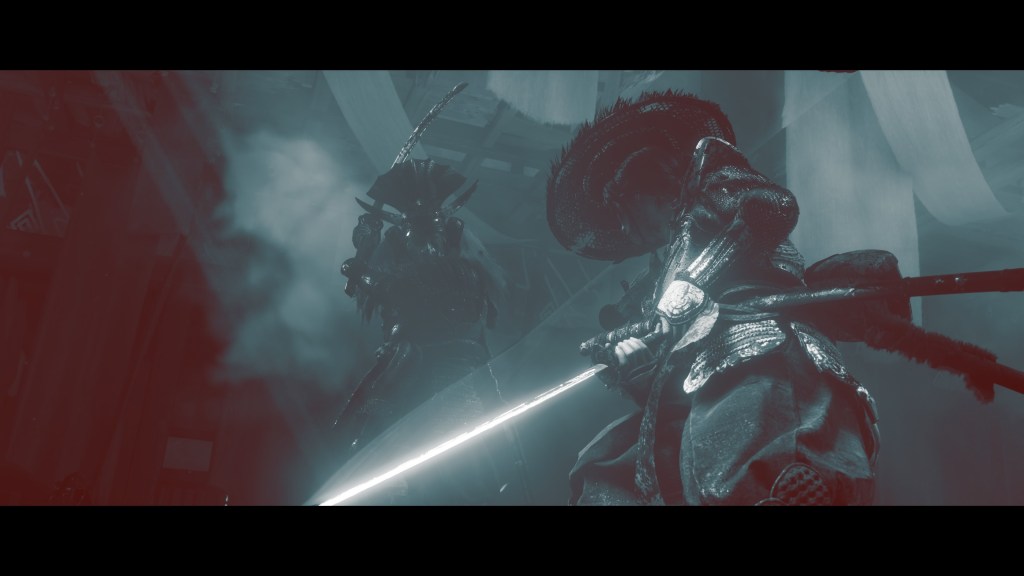
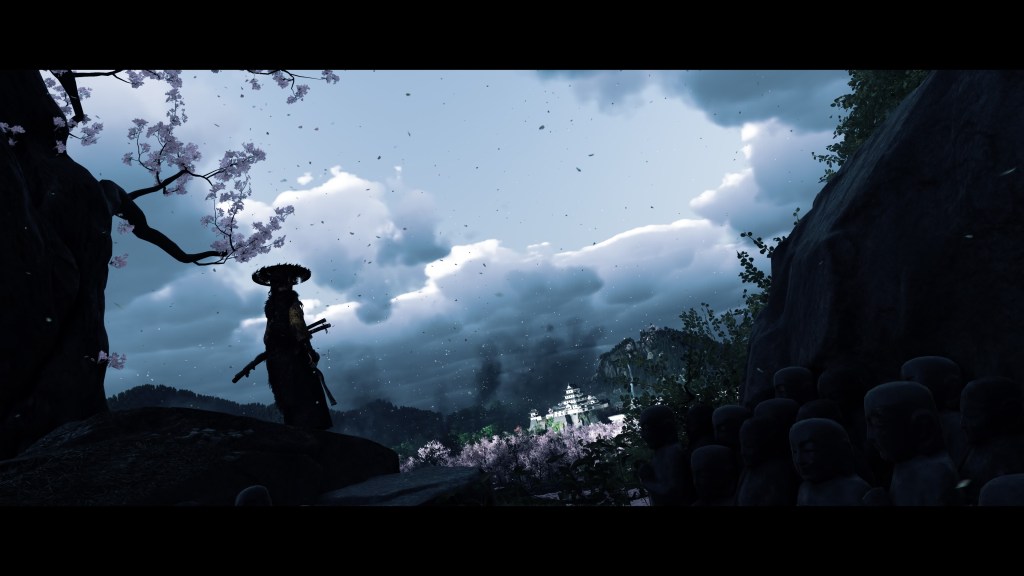
Just because Atsu’s storyline is nothing new does not mean it is not interesting, however, because I still cared about Atsu across her journey and the bonds she made with her Wolf Pack. This pack is a collection of characters across Ezo, who range from important to the story to only involved in minor side quests. The way these quests are tracked with a card system presents a rather unique way to keep track of everything going on in Yotei’s open world. Speaking of that open world, it is just as gorgeous as I expected it to be. I went wild with photo mode during my first playthrough, capturing the brutal fights and beautiful landscapes every chance I got.
The art style of Yotei is so beautiful I just had to mess with it in photo mode.
Adding to these environments and confrontations are the different modes, like Kurosawa Mode from Tsushima, and Japanese dubbing with accurate lip syncing, providing a much more immersive experience. The combat has also been advanced from the first game where, instead of stances, combat is tied to which weapon you are holding. You can even be disarmed, leading the desperate choice of retrieving your weapon or switching to another one. This choice is especially tense in boss fights, which hold a lot more challenge than they did in Tsushima.
Each of the Yotei Six presents a challenge.
The combat is not the only draw of the gameplay, though. I have already said the beautiful environments offer a lot, but so do some of the side activities, like the Zeni Hajiki minigames. I spent most of my first playthrough riding around on my horse, doing side quests, fighting alongside the wolf, and hunting down bounties. That alone speaks to the quality of Ghost of Yotei’s open world. Unfortunately, it also leads into my big flaw with the game, which is its pacing. I would say I spent around 60% of my time playing Yotei in the first act of the game, leaving the second and third act with a mere 40%. As a result, it felt like the game speeds towards a conclusion once you reach Act Two, making the final hours feel a little rushed. This is not even due to the side quests because dealing with those left on Atsu’s list from Act Two onwards felt a lot quicker than Act One.
By the story’s end it felt like it was rushing to finish.
Overall, though, I would still say Ghost of Yotei is a worthy sequel to Tsushima, even if it is not as good. Sure, the revenge story it tells is nothing new and the pacing between the first act and the other two is inconsistent. But the characters are likeable, the gameplay is a lot of fun and, of course, the visuals are spectacular. Say what you want about the Ghost games, but you cannot deny they are beautiful. Fingers crossed we get DLC for Yotei in the future.
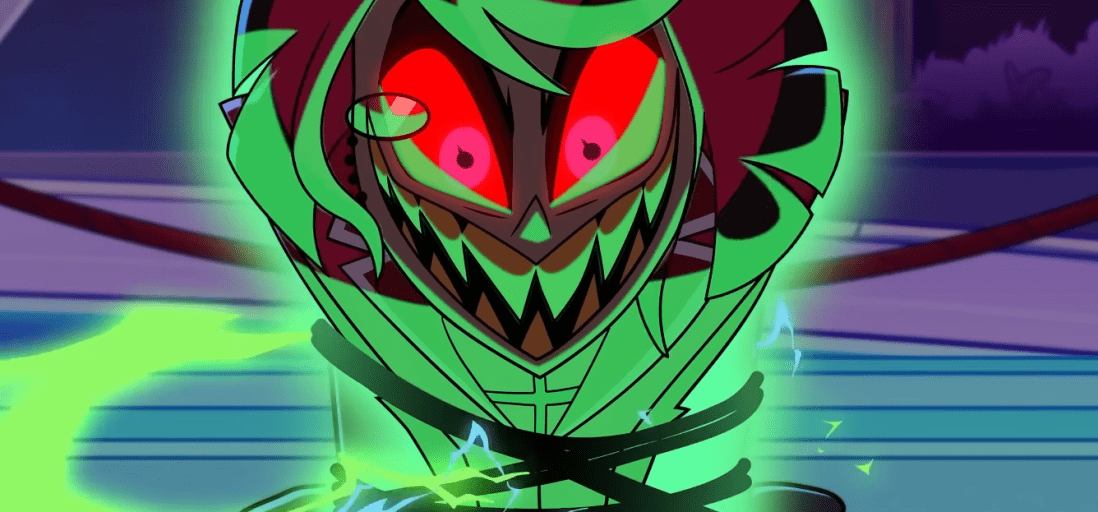
My biggest issue with the first season of Hazbin Hotel was the pacing. It often felt like important events and character moments were skipped or rushed because of the limited eight-episode runtime. So, after learning the second season was also eight episodes, I was concerned the issue would repeat itself. Well, after seeing the final two episodes of Hazbin Hotel Season Two, I can happily say that I was wrong because the pacing this season has been great. The penultimate episode, “Weapons of Mass Distraction”, follows up from where “Scream Rain” left off, with Lucifer being lured into a trap set by Vox. Lucifer is immediately captured with the use of Angelic weaponry, but he is more antagonized by Alastor than Vox. It is quite humorous to watch Vox’s captives have more beef with each other than their literal captor. Not only that, but it leads to one of my favorite songs of Hazbin Hotel, “Brighter”, which fully reveals Vox’s backstory. In life, Vox was named Vincent Whittman, a weatherman so envious of those around him that he killed again and again to reach the top. Eventually earned a cult-like following, this all culminated with him giving a speech in a pool, ranting about being “baptized into a new era of entertainment.” Overlooking the pool are dozens of suspended TVs, which turns out to be a rather poor decision design wise because one of these TVs falls and crashes onto Vox’s head, killing him and sending him to hell for his murders. Vox’s death is both gruesome and ironic, considering his hell-form has a TV for a head.
It is also a deserving end considering all the murders he committed in life.
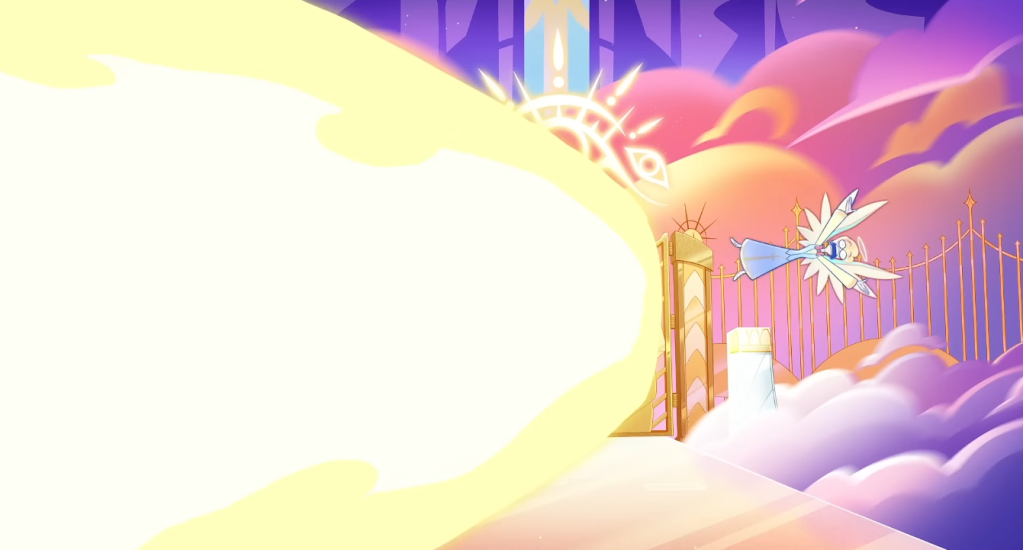
It also may explain how Vox became so powerful in Hell because, when the TV kills him, it also electrocutes all of his followers standing in the pool as well. So, when Vox arrived in Hell, he already had a group of loyal followers to use. Through this, we can see that Alastor is actually right in his understanding of Vox. He always has a desire to be “brighter,” never satisfied with what he has, but relies on others to gain his power, whether that be his followers or the Vees. We see this with him hypnotizing Angel Dust into publicly bad mouthing the hotel and supporting the Vees. He uses this event to unveil his weapon, powered by Lucifer, which he fires at Heaven, destroying Sera’s barrier. Although terrifying for Heaven, it was funny for me, what with the shot of Peter being spun around when Vox’s weapon punches through the pearly gates.
This moment got a good chuckle out of me.
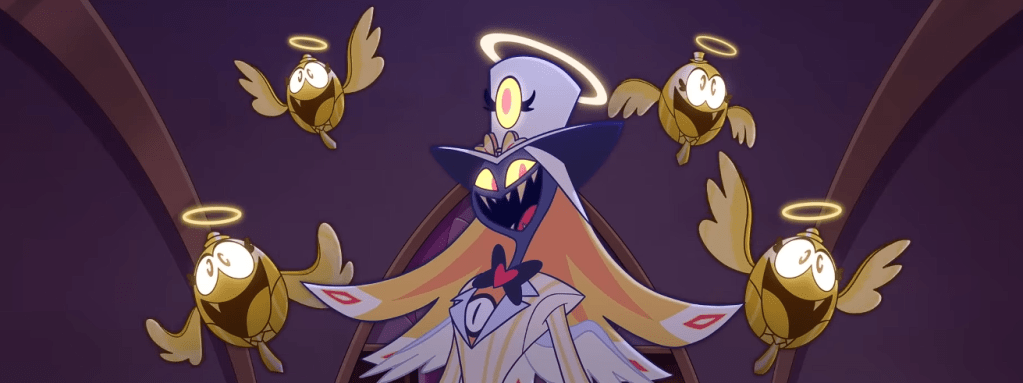
Vox gives Heaven 24 hours to surrender, and the turmoil this causes leads into the episode’s second song, “Live to Live”, where Pentious advises Sera on her next move, with a great callback to last season’s “It Starts with Sorry.” While this is happening, Vox continues to fall into Alastor’s trap, further distancing himself from the Vees, and is also manipulated into inviting Charlie to his party. Following Vox’s invitation, Emily arrives to help Charlie, and the group formulate a plan to rescue Angel Dust and stop Vox. Baxter is key to this plan, and more than willing to help, showing his role in the season.
I think Baxter’s characterization is a little wonky, since his initial goal of proving the hotel wrong has been completely brushed aside, but it is not a big deal.
The newfound confidence of the hotel results in the final song of the episode, “When I Think About the Future”, which calls back to multiple songs sung previously in the season, before setting up the big finale. That finale, “Curtain Call”, kicks off with the hotel crew going through their plan to stop Vox, free Angel from mind control, and show everyone that Pentious was redeemed. Two things, though. First, it feels like a scene was skipped over where the characters realize Angel was brainwashed, since in the final scene of Episode Nine they were confused about him siding with the Vees. Second, I still find it pretty convenient that Pentious is not allowed to leave Heaven. They just say he is not allowed to leave and provide no reason why.
I just wish they would explain why Sir Pentious cannot leave Heaven.
At Vox’s party, Baxter attempts to provide a connection with Heaven to show Sir Pentious’ redemption, while Cherry and Husk go to save Angel Dust, and Charlie distracts Vox. The plan quickly goes awry because, although Baxter is hilariously able to silence Vox, Velvette and Nifty fight around him, while Cherry and Angel Dust are ambushed by Valentino. The fight quickly grows, and Charlie is unable to get a signal to prove her point, leading to the best scene of the finale. Vox mocks her and, in his moment of triumph, orders her to admit his power. Unexpectedly for Charlie, Alastor chimes in, using their deal to force her to admit that Vox is the strongest sinner in Hell. This breaks Alastor’s contract with Rosie and, to top it all off, Vox celebrates his victory by landing his hands on Charlie, breaking his contract with Al. Alastor’s laughter as Vox falls right into his trap was great to see. You can see how he perfectly planned all this right from Episode Four and it went off without a hitch.
Vox and Alastor’s rivalry has been a highlight this season.
And if you thought the fight between Alastor and Vox in that episode was hype, you have not seen anything yet. Watching the two old friends turned rivals fight at full strength is greatly improved by some top-notch animation. The budget for Season Two clearly went up after Season One’s success. Vox predictably needs help from his giant robot shark, but this allows him to get back to his weapon and shoot wildly at Alastor. This has the unfortunate side effect of decimating Pentagram City with an angelic blast, killing many sinners for good. So, Hell’s entire population just saw their supposed savior annihilating a bunch of them. Yeah, there is no coming back for Vox’s reputation after this.
As Alastor predicted, Vox really did lose his marbles in Act Three.
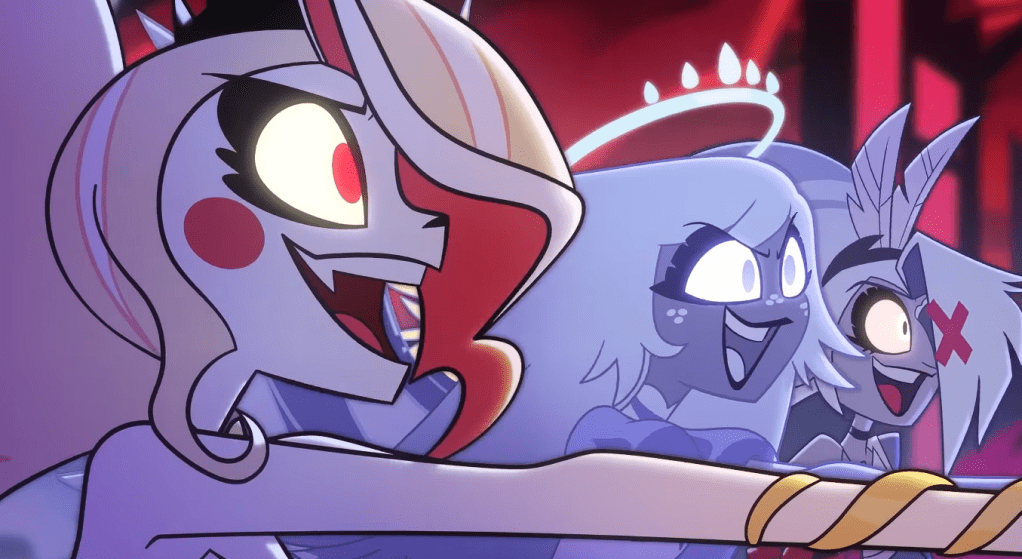
Even the Vees are sick of Vox’s antics because, after their respective fights, they stop him from blowing them all up just to kill Alastor. Valentino rips off Vox’s head before attempting and failing to leave with him and Velvette. Say what you want about the Vees, but they do care about each other. Well, Valentino and Velvette do at least; not sure about Vox at this point. However, while Vox is finished, his weapon remains. For a moment, it looks like Emily is going to sacrifice herself to save Hell, but this is thankfully instead used to build into the final song of the season, “Hear my Hope,” where all of Hell’s overlords band together to stop the explosion.
Admit it, we all thought Emily was going to self-sacrifice at first.
“Hear My Hope” is a hopeful, and emotional song with two interludes. The first sees Lute and Abel arrive, and the former attempt to get her revenge, only to be stopped by Abel in a moment of character growth. While this moment is well sung, I kind of feel like it needed a little more build up, and it kinds of just feels thrown in there. The second interlude of the song is far better, and sees Rosie confront Alastor, who threatens to let everyone die unless she fixes his staff. What is interesting to me about this part is how Alastor says, “You’ll watch them die, unless you do,” making it seem like Rosie cares for Charlie and the others. This adds more layers of mystery to Rosie, of which I have seen a few theories about. One such theory is that Rosie is Lillith in disguise, which would retroactively make her talk with Charlie about Vaggie in Season One a lot more emotional. Although, if Rosie is Lillith, then that raises the question of who the Lillith in Heaven is? But that is just a theory.
A Hazbin Hotel theory!… I’m sorry.
Rosie fixes Alastor’s staff, and the two join the circle, along with Velvette and Valentino, much to Vox’s dismay. The power of friendship puts an end to the explosion, saving Hell. From here, Lucifer pulls himself from the remains of the weapon, Sir Pentious proves his redemption to Hell, and Angel Dust decides to go back with the Vees because he believes he is a danger to the hotel and his friends. I originally did not like how Angel was playing very little role in his own rescue, but it seems like they are setting up an arc for Season Three here, so I will reserve judgement on that. As for the Vees, Valentino has had to become the face of the organization. Speaking of face, Vox is still just a head, and I think it would be pretty funny for him to remain that way for the foreseeable future. He has had his time in the spotlight, but man did he ever shine brighter. The writing team quickly proved me wrong with how much of a convincing threat Vox would prove to be. For next season’s antagonist, I am pretty confident it is going to be Alastor, based on things Viziepop has said. It makes sense too, what with Alastor having no more strings, and being free to do whatever he wants.
Alastor’s official villain arc may be about to begin.
Back at the hotel, it sees even more success, but for the right reasons this time. Surprise, surprise, Vaggie has also kept her name but dropped the E. Blitzo would approve. Still, I am glad that this storyline did not take up as much time as I thought it would back in Episode One. The final scene of the season sees Lillith finally call Charlie back, ending on yet another Lillith cliffhanger. Hopefully, Season Three will arrive sooner than Season Two did, and keep up the quality. Overall, Season Two was a vast improvement over the first. The pacing, animation and songs were so much better. Speaking of the songs, I am currently planning to do a top ten list of my favorite Hazbin Hotel songs. So, you can expect to see that in the next few weeks or so.












 THE REVIEW MONSTER