
The Planet of the Apes franchise has been an icon of cinema for decades.
This is, in my opinion, most encapsulated by the success of the recent Caesar trilogy of Rise, Dawn, and War, which is one of my favorite trilogies of all time.
Despite this, I was a bit concerned when I heard we were getting a follow up to this trilogy with Kingdom of the Planet of the Apes.
It felt like the story had been told to completion, and any follow up would be an obvious cash-grab.
Well, after having seen Kingdom, I can gladly eat my words because it is more than a worthy follow up to the iconic trilogy.

Directed by Wes Ball, Kingdom of the Planet of the Apes follows Noa (Owen Teague), a young ape whose clan trains eagles, centuries after the death of Caeser.
Noa sets out of a journey to rescue his clan after they are violently taken away by the forces of Proximus Caeser (Kevin Durand), an ape ruler who has warped Caeser’s words to suit his own ends.
Along the way, Noa picks up two companions, an orangutan named Raka (Peter Macon), the last of an order who stay true to Caeser’s teachings, and Nova (Freya Allan), a human woman who is much smarter than the feral humans now inhabiting the world.

With how great the characters in the Caser trilogy were, I knew it would be difficult for Kingdom to match them, but the movie does an excellent job of setting these characters up for future films.
Noa is a relatable protagonist, starting off naive about the world but slowly growing both in confidence and as a leader.
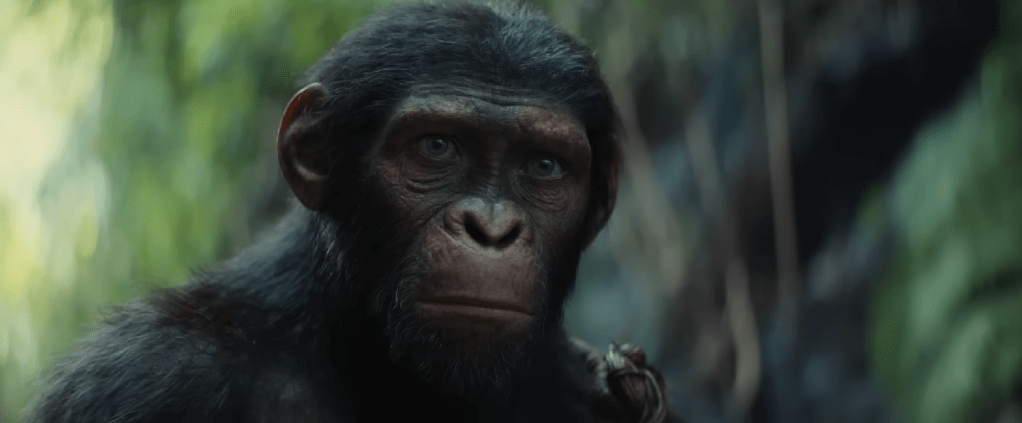
Raka provides some good humor and also has great use delivering world-building.
Mae seems to be a bit of a divisive character, given her role in the film, but I personally found her moral ambiguity to be highly engaging, and I especially look forward to seeing how her connection with Noa will evolve.
As for the villain, Proximus Caesar, he makes for a great showcase of one of the film’s main themes, this being the corruption of legacy, as powerful tyrants warp words to suit their own ends.
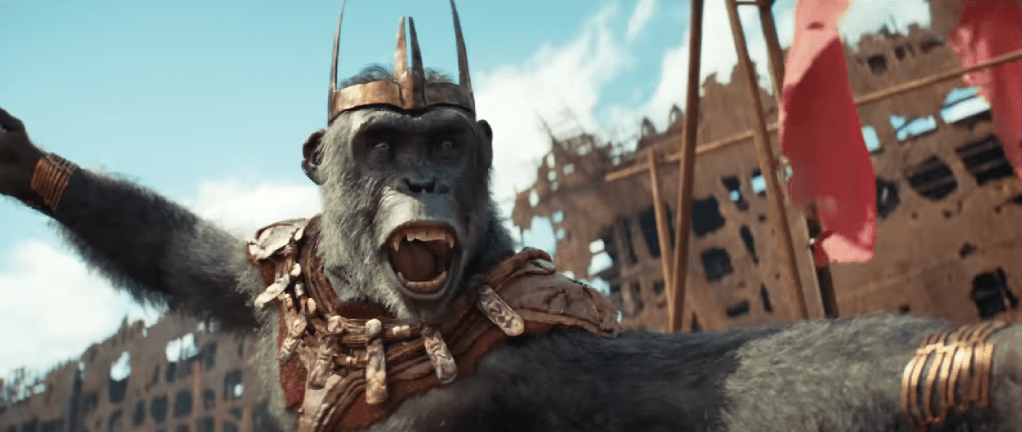
These characters are all well done, not just in their writing and in the acting, but also in the visuals for them.
The Caesar trilogy had some of the best motion capture put to film and obviously Kingdom is no different.
There was not a single moment in the movie when I thought the apes were not really on screen.
It is not just the apes, though, because the CGI for the post-apocalyptic world they inhabit is also a feast for the eyes.
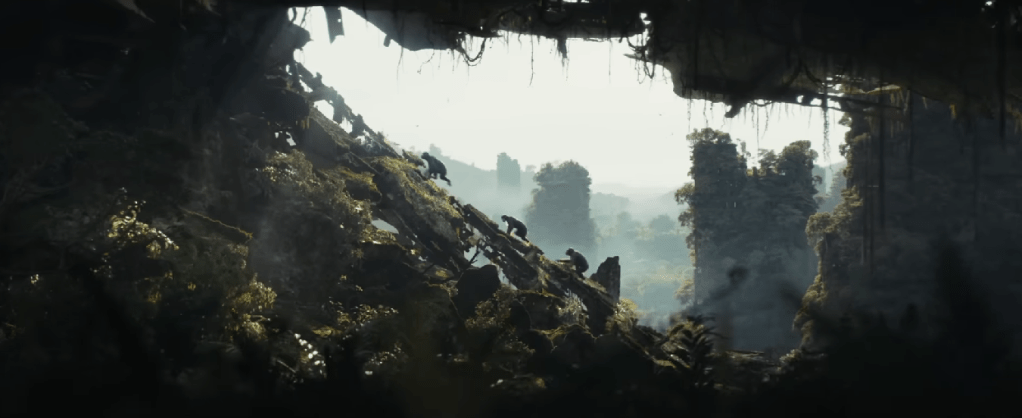
As for our ears, the soundtrack is also solid, helping to deliver the impact of various moments.
All in all, Kingdom of the Planet of the Apes is another fantastic entry in the series.
While I personally prefer the trilogy films more, I feel like my perception of Kingdom could become even better if the sequels continue in quality.
There are certainly a lot of questions I have that I am looking forward to seeing answered in the next film.
Apes. Together. Strong.
 THE REVIEW MONSTER
A great review. I am definitely looking to watch this movie soon. I’m a huge fan of the original POTA franchise that starred Andy Serkis. Serkis set such a powerful standard for these movies through use of groundbreaking motion capture. I’m curious to see how the sequel fares in his absence.
Recently, I had a chance to see “Dawn of the Planet of the Apes” and love it. Here’s why I adored that movie:
LikeLike